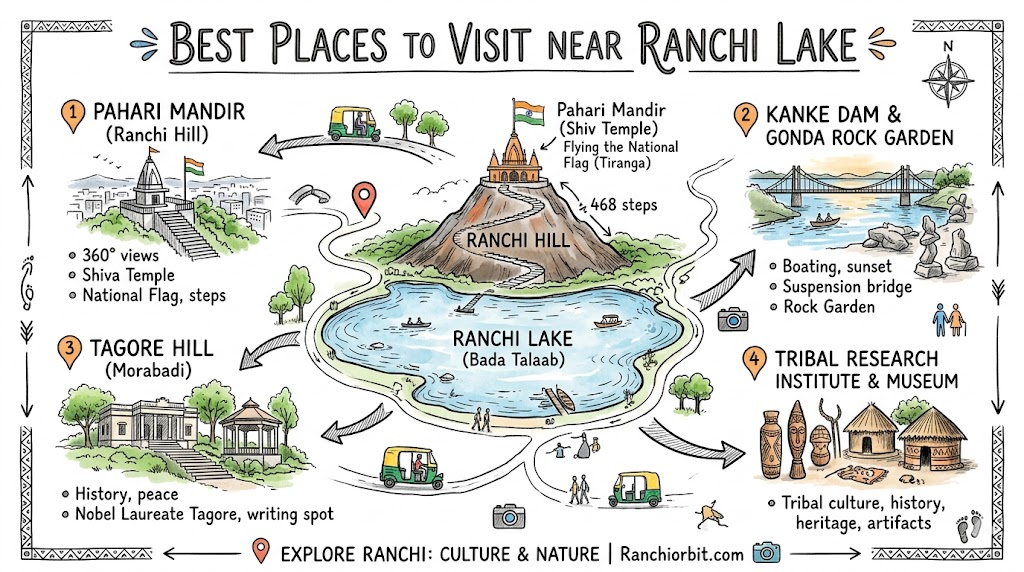
When people plan a trip to Jharkhand, they often expect simple industrial towns or quiet rural stretches. However, the capital city of Ranchi completely shatters those preconceptions. Known affectionately as the “City of Waterfalls,” Ranchi is a dynamic urban destination surrounded by pristine nature, spiritual hills, historic architecture, and rich tribal heritage. It offers culture, nature, food, adventure, peace, and deep local experiences all wrapped into one.
At the literal and historical heart of this city lies Ranchi Lake (also known locally as Bada Talaab). Dug out in 1842 by British National Colonel Onsely to manage the city’s water supply, this massive 50-acre water body sits quietly at the base of Ranchi Hill. Today, it serves as the perfect central starting point for travelers looking to unlock the city’s best attractions. Whether you are a solo backpacker, a couple seeking quiet sunsets, a family on vacation, or a weekend traveler, exploring the best places to visit near Ranchi Lake is the smartest way to experience the city.
Why Ranchi is a Must-Visit City
Ranchi is a city that naturally respects its environment while slowly opening its doors to modern travelers. It is incredibly accessible, affordable, and practical to navigate. Unlike overcrowded commercialized tourist hubs, Ranchi retains an air of raw, green authenticity. Within a 5- to 15-kilometer radius of Ranchi Lake, you can scale spiritual hilltops, relax by vast dam reservoirs, dive into regional history at tribal museums, and gorge on local Jharkhandi delicacies. It acts as a perfect pocket-friendly weekend travel plan or a base for a comprehensive regional itinerary.
Best Places or Experiences Near Ranchi Lake
To help you map out your days around Bada Talaab, here is a deep dive into the top attractions located just short distances away.
1. Pahari Mandir (Ranchi Hill)
Perched right next to Ranchi Lake, this historic temple dedicated to Lord Shiva sits atop a volcanic hill at an altitude of 2,140 feet. It is deeply revered and uniquely tied to India’s freedom struggle, as it is one of the few temples in India where the National Flag is proudly hoisted alongside religious flags.
- Location: Kumhartoli, less than 2 km from Ranchi Lake.
- Why it is worth visiting: It offers an unparalleled, 360-degree bird’s-eye view of the entire Ranchi skyline and the sprawling waters of Ranchi Lake below. The spiritual vibe combined with the physical climb makes it an invigorating experience.
- Best things to do: Climb the 468 steps to reach the main shrine, capture panoramic photographs of the city at dawn, and offer prayers at the ancient Shiva lingam.
- Best time to visit: Early morning (5:00 AM to 7:00 AM) to catch the sunrise, or during the holy month of Shravan (July–August) to witness vibrant local festivities.
- Ideal for whom: Families, spiritual travelers, and photography enthusiasts.
- Travel tip: The steps can get steep. Wear comfortable walking shoes and carry a water bottle, as it takes about 15 to 20 minutes to reach the top.
2. Kanke Dam and Gonda Rock Garden
This is a beautiful two-in-one attraction where man-made architecture seamlessly blends with natural topography. Built across the foothills of Gonda Hill, the Rock Garden is carved entirely out of the local boulders, featuring sculptures, waterfalls, and a thrilling suspension bridge. Right adjacent to it lies the expansive Kanke Dam.
- Location: Kanke Road, approximately 5 km north of Ranchi Lake.
- Why it is worth visiting: It is the ultimate evening chill-out spot. The combination of well-manicured stone gardens and a massive, peaceful lake reservoir provides immediate relief from the city’s traffic.
- Best things to do: Walk across the suspension bridge, enjoy a peaceful boat ride on Kanke Dam during sunset, and sit along the stone benches watching migratory birds.
- Best time to visit: Late afternoons (3:30 PM to 6:00 PM) when the stone surfaces cool down and the sunset over the dam reflects beautifully across the water.
- Ideal for whom: Couples looking for a romantic walk, families with children, and weekend picnic seekers.
- Travel tip: Don’t leave immediately after sunset; the local food stalls outside the gates serve amazing Dhuska and hot tea.
3. Tagore Hill (Morabadi)
Standing at an elevation of 300 feet, this isolated hilltop is named after the Nobel Laureate Rabindranath Tagore. It is widely believed that Tagore, along with his family members like Jyotirindranath Tagore, frequently visited this hill to leverage its intense quietude for writing books and composing poetry.
- Location: Van Vrindavan Colony, Morabadi, roughly 4.5 km from Ranchi Lake.
- Why it is worth visiting: It is a cradle of art, history, and deep peace. The colonial-era structures and the Tagore Pavilion at the top give you a nostalgic glimpse into the past.
- Best things to do: Climb the 200 odd stairs to explore the old structures, read a book under the shade of ancient trees, and try amateur rock climbing on the lower boulders.
- Best time to visit: October to February (winter months) during the daytime, or early mornings to catch the cool breeze.
- Ideal for whom: Solo travelers, writers, history buffs, and backpackers.
- Travel tip: Visit the Ramakrishna Mission Ashrama located at the base of the hill to buy authentic regional books and understand the local agrarian work being done there.
4. Tribal Research Institute and Museum
Jharkhand’s true soul lies within its indigenous tribal communities. This museum acts as an educational sanctuary, carefully preserving and displaying the lifestyle, clothing, weapons, and artistic expressions of the state’s major tribes (like the Santhals, Mundas, Oraons, and Hos).
- Location: Ratu Road, about 3.5 km from Ranchi Lake.
- Why it is worth visiting: It gives deep context to your trip. Instead of just seeing Ranchi superficially, you learn about Sarhul (the flower festival), Karma rituals, and ancient survival arts.
- Best things to do: Explore the life-sized tribal hut models, examine rare Dhokra metal art artifacts, and view authentic Paitkar paintings.
- Best time to visit: Weekdays between 10:30 AM and 5:00 PM for a crowd-free, educational stroll.
- Ideal for whom: Solo travelers, students, backpackers, and curious first-time visitors.
- Travel tip: Photography rules can be strict inside certain galleries. Always ask the museum curators for permission before taking close-up shots of ancient artifacts.
Detailed Practical Guidance for Visitors
To make your exploration near Ranchi Lake smooth and stress-free, keep these vital travel metrics in mind:
- Entry Fees: Ranchi Lake has no entry fee. Pahari Mandir and Tagore Hill are free to access (though nominal parking fees apply). The Rock Garden charges a very basic entry fee of around ₹20 to ₹30 per adult, and boating at Kanke Dam ranges from ₹50 to ₹150 depending on whether you choose a pedal boat or a speed boat.
- Local Transport Options: Auto-rickshaws (both shared and private) are the lifeblood of Ranchi. You can easily hail an auto from Firayalal Chowk or Ratu Road to any of these spots. For ultimate freedom, rent a scooter or book rides via local app-based cabs (Ola/Uber are fully functional here).
- Food Options: Do not leave the Ranchi Lake area without trying Dhuska—a deep-fried rice and chana dal snack served with spicy potato curry and green chutney. For a sit-down family meal, check out nearby local favorites like Jungli Moondance Restaurant or Prana Lounge for a mix of traditional and global cuisines.
- Safety Tips: The central city area around Ranchi Lake is highly safe for solo travelers and families alike. However, hilly spots like Tagore Hill or secluded corners near Kanke Dam can get poorly lit after dark. Wrap up your hilltop sight-seeing by 6:30 PM.
Travel Planning Tips for Ranchi
Planning a trip to the capital requires a touch of practical foresight to avoid minor logistical hurdles. Use this checklist for a seamless holiday:
- Book stays early during peak season: Winters (October to February) see a massive rush of tourists heading to the nearby waterfalls. Book your hotels near the city center or Main Road early to secure the best rates.
- Rent scooters only with proper documents: Independent travel is highly rewarding here. If you rent a scooter, ensure you carry a valid driving license and check that the registration documents match. Local traffic police strictly enforce helmet rules.
- Carry cash for local markets: While digital UPI payments are widely accepted in Ranchi’s malls and restaurants, street vendors selling local handicrafts, terracotta items, or snacks near Ranchi Lake usually prefer hard cash.
- Check weather before water activities: If you plan to extend your trip to the grand waterfalls outside the city (like Hundru, Jonha, or Dassam), always monitor local rain alerts. Water currents can change rapidly during or just after the monsoons.
- Respect local culture and environment: Many hills here (like Pahari Mandir) double as sacred religious grounds. Dress modestly when visiting shrines, remove footwear where indicated, and avoid littering around the water bodies.
Common Mistakes to Avoid
- Poor Itinerary Planning: Packing massive waterfalls like Hundru Falls (which is 43 km away) and central city spots like Ranchi Lake into the exact same morning. You will end up spending your whole day in transit.
- Ignoring the Hills of North and South Ranchi: Many travelers casually glance at the city lake and leave. They miss out on climbing Pahari Mandir or exploring the historic steps of Tagore Hill just a few kilometers away.
- Overpaying for Private Transport: Avoid boarding unmetered private auto-rickshaws without finalizing the fare upfront. Always ask a local shopkeeper about the standard rate to avoid paying tourist premiums.
- Skipping Local Food: Sticking purely to standard North Indian or continental food in your hotel. Ranchi’s local street food culture is clean, delicious, and deeply unique.
Suggested Ranchi Itinerary Angle
Here is how you can perfectly integrate the areas around Ranchi Lake into your broader travel plans depending on the duration of your stay.
1-Day Plan: The Central Explorer
- Morning (7:00 AM): Climb Pahari Mandir to witness the sunrise over Ranchi Lake. Grab a breakfast of hot Dhuska nearby.
- Mid-Day (11:00 AM): Dive into the Tribal Research Institute and Museum on Ratu Road to understand Jharkhand’s heritage.
- Afternoon (3:00 PM): Head to Tagore Hill for a quiet, historical afternoon stroll.
- Evening (5:00 PM): Conclude your day at Kanke Dam and Gonda Rock Garden for a relaxing boat ride and a sunset dinner.
2-Day Plan: Culture & Natural Wonders
- Day 1: Follow the 1-Day Central Explorer plan detailed above to master the city center.
- Day 2: Head out of the central zone. Spend your morning witnessing the roaring majesty of Hundru Falls or Jonha Falls, and wrap up your evening shopping for local tribal handicrafts at Firayalal Chowk.
Weekend Travel Plan: The Complete Escape
- Friday Evening: Arrive in Ranchi, check into a hotel near Main Road, and enjoy a peaceful night stroll along the newly illuminated banks of Ranchi Lake.
- Saturday: Execute a complete city tour (Pahari Mandir, Tagore Hill, Rock Garden, and Jagannath Temple).
- Sunday: Take a scenic drive through the breathtaking Patratu Valley (just 33 km away) before heading back to the railway station or airport.
FAQs
1. Where is Ranchi Lake located exactly?
Ranchi Lake, also widely known as Bada Talaab, is centrally located near the base of Ranchi Hill, very close to major urban markers like Ratu Road and the Ranchi Main Road area.
2. Can we do boating in Ranchi Lake?
Yes, basic boating facilities are available at Ranchi Lake. However, for a more expansive and scenic boating experience, travelers also highly frequent the nearby Kanke Dam or Dhurwa Dam.
3. Is Pahari Mandir safe to visit for elderly family members?
Pahari Mandir involves climbing approximately 468 concrete steps. While there are railings and resting spots along the way, it might be physically demanding for elderly individuals with severe knee or respiratory issues.
4. What is Ranchi famous for buying?
Ranchi is highly famous for its rich tribal handicrafts. You can buy beautiful Dhokra brass metal figurines, terracotta items, Paitkar paintings, and organic forest products like pure honey and handmade bamboo items.
5. How far is Tagore Hill from Ranchi Lake?
Tagore Hill is roughly 4.5 kilometers north of Ranchi Lake. It takes less than 15 to 20 minutes to reach via an auto-rickshaws or private car under normal traffic conditions.
6. Are there good food options available near Kanke Dam?
Absolutely. The entire perimeter outside the Gonda Rock Garden and Kanke Dam is lined with local street food vendors serving fresh Dhuska, Litti Chokha, momos, and sweet corn. There are also nice family restaurants within a 1 km radius.
7. What is the best time of the year to visit Ranchi?
The absolute best time to explore Ranchi is during the winter season, from October to February. The weather remains pleasantly cool, hovering between $10^\circ\text{C}$ and $25^\circ\text{C}$, making outdoor sightseeing highly comfortable.
8. Can we visit Patratu Valley during a trip to Ranchi Lake?
Yes. Patratu Valley is situated about 33 km away from Ranchi Lake. You can easily explore the places near Ranchi Lake in the morning and take a stunning afternoon drive down the winding ghats of Patratu Valley.
9. Is there any entry fee for Tagore Hill?
No, entry to Tagore Hill is completely free for all national and international tourists. You only pay a very minimal fee for vehicle parking at the base if you are driving your own car or scooter.
10. Which is the closest railway station and airport to Ranchi Lake?
Ranchi Railway Station (CNC) is roughly 4 to 5 km away, and the Birsa Munda Airport (IXR) is approximately 8 to 9 km away from Ranchi Lake, making the area immensely accessible.
Conclusion
Ranchi Lake is far more than just a body of water—it is the geometric center around which Ranchi’s urban energy and natural peace revolve. By planning your trip around this historic landmark, you can seamlessly balance spiritual hill climbs, deep tribal history, and peaceful lakeside evenings without spending hours stuck in long transit routes.
To explore the city in a smarter, more meaningful way, keep checking Ranchiorbit.com. Think of us as your go-to companion for local travel updates, helping you skip the tourist traps, discover hidden city gems, and make better travel decisions. Pack your bags, book your stays, and get ready to experience the refreshing, green charm of Jharkhand’s capital!
