Introduction
When the daily grind of city life begins to feel like a monotonous cycle, the instinct is often to book a flight to mainstream, overcrowded tourist hubs. We look toward commercialized hill stations or heavily packed coastal resorts, only to find the same urban chaos waiting for us in a different zip code. True rejuvenation doesn’t come from standing in long queues at commercialized viewpoints; it comes from stepping into spaces that possess deep roots, untouched natural beauty, and a profound cultural soul.
Jharkhand, often bypassed by conventional holiday itineraries, holds some of the most raw and enchanting travel secrets in eastern India. As the capital city, Ranchi serves as an incredible springboard to an array of rugged terrains, misty plateaus, and cascading water systems that have remained blissfully authentic. Choosing a short road trip into the heart of Chota Nagpur’s wilderness means trading concrete soundscapes for the rustle of dense sal forests and the thunder of ancient waterfalls.
Why Ranchi’s Surroundings Are a Must-Visit Circuit
The travel landscape sprawling outward from Ranchi is a masterclass in geographical diversity and seamless connectivity. Within a two-to-four-hour driving radius, the terrain dramatically morphs from sweeping valley switchbacks and high-altitude plateaus to sacred tribal corridors. This regional circuit is highly accessible for every type of traveler archetype. Whether you are a solo backpacker looking for affordable state transport, a couple seeking a quiet misty retreat, or a family navigating via a smooth self-drive highway, the infrastructure accommodates everyone perfectly.
The well-maintained national highways like NH-33 and NH-20 weave through dense forest canopies, making the journey itself an active part of the vacation experience. Furthermore, the region is highly unique due to its integration of ecotourism initiatives managed by local tribal communities. This ensures that your travel footprint directly supports local forest conservation and village economies, offering a level of meaningful connection that commercialized luxury resorts simply cannot replicate.
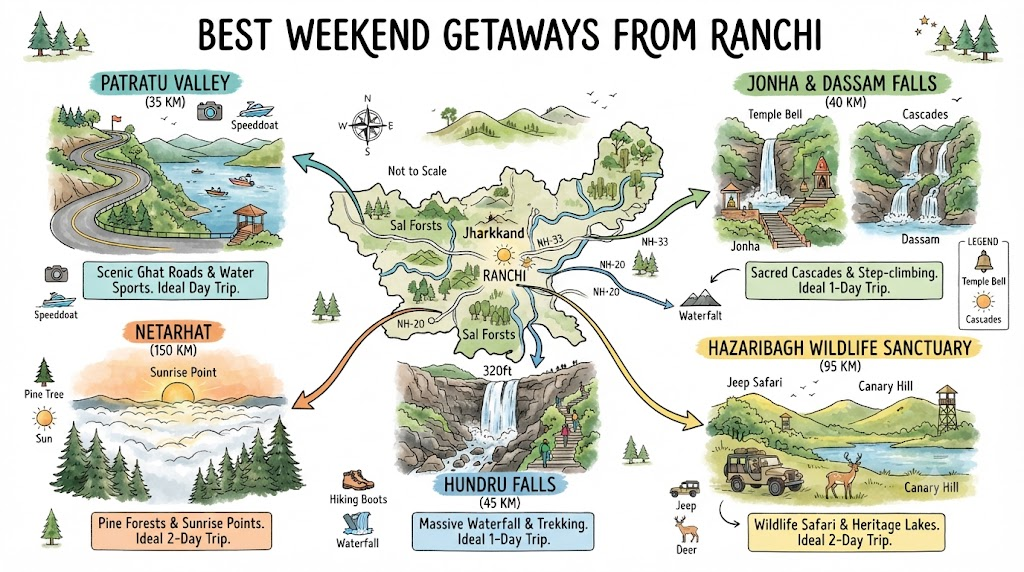
| Destination | Distance from Ranchi | Primary Attraction Type | Ideal Trip Duration |
|---|---|---|---|
| Patratu Valley | 35 km | Scenic Ghat Roads & Water Sports | 1 Day / Same-day return |
| Netarhat | 150 km | Pine Forests & Sunrise Points | 2 Days / Full Weekend |
| Hundru Falls | 45 km | Massive Waterfall & Trekking | 1 Day / Afternoon trip |
| Jonha & Dassam Falls | 40 km | Sacred Cascades & Step-climbing | 1 Day / Nature trail |
| Hazaribagh Wildlife Sanctuary | 95 km | Wildlife Safari & Heritage Lakes | 2 Days / Weekend stay |
Best Places or Experiences
Patratu Valley
Patratu Valley is a breathtaking display of engineering marvel meeting natural grandeur, widely celebrated as Jharkhand’s answer to the winding ghats of the Western Ghats. The route features a mesmerizing, multi-tiered S-curve highway that descends gracefully into a lush green basin, revealing panoramic views of the glistening Patratu Dam below. As you drive down the perfectly paved hairpins, the cool breeze coming off the reservoir cuts through the tropical heat, instantly shifting your headspace into holiday mode.
The valley serves as the perfect quick escape for those who want dramatic landscapes without spending half their weekend in transit. Down at the reservoir, the state has developed a modern waterfront park complete with boating docks, manicured lawns, and local snack shacks serving steaming plates of pakoras. Whether you catch it covered in early morning fog or bathed in the golden hues of sunset, Patratu leaves a lasting visual imprint.
The mesmerizing hairpin loops of Patratu Valley.
- Location: Ramgarh district, approximately 35 km north-west of Ranchi.
- Why it is worth visiting: The jaw-dropping hairpin switchbacks offer one of the finest scenic driving experiences in eastern India, culminating in a sprawling lakeside expanse.
- Best things to do: Take an exhilarating speedboat ride across the Patratu Dam reservoir, photograph the valley from the designated S-Curve Viewpoint, and enjoy freshly fried river fish at the local shoreline stalls.
- Best time to visit: Late afternoon (3:30 PM to 6:00 PM) to experience the sunset casting long shadows across the valley loops.
- Ideal for whom: Biking enthusiasts, couples looking for a romantic drive, and photography hobbyists.
- Travel tip: The ghat road can experience heavy truck traffic during late-night hours, so complete your downhill and uphill drives before complete darkness sets in.
Netarhat
Affectionately crowned the “Queen of Chota Nagpur,” Netarhat is a pristine hill station perched on a massive plateau surrounded by dense, old-growth forests. The journey to Netarhat takes you through winding tribal roads, climbing steadily past bamboo groves and pine plantations until the air grows noticeably crisp. This destination is deeply rooted in folklore and colonial history, having once served as a summer retreat for British officers seeking refuge from the plains’ sweltering summer heat.
The true magic of Netarhat unfolds at the dawn hour at Sunrise Point, where travelers gather to watch the sun pierce through a vast sea of low-lying clouds. The landscape here is slow, quiet, and profoundly rejuvenating, completely devoid of the commercial honking and souvenir traps common to northern Indian hill stations. It is a place where you can walk through towering pine forests in total silence, listening only to the wind whispering through the needles.
Golden hour sunrise at Netarhat.
- Location: Latehar district, roughly 150 km west of Ranchi capital.
- Why it is worth visiting: It is the highest point in the region, offering an untouched alpine atmosphere featuring magnificent sunrises, sunsets, and British-era pine forests.
- Best things to do: Walk through the majestic Pine Forest canopy, witness the spectacular sunrise at Sunrise Point, and take a short drive to the nearby Magnolia Sunset Point to hear the tragic colonial love story associated with it.
- Best time to visit: October to March for chilly mountain weather, though the monsoon months turn the entire plateau into a misty green paradise.
- Ideal for whom: Nature lovers, writers seeking solitude, and families looking for an overnight hill station getaway.
- Travel tip: Accommodation options are limited to the state-run JTHDC tourist lodge (Prabhat Vihar) and a few homestays, so booking your rooms a month in advance is mandatory.
Hundru Falls
Hundru Falls is one of the most powerful and visually spectacular water systems in the state, created by the Subarnarekha River plunging down a sheer 320-foot vertical cliff. The approach to the waterfall is an adventure in itself, requiring travelers to walk down a series of well-maintained concrete steps cut into the rock face. As you descend, the ambient sound of the forest is gradually replaced by the deep, resonant roar of crashing water.
At the base of the falls, the river has carved out unique rock formations and a massive pool surrounded by giant boulders. Over centuries, the continuous friction of the water has polished these rocks into smooth, abstract sculptures that are a marvel to explore. During the post-monsoon months, the sheer volume of water creates a dense mist that blankets the entire canyon, rewarding visitors with frequent rainbow sightings across the gorge.
The roaring torrent of Hundru Falls.
- Location: Ranchi district, located 45 km north-east of the main city center via the Ranchi-Purulia Highway.
- Why it is worth visiting: It stands as one of the highest waterfalls in Jharkhand, showcasing the immense power of the Subarnarekha River amidst dramatic rock formations.
- Best things to do: Hike down the 750 steps to reach the lower misty plunge pool, photograph the unique water-carved rock patterns, and enjoy local tribal snacks like dhuska sold by vendors along the cliffside stairs.
- Best time to visit: September to December, when the water volume is at its peak right after the monsoon rains subside.
- Ideal for whom: Adventure junkies, trekking clubs, and fitness enthusiasts who enjoy challenging cliff walks.
- Travel tip: The steps can become incredibly slick due to spray mist and algae growth; wear high-grip trekking shoes and avoid stepping past the designated safety barricades at the pool edge.
Dassam Falls
Dassam Falls, also known as Dassam Ghagh, is a spectacular natural wonder where the Kanchi River tumbles down a jagged, staircase-like rock face from a height of about 144 feet. The name “Dassam” translates loosely to “ten streams” in the local tribal dialect, referencing the ten distinct water channels that form during peak flow periods. The sight of these multiple channels converging into a singular, thunderous sheet of white foam is nothing short of hypnotic.
The geographic setting of Dassam Falls feels distinctly primitive and wild. Hemmed in by dense sal canopies and towering granite walls, the site has preserved its rugged identity despite growing popularity. A beautifully constructed viewing platform offers panoramic vistas of the gorge, allowing travelers to soak in the dramatic landscape safely without navigating treacherous footholds down by the aggressive undercurrents.
- Location: Khunti district, approximately 40 km south of Ranchi via the Tata-Ranchi Highway.
- Why it is worth visiting: The unique ten-stream sheet formation creates a dense, permanent mist zone inside a steep forest canyon.
- Best things to do: Observe the panoramic view from the upper clean viewing deck, explore the surrounding wooded trails, and shop for authentic hand-woven bamboo baskets from local rural artisans.
- Best time to visit: Winter mornings (8:00 AM to 11:00 AM) when the mist hangs heavy in the air and the light is soft for landscape photography.
- Ideal for whom: Landscape photographers, road-trippers, and travelers interested in rugged geomorphology.
- Travel tip: The water currents at the base pool of Dassam are notoriously deceptive with hidden whirlpools; swimming is strictly prohibited by local authorities, and visitors must respect the warning signs.
Hazaribagh Wildlife Sanctuary
For travelers who prefer their weekend getaways laced with historical depth and wildlife encounters, Hazaribagh is an exceptional choice. The name translates literally to “Land of a Thousand Gardens,” and the region delivers on this green promise with its rolling hills, ancient lakes, and deeply historic forest reserve. Established in the mid-20th century, the wildlife sanctuary serves as a vital green lung and sanctuary for various species of deer, wild boars, sambars, and elusive leopards.
Beyond the wildlife, Hazaribagh is steeped in rich cultural history. The surrounding tribal villages are home to the world-renowned Sohrai and Khovar wall art traditions, where indigenous women paint clay houses with beautiful geometric and natural motifs. A weekend spent here easily balances jeep safaris through dry deciduous forests with peaceful evening strolls along the historic Hazaribagh Lake complex.
- Location: Hazaribagh district, roughly 95 km north of Ranchi via the smooth 4-lane NH-20 highway.
- Why it is worth visiting: It offers an incredible blend of biodiverse forest safaris, historic lakes, and direct access to ancient tribal art heritages.
- Best things to do: Book an early morning open-top jeep safari through the sanctuary, visit the local tribal hamlets to witness authentic Sohrai paintings, and enjoy a peaceful paddle boat ride on Hazaribagh Lake during sunset.
- Best time to visit: November to April, when the dry foliage increases the probability of spotting wildlife near the forest waterholes.
- Ideal for whom: Wildlife photographers, families with young children, and cultural heritage enthusiasts.
- Travel tip: Hire an authorized local forest guide at the sanctuary gate; their tracking skills and deep knowledge of animal migration paths significantly increase your chances of wildlife sightings.
Offbeat Exploration: Hidden Gems Tourists Miss
Lodh Falls
Tucked deep within the dense interiors of the Latehar district, Lodh Falls (also called Budha Ghagh) is the absolute highest waterfall in Jharkhand, dropping from a colossal height of 469 feet. Because it requires a slightly longer driving detour beyond Netarhat, the casual tourist crowds completely miss it. The waterfall is surrounded by the deep, dense woods of the Mahuadanr Wolf Sanctuary region, making the journey feel like a true expedition into uncharted wilderness. The sight of a massive river dropping off a forested mountain rim in complete isolation is an unforgettable reward for offbeat explorers.
Tagore Hill
Located on the northern fringes of Ranchi city itself, Tagore Hill is an isolated rocky hillock that carries an immense literary legacy. Named after Jyotirindranath Tagore, the elder brother of Nobel laureate Rabindranath Tagore, this quiet hill served as a peaceful ashram where the Tagore family engaged in deep philosophical writing and meditation. Visitors can climb the stone steps to reach a beautiful, colonial-era open canopy structure known as the Shanti Dham. It provides a stunning, undisturbed 360-degree view of the city’s green outskirts and serves as a peaceful escape from urban noise.
Detailed Practical Guidance for Travelers
| Destination | Standard Entry Fee | General Timings | Best Local Food Options Nearby | Recommended Nearby Attractions |
|---|---|---|---|---|
| Patratu Valley | Free access to highway; ₹30 for lake park | 6:00 AM – 7:00 PM | Freshly caught fried river fish, hot littis | Patratu Dam, Sunset Park |
| Netarhat | Free entry | Open 24 Hours | Tribal country chicken curry, Madua rotis | Pine Forest, Magnolia Point |
| Hundru Falls | ₹20 per person | 8:00 AM – 5:00 PM | Spicy dhuska with aloo chana sabzi | Jonha Falls, Sita Falls |
| Dassam Falls | ₹20 per person | 8:00 AM – 4:30 PM | Local roasted corn, vegetable pakoras | Sun Temple, Khunti craft villages |
| Hazaribagh Sanctuary | ₹50 per person; vehicle charges extra | 7:00 AM – 5:00 PM | Traditional Jharkhandi thali, sweet tilkut | Canary Hill, Hazaribagh Lake |
Logistics & On-Ground Navigation
Local Transport Options
- Car Rentals / Self-Drives: This is the most efficient option for exploring Ranchi’s weekend getaways. Having your own vehicle or hiring an outstation taxi provides the flexibility needed to navigate steep valley loops and remote forest roads comfortably.
- Railways: For destinations like Hazaribagh, the local passenger and express trains running from Ranchi Junction offer an incredibly economical and comfortable alternative to road transport.
- Auto-Rickshaws & E-Rickshaws: These are widely available at major transit hubs for short-distance commutes. However, they are not suitable for high-altitude ghats like Patratu or Netarhat due to power limits and open designs.
Budget Planning
- Backpacking / Budget Tier (₹1,200 – ₹2,000 per day): Utilizes local state transport buses, stays in budget homestays or state dormitories, and enjoys local street food like dhuska and litti chokha.
- Comfort / Mid-Range Tier (₹4,500 – ₹7,500 per day): Involves renting a private AC sedan, staying in comfortable mid-range resorts or JTHDC tourist lodges, and dining at established highway dhabas and family restaurants.
Safety and Inclusivity Tips
- For Families: Most waterfalls involve climbing down hundreds of stone steps. Take frequent breaks for elderly family members and keep young children away from steep cliff edges.
- For Couples: Stick to well-traveled tourist routes and plan your returns so that you reach the highway before late evening. Avoid exploring isolated forest tracks after dusk.
- General Safety:Ensure your vehicle has a healthy spare tire and a full tank of fuel before venturing out to remote spots like Netarhat or Lodh Falls, as fuel stations can be rare along forest stretches.
Strategic Travel Planning Guardrails
Travel Planning Tips for the Ranchi Circuit
- Pre-Book State Lodges: Always pre-book your stays at JTHDC properties online, especially for Netarhat, as walk-in options are almost non-existent during weekends.
- Keep Liquid Cash Handy: While digital payments like UPI are common in Ranchi, network connectivity can drop significantly inside deep forest gorges and waterfalls. Carry enough physical cash for entry tickets and local food stalls.
- Pack Insect Repellent: Since you will be exploring dense tropical sal forests, carrying a high-quality insect repellent is essential to protect against mosquitoes.
- Dress in Layers: The temperature drops sharply in high-altitude zones like Netarhat during evening hours, even if it feels warm down in the plains of Ranchi. Pack a light jacket or stole.
Common Mistakes to Avoid
- Over-packing the Day Itinerary: Trying to cover Hundru, Jonha, and Dassam falls all on the same day leads to exhaustion and leaves zero time to actually enjoy the natural scenery.
- Ignoring Monsoon Warnings: Avoid stepping close to the river beds or lower plunge pools during heavy downpours, as sudden water surges from upstream dams can occur without warning.
- Assuming Continuous Mobile Network: Do not rely entirely on live online navigation maps when driving through remote forested stretches; download offline maps of the region beforehand.
- Skipping the Regional Culinary Spices: Do not default to familiar multi-cuisine restaurant food; missing out on regional delicacies like chilka roti or authentic country chicken means missing a vital part of the local culture.
Suggested Itinerary Blueprints
1-Day Quick Dash (The Valley & Reservoir Loop)
Designed for travelers short on time who want maximum visual reward with minimal driving friction.
- 07:30 AM: Depart from Ranchi via the Kanke road toward Patratu.
- 09:00 AM: Stop at the main Patratu Valley Viewpoint for photography and morning tea.
- 10:30 AM: Arrive at Patratu Dam; enjoy speed boating and a walk through the lakeside park.
- 01:30 PM: Indulge in a traditional fish curry lunch at a lakeside dhaba.
- 04:00 PM: Begin the return drive, stopping at the hairpin curves to capture the golden hour views.
- 06:30 PM: Arrive back in Ranchi city limits.
2-Day Deep-Dive (The Wilderness & Waterfall Circuit)
A well-balanced weekend split that covers magnificent waterfalls and the rich historical paths of the region.
- Day 1: Depart early from Ranchi toward Hundru Falls. Spend the morning descending the canyon and exploring the rocky gorge. Have a rustic lunch nearby, then drive to Jonha Falls in the afternoon. Check into a nature resort near the highway for the night.
- Day 2: Wake up early and drive toward Hazaribagh via NH-20. Spend the afternoon on an exciting open-jeep safari inside the Wildlife Sanctuary. End your trip with a peaceful sunset boat ride on Hazaribagh Lake before driving back to Ranchi by evening.
Complete Weekend Travel Plan (The High-Altitude Misty Escape)
The ultimate Friday-to-Sunday loop designed for deep immersion into the mountain landscape.
- Friday Afternoon: Leave Ranchi by 2:00 PM and enjoy a scenic drive through the forest check-posts to reach Netarhat by late evening. Check into your lodge and enjoy a quiet dinner under the stars.
- Saturday: Watch the spectacular sunrise at Sunrise Point at 05:00 AM. Post breakfast, take a long walk through the Pine Forest and visit the Netarhat Residential School. In the afternoon, take a day excursion to the majestic Lodh Falls, returning to Magnolia Point just in time for sunset.
- Sunday: Enjoy a slow morning exploring local orchards. Check out after breakfast and drive back toward Ranchi, stopping at the historic town of Lohardaga for an authentic local lunch before reaching the capital by evening.
Common Tourist Mistakes to Avoid
- Geographic Blunders: Many tourists mistakenly try to group Netarhat (which lies far to the west) and Hundru Falls (which lies to the east) into the same weekend loop, resulting in a stressful trip spent entirely inside a car.
- Commercial Traps: Avoid spending your limited weekend hours visiting modernized, noisy shopping hubs within Ranchi’s urban center when you could be sitting by a pristine waterfall just an hour away.
- Neglecting Alternative Zones: Don’t skip the beautiful, quieter rural craft hamlets around the Khunti district; these areas offer a wonderful glimpse into local art that most regular tourists overlook.
- Transport Overpayment: Always negotiate outstation taxi fares beforehand or use verified local car rental platforms to avoid paying inflated tourist prices at unorganized taxi stands.
- Luxury Dining Bias: Sticking exclusively to fancy hotel buffets deprives you of tasting the real culinary soul of Jharkhand, which thrives in simple highway dhabas serving fresh, clay-cooked dishes.
Frequently Asked Questions
1. What is the best time of year to plan a weekend getaway from Ranchi? The ideal period is between October and March when the weather across Jharkhand is pleasantly cool and dry, making it perfect for driving through ghats and climbing waterfall steps. The monsoon season (July to September) is also exceptional if you want to see the waterfalls at their maximum, roaring capacity, though trekking trails can be slippery.
2. Are the roads leading to Netarhat safe for self-driving cars? Yes, the highway from Ranchi to Netarhat is generally well-maintained and smooth. However, the final 30-kilometer climb features steep hairpin bends and narrow forest stretches that require careful, attentive driving. It is highly recommended to complete this climb during daylight hours.
3. Is public transport readily available for all major waterfalls near Ranchi? While state buses and shared auto-rickshaws run frequently between major towns like Khunti or Bundu, they do not provide direct connectivity to the actual waterfall sites like Hundru or Dassam. Hiring a private taxi or using a personal vehicle remains the most practical choice.
4. What are the key local dishes one must try during these getaways? You should definitely try dhuska (a deep-fried savory rice and lentil snack served with spicy potato curry), litti chokha, and chilka roti (a delicate rice flour crepe). In rural areas, look for traditional dishes prepared with madua (finger millet) and country chicken curry cooked in mustard oil.
5. Do I need any special permits to visit the Hazaribagh Wildlife Sanctuary? No special advance permits are required for Indian citizens. You can purchase standard entry tickets and book forest safari jeeps directly at the main sanctuary gate upon arrival. Carrying a valid government photo ID is mandatory for registration.
6. Can we swim in the pools below Hundru and Dassam falls? Swimming is strongly discouraged and strictly prohibited in most sections of these pools. The underwater currents are highly deceptive, and the smooth river rocks hide deep undercurrents and sharp drops that can be incredibly dangerous.
7. Is mobile network connectivity stable across all these weekend destinations? Network connectivity is completely stable in open valley areas like Patratu and major towns like Hazaribagh. However, you will experience significant network drops or complete signal loss inside the deep gorges of Hundru and Dassam falls, as well as along certain forest stretches on the way to Netarhat.
8. What accommodation choices are available for an overnight stay in Netarhat? The premier accommodation is the state-run Prabhat Vihar tourist complex managed by JTHDC, famous for its direct views of Sunrise Point. Additionally, several eco-homestays run by local communities offer clean rooms and authentic tribal hospitality.
9. Are these remote nature destinations safe for solo female travelers? Yes, the destinations are generally safe, and the local communities are incredibly warm and helpful. As a standard safety practice, solo travelers should plan their itineraries to ensure they arrive at their destination before dark and avoid exploring isolated forest tracks alone late at night.
10. What unique local handicrafts can we buy directly from rural artisans? The region is famous for exquisite bamboo artifacts, hand-woven grass mats, and beautiful terracotta pottery. If you travel toward Hazaribagh or Khunti, you can also purchase authentic Sohrai paintings directly from village cooperatives, ensuring your money supports the artists directly.
11. How many steps does one need to climb down at Hundru Falls? Reaching the lower viewpoint pool at Hundru Falls requires walking down approximately 750 concrete steps. While the path is well-made with safety railings, the climb back up can be physically demanding, so it is best to take your time and carry a bottle of water.
12. Can we cover Patratu Valley and Netarhat together in a single weekend? While it is technically possible if you drive continuously, it is not recommended. Patratu is ideal for a quick, relaxed half-day trip, whereas Netarhat demands a dedicated overnight stay to enjoy the early morning sunrise and its quiet, slow hill station pace without rushing.
Conclusion
Choosing to explore the rugged, forested getaways surrounding Ranchi over a predictable, commercialized vacation spot is an incredibly rewarding travel decision. These journeys offer something rare in today’s fast-paced world: the chance to witness nature in its rawest, most unpolished form and to connect deeply with indigenous cultures that have lived in harmony with these woods for generations. Whether you are watching the morning mist lift from the deep canyon of Hundru Falls, driving down the perfect curves of Patratu, or listening to the wind rustle through the pine forests of Netarhat, you will return home with a profound sense of peace. These hidden paths remind us that true travel is about discovery, slow moments, and returning to the city with a refreshed and inspired soul.
