Introduction
When travelers plan an escape to the hill stations of Eastern India, their minds almost instantly drift toward the predictable, highly commercialized corridors of Darjeeling or the intensely crowded ridge lines of Shimla. Yet, tucked away on the undulating expanses of the Chotanagpur Plateau lies an entirely different rhythm of travel. Ranchi, the capital of Jharkhand, does not scream for attention with high-rise tourist traps or overcrowded boardwalks. Instead, it invites the intentional traveler into a landscape deeply rooted in ancient tribal heritage, pristine geological formations, and sweeping, mist-shrouded valleys.
To witness a sunrise in and around Ranchi is to experience a meditative communion with nature that mainstream tourism has largely forgotten. Long before the city stirs, a profound silence blankets the surrounding sacred groves and primeval hills. As the first light fractures the horizon, it doesn’t just illuminate concrete; it burnishes ancient granite monoliths, pierces dense sal forests, and turns cascading waterfalls into ribbons of liquid gold. For those seeking authenticity over commercial gloss, waking up early in this plateau region offers a raw, unfiltered glimpse into the geological and cultural soul of Eastern India.
Why Ranchi is a Must Visit City
Ranchi is far more than a stopover; it is the beating heart of a geographically unique highland region characterized by dramatic escarpments, dense forest canopies, and a sprawling network of river systems. Historically and culturally, the city and its surrounding areas are deeply intertwined with the heritage of the Santhal, Munda, and Oraon communities, who have preserved the sanctity of these hills for millennia. Geographically, the city sits at an average elevation of roughly 2,140 feet above sea level, providing it with a sub-tropical climate that keeps early mornings crisp, breezy, and often draped in rolling blankets of low-lying fog.
For the modern traveler, the macro-level appeal of Ranchi lies in its exceptional structural accessibility paired with its untouched natural perimeter. The city is seamlessly connected to major national hubs via the Ranchi Junction railway station and Birsa Munda Airport. Well-maintained national highways (NH-33 and NH-43) unfurl like smooth ribbons from the urban core, allowing backpackers, road-tripping couples, and family vacationers to transition from a modern cafe-centric city center to isolated, raw wilderness in less than an hour. The regional travel circuit functions as a brilliant radial network, where a short morning drive in any direction drops you directly into dramatic valleys, reservoir shorelines, or historic hilltop lookouts.
| Core Destination Metric | Regional Travel Fact & Logistic Detail |
| Average Elevation | 651 Meters (2,140 Feet) above sea level |
| Primary Highway Arteries | NH-33 (Connecting Patna/Hazaribagh) & NH-43 (Connecting Jamshedpur) |
| Best Travel Season | October to March (For dense morning mist and post-monsoon greenery) |
| Cultural Epicenters | Tagore Hill literary site, tribal sacred groves (Sarnas), and ancient rock shelters |
| Top Landscape Features | Hanging valleys, stepped waterfalls, granite plutons, and river reservoirs |
Best Places or Experiences
Tagore Hill
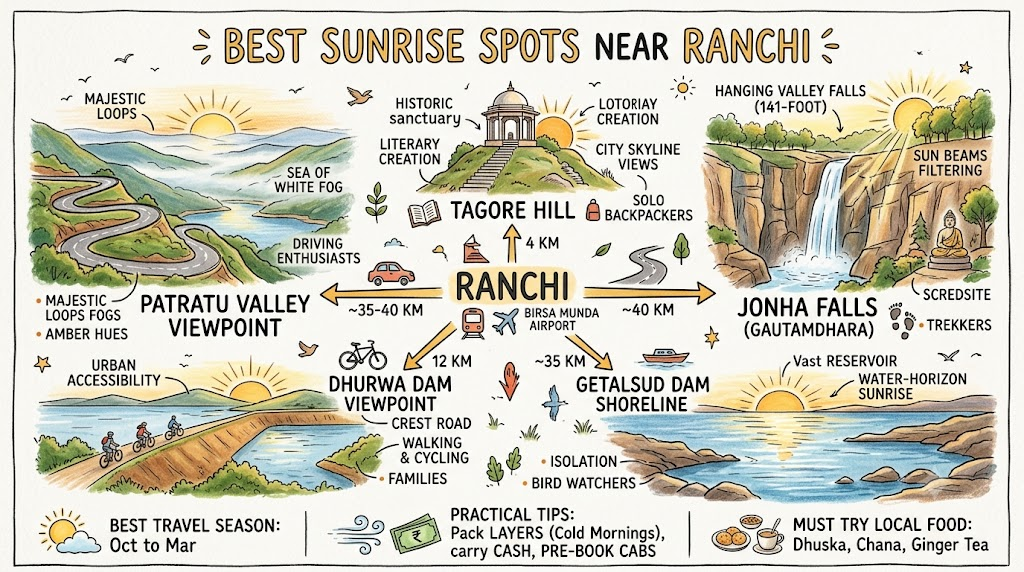
Perched like a silent sentinel over the Morabadi area, Tagore Hill rises roughly 300 feet above the surrounding city plains. This historic eminence carries immense cultural and literary weight; it was chosen by Jyotirindranath Tagore—the elder brother of Noble Laureate Rabindranath Tagore—as a permanent sanctuary for literary creation and deep spiritual meditation. The hill features an exquisite, colonial-era open canopy pavilion known as the Shanti Dham, along with an old ashram structure at its base that whispers stories of the late 19th century. Clambering up the stone steps in the pre-dawn darkness rewards travelers with a front-row seat to the awakening of the capital city.
The sunrise here is nothing short of a sensory poetry session. As dawn breaks, the golden light gradually illuminates the geometric layout of Ranchi’s skyline on one side and the soft, rolling green hills of the plateau on the other. The cool morning air carries the distant chants from the Ramakrishna Mission Ashram down below, creating a surreal, reflective ambiance. It is the ultimate urban vantage point where history, literature, and raw geography fuse into a singular, breathtaking morning experience.
- Location: Morabadi District, approximately 4 kilometers north of Ranchi city center (Albert Ekka Chowk).
- Why it is worth visiting: It seamlessly combines deep literary history with an unmatched 360-degree panoramic view of the entire city skyline bathing in early morning light.
- Best things to do: Photograph the sun rising through the arches of the historic Shanti Dham pavilion, meditate near the old rock-carved steps, and explore the Ramakrishna Mission exhibition at the base.
- Best time to visit: Arrive by 4:45 AM during the summer months or 5:30 AM during winter to catch the deep indigo hues before the sun clears the horizon.
- Ideal for whom: Literature enthusiasts, travel photographers, solo backpackers, and fitness lovers seeking an early morning climb.
- Travel tip: The stone steps leading to the pavilion can become remarkably slick with morning dew or monsoon dampness; wear high-traction trail shoes.
Patratu Valley Viewpoint
Descending into the majestic loops of the Patratu Valley feels like watching a masterpiece of highway engineering slice through a prehistoric mountain range. Located a short drive from the capital, the valley features a series of sweeping hairpin turns that hug the contours of the rugged hills, dropping down dramatically toward the glassy waters of the Patratu Reservoir. In the early hours of the morning, this entire chasm becomes a natural collector for low-lying clouds and dense river fog, transforming the landscape into a dreamlike sea of white.
When the sun begins to peek over the distant ridgelines, its rays strike the upper layers of the fog bank, creating a spectacular display of shifting amber, violet, and deep crimson hues. Watch the winding ghat road slowly reveal itself from beneath the disappearing mist, resembling a giant silver serpent tracing the hills. The contrast between the stark engineering of the road, the lush green valley walls, and the vast water mirror below is unforgettable.
- Location: Patratu Ghat Road, Ramgarh District, roughly 35 to 40 kilometers from Ranchi city center.
- Why it is worth visiting: Renowned for its world-class, multi-tiered hairpin curves that offer an dramatic mountain view mimicking the high-altitude roads of North India.
- Best things to do: Park safely at the designated highway turnouts for long-exposure photography, watch the mist rise off the distant Patratu Dam, and enjoy a piping hot cup of local ginger tea from a cliffside shack.
- Best time to visit: November through February is magic, particularly between 5:15 AM and 6:15 AM when the valley fog is at its thickest.
- Ideal for whom: Road trippers, driving enthusiasts, couples seeking romance, and landscape photographers.
- Travel tip: Heavy transport vehicles occasionally use this route early in the morning; never park your vehicle on the active shoulder of a blind hairpin curve.
Jonha Falls (Gautamdhara)
Jonha Falls is a classic example of a hanging valley waterfall, where the hanging tributary river of Ganga drops over a sheer 141-foot cliff to join the Raru River below. Named Gautamdhara due to an ancient Buddhist tradition associated with the site, a beautiful monastery dedicated to Lord Buddha rests near the top of the plateau. To witness the sunrise here, travelers must descend a flight of over 700 rock-hewn steps that cut straight through a dense, primeval canopy of sal, mahua, and bamboo trees.
As dawn approaches, the deep valley floor remains cloaked in shadow while the rising sun begins to paint the upper canopy and the lip of the falls in brilliant gold. The roar of the crashing water echoes off the canyon walls, mixing with early morning birdsong. Standing on the lower rocky platforms as the first direct shafts of sunlight pierce the dense forest and illuminate the swirling mist from the plunge pool is a deeply spiritual experience.
- Location: Purulia Road (NH-32), roughly 40 kilometers east of Ranchi city.
- Why it is worth visiting: A pristine, jungle-enclosed river canyon where you can experience the sunrise alongside an ancient sacred Buddhist site.
- Best things to do: Descend the historic cliffside staircase, sit on the sun-warmed boulders at the river base, and visit the serene Buddha shrine at the crest.
- Best time to visit: October to December, strictly between 5:30 AM and 7:00 AM to catch the dramatic sunbeam filtering through the forest trees.
- Ideal for whom: Nature purists, spiritual seekers, trekkers, and adventure-loving groups.
- Travel tip: The climb back up the 700 steps requires moderate physical stamina; carry a bottle of water and pace your ascent to avoid quick exhaustion.
Getalsud Dam Shoreline
Sprawling across the Subarnarekha river system, Getalsud Dam is a massive reservoir that functions as an inland sea on the outskirts of Ranchi. The northern and eastern shorelines of this vast body of water are completely free of urban infrastructure, bordered instead by rolling meadows, small tribal hamlets, and patches of deciduous scrub forest. Because of its sheer scale, the reservoir offers an uninterrupted, flat eastern horizon—a rarity in the otherwise rugged, valley-scarred terrain of the Chotanagpur Plateau.
An early morning trip to Getalsud feels like entering a minimalist watercolor painting. Long before the sun shows itself, the massive water body acts as a mirror, reflecting the changing cool blues and soft pinks of the pre-dawn sky. When the sun finally breaks over the horizon, it casts a long, blazing trail of crimson light straight across the calm water, directly to where you stand on the rocky bank. The complete absence of crowds makes this the quietest sunrise spot in the entire region.
- Location: Near Ormanjhi block, approximately 35 kilometers northeast of the city center.
- Why it is worth visiting: It offers an expansive, unobstructed water-horizon sunrise that feels completely isolated from the modern world.
- Best things to do: Set up a tripod on the rocky shoreline for water-reflection photography, spot migratory waterbirds arriving at dawn, and enjoy a quiet lakeside morning walk.
- Best time to visit: Post-monsoon months (October to January) when the reservoir water levels are at their highest and cleanest.
- Ideal for whom: Peace seekers, solo travelers, birdwatching enthusiasts, and camping minimalists.
- Travel tip: The shoreline is highly rural and unlit; make sure to complete your drive down the dirt approach tracks before the first hint of twilight.
Dhurwa Dam Viewpoint
For those who want a breathtaking sunrise without driving far from their hotel, the massive earthen embankment of Dhurwa Dam is the ultimate local secret. Located on the southwestern fringe of Ranchi, this long, stone-reinforced dam controls the twin waters of the Shalimar and Subarnarekha tributaries. The main crest road runs perfectly straight for several kilometers, providing sweeping, unobstructed views of the water on one side and a vast, tree-lined valley on the other.
Watching the sunrise here is a favorite ritual for local cyclists, runners, and thoughtful early birds. The sun rises directly behind a series of small, distant hill locks across the lake, casting sharp silhouettes against an orange sky. The cool morning breeze blowing off the water carries the scent of damp earth and blooming wildflowers. It provides a quick, refreshing escape into nature before the city’s traffic begins to hum.
- Location: Dhurwa region, roughly 12 kilometers southwest of Ranchi’s commercial core.
- Why it is worth visiting: Exceptional close-in urban accessibility combined with a long, beautiful lakeside road perfect for walking during dawn.
- Best things to do: Take a brisk walk or bicycle ride along the flat dam crest road, photograph the local fishermen launching their traditional small boats at dawn, and sit on the stone embankment.
- Best time to visit: Year-round, between 5:00 AM and 6:30 AM for the coolest lake breezes.
- Ideal for whom: Families with young children, elderly travelers, cyclists, and casual morning walkers.
- Travel tip: The dam road has no guardrails on the outer slopes; keep a close eye on young children if you walk down along the stone embankments.
Offbeat Exploration: Hidden Gems Tourists Miss
Ratu Sunrise Point (Kathitand)
Tucked away past the historic Ratu Palace grounds on the western edge of the Ranchi periphery, this lesser-known hillock remains almost exclusively a local secret. Unlike the popular spots, you won’t find tourist buses or souvenir vendors here. The hill rises gently out of the rustic landscape, offering an uninterrupted view of old mango orchards, fields, and traditional mud-brick hamlets. At dawn, a soft ground mist often rolls through the low-lying farmlands, creating a scene that feels completely disconnected from modern times. Standing here as the sun illuminates the fields provides a beautiful glimpse into the timeless rhythm of rural Jharkhand.
Sita Falls Canyon View
While most travelers crowd around the main viewing decks of nearby Jonha or Hundru, the deep river canyon of Sita Falls remains wonderfully wild and unexplored. Named after the revered epic figure, this stunning waterfall drops down a series of rugged granite steps into a deep, steep-sided gorge. Savvy travelers head to the unmapped eastern rim of the canyon just before daybreak. From this high rocky edge, you can look down into the misty depths as the first golden sunbeams cut diagonally through the gorge, lighting up the churning white water below like a neon stripe amid dark rock.
Detailed Practical Guidance for Travelers
The logistics of planning an early morning trip around the Ranchi plateau require careful timing, as entry gates, trail conditions, and local food options vary widely between urban and rural areas.
| Destination | Standard Entry Fee | General Timings | Best Local Food Options Nearby | Recommended Nearby Attractions |
| Tagore Hill | Free Admission | 05:00 AM – 06:00 PM | Morabadi street stalls (Duska, Chana, Ginger Tea) | Ranchi Rock Garden, Kanke Dam Park |
| Patratu Valley Viewpoint | Free Admission | Open 24 Hours | Cliffside dhabas (Maggi, Bread-Omlet, Samosas) | Patratu Lake Resort, Boating Ghats |
| Jonha Falls | ₹10 per person | 06:00 AM – 05:00 PM | Local tribal kiosks (Marua Roti, Dehati Chicken) | Sita Falls, Gautam Dhara Buddhist Temple |
| Getalsud Dam Shoreline | Free Admission | Open 24 Hours | Highway dhabas near Ormanjhi (Litti Chokha) | Bhagwan Birsa Biological Park |
| Dhurwa Dam Viewpoint | Free Admission | Open 24 Hours | Dhurwa Chowk food carts (Fried Pitha, Milk Tea) | Jagannath Temple, Dhurwa Park |
Logistics & On-Ground Navigation
Local Transport Options
- Car Rentals & Private Cabs: For sunrise excursions, pre-booking a private cab (via local agencies or app-based services like Ola) the previous evening is highly recommended. Most sunrise spots are outside the city limits where on-demand booking is unavailable at 4:30 AM.
- Auto-Rickshaws & E-Rickshaws: These are excellent, budget-friendly options for intra-city viewpoints like Tagore Hill or Dhurwa Dam. You can easily hail them from major hubs like Albert Ekka Chowk or Ratu Road. However, they are not suitable for long-distance, steep ghat routes like Patratu Valley.
- Railways: While Ranchi Junction connects major cities, local trains to stations like Lohardaga or Muri can drop adventure backpackers close to rural hubs, though their timings rarely align with early dawn requirements.
Budget Planning
- Budget / Backpacking Tier (₹800 – ₹1,500 per day): This tier relies on shared auto-rickshaws for transport within the city, staying in budget homestays or minimalist guesthouses near Morabadi, and eating local street food like Dhuska, Chana Bhatura, and Litti.
- Mid-Range / Comfort Tier (₹3,000 – ₹6,000 per day): This tier includes hiring a dedicated private hatchback for the entire day (including early dawn transfers), staying in comfortable 3-star business or heritage hotels in Hindpiri or Lalpur, and dining at clean highway restaurants and established local eateries.
Safety and Inclusivity Tips
- For Families: Stick to well-developed areas like Dhurwa Dam or Tagore Hill for early mornings. Ensure elderly members have walking sticks for the steps at Tagore Hill, and always carry personal water bottles as rural vendors don’t open until mid-morning.
- For Couples: Patratu Valley and Getalsud Dam offer beautiful romantic backdrops. For a safe and comfortable experience, choose the main, well-frequented highway view areas rather than wandering off into unmapped trails or isolated forest patches alone early in the morning.
- General Safety: The Chotanagpur Plateau is beautiful but rugged. Always complete your return journeys from isolated waterfall canyons or remote dam shorelines before twilight fades. Stick to primary state and national highways when driving during early morning fog.
Strategic Travel Planning Guardrails
Travel Planning Tips for Ranchi
- Prioritize the Post-Monsoon Window: Plan your trip between October and March to see the plateau landscapes at their best, with full waterfalls, green valleys, and beautiful morning mist.
- Keep Cash on Hand: While digital UPI payments are widely used in Ranchi city, mobile networks can be spotty down in deep river canyons like Jonha or out on the Getalsud shores. Always carry physical cash for entry fees and local food stalls.
- Dress in Layers: Don’t let the tropical location fool you; because of the plateau’s elevation, winter morning temperatures can drop to a chilly 6°C to 10°C, often made colder by strong valley winds. Bring a windcheater or light jacket.
- Respect Tribal Sacred Spaces: Many hills and groves (Sarnas) are deeply sacred places for the local tribal communities. Avoid littering, don’t disturb small stone arrangements, and always ask before taking photos of local rituals.
- Pre-Book Your Early Morning Ride: Do not rely on hailing a ride-sharing app at 4:30 AM for out-of-town trips. Always arrange your vehicle and confirm the driver the night before.
Common Mistakes to Avoid
- Over-packing the Morning Schedule: Trying to combine two major sunrise spots—like Patratu Valley and Jonha Falls—on the same morning is impossible due to the driving distance across the city. Focus on one spot per dawn.
- Assuming All Waterfalls Have Easy Access: Many travelers don’t realize that reaching spots like Jonha or Sita Falls requires descending and climbing hundreds of steep stone steps. Check your physical fitness levels before heading down.
- Skipping the Local Morning Food Stalls: Don’t head back to your hotel for a standard continental buffet. Missing out on a roadside breakfast of hot, fresh Dhuska with spicy potato-gram curry is missing the culinary soul of Ranchi.
- Driving Too Fast in the Morning Fog: The dense mist that settles over the Patratu and Ormanjhi roads can drop visibility to near zero very quickly. Drive slowly and keep your fog lights or hazard signals on.
- Forgetting to Check Seasonal Water Flows: By March and April, some of the smaller plateau streams can dry up considerably. If you’re visiting in late spring, check with locals about water levels before planning an early trek to the falls.
Suggested Itinerary Blueprints
1-Day Quick Dash (The Classic Valley Loop)
This rapid routing layout is tailor-made for business travelers or short-stay visitors wanting a scenic escape.
- 04:30 AM – 05:00 AM: Pre-dawn drive from city center up through Kanke Road towards Ramgarh district.
- 05:15 AM – 06:45 AM: Arrive at Patratu Valley Viewpoint; watch the sun rise over the fog-draped curves and reservoir.
- 07:00 AM – 08:00 AM: Breakfast at a cliffside dhaba with fresh ginger tea and hot omelets.
- 08:30 AM – 10:30 AM: Head down to the reservoir for a quick morning boat ride at Patratu Lake Resort before returning to Ranchi.
2-Day Deep-Dive (The Nature & Literary Circuit)
An explicit itinerary split balancing cultural exploration with deep wilderness.
- Day 1: Begin at Tagore Hill at 05:00 AM to witness an urban sunrise and explore the old colonial pavilions. Spend the afternoon exploring the rock carvings at the Rock Garden. Conclude your evening with traditional shopping at the local state emporium.
- Day 2: Leave early at 04:30 AM for Jonha Falls. Descend the gorge steps at dawn to see the sunbeams light up the canyon mist. Hike over to the nearby, lesser-known Sita Falls by mid-morning before returning to town.
Complete Weekend Travel Plan (The Grand Plateau Loop)
A comprehensive Friday-to-Sunday travel plan covering the finest spots in the region.
- Friday Evening: Arrive in Ranchi, check into your hotel, and head out for a relaxed walk around the breezy perimeter of Kanke Dam.
- Saturday: Head out for a 04:30 AM drive to Getalsud Dam Shoreline for a peaceful, crowd-free water sunrise. Spend the afternoon exploring the nearby wildlife safaris at the Bhagwan Birsa Biological Park in Ormanjhi.
- Sunday: Finish your weekend with a classic road trip down the Patratu Valley Ghat Road for the dramatic misty-valley sunrise, followed by an early afternoon visit to the historic, centuries-old Jagannath Temple on the city’s skyline.
Common Tourist Mistakes to Avoid
Geographic Blunders
One of the most common errors travelers make is trying to map out a single day that combines destinations on opposite sides of the city—like visiting Patratu Valley (Northwest) and Jonha Falls (East) in the same morning. Because you have to drive back through Ranchi’s busy city traffic, you’ll end up spending most of your day on the road instead of enjoying nature.
- Commercial Traps: Don’t waste your precious early mornings or late evenings inside the modern, enclosed shopping malls on Main Road or Lalpur. These spaces look like those in any other major city. Instead, head to the open-air morning markets and old city squares where the real character of the town comes alive.
- Neglecting Alternative Zones: Many visitors completely overlook the quieter, artistic, and cafe-centric modern expansions around Morabadi and the corporate-clean avenues of the Smart City zone near Dhurwa, both of which offer lovely, peaceful areas for morning strolls.
- Transport Overpayment: Always avoid accepting flat, unmetered rates from auto-rickshaw drivers outside major transit points like the Ranchi Railway Station. Instead, cross-reference pricing with app-based ride services to ensure you pay a fair, standard local rate.
- Luxury Dining Bias: Relying solely on fine-dining hotel restaurants means missing out on the authentic local cuisine. The true culinary heart of the region lives in its street food—like steamed Pitha or a plate of spicy Ghgugni-Chura enjoyed at a simple roadside stall.
Frequently Asked Questions
1. What is the absolute best time of year to see morning mist during sunrise around Ranchi?
The ideal window runs from November to February. During these winter months, the high moisture levels of the Chotanagpur Plateau combined with cool night temperatures create dense layers of low-lying fog, especially over valleys like Patratu and large reservoirs like Getalsud.
2. Are the entry gates to Tagore Hill open early enough for travelers to catch the sunrise?
Yes, the side gates and walking trails at Tagore Hill are accessible to early morning walkers and fitness enthusiasts from around 5:00 AM, long before the regular tourist crowds arrive later in the morning.
3. Is it safe to drive along the Patratu Valley ghat roads during the pre-dawn hours?
Yes, the roads are well-surfaced and feature clear reflective markers. However, you must drive slowly and cautiously to safely navigate the sharp turns during times of heavy morning fog or when encountering early commercial trucks.
4. Can I easily find public transport options back to Ranchi from places like Jonha or Sita Falls after sunrise?
Shared auto-rickshaws can be spotty and unreliable in these rural areas early in the morning. It is highly recommended to book a round-trip private cab that stays with you for the entire morning excursion.
5. Are there any camera fees or photography restrictions at these sunrise viewpoints?
Most natural viewpoints, dams, and historic hills like Tagore Hill do not charge any fees for standard smartphone photography or amateur DSLR cameras. However, professional commercial videography or drone flying may require prior permission from local authorities.
6. What are the key local breakfast items I should try at roadside stalls after a sunrise shoot?
You should definitely try Dhuska (a deep-fried, savory rice and lentil snack) served with a spicy potato and chickpea curry, along with hot, fresh Samosas and a cup of local sweet ginger tea.
7. Is it physically difficult to climb down to the base of Jonha Falls for the early morning views?
The descent involves walking down over 700 concrete and stone steps. While going down is relatively easy, the climb back up requires a moderate level of physical stamina and may be challenging for elderly travelers or anyone with knee issues.
8. Which sunrise spot near Ranchi is the absolute quietest and least crowded for meditation?
The northern shorelines of Getalsud Dam are the quietest option. This vast reservoir area has no formal tourism gates or commercial stalls, offering complete silence and a peaceful setting for morning meditation.
9. Can we couple a sunrise trip to Patratu Valley with a boating experience on the same morning?
Yes, you can watch the sunrise from the high valley viewpoints around 5:30 AM, drive down the ghat road to the lakeside resort by 7:30 AM, and enjoy early morning boating as the water activities open up for the day.
10. Do local street food stalls and rural kiosks near the waterfalls accept mobile UPI payments?
While UPI is widely accepted throughout Ranchi city and along major highways, cellular networks can be very weak down in deep river canyons like Jonha or Sita Falls. Always carry enough cash for small expenses.
11. Is there a dress code or any specific etiquette required when visiting the temple areas at Tagore Hill?
There is no strict formal dress code, but visitors are expected to dress modestly. You will also need to remove your shoes before stepping onto the raised platform areas of the Shanti Dham pavilion.
12. Are there any clean restroom facilities available for families at these remote sunrise locations?
Well-developed sites like Patratu Lake Resort and the tourist complex at Jonha Falls offer clean public restrooms. However, more rural and offbeat spots like the Getalsud shoreline or the high valley turnouts do not have public facilities available early in the morning.
Conclusion
Choosing to explore the sunrise spots of Ranchi over a standard, predictable vacation destination is a rewarding choice for the intentional traveler. As the golden dawn light spreads across the ancient granite hills and mist-draped valleys of the Chotanagpur Plateau, it brings a profound sense of peace and a deep connection to the earth. This is a landscape where nature still sets the pace, free from the rush of commercial tourism. Watching the morning sun lift the fog from a quiet reservoir or pierce the canopy of a sacred jungle grove offers a rare, refreshing experience that stays with you long after the journey ends.
