Introduction
When planning a family vacation, the modern traveler is often funneled toward mainstream, congested hill stations or hyper-commercialized theme parks where the local essence has been paved over by tourist traps. If you are looking for a destination that rejects this artificial plastic veneer in favor of deep roots, ancient geological wonder, and profound cultural connection, the capital city of Jharkhand is an exceptional choice. Ranchi is a rare landscape where the Chotanagpur Plateau’s raw, primordial topography meets the rich, living heritage of the Santhal, Munda, and Oraon communities.
Far from the mechanical pacing of neighboring mega-cities, Ranchi moves to a rhythm dictated by crashing water, whispering Sal forests, and centuries-old red-clay shrines. For families, this translates into an experiential playground where children do not just observe nature but physically step into it—whether by climbing ancient granitic kopjes or standing within mist-shrouded valleys. Choosing Ranchi means stepping away from the predictable and embracing an atmospheric, authentic regional chapter that balances the infrastructure of a modern capital with the soulful solitude of India’s tribal heartland.
Why Ranchi is a Must-Visit City
Ranchi stands as a macro-level marvel in the geographic tapestry of Eastern India. Geologically positioned on an elevated plateau approximately 2,140 feet above sea level, it acts as a massive thermal cushion, blessing the region with a distinctively temperate microclimate while the surrounding plains swelter in tropical heat. Historically, it served as the summer capital of the Bihar province during the British Raj—a legacy still palpable in its expansive bungalows and manicured urban layout. Culturally, it is the beating heart of Jharkhand, serving as a repository for indigenous folklore, specialized metallurgic arts, and sacred groves (Sarnas) that have resisted external homogeneity for thousands of years.
For families across different generations, Ranchi offers frictionless practical accessibility. The city is flawlessly integrated into India’s infrastructure network via the Birsa Munda Airport (IXR), which features direct daily flights from major metro hubs, and the Ranchi Junction Railway Station, a pristine terminal serving major superfast express lines like the Rajdhani and Vande Bharat. The highway system—predominantly NH-33 and NH-20—boasts incredibly smooth, multi-lane bituminous asphalt that transforms regional road tripping into a seamless luxury.
The overall travel circuit is intuitive, spreading radially outward from a central urban nucleus of historical architecture and botanical parks to an outer ring of world-class waterfalls, deep river gorges, and ecological reserves.
| Metric / Parameter | Regional Specifics & Logistics |
| Geographic Coordinates | 23.34° N, 85.30° E (Chotanagpur Plateau Rim) |
| Ideal Trip Duration | 3 Nights / 4 Days for a comprehensive family loop |
| Peak Tourist Season | October to February (Crisp winters with clear blue skies) |
| Signature Local Flavors | Dhuska with Ghugni, Chilka Roti, Litti Chokha, Madua Roti |
| Primary Transit Hubs | Birsa Munda Airport & Ranchi Junction Railway Station |
| Top Travel Experiences | Chasing multi-tiered waterfalls, sunset valley driving, tribal art hunting |
Best Places or Experiences
Bhagwan Birsa Biological Park (Ormanjhi Zoo)
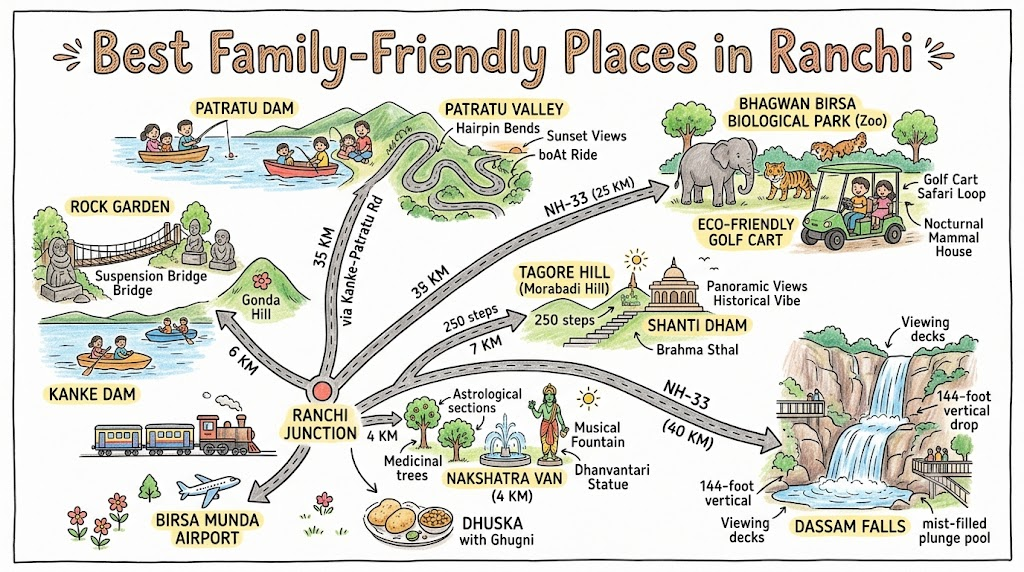
Spread across a massive expanse of over 104 hectares of undulating terrain, the Bhagwan Birsa Biological Park is widely recognized as one of the most progressively managed ecological enclosures in Eastern India. Rather than confining its inhabitants to archaic iron cages, the facility utilizes vast, moat-isolated natural exhibits that mirror the dry-deciduous forest profile of Jharkhand. The park is bisected by a natural water body, creating a striking visual landscape where native and exotic fauna thrive in a contiguous ecosystem shaded by soaring Sal and Asan trees.
The historical significance of this sanctuary lies in its dedication to the preservation of endangered regional wildlife, particularly the Asiatic Lion and the Royal Bengal Tiger. The park operates a state-of-the-art veterinary rescue center and a highly successful breeding program for nocturnal mammals and reptiles. For families, walking through this expansive sanctuary offers a vivid, real-time biology lesson, far removed from the static pages of a textbook, where children can witness the symbiotic relationships of a thriving woodland environment.
- Location: Ormanjhi, situated directly on the Ranchi-Patna National Highway (NH-33), roughly 25 km from the city center.
- Why it is worth visiting: It is an immaculate, conservation-first sanctuary allowing families to witness apex predators in expansive, barrier-free natural habitats.
- Best things to do: Embark on the dedicated internal golf-cart safari loop, visit the specialized nocturnal mammal house, and spend an hour bird-watching by the central lake.
- Best time to visit: Arrive early between 9:30 AM and 11:30 AM when animals are highly active and feeding, preferably from November to January.
- Ideal for whom: Multi-generational families, wildlife enthusiasts, children, and amateur travel photographers.
- Travel tip:
Skip the exhausting multi-kilometer walk by renting an eco-friendly four-seater or six-seater battery-operated golf cart immediately at the main ticketing counter.
Patratu Valley and Dam
The journey through Patratu Valley is an architectural and engineering marvel that rivals any international mountain pass. The winding ghat road descends down the steep edges of the Ranchi plateau, twisting through more than two dozen hairpin bends flanked by towering granitic cliffs on one side and a sheer drop into emerald-green canopies on the other. As you reach the floor of the valley, the dramatic mountain landscape gives way to the vast, shimmering reservoir of the Patratu Dam, a massive water body constructed to supply the nearby thermal power plants.
The engineering of the switchback loop provides panoramic viewpoints where families can park safely within designated laybys to watch the evening mist roll over the hills. The waterfront has been comprehensively developed into a world-class promenade featuring manicured gardens, seating alcoves, and a clean boating jetty. The stark contrast between the thrilling high-altitude drive and the tranquil, glassy stillness of the reservoir makes Patratu an unmissable destination for families seeking both adventure and relaxation.
- Location: Patratu Region, approximately 35 km north of Ranchi, easily accessed via the state-of-the-art Kanke-Patratu Road.
- Why it is worth visiting: The breathtaking, snake-like alpine switchbacks open up to a massive, mirror-calm reservoir that reflects the changing colors of the sky.
- Best things to do: Take a high-speed motorboat ride out to the small islands within the reservoir, photograph the sunset from the hairpin loop view-points, and enjoy local fried fish along the promenade.
- Best time to visit: 3:30 PM to 6:30 PM to experience the dramatic transformation of the valley during the golden hour and sunset.
- Ideal for whom: Road-trip enthusiasts, families seeking premium leisure spaces, and landscape photographers.
- Travel tip:
Ensure your vehicle’s braking system is in top condition before embarking on the descent, and strictly avoid driving back up the ghats after 7:30 PM due to lingering fog and minimal illumination along the sharpest turns.
Rock Garden and Kanke Dam
Perched gracefully on the foothills of the Gonda Hill complex, the Ranchi Rock Garden is a brilliant testament to human creativity and spatial recycling. Entirely carved out of the residual granitic rocks excavated during the structural layout of the Kanke Dam, this urban park blends structural art with natural topography. The garden features beautifully hand-carved stone sculptures, artificial waterfalls that cascade over natural bedrock, and stone seating platforms that look out directly over the expansive waters of the Kanke Dam reservoir.
The architectural centerpiece of the garden is a spectacular iron footbridge that stands supported by only two massive structural pillars, defying conventional layout standards and offering a thrilling walking experience. Below the garden, the tranquil waters of Kanke Dam gently lap against the stone embankments. The area serves as a vital community space where families can escape the urban bustle, watch migratory waterbirds, and enjoy the cool breeze that rolls off the reservoir every evening.
- Location: Gandhi Nagar area, near the Gonda Hill base, roughly 6 km from the Ranchi railway station.
- Why it is worth visiting: It is a masterful display of rock-cut architecture and artistic sculptures set against a sweeping panoramic backdrop of a massive urban lake.
- Best things to do: Cross the gravity-defying iron suspension bridge, explore the hidden stone-carved caves, and relax with a paddle-boat ride on the adjacent Kanke Dam.
- Best time to visit: Late afternoons from 4:00 PM to 7:00 PM when the stone structures cool down and the sunset paints the dam in deep shades of amber.
- Ideal for whom: Families with young kids, art appreciators, and casual evening walkers.
- Travel tip:
The rock pathways can be smooth and slippery due to centuries of natural weathering, so ensure everyone in the family wears high-traction rubber-soled footwear.
Tagore Hill (Morabadi Hill)
Rising over 300 feet above the surrounding plains of Morabadi, Tagore Hill is a deeply historic spot soaked in literary and spiritual heritage. This isolated granitic hillock was chosen by Jyotirindranath Tagore, the elder brother of Nobel Laureate Rabindranath Tagore, who fell in love with its absolute silence and panoramic views in the early 20th century. He built a beautiful, colonial-style retreat called ‘Shanti Dham’ and a monument named ‘Brahma Sthal’ at the absolute summit, where he spent years writing literary works, translating philosophical texts, and practicing deep meditation.
Climbing the 250 well-paved stone steps to the summit is a rewarding experience for families. As you ascend, the urban sounds fade away, replaced by the whispering wind. The peak offers a spectacular 360-degree view of Ranchi, showing the perfect balance between the growing modern city and the vast, green rural plateaus beyond. The base of the hill houses the historic Ramakrishna Mission Ashram, adding an extra layer of cultural and educational value to the visit.
- Location: Morabadi, situated in the northern sector of the city, roughly 7 km from Ranchi Junction.
- Why it is worth visiting: A stunning fusion of literary history and panoramic views, this hilltop provides unmatched vantage points of the entire city skyline.
- Best things to do: Explore the restored colonial architecture of Shanti Dham, meditate at the historic Brahma Sthal pavillion, and view the city through the vintage arches.
- Best time to visit: 5:30 AM to 7:30 AM for a glorious sunrise, or late winter afternoons.
- Ideal for whom: History buffs, literary enthusiasts, couples, and photography lovers.
- Travel tip:
There are no vendors or hydration kiosks at the top monument to preserve its cleanliness, so make sure to carry your own water bottles up the steps.
Dassam Falls
Dassam Falls is a breathtaking display of nature’s raw power, where the sacred Kanchi River plunges down a sheer 144-foot vertical drop over a rugged granitic cliff face. The waterfall is a classic example of a ‘nick point’ on the plateau, where the river channel breaks into a multi-tiered cascade. When the river is full, it splits into ten distinct channels that roar down into a deep, mist-filled plunge pool below, creating a thunderous sound that echoes through the surrounding Sal forests.
The tourism department has developed secure viewing decks, paved walkways, and concrete staircases that lead visitors safely to various vantage points down the gorge. The air around the falls is constantly filled with a cool, refreshing spray, offering an invigorating sensory experience. Surrounded by untouched forest scenery and unique rock formations, Dassam Falls is a beautiful destination that highlights the wild, untamed nature of Jharkhand’s plateau landscape.
- Location: Near Taimara Village, along the Ranchi-Jamshedpur Highway (NH-33), approximately 40 km southeast of the capital.
- Why it is worth visiting: It is one of the tallest and most powerful multi-tiered waterfalls in the state, offering a grand look at the plateau’s geographic shifts.
- Best things to do: Stand on the primary viewing terrace to experience the natural mist spray, explore the ancient rock steps, and enjoy a family picnic in the designated forest zones.
- Best time to visit: September to November when the post-monsoon river flow is at its peak, providing a full, dramatic cascade.
- Ideal for whom: Nature lovers, adventure-seeking families, and landscape photographers.
- Travel tip:
The deep plunge pool at the bottom has dangerous, hidden undercurrents and slippery underwater rocks; entering or swimming in the water is strictly banned and highly hazardous.
Nakshatra Van
Located right across from the formal Raj Bhawan, Nakshatra Van is a beautifully designed urban park that uniquely blends botanical science with ancient Indian astrology. The entire layout of the park is conceptualized around the 27 Nakshatras (zodiac constellations) of traditional Indian astronomy. The park is divided into precise geometric sectors, with each section planted with specific medicinal, aromatic, or ornamental trees that correspond to a particular star constellation, creating an engaging, interactive map of the night sky on earth.
At the center of this astrological garden is a beautiful musical fountain, surrounded by a ring of paved walking paths, an expansive herbal nursery, and a specialized section for rare medicinal plants. The park also features a striking sleeping statue of Dhanvantari (the deity of Ayurveda). For families, Nakshatra Van offers a refreshing green escape within the city where children can explore the unique links between indigenous plants, astronomy, and ancient wellness traditions.
- Location: Raj Bhawan Road, in the high-security VIP zone of central Ranchi, 4 km from the railway terminal.
- Why it is worth visiting: A beautifully unique themed park that combines rich astrological folklore with detailed botanical collections and therapeutic gardens.
- Best things to do: Find and study the specific sacred tree linked to your family members’ zodiac signs, enjoy the evening musical fountain show, and walk along the reflexology paths.
- Best time to visit: 5:00 PM to 7:30 PM to catch the colorful lighting displays and the main fountain performance.
- Ideal for whom: Families with elderly relatives, wellness seekers, and curious young minds.
- Travel tip:
Photography using professional DSLR cameras requires a small additional fee at the entrance, though standard smartphone photography is completely free.
Offbeat Exploration: Hidden Gems Tourists Miss
Jonha Falls (Gautamdhara)
While mainstream crowds flock to Dassam, Jonha Falls offers a quieter, more spiritual experience hidden away in a dense canopy of pristine forest. Also known as Gautamdhara, this beautiful waterfall is formed where the hanging valley of the Raru River plunges 45 meters into a rocky gorge.
To reach the base, families walk down a winding flight of nearly 500 concrete steps shaded by ancient trees. At the top of the gorge sits a peaceful Buddhist shrine and ashram built by the Birla family, giving the entire site a calm, meditative atmosphere.
Gonda Hill Eco-Reserve
Tucked away just behind the popular Rock Garden is the largely overlooked Gonda Hill Eco-Reserve, a quiet sanctuary of untouched wilderness within the city limits. This hidden gem features a natural forest trail that leads up to a peaceful viewpoint overlooking the entire Kanke reservoir from a much higher elevation.
It is an exceptional spot for families who want a light trekking experience without the crowds, where you can often spot native peacocks, hornbills, and a variety of colorful butterflies flying through the wild shrubs.
The Anglo-Indian Settlement of McCluskieganj
For an extraordinary day trip back in time, take your family 60 km northwest of Ranchi to McCluskieganj, a unique, nostalgic enclave known as the world’s only custom-built Anglo-Indian settlement. Founded in the 1930s, this sleepy town is dotted with charming, old colonial-style bungalows, old brick bakeries, and sprawling orchards.
Walking through its quiet, pine-lined lanes offers a fascinating look into a bygone era, making it a wonderful, slow-paced historical experience away from typical tourist routes.
Detailed Practical Guidance for Travelers
The following comprehensive logistical matrix provides a precise blueprint for planning family excursions to the primary landmarks discussed above:
| Destination | Standard Entry Fee | General Timings | Best Local Food Options Nearby | Recommended Nearby Attractions |
| Birsa Biological Park | ₹40 per Adult; ₹20 per Child | 9:00 AM – 5:00 PM (Closed on Mondays) | Hot Dhuska stalls outside gate; Park Canteen | Getalsud Dam / Rukka Dam |
| Patratu Valley & Dam | Free entry to valley; ₹50 for Lake Promenade | 6:00 AM – 7:00 PM | Fresh lake-fish fry, local Jhalmuri vendors | Patratu Thermal Power Point |
| Rock Garden | ₹30 per person | 9:00 AM – 7:30 PM | Kanke Road cafes, Chowmein & Roll stalls | Kanke Dam Boating Jetty |
| Tagore Hill | ₹10 per person | 8:00 AM – 5:30 PM | Morabadi Chowpatty (Litti Chokha, Momos) | Ramakrishna Mission Ashram |
| Dassam Falls | ₹20 per vehicle parking | 8:30 AM – 4:30 PM | Local tribal stalls serving boiled corn and tea | Sun Temple (Surya Mandir) |
| Nakshatra Van | ₹20 per person | 9:30 AM – 6:30 PM | Albert Ekka Chowk street food hubs | Ranchi Lake & Pahari Mandir |
Logistics & On-Ground Navigation
Local Transport Options
- Railways: Ranchi Junction is the central transport hub. For local sightseeing, luxury tourist trains are not applicable, but outstation connections to nearby historic towns are highly efficient.
- Auto-Rickshaws (Shared & Reserved): The absolute backbone of Ranchi’s inner-city transit. For families, it is highly recommended to reserve an entire auto-rickshaw for a half-day or full-day city tour rather than opting for shared rides. Always negotiate and fix the price before stepping inside.
- E-Rickshaws: Ideal for short, quiet point-to-point hops within specific neighborhoods like Morabadi, Kanke, or the Raj Bhawan circuit. They are highly eco-friendly and cost-effective but limited to flatter, non-ghat roads.
- Car Rentals & App Cabs: For destinations outside the main city center like Patratu Valley, Dassam Falls, or Jonha Falls, booking a private app cab (Ola/Uber) or renting an SUV through a registered local travel agency is the safest and most comfortable option for a family.
Budget Planning
Budget / Backpacking Tier (Family of Three)
- Estimated Per-Day Cost: ₹2,500 – ₹3,500
- Breakdown: Budget non-AC/AC family rooms in verified guest houses near the station area (₹1,500), commuting via shared autos and e-rickshaws (₹500), and dining at authentic local sweet shops and street-side Dhuska/Litti stalls (₹800).
Mid-Range / Comfort Tier (Family of Three)
- Estimated Per-Day Cost: ₹6,500 – ₹9,500
- Breakdown: Stay in a premium 3-star or 4-star hotel in areas like Lalpur or Hinoo (₹4,000 – ₹5,500), renting a dedicated private AC sedan for the entire day’s sightseeing (₹2,500), and dining at upscale regional restaurants and modern multi-cuisine cafes (₹1,500).
Safety and Inclusivity Tips
- For Families: Keep a close eye on children near water bodies and waterfall areas. Always stay behind the structural safety railings. Carry a basic first-aid kit and mosquito repellent when visiting forest reserves like the Birsa Biological Park.
- For Couples: The Rock Garden promenade and the sunset points along Patratu Dam are generally safe and welcoming. However, it is best to avoid isolated sections of Tagore Hill or distant highway viewpoints after dark.
- General Safety: Ranchi is a friendly, welcoming city, but outstation highway driving through waterfall zones should be wrapped up before nightfall. Stick to main roads, and ensure your digital payments are backed up with enough physical cash, as mobile networks can be spotty in deep valleys.
Strategic Travel Planning Guardrails
Travel Planning Tips for Ranchi
- Book Accommodations Early: If you plan to visit during the peak winter months or around the historic tribal festivals like Sarhul or Karma, ensure your hotel bookings are completed at least a month in advance.
- Keep Physical Cash Handy: While digital UPI payments are widely accepted throughout Ranchi’s urban center, rural stalls near distant waterfalls and valley viewpoints often suffer from network drops. Always carry ₹1,500 to ₹2,000 in small cash denominations.
- Dress in Layers: Due to the city’s unique plateau location, temperatures can drop quickly after sunset. Pack light sweaters or shawls even if your days are warm and sunny.
- Respect Sacred Spaces: When visiting tribal monuments or hill temples like Pahari Mandir, ensure your clothing covers your shoulders and knees, and always remove footwear before entering clean stone platforms.
- Carry Motion-Sickness Remedies: The winding ghat roads leading down to Patratu Valley can cause mild motion sickness for children or elderly family members. Keep appropriate mints or medication ready in your daypack.
Common Mistakes to Avoid
- Over-packing the Daily Itinerary: Do not attempt to visit Dassam Falls and Patratu Valley on the exact same day; they are located in completely opposite directions from the capital, which will lead to an exhausting day spent entirely in transit.
- Ignoring the Monsoon Appeal: Many travelers completely avoid Jharkhand during the rainy season, missing out on the spectacular sights of the waterfalls when they are at their absolute peak volume.
- Assuming All Waterfalls are Safe for Swimming: Do not let children step into any natural river pools or waterfall bases; the underwater rock shelves are sharp, slick, and have dangerous hidden currents.
- Skipping the Local Cuisine: Avoid sticking solely to predictable hotel buffets. Missing out on freshly fried street-side Dhuska or authentic Chilka Roti means missing the culinary heart of the region.
- Overpaying for Street Transit: Never board an unmetered, reserved auto-rickshaw without firmly confirming the final fare beforehand; check rates on app-based rides sharing platforms first to establish a fair baseline price.
Suggested Itinerary Blueprints
1. The One-Day Quick Dash (The Urban Essence Circuit)
- Target Audience: Families on a brief weekend stopover or business transit.
- Morning (8:00 AM – 10:30 AM): Beat the crowds by climbing Tagore Hill early to enjoy the crisp morning air and stunning views of the city. Grab a traditional breakfast of Dhuska and hot Jalebis at the Morabadi food hubs.
- Mid-Day (11:00 AM – 2:00 PM): Head straight to the Ranchi Rock Garden, exploring the unique rock carvings and enjoying a relaxed lunch overlooking the scenic Kanke Dam.
- Evening (4:00 PM – 7:30 PM): Wind down with a pleasant family walk through the themed pathways of Nakshatra Van, catching the beautiful musical fountain performance as the sun sets.
2. The Two-Day Deep-Dive (The Wilderness & Waves Loop)
- Day 1: Capital Culture & Sunsets
- Morning: Explore the educational exhibits and planetary walks at the Ranchi Science Centre with the kids.
- Afternoon: Enjoy an authentic local lunch in the Lalpur area before taking a relaxing stroll through the manicured lanes of Oxygen Park.
- Late Afternoon: Take a scenic drive to the Patratu Dam Promenade, enjoying high-speed motorboating and a spectacular sunset over the water.
- Day 2: The Mighty Cascades & Wildlife
- Morning (9:00 AM – 1:00 PM): Pack a picnic basket and head to the Bhagwan Birsa Biological Park in Ormanjhi, opting for the golf-cart safari to explore the vast forest enclosures comfortably.
- Afternoon (2:30 PM – 5:30 PM): Drive down to the dramatic Jonha Falls, descending the stone steps to experience the peaceful, forested gorge and the nearby Buddhist shrine.
3. Complete Weekend Travel Plan (The Grand Chotanagpur Explorer)
- Friday: Arrival & Skyline Views
- 3:00 PM: Check into your hotel and head straight to Pahari Mandir to climb the historic hill and view the layout of the city from the top.
- 6:00 PM: Stroll around the historic Bada Talab (Ranchi Lake) and enjoy an evening family dinner at an authentic regional restaurant.
- Saturday: The Great Waterfalls & Tribal Art
- 8:30 AM – 12:30 PM: Take a morning drive down the beautiful Jamshedpur highway to the roaring Dassam Falls, exploring its scenic viewing platforms.
- 1:30 PM – 3:30 PM: On the return journey, visit the architectural marvel of the Sun Temple (Surya Mandir) at Bundu.
- 4:30 PM – 8:00 PM: Head to the local markets to shop for authentic souvenirs like Paitkar paintings and beautiful terracotta pottery.
- Sunday: The Alpine Valley Experience
- 9:00 AM – 11:30 AM: Enjoy a relaxing morning walk through the therapeutic green sections of Nakshatra Van.
- 12:00 PM – 5:00 PM: Embark on the spectacular road trip through the hairpin turns of Patratu Valley, wrapping up your weekend with a scenic lakeside lunch by the dam before heading to the airport or railway station.
Common Tourist Mistakes to Avoid
- Geographic Blunders: Many tourists mistakenly try to combine visits to Dassam Falls and Patratu Valley on the same afternoon. These spots are on completely opposite sides of the city, and trying to do both in one day results in hours of stressful driving, leaving your family too exhausted to enjoy either location.
- Commercial Traps: Do not spend your limited vacation hours inside air-conditioned shopping malls that look just like the ones back home. Ranchi’s true charm lies in its open-air spaces, historical hills, and local tribal markets.
- Neglecting Modern/Alternative Zones: Travelers often miss out on Ranchi’s newer, more relaxed residential and artistic expansions. The beautiful, tree-lined avenues around Morabadi and the cozy local cafes near Kanke Road offer wonderful places for families to walk and relax.
- Transport Overpayment: Avoid walking out of transit hubs and hiring the very first unverified taxi or auto-rickshaw you see. Always cross-reference standard point-to-point fares on ride-hailing apps like Ola or Uber to avoid paying inflated tourist prices.
- Luxury Dining Bias: Sticking only to standard multi-cuisine hotel buffets can keep you from experiencing the best of local flavor. Ranchi’s street-level culinary vendors use fresh, indigenous ingredients like Rugra (wild earth truffles) and Bamboo Shoot, which carry the authentic taste and soul of Jharkhand.
Frequently Asked Questions
1. Is Ranchi safe for a family trip with young children and elderly grandparents?
Yes, Ranchi is a peaceful, welcoming city with a relaxed pace that makes it excellent for multi-generational family trips. The main roads are wide and smooth, and major family attractions like the Birsa Biological Park offer convenient battery-operated golf carts so elderly guests can explore without tiring walks.
2. What is the most unique local dish in Ranchi that families must try?
You should definitely try Dhuska. It is a delicious, deep-fried savory snack made from a blended batter of rice and chana dal, lightly spiced with cumin and turmeric. It is traditionally served hot with a spicy black chickpea curry (Ghugni) and tangy potato gravy, offering a wonderful taste of local culinary culture.
3. Can we hire private guides at historical sites like Tagore Hill?
While formal, licensed guides are not regularly stationed at Tagore Hill, the site features detailed informational plaques installed by the tourism department. The local caretakers and staff are also incredibly friendly and happy to share the rich history of the Tagore family’s time on the hill.
4. Are the roads in Patratu Valley safe for an amateur driver?
The road surfaces through Patratu Valley are flawlessly maintained, featuring clear lane markings and strong safety crash barriers. However, because the descent includes over two dozen sharp hairpin turns and steep drops, drivers should be comfortable with mountain driving, use lower gears to control speed, and maintain complete focus.
5. Which month offers the absolute best weather for sightseeing in Ranchi?
The best time to visit is during the winter months, specifically December and January. During this season, daytime temperatures hover around a comfortable 22°C with clear blue skies, making it perfect for outdoor activities like exploring parks and waterfalls.
6. Is public transport readily available at distant waterfalls like Dassam or Jonha?
No, public transport like shared autos or buses is very infrequent around the distant waterfall zones. It is highly recommended to book a private cab for the entire day from Ranchi, ensuring your family has a safe, comfortable ride waiting for the return journey.
7. Do we need any special forest permits to visit the Birsa Biological Park?
No special forest department permits are required to visit the park. Standard entry tickets can be purchased directly at the main entrance gates or through the official Jharkhand Tourism digital portal.
8. Are digital wallets and UPI widely used across Ranchi?
Yes, digital payments via UPI are standard at almost all hotels, restaurants, app-based cabs, and stores within Ranchi’s city limits. However, network connections can be spotty near rural waterfalls or valley roads, so it is always a good idea to keep some physical cash handy.
9. What authentic souvenirs can we buy from local markets in Ranchi?
Look for stunning, traditional Paitkar scroll paintings, elegant metal crafts made using the ancient Dhokra lost-wax casting technique, and beautiful, practical home items woven from local bamboo by regional tribal artisans.
10. Is it safe to visit the waterfalls during the peak monsoon season in July?
While the waterfalls look incredibly grand and powerful during the monsoons, heavy rains can make the rock steps slippery and cause river levels to rise rapidly. For a safer family trip, it is best to visit during the post-monsoon months from September to November.
11. Are there any dress code restrictions for entering Jagannath Temple in Ranchi?
While there is no rigid, official dress code, visitors are expected to dress modestly out of respect for local traditions. It is best to avoid shorts or sleeveless tops, and everyone must remove footwear before stepping onto the sacred temple platforms.
12. How far is the main airport from the central hotel hubs in Ranchi?
The Birsa Munda Airport is conveniently located within the city limits, just about 5 to 7 km from major hotel and commercial areas like Hinoo, Main Road, and Lalpur, making for a quick and easy 15-to-20-minute drive.
Conclusion
Choosing Ranchi for your next family vacation is a choice to slow down and experience a destination with real soul, far from the predictable routines of typical, crowded tourist tracks. The rewarding essence of this journey lies in its beautiful contrasts—the thrilling drive down Patratu’s mountain bends opening up to a wide, tranquil lake, or the quiet, poetic air of Tagore Hill rising just above a growing modern capital. Ranchi offers families a rare chance to bond over shared moments of genuine discovery, whether you are watching a majestic tiger in a sunlit forest enclosure or enjoying hot, freshly made Dhuska by a misty waterfall. By exploring the timeless plateaus and rich cultural paths of Jharkhand, your family will return home not just with standard holiday photographs, but with a deep, lasting connection to India’s beautiful tribal heartland.
