Introduction
When travelers plan an escape to the Indian subcontinent, their itineraries usually center around the frantic bazars of Rajasthan, the highly commercialized hill stations of Himachal Pradesh, or the overcrowded beaches of Goa. Yet, true wanderlust finds its home in the places that modern commercial tourism forgot to spoil. Tucked away in the rugged plateaus of Jharkhand lies Ranchi, an evocative landscape steeped in deep indigenous roots, dense saal forests, and ancient tribal heritage. Unlike typical mainstream vacations where you must fight crowds to catch a glimpse of nature, Ranchi offers an intimate, slow-travel alternative. It is a city where the sky tells a different story every evening, inviting soul-seekers to witness stunning sunsets that paint the Chota Nagpur Plateau in breathtaking colors.
Why Ranchi is a must visit city
Ranchi is not merely a stopover; it is an essential chapter in the story of eastern India’s natural landscape. Geographically resting at an elevation of over 2,100 feet, the city acts as a natural cooler, earning its historical reputation as the summer capital of Bihar. Its undulating topography is a marvel of ancient tectonic shifts, resulting in a dramatic geological ring of cascading waterfalls, prehistoric hill rocks, and massive, mirror-like reservoirs. For the modern traveler, Ranchi provides a seamless blend of wild topography and effortless accessibility. The region is cleanly connected via national highways, a robust regional railway network, and a fast-developing airport infrastructure. The city’s legendary hospitality is deeply anchored in its indigenous culture, offering everything from quaint eco-resorts to high-end urban comfort.
A journey through Ranchi’s travel circuit reveals a carefully balanced rhythm of deep history and natural wonders. Travelers can easily move from evaluating centuries-old architectural ruins to sitting quietly on the banks of a massive reservoir as the day ends. The true pull of this circuit lies in its raw variety. It caters with equal ease to the lone motorcycle backpacker searching for winding mountain ghats, and families looking for clean, peaceful picnic horizons.
| Key Travel Factor | Regional Specification & Logistics |
| Topographical Profile | Mountainous plateau terrain with over 10 major waterfalls and 5 large dams. |
| Primary Connectivity Hub | Birsa Munda Airport (IXR) and Ranchi Junction Railway Station. |
| Peak Seasonal Window | October to March, with crisp daytime temperatures ranging between 10°C to 25°C. |
| Key Cultural Flavor Profile | Indigenous tribal delicacies like Dhooska, Chilka Roti, and bamboo shoot curries. |
Best Places or Experiences
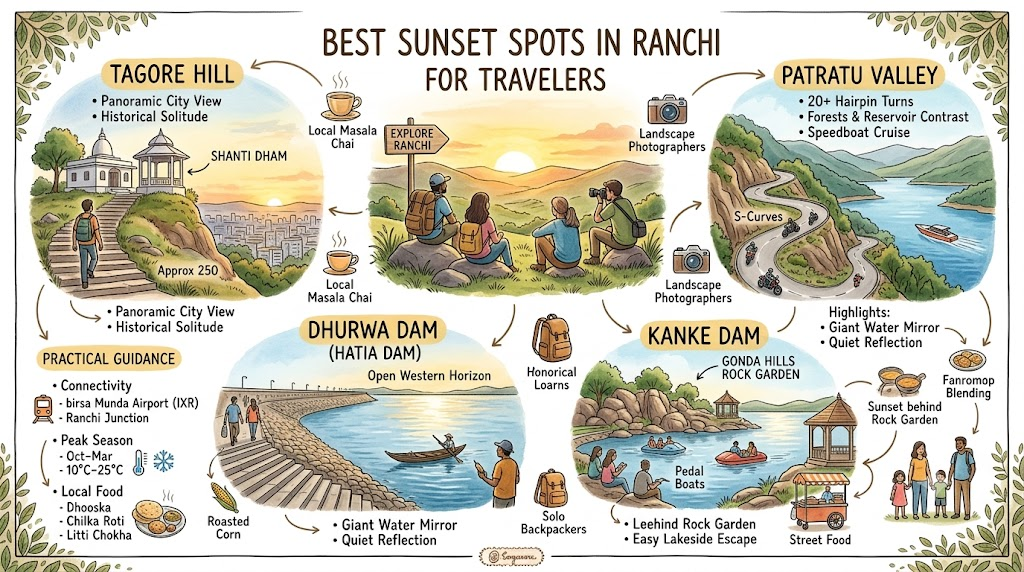
Patratu Valley
Patratu Valley is a masterclass in civil engineering meeting raw nature. Winding down the hillsides like a massive emerald ribbon, the valley features over 20 sharp hairpin turns flanked by dense forests on one side and the sprawling waters of the Patratu Dam on the other. Historically, the area serves as the lifeline for the local thermal power infrastructure, but to the traveler, it remains a spellbinding visual escape. As the evening sun begins its descent, the entire valley glows in a deep golden light, casting long shadows across the terraced green hills.
The true magic of Patratu reveals itself at the edge of the reservoir. The vast sheet of water catches the dying light of day, reflecting a brilliant display of copper and deep violet across its surface. The stillness of the early evening, broken only by the occasional local fishing boat slicing through the water, creates a profound sense of peace. It is an unmissable destination that perfectly illustrates the dramatic natural beauty of the Chota Nagpur Plateau.
- Location: Ramgarh District, situated roughly 40 km north of Ranchi’s main commercial district.
- Why it is worth visiting: The unique selling proposition is the dramatic visual contrast of a winding mountain ghat road overlooking a massive, glowing water reservoir.
- Best things to do: Take a speedboat cruise during the golden hour, ride a motorbike along the sweeping S-curves of the valley ghat, and sample hot local tea from roadside stalls at the highest viewpoint.
- Best time to visit: Arrive by 3:30 PM to catch the shifting colors of the sky; ideal months are October through February.
- Ideal for whom: Biking enthusiasts, couples looking for scenic drives, and landscape photographers.
- Travel tip:
Avoid driving back down the unlit valley roads well after dark; the area lacks dense street lighting, and heavy commercial vehicles frequently dominate the narrow lanes.
Tagore Hill
Standing proudly at a height of 300 feet above the surrounding plains, Tagore Hill is a sanctuary of art, poetry, and historical solitude. This rocky hill was once chosen by Jyotindranath Tagore, the elder brother of Nobel Laureate Rabindranath Tagore, as a peaceful retreat to escape personal tragedy. Drawn to its deep quiet, the Tagore family built an ashram and a beautifully minimal home at the summit, known as Shanti Dham. Legend has it that the serene landscape inspired several of Rabindranath Tagore’s literary compositions.
Reaching the top requires climbing a winding flight of roughly 250 stone steps. Once at the summit, you are treated to a sweeping 360-degree view of Ranchi. When evening approaches, the urban sprawl below slows down as the sun dips behind the distant hills. The sky behind the historical white pillars of the ashram turns brilliant shades of amber, casting a peaceful glow over the ancient rocks.
- Location: Morabadi district, located a convenient 4 km from the center of Ranchi.
- Why it is worth visiting: It combines deep literary history with the highest natural vantage point within Ranchi’s city limits.
- Best things to do: Explore the historical architecture of Shanti Dham, meditate inside the Brahma Sthal pavilion, and photograph the panoramic city skyline at sunset.
- Best time to visit: 4:30 PM onwards for the best photography lighting; accessible year-round.
- Ideal for whom: History buffs, writers seeking quiet inspiration, and families.
- Travel tip: The stone steps can become quite slippery after a sudden downpour, so wearing shoes with solid grip is highly recommended.
Dhurwa Dam
Sprawling across an impressive 7 square kilometers, Dhurwa Dam (frequently called Hatia Dam by local residents) is an expanse of water that transforms into a giant mirror every evening. Built to manage the water needs of the heavy industrial zones nearby, this engineering marvel has naturally evolved into a favorite spot for travelers seeking quiet reflection. The dam’s long, stone-paved embankment offers an open view of the western horizon, completely free from building obstructions.
At sunset, Dhurwa Dam delivers an unforgettable show. The water turns into a perfect reflection of the pink and orange sky above. Sitting on the concrete steps of the embankment as a cool breeze blows off the water is a deeply soothing experience. It provides a simple, unhurried space where you can sit and watch the day fade away.
- Location: Sithiyo zone, situated roughly 15 km south of the central railway station.
- Why it is worth visiting: A vast water reservoir that offers completely clear views of the western horizon for unobstructed sunset photography.
- Best things to do: Walk along the stone embankment, book a traditional hand-rowed boat ride with a local fisherman, and enjoy fresh roasted corn on the cob.
- Best time to visit: Late afternoons around 4:45 PM are ideal for catching the cool evening breeze.
- Ideal for whom: Solo backpackers, budget travelers, and local families.
- Travel tip:
Swarms of twilight insects gather near the shoreline right as the sun sets; carrying a reliable bug spray is essential to enjoy the evening comfortably.
Kanke Dam
Nestled quietly at the base of the iconic Rock Garden hills, Kanke Dam is a beautiful water reservoir where nature and city life come together. This vast body of water is framed by ancient, weather-beaten rock formations that are millions of years old. The dam provides a peaceful escape right on the edge of the city, making it an easy addition to any afternoon itinerary.
As evening approaches, the sun sets directly behind the dark volcanic rocks, creating a dramatic silhouette against a fiery red sky. The gentle lapping of the water against the rocky shore and the calls of returning birds make it a wonderful spot to unwind. It is a favorite local getaway that offers a quick dose of natural beauty without requiring a long drive outside the city.
- Location: Gonda Hills region, located just 7 km from the central city hub.
- Why it is worth visiting: An easy-to-reach lakeside sunset point that can be combined with a visit to the neighboring Rock Garden.
- Best things to do: Take a leisurely pedal boat ride across the calm waters, sit in the lakeside gazebos, and try local street food snacks like spicy Chana Bhatura.
- Best time to visit: 4:00 PM to 5:30 PM offers the perfect balance of warm afternoon light and cool twilight.
- Ideal for whom: Couples, families with young children, and street food lovers.
- Travel tip: Avoid the crowded main entry points; walk a few hundred meters down the shoreline path to find a much quieter spot to watch the sunset.
Offbeat Exploration: Hidden Gems Tourists Miss
Jonha Falls Sunset Vantage Point
While thousands of tourists flock to Jonha Falls in the morning to see the water plunge down 140 feet, almost all of them leave before the evening. If you climb the stone steps leading to the top plateau of the falls around 4:30 PM, you will find a completely empty rocky ledge. From here, you can watch the sun drop behind the dense canopy of saal trees, lighting up the mist from the waterfall in a gorgeous golden glow.
Dassam Falls Upper Ridge
Most visitors stay at the lower plunge pools of Dassam Falls, missing the spectacular view from the upper ridge. The upper trail winds through a small tribal village to an open, rocky plateau. Standing here as the sun dips below the horizon gives you an unmatched view of the Kanchi River snaking through the deep valley below, glowing like a thread of liquid gold.
Detailed Practical Guidance for Travelers
The following logistical breakdown provides essential travel data for planning your evening itinerary across Ranchi’s premier sunset landmarks:
| Destination | Standard Entry Fee | General Timings | Best Local Food Options Nearby | Recommended Nearby Attractions |
| Patratu Valley | Free Access | 24 Hours Open | Hot Pyaz Pakodas & local Masala Chai at the valley turns | Patratu Lake Resort & Water Park |
| Tagore Hill | Free Access | 07:00 AM – 06:00 PM | Litti Chokha from vendors at the hill base | Morabadi Ground & Ramakrishna Mission |
| Dhurwa Dam | Free Access | 05:00 AM – 07:00 PM | Roasted Jhalmuri & fresh spicy sweet corn | JSCA International Stadium Complex |
| Kanke Dam | INR 10 to 20 | 08:00 AM – 06:30 PM | Aloo Tikki Chaat & cold Kulfi from lakeside carts | Gonda Hill Rock Garden & Nakshatra Van |
Logistics & On-Ground Navigation
Local Transport Options
- Railways & City Stations: Ranchi Junction is the main railway hub, with regular trains connecting to major cities. For sites located further out like Patratu, local passenger trains offer a very budget-friendly alternative.
- Auto-Rickshaws (Shared & Reserved): Shared autos run on fixed routes across the city and are very inexpensive. For sunset points outside the main center, it is best to book a reserved auto for a round trip to ensure you have a ride back.
- E-Rickshaws: These quiet, eco-friendly rides are perfect for short trips within neighborhoods like Morabadi (near Tagore Hill) or Kanke.
- Car Rentals & App Cabs: For destinations like Patratu Valley or distant waterfalls, booking a private taxi or using app-based car rentals for the day is the most comfortable and reliable option.
Budget Planning
- Budget / Backpacking Tier: Expect to spend around INR 800 to 1,200 per day. This covers relying on shared auto-rickshaws, enjoying local street food like Dhooska and Litti, staying in budget backpacker guest houses, and visiting free-access natural spots.
- Mid-Range / Comfort Tier: Expect to spend around INR 3,500 to 5,500 per day. This includes hiring a private AC cab for your excursions, dining at established local restaurants, and staying in comfortable 3-star hotels or regional eco-resorts.
Safety and Inclusivity Tips
- For Families: Stick to well-frequented sunset destinations like Kanke Dam and Tagore Hill, which feature proper steps, secure pathways, and plenty of families around.
- For Couples: While places like Patratu Valley offer romantic views, stay near the main viewing areas and avoid wandering onto isolated lakeside trails after dark.
- General Safety: Due to the hilly terrain and limited street lighting outside the city, plan to head back toward central Ranchi within 30 minutes of the sun setting.
Strategic Travel Planning Guardrails
Travel Planning Tips for Ranchi
- Carry a modest amount of physical cash; while digital UPI payments work across the city, mobile networks can be spotty near distant dams and valleys.
- Pack a light jacket or pashmina shawl even during the summer months, as plateau temperatures drop noticeably once the sun sets.
- Respect local tribal customs and avoid photographing indigenous rituals or village areas without asking for permission first.
- Book your accommodation near the Main Road or Morabadi areas to keep your travel times to different sunset points balanced.
- Wear sturdy walking shoes or sports shoes, as almost all viewpoints require climbing stone steps or walking on uneven, rocky ground.
Common Mistakes to Avoid
- Trying to cram Patratu Valley and Dhurwa Dam into the same evening; they sit on opposite sides of the region and cannot be combined.
- Assuming you can easily find an app-based cab at a distant reservoir after sunset; always arrange a round-trip ride beforehand.
- Skipping the local street food stalls in favor of familiar fast-food chains; you will miss out on the true culinary heart of the city.
- Forgetting to bring bug spray for lakeside visits during the twilight hour.
- Planning hikes around the rocky hills during the peak afternoon heat instead of waiting for the cooler late afternoon hours.
Suggested Itinerary Blueprints
1. One-Day Quick Dash (The Water & Valley Circuit)
- Target Audience: Time-pressed travelers and weekend backpackers.
- Routing Layout: Start your morning at the historic Jagannath Temple, followed by a lunchtime stop for authentic local food on Main Road. By 2:30 PM, hire a private cab and head north through the winding roads of Patratu Valley, arriving at the reservoir edge by 4:15 PM to enjoy a golden hour boat ride and watch a spectacular sunset over the water.
2. Two-Day Deep-Dive (The Culture & Nature Split)
- Day 1: Spend the morning exploring the stone carvings at the Gonda Hill Rock Garden. In the afternoon, head over to the peaceful banks of Kanke Dam for a relaxing pedal boat ride and a beautiful sunset behind the rocky hills.
- Day 2: Start early with a trip to the historic, literary ruins of Tagore Hill to enjoy the cool morning air. Spend your afternoon visiting the tribal exhibits at the State Museum, then end your day on the wide, open embankment of Dhurwa Dam to watch the sunset reflect beautifully across the massive reservoir.
3. Complete Weekend Travel Plan (The Ultimate Loop)
- Friday: Arrive by midday, settle into your hotel, and head straight to Tagore Hill for an easy evening introduction to Ranchi’s skyline at sunset.
- Saturday: Dedicate the day to nature. Head north to explore the dramatic lookouts of Patratu Valley, spend the afternoon at the lakeside resort, and watch the sun go down over the vast Patratu reservoir before heading back to the city for dinner.
- Sunday: Take a morning drive out to see Jonha Falls. On your way back in the afternoon, wrap up your weekend trip on the tranquil shores of Dhurwa Dam, enjoying hot street snacks as the sun dips below the horizon.
Common Tourist Mistakes to Avoid
- Geographic Blunders: Many travelers try to visit Dassam Falls and Patratu Valley on the exact same afternoon. These spots are located in completely opposite directions, and attempting this will leave you stuck in transit during the best sunset window.
- Commercial Traps: Do not spend your limited evening hours inside the modernized shopping malls of central Ranchi. The true charm of the region lies in its raw, outdoor spaces and natural view points.
- Neglecting Modern/Alternative Zones: Many visitors completely overlook the quiet, tree-lined lanes of the Morabadi residential area. This neighborhood is home to lovely walks, local art displays, and charming independent cafes that are perfect for a relaxing afternoon.
- Transport Overpayment: Avoid accepting blind flat rates from auto drivers outside the main transit hubs. Always cross-check estimated fares on ride-sharing apps to avoid paying double the local rate.
- Luxury Dining Bias: Sticking exclusively to high-end hotel buffets means missing out on Ranchi’s vibrant street food culture. The city’s true culinary flavors are found at small local stalls serving fresh, hot Dhooska with spicy chickpea curry.
Frequently Asked Questions
1. What makes Ranchi’s sunsets different from those at typical coastal destinations?
Ranchi’s sunsets are uniquely framed by the ancient, rugged geography of the Chota Nagpur Plateau. Instead of a flat ocean horizon, the sun dips behind prehistoric volcanic rocks, rolling terraced hills, and dense saal forests, creating dramatic silhouettes and deep, layered colors across the sky.
2. Is it safe for solo female travelers to visit Dhurwa Dam for sunset?
Yes, Dhurwa Dam is generally safe during the day and late afternoon as many local families and walkers gather there. However, because it is an open reservoir with limited lighting, solo female travelers should plan to head back toward the city center within 15 to 20 minutes after sunset.
3. Do any of these sunset points charge an entry fee for travelers?
The majority of Ranchi’s premier sunset spots—including Patratu Valley, Tagore Hill, and Dhurwa Dam—are completely free to access. Kanke Dam charges a very small nominal entry fee of around INR 10 to 20 due to its location next to the managed Rock Garden.
4. Can I get reliable mobile network coverage at Patratu Valley?
Mobile connectivity is generally reliable along the main highways and at the primary valley lookouts. However, as you descend closer to the reservoir edge or move deep into the valley curves, data signals can become weak or drop completely, so it is a good idea to download your maps beforehand.
5. What is the absolute best month of the year to plan a sunset photography trip to Ranchi?
The ideal period runs from November through January. During these winter months, the plateau air is wonderfully crisp and clear, free from summer haze or monsoon clouds, resulting in exceptionally vibrant and sharp sunset colors.
6. Are there public restroom facilities available at Dhurwa Dam?
Dhurwa Dam is largely a raw, natural reservoir, meaning it lacks formal public restroom blocks right along the main embankment. If facilities are a priority, the nearby JSCA Stadium area or local cafes offer cleaner, more accessible options.
7. How many stairs must one climb to reach the top of Tagore Hill?
Visitors need to climb roughly 250 stone steps to reach the historic summit of Tagore Hill. The staircase is broken up by small, flat landing areas where you can rest, making the walk manageable for most travelers of average fitness.
8. What local street food item is an absolute must-try while watching the sunset at Kanke Dam?
You should definitely try Dhooska—a classic Jharkhandi snack made from deep-fried rice and lentil batter, served hot with a spicy potato and chickpea curry. It is a delicious, savory treat that pairs perfectly with a cup of evening tea.
9. Can you hire local rowboats for sunset cruises at Patratu Dam?
Yes, the local boating cooperative offers both traditional hand-rowed boats and modern speedboats. Booking a slow, hand-rowed boat around 4:45 PM lets you glide across the calm, golden water just as the sun begins to set.
10. Is private vehicle parking available at Tagore Hill?
Yes, there is a dedicated parking area managed at the base of Tagore Hill that can accommodate both two-wheelers and private cars for a small fee, making it very easy for road-trippers to visit.
11. How much should a private taxi for a day-long sunset circuit cost?
Hiring a private, air-conditioned hatchback cab for an 8-hour round trip covering the city highlights and outer spots like Patratu Valley typically ranges between INR 1,800 to 2,500, depending on your exact route.
12. Do the local transport options run regularly after 6:30 PM from Patratu?
Public buses and shared auto-rickshaws become much less frequent after dark along the Patratu route. If you are staying to watch the sunset, it is highly recommended to have a pre-booked private cab or your own vehicle ready for the return trip.
Conclusion
Choosing to explore Ranchi over a standard, commercialized vacation spot is an invitation to experience travel in its truest form. As the evening sky turns a deep crimson over the vast reservoirs, hills, and winding valleys, you find a sense of quiet wonder that crowded tourist traps simply cannot offer. Ranchi rewards the mindful traveler with something rare: the space to slow down, breathe in the fresh plateau air, and connect deeply with the raw beauty of the earth. It is a journey that stays with you long after the trip is over, reminding you of the quiet magic that happens when the sun sets over the ancient heart of Jharkhand.
