Introduction
As modern enterprises rapidly expand their digital footprints across cloud environments, managing dynamic usage costs has become a critical operational challenge. Traditional IT procurement relied on fixed capital expenditures and predictable annual budgeting cycles, whereas cloud computing introduces a variable pay-as-you-go consumption model that changes minute by minute. Without proper oversight, decentralized engineering teams can instantly spin up high-cost infrastructure, leading to massive budget overruns and unexpected cloud bills. FinOps addresses this operational gap by bridging the communication divide between engineering, finance, procurement, and executive leadership to align cloud usage directly with business metrics. Through structured financial operations, organizations gain real-time visibility, drive accountability, and ensure that every cloud dollar directly supports core business value. For technical professionals looking to build high-value skills in this evolving space, exploring FinOpsSchool provides a structured path toward mastering cloud financial management and cost optimization strategies across AWS, Azure, and Google Cloud platforms.
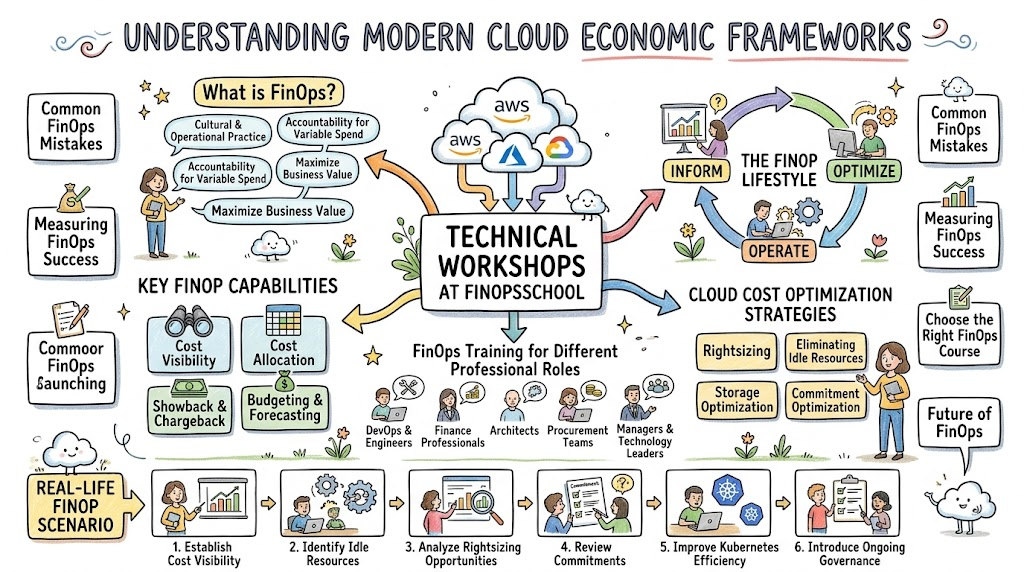
What Is FinOps?
FinOps, short for Cloud Financial Operations, is an evolving discipline and cultural practice that enables organizations to maximize business value by fostering collaboration between technology, finance, and DevOps teams. Unlike legacy cost-cutting programs that focus purely on slashing infrastructure budgets, FinOps creates a data-driven operating model where decentralized engineering teams make cost-aware architectural decisions without sacrificing delivery speed or operational agility. Engineering teams gain real-time visibility into their cloud spend, enabling them to optimize workload design and eliminate resource waste proactively. Finance professionals receive accurate allocation metrics for precise forecasting and budgeting, while procurement teams leverage clear usage trends to negotiate enterprise discounts and commitment-based savings. Executive leadership ultimately gains predictable cloud economics and full transparency, ensuring every infrastructure deployment yields measurable commercial returns.
The FinOps Lifecycle
Inform
The Inform phase establishes foundational visibility, ensuring organizations accurately understand their current spend, track cost allocation, and deliver real-time reporting to relevant stakeholders. Technology teams use detailed tags and subscriptions to allocate cloud expenses back to specific application owners, departments, and business units. By setting up automated anomaly detection, budget tracking, and usage trends, leadership can make proactive operational decisions before invoices arrive.
Optimize
The Optimize phase focuses on identifying efficiency gains and driving down unnecessary cloud expenses across multi-cloud environments. Engineering teams evaluate workload utilization to execute rightsizing actions, eliminate idle infrastructure, clear orphaned storage volumes, and refactor applications for serverless or containerized architectures. Simultaneously, finance and procurement teams leverage usage stability metrics to purchase commitment-based discounts like Reserved Instances and Savings Plans.
Operate
The Operate phase converts financial governance into a continuous organizational habit by embedding operational metrics directly into standard operational workflows. Cross-functional teams establish key performance indicators, monitor budget variances, and evaluate unit economics metrics alongside traditional system uptime dashboards. Automated policy enforcement rules prevent policy violations, ensure consistent tag compliance, and streamline cloud cost governance across all active cloud subscriptions.
Key FinOps Capabilities
Cost Visibility
Cost visibility gives multi-cloud enterprises real-time transparency into baseline cloud spend across complex AWS, Azure, and GCP architectures. By consolidating billing data into centralized operational dashboards, engineering managers, finance leaders, and platform teams gain immediate insights into daily spending spikes and resource utilization trends. Clear spend visibility ensures teams can proactively detect cost anomalies, validate architectural decisions, and verify that infrastructure investments align directly with expected business outcomes.
Cost Allocation
Cost allocation categorizes and attributes raw cloud provider charges directly to the specific teams, business units, environments, and applications responsible for generating them. Organizations enforce structured resource tagging policies, management groups, subscription boundaries, and project hierarchies to map shared cloud services cleanly. Accurate allocation eliminates unallocated overhead spend, establishes clear financial accountability among engineering leads, and creates the baseline metrics required for equitable internal showback or chargeback models.
Showback and Chargeback
Showback and chargeback models drive organizational accountability by visibly linking infrastructure consumption directly to operating team budgets. Showback delivers transparent reporting that informs engineering managers of their actual monthly cloud costs without directly transferring money from their operational budgets. Chargeback takes accountability further by formally billing internal business units for their specific resource consumption, encouraging software teams to write cost-efficient code, optimize infrastructure, and treat cloud expenses as a direct component of product profitability.
Budgeting and Forecasting
Effective cloud budgeting and forecasting require moving away from static annual projections and adopting dynamic, data-driven financial models that account for variable cloud consumption. Finance and engineering teams analyze historical billing data, seasonal demand spikes, business growth projections, and planned product releases to build accurate spending forecasts. Advanced predictive models account for upcoming workload migrations, planned commitment purchases, regional pricing differences, and potential architecture changes across AWS, Azure, and Google Cloud environments. By continuously comparing real-time spend against dynamic forecasts, organizations can detect unexpected cost overruns early, adjust allocation strategies mid-cycle, and preserve financial predictability without halting engineering innovation.
What Does FinOps Training Teach?
Structured educational programs teach technical and financial professionals how to build sustainable cloud cost management practices through hands-on technical skills and collaborative frameworks. Learners gain actionable expertise in cloud billing mechanics, taxonomy standards, metadata tagging enforcement, and advanced cost allocation across multi-cloud environments. Training curricula cover practical optimization methods, including compute rightsizing, storage tiering, commitment optimization strategies, anomaly detection setup, and automated governance policies using Infrastructure as Code tools. Additionally, participants learn how to build real-time executive dashboards, evaluate unit economics, track workload efficiency KPIs, and execute continuous cost optimization across enterprise container deployments and serverless architectures.
Cloud Cost Optimization Strategies
Rightsizing
Rightsizing aligns compute, memory, and storage configurations with actual operational workload demands to eliminate overprovisioning without impacting performance. Engineering teams analyze historical performance metrics, such as CPU utilization, RAM usage, and disk I/O, to downsize oversized virtual machines, databases, and container nodes. By leveraging automated autoscaling groups and modern instance families, technical teams ensure workloads scale dynamically based on real-time application traffic demands.
Eliminating Idle Resources
Eliminating idle resources removes unused, abandoned, or unattached cloud assets that quietly inflate monthly cloud bills without providing operational value. Operations teams use automated discovery tools to detect unattached storage volumes, old snapshots, idle development virtual machines, unused load balancers, and abandoned database instances. Implementing automated cleanup scripts and weekend schedule policies for non-production environments ensures organizations systematically eliminate waste before costs accumulate.
Storage Optimization
Storage optimization lowers cloud data costs by moving files, backups, and objects to appropriate storage tiers based on access frequency and lifecycle rules. Engineering teams establish automated lifecycle policies that move legacy data from high-performance block storage to low-cost object tiers, cold storage, or long-term deep archives. Implementing log retention limits, snapshot consolidation, and data deduplication ensures enterprises maintain compliance standards while substantially lowering overall storage expenditure.
Commitment Optimization
Commitment optimization leverages volume-discount models, such as AWS Savings Plans, Azure Reservations, and Google Cloud Committed Use Discounts, to lower baseline compute expenses. Finance and Cloud Center of Excellence teams analyze usage stability metrics to purchase flexible multi-year commitment contracts that yield significant savings compared to standard on-demand rates. Data-driven decision frameworks ensure commitments balance overall financial flexibility against utilization risks across fluctuating production workloads.
FinOps Across AWS, Azure and Google Cloud
Applying cost management practices across multi-cloud environments requires understanding the native management capabilities, billing metrics, and discount models of each major cloud service provider. While core FinOps principles remain consistent, AWS, Microsoft Azure, and Google Cloud offer distinct native tools, taxonomy structures, and commitment mechanisms that teams must navigate. Managing these variations requires standardized reporting rules that normalize raw cloud billing datasets into a single unified financial view.
| FinOps Area | AWS | Microsoft Azure | Google Cloud |
| Cost Analysis | AWS Cost Explorer & CUR | Azure Cost Management | GCP Cloud Billing Reports |
| Budgeting | AWS Budgets | Azure Budgets | GCP Billing Budgets |
| Cost Allocation | Cost Allocation Tags | Resource Tags & Management Groups | Labels & Projects |
| Commitment Options | Reserved Instances & Savings Plans | Azure Reservations & Savings Plans | Committed Use Discounts (CUDs) |
| Optimization | AWS Compute Optimizer | Azure Advisor | GCP Recommender |
FinOps and Kubernetes
Managing containerized infrastructure adds operational complexity to cloud financial oversight because multiple microservices share underlying compute nodes, memory pools, and network ingress. Standard cloud provider bills only display the baseline instance costs for the physical or virtual nodes hosting the cluster, obscuring which specific pod, deployment, namespace, or engineering team generates the spend. Technical teams must track internal resource requests, memory limits, CPU throttle rates, and node autoscaling metrics to allocate shared cluster costs accurately. Modern container cost tools provide container-level visibility, enabling platform engineers to optimize pod requests, rightsize node pools, utilize spot instances, and enforce workload efficiency without compromising system availability.
FinOps and Cloud Cost Optimization Are Not the Same Thing
Cloud cost optimization is a tactical engineering activity focused on reducing immediate cloud expenses by eliminating waste, rightsizing infrastructure, and purchasing discount commitments. FinOps is a broader operational methodology and cross-functional cultural practice that focuses on maximizing total business value from cloud investments rather than simply driving costs down. While cost optimization answers how to make a specific workload cheaper, FinOps evaluates whether spending more money on cloud infrastructure accelerates feature delivery, drives revenue growth, or increases market share. For example, a FinOps team might consciously approve a 20% increase in cloud compute spend if that infrastructure directly yields a 50% rise in processed customer transactions, directly demonstrating how financial management prioritizes business velocity over raw cost reduction.
FinOps Training for Different Professional Roles
- Cloud and DevOps Engineers: Learn how architectural design choices directly impact daily cloud spend, enabling them to build cost-aware CI/CD pipelines and automate rightsizing workflows.
- Finance Professionals: Master cloud billing structures, dynamic variable cost modeling, and accurate budget forecasting techniques to replace outdated legacy IT accounting models.
- Architects: Acquire deep visibility into multi-cloud pricing mechanics, enabling them to design cost-optimized, resilient, and scalable system architectures from day one.
- Procurement Teams: Gain data-driven insights into usage trends, enabling them to negotiate enterprise agreement terms and execute high-value commitment discount strategies.
- Managers and Technology Leaders: Develop strategic oversight frameworks to align engineering initiatives with corporate fiscal goals, drive team accountability, and prove cloud return on investment.
FinOps Certification vs. Practical Training
Pursuing formal certification validates a professional’s foundational knowledge of cloud financial concepts, operational frameworks, and standardized industry definitions. However, theoretical certification alone is insufficient for managing complex, real-world enterprise cloud environments with messy billing data and legacy workloads. Practical, hands-on training complements certification by exposing professionals to real cloud billing datasets, advanced tagging enforcement scripts, multi-cloud allocation challenges, and live optimization workflows. A comprehensive learning framework combines recognized certification preparation with practical scenario-based exercises, ensuring candidates build both industry credibility and the technical execution capabilities required by modern engineering organizations.
FinOps Practitioner Training
Practitioner-level training establishes a baseline understanding of foundational cloud financial operations concepts, core capabilities, and cross-functional collaboration frameworks. Suitable for finance managers, technology leads, procurement specialists, and junior cloud analysts, this learning path demystifies cloud billing terminology and governance models. Participants explore baseline cost allocation methods, fundamental budgeting concepts, showback reporting, and simple optimization strategies like compute rightsizing and commitment discounts. Mastering these fundamental concepts enables non-technical and technical team members to communicate effectively, analyze spending trends, and support ongoing cost accountability initiatives across their organizations.
FinOps Engineer Training
Technical professionals focus on the hands-on engineering side of cloud cost management, learning to build automated workflows that track, optimize, and govern cloud infrastructure. This training delves into querying raw cloud billing datasets, interacting with provider cost APIs, and configuring automated policy enforcement scripts using Infrastructure as Code tools. Engineers learn how to ingest container metrics, build custom Grafana or Cost Explorer dashboards, enforce tag compliance rules, and set up real-time anomaly alerts within DevOps deployment pipelines. By mastering automated rightsizing and programmatic governance, technical FinOps engineers systematically embed cost efficiency directly into modern cloud operations.
FinOps in Kubernetes and Modern Cloud Environments
Modern software platforms rely on microservices, serverless functions, managed cloud databases, and high-performance AI data pipelines, making cloud cost allocation increasingly complex. In Kubernetes environments, shared cluster resources require pod-level tracking to measure CPU requests, memory limits, and namespace usage accurately across distributed engineering teams. Beyond compute, serverless architectures charge based on execution time and event volume, while AI infrastructure and big data platforms incur rapid, volatile expenses driven by GPU utilization and massive network data transfers. Mastering cloud financial management across these advanced technologies requires specialized analytics tools, automated utilization tracking, and precise unit economics models that monitor operational efficiency in real time.
FinOps in Multi-Cloud Environments
Operating across AWS, Azure, and Google Cloud environments presents unique cost management challenges due to disparate billing formats, differing naming taxonomies, and distinct commitment models. Organizations must normalize raw billing data from multiple providers into a single unified schema to maintain consistent executive dashboards and cross-cloud financial visibility. While native cloud management tools work well within individual environments, multi-cloud strategy requires centralized cost allocation frameworks, uniform tagging policies, and standardized governance rules. By decoupling cost governance processes from provider-specific native tools, enterprise leadership can evaluate workload economics holistically and make informed, platform-agnostic cloud deployment decisions.
Choosing the Right FinOps Course
Selecting an effective educational program requires evaluating how well the curriculum aligns with real-world enterprise infrastructure challenges and career goals. Professionals should prioritize practical programs that offer hands-on exercises involving multi-cloud billing datasets, container cost allocation models, and automated policy implementation.
- Comprehensive coverage of AWS, Microsoft Azure, and Google Cloud billing ecosystems.
- Hands-on exercises involving raw cloud billing datasets, SQL querying, and custom dashboard creation.
- Practical training in Kubernetes cost allocation, container rightsizing, and shared infrastructure tracking.
- In-depth modules covering Reserved Instances, Savings Plans, and automated commitment lifecycle management.
- Instruction on Infrastructure as Code automation, budget alerts, and programmatic governance workflows.
- Preparation alignment for industry-recognized professional certifications and technical career advancement.
- Experienced instructors with verified backgrounds in corporate cloud financial management and DevOps execution.
FinOps Skills Comparison by Career Path
Different professional roles require distinct operational capabilities, technical competencies, and strategic focus areas to manage cloud financial operations effectively.
| Career Path | Core FinOps Skills | Useful Learning Focus |
| FinOps Practitioner | Cost visibility, baseline budgeting, stakeholder alignment | FinOps framework, showback models, cloud billing basics |
| FinOps Engineer | Billing API integration, automation, container allocation | SQL, Python, Infrastructure as Code, Kubernetes metrics |
| Finance Professional | Cloud cost modeling, forecasting, unit economics | Variable expense accounting, commitment ROI, budget tracking |
| Cloud Engineer | Workload rightsizing, idle resource cleanup, tagging | Compute optimization, storage tiering, automated schedules |
| DevOps Professional | Automated governance, CI/CD cost checks, policy enforcement | Terraform, cloud policy engines, cost anomaly alerts |
| Technology Manager | KPI tracking, cross-functional alignment, vendor review | Team cost accountability, spending reports, business ROI |
| Procurement Specialist | Contract negotiation, commitment tracking, discount modeling | Enterprise agreements, Savings Plans, vendor management |
| Technology Leader | Executive strategy, unit economics, cloud ROI alignment | Business value mapping, total cost of ownership modeling |
FinOpsSchool: Practical Learning for FinOps Skills
FinOpsSchool.com offers structured, hands-on educational courses designed to help technical professionals and enterprise teams build real-world competency in managing cloud economics. The practical curriculum covers core concepts across AWS, Azure, and Google Cloud, guiding students through billing data analysis, tagging enforcement, cost allocation frameworks, and showback reporting. Participants learn how to handle compute rightsizing, evaluate commitment-based discounts, design operational dashboards, and configure automated anomaly detection alerts. Through scenario-based exercises and multi-cloud case studies, the platform prepares engineers, finance leads, and DevOps specialists to establish continuous cost accountability and manage complex cloud environments effectively.
Benefits of FinOps Certification Training
Structured certification training establishes a comprehensive learning path that validates an individual’s technical expertise and operational understanding of cloud financial management. Preparing for recognized examinations ensures professionals thoroughly master core frameworks, standardized terminology, governance structures, and cross-functional operational processes. Beyond building personal technical credibility, formal training gives engineers and finance specialists the confidence required to lead enterprise cost management initiatives, negotiate vendor terms, and implement effective governance frameworks. When combined with practical, hands-on technical execution, certification significantly enhances career mobility, opening doors to high-demand roles across modern cloud-native enterprises.
Corporate FinOps Training
Customized corporate training programs help enterprises bridge operational silos between engineering, finance, procurement, and platform teams to build a unified culture of cloud cost accountability. Interactive team workshops focus on real-world organizational challenges, such as normalizing multi-cloud billing data, standardizing tagging taxonomies, and establishing equitable chargeback frameworks for shared infrastructure. Through guided cloud billing exercises, architectural rightsizing reviews, and container cost allocation case studies, cross-functional teams learn how to implement continuous governance rules without slowing product delivery. Upskilling internal teams ensures organizations accelerate overall cloud maturity, reduce annual cloud waste, and maximize the commercial return on technology investments.
FinOps Training in India
Technology professionals and enterprise teams across India are increasingly acquiring cloud financial management skills to support rapidly expanding multi-cloud architectures and global engineering operations. As organizations across software development, financial services, e-commerce, and IT consulting expand their AWS, Azure, and Google Cloud deployments, managing variable infrastructure costs has become an urgent operational priority. Developing expertise in cloud cost visibility, resource allocation, compute optimization, and automated governance enables Indian cloud engineers, DevOps leads, SREs, and IT managers to drive higher operational efficiency. Building these specialized capabilities positions local professionals for high-demand technical leadership roles both regionally and globally.
Individual Training vs Corporate DevSecOps Training
Individual learning paths focus primarily on building personal technical capabilities, preparing for professional certifications, mastering specific management tools, and driving career growth in cloud financial operations. In contrast, Corporate DevSecOps Training programs focus on aligning cross-functional teams around an organization’s specific technical architecture, internal governance requirements, and automated deployment pipelines. Enterprise training integrates financial security policies, automated compliance checks, and cost governance directly into existing CI/CD workflows and multi-cloud environments. While individual courses build foundational skills for single professionals, corporate initiatives focus on breaking down organizational silos, improving security maturity, and establishing consistent team-wide accountability across enterprise infrastructure.
Real-Life FinOps Scenario: Reducing Cloud Waste in a Growing Enterprise
CloudRetail, a fast-growing e-commerce platform, faced escalating monthly cloud invoices across AWS and Azure without clear insight into which application features were driving costs. Engineering teams spun up high-performance environments without standardized resource tags, leading to unassigned spending, overprovisioned Kubernetes clusters, and zero usage visibility for executive leadership.
Step 1: Establish Cost Visibility
The operations team implemented mandatory resource tagging policies across all AWS accounts and Azure subscriptions to map infrastructure spend directly to application owners and business units. Centralized visibility dashboards were created, giving engineering leads real-time insights into daily cost trends and unallocated system overhead.
Step 2: Identify Idle Resources
Engineers deployed automated cleanup scripts to detect and remove orphaned EBS storage volumes, obsolete database snapshots, unattached elastic IPs, and non-production development virtual machines left running during off-peak weekend hours.
Step 3: Analyze Rightsizing Opportunities
By reviewing 90 days of continuous CPU and memory utilization metrics, technical leads downsized overprovisioned EC2 instance families and container nodes to match actual workload performance needs without compromising application stability.
Step 4: Review Commitments
Finance and architecture leads analyzed baseline usage stability to purchase a mix of 3-year compute Savings Plans and Azure Reservations, reducing on-demand spending for predictable production workloads by 35%.
Step 5: Improve Kubernetes Efficiency
Platform engineers installed container cost analytics tools to track pod-level CPU and memory requests across shared EKS clusters, rightsizing resource requests and moving batch workloads to lower-cost spot instance pools.
Step 6: Introduce Ongoing Governance
CloudRetail established bi-weekly cost reviews between engineering, finance, and product managers to monitor budget variances, analyze unit economics metrics, and ensure new software deployments follow cost-aware design guidelines.
Executing these coordinated phases enabled CloudRetail to lower monthly cloud expenditure significantly while embedding continuous cost governance into standard engineering operations.
How FinOpsSchool Supports FinOps Learning
FinOpsSchool.com provides specialized training programs that help professionals and corporate teams develop real-world skills in cloud cost management and governance. The platform offers structured learning tracks, including general FinOps Training, certification preparation, and technical FinOps Engineer Training tailored for DevOps and platform teams. Participants gain practical experience managing AWS, Azure, and GCP billing data, implementing resource allocation strategies, building custom cost dashboards, and configuring Kubernetes cost allocation models. Through instructor-led sessions, corporate workshops, and hands-on case studies, the platform enables learners to turn theoretical concepts into actionable operational efficiency across multi-cloud environments.
Building a FinOps Career
Transitioning into a cloud financial management role allows engineers, finance specialists, architects, and IT managers to combine business strategy with technical cloud execution. Professionals entering the field typically build core competencies in cloud infrastructure fundamentals before expanding into advanced cost visibility, multi-cloud allocation mechanics, rightsizing strategies, and automated governance policy creation.
Cloud Fundamentals → FinOps Fundamentals → Cost Visibility → Cost Allocation → Optimization → Automation → Governance → Business Value
Succeeding in this evolving field requires mastering both technical implementation skills and cross-functional communication, enabling specialists to translate complex cloud billing data into clear commercial insights for business executives.
Measuring FinOps Success
Evaluating the maturity of a cloud financial practice requires tracking operational performance metrics beyond raw month-over-month infrastructure savings. Mature organizations monitor forecast accuracy, budget variance percentages, resource tagging coverage, and commitment utilization rates to measure financial predictability. Furthermore, teams measure unit economics KPIs, such as cost per active customer, cost per deployment, or cost per completed transaction, to evaluate architectural efficiency accurately. By linking cloud infrastructure spend directly to product sales and user growth, executive leadership can verify that expanding cloud investments drive measurable, scalable business value.
Common FinOps Mistakes
- Treating cost management as a one-time audit project rather than an ongoing operational habit leads to rapid cost regrowth as soon as initial cleanup activities conclude.
- Focusing exclusively on reducing total infrastructure spend without evaluating workload performance, system resilience, or business growth metrics can stall critical product engineering innovation.
- Failing to enforce mandatory, standardized tagging policies prevents finance teams from accurately allocating cloud costs back to specific business units or application owners.
- Purchasing multi-year compute commitments without consulting software architecture teams risks committing to outdated instance families that engineering plans to migrate away from.
- Managing cloud expenses entirely within isolated finance departments without engaging engineering leads leads to friction, unfulfilled optimization recommendations, and zero architectural accountability.
- Ignoring container-level cost tracking in Kubernetes environments results in massive unallocated spending hidden within generic compute node bills.
- Delaying anomaly detection setup leaves organizations vulnerable to accidental spending spikes caused by infinite code loops, unclosed test environments, or misconfigured autoscaling policies.
The Future of FinOps
As enterprise technology stacks expand into multi-cloud architectures, edge computing, managed data platforms, and artificial intelligence workloads, managing variable cloud spend will become increasingly complex. The rapid deployment of AI infrastructure, GPU clusters, and large language models introduces highly volatile, resource-intensive execution costs that demand real-time visibility and stringent financial oversight. Future cloud financial practices will heavily rely on automated machine learning models to predict spending anomalies, dynamically adjust commitment portfolios, and optimize resource requests in real time. Organizations that embed transparent cost visibility and automated financial governance into their technology management practices will maintain a decisive competitive advantage in managing next-generation cloud environments.
Frequently Asked Questions
1. What is the main purpose of cloud financial management?
The primary purpose of cloud financial management is to maximize the business value of cloud investments by aligning technology spending with strategic business goals. It fosters cross-functional accountability between engineering, finance, and executive leadership, enabling organizations to optimize infrastructure costs without sacrificing operational performance or innovation speed.
2. How does cloud cost optimization differ from traditional IT budgeting?
Traditional IT budgeting relies on predictable capital expenditures with fixed annual procurement cycles for physical hardware. Cloud cost optimization addresses variable operational expenditures, where decentralized engineering teams consume resources dynamically in real time, requiring continuous visibility, flexible forecasting, and real-time usage management.
3. Why do software engineers need to understand cloud financial practices?
Software engineers make architectural decisions that directly impact monthly infrastructure spend every time they provision virtual machines, configure databases, or deploy container clusters. Understanding cost efficiency enables engineers to design cost-aware systems, write optimized code, and select efficient infrastructure components without degrading application performance.
4. What role does tagging play in multi-cloud financial oversight?
Resource tagging attaches structured metadata labels to cloud assets, enabling organizations to categorize infrastructure by department, environment, project, and application owner. Precise tagging forms the foundation of accurate cost allocation, showback reporting, chargeback models, and automated policy governance across multi-cloud deployments.
5. How do organizations manage shared container costs in Kubernetes?
Organizations manage shared Kubernetes expenses by deploying specialized container analytics tools that monitor CPU requests, memory allocations, and namespace metrics at the pod level. This detailed granular tracking enables platform teams to attribute shared cluster node expenses accurately to specific microservices and development teams.
6. What is the difference between showback and chargeback models?
Showback provides business units with detailed spending reports to build cost awareness without actually deducting funds from their operating budgets. Chargeback formally transfers cloud infrastructure expenses directly to internal department budgets, establishing direct financial accountability for consumed resources.
7. How do compute commitment discounts reduce monthly cloud expenses?
Commitment discounts, such as AWS Savings Plans, Azure Reservations, and GCP Committed Use Discounts, offer discounted hourly rates in exchange for committing to a consistent level of compute usage over a one- or three-year period, significantly lowering baseline infrastructure spend.
8. Why is compute rightsizing an important cost management practice?
Rightsizing analyzes historical performance metrics to align instance sizes, CPU resources, and memory allocations with actual workload demands. Eliminating overprovisioned infrastructure allows organizations to lower monthly compute expenses substantially while maintaining required application performance and availability standards.
9. What core technical skills are required for a FinOps Engineer?
A technical engineer needs strong capabilities in cloud provider management consoles, SQL querying, billing APIs, Python or Bash scripting, Infrastructure as Code tools, Kubernetes resource metrics, and visualization platforms like Grafana or native cloud dashboards.
10. How do automated budget alerts help prevent unexpected cloud bills?
Automated budget alerts monitor daily infrastructure spend against pre-set threshold limits and projected usage trends, sending immediate notifications via email or Slack when costs spike unexpectedly, allowing engineering teams to resolve cost anomalies before invoices final.
11. Can small startup businesses benefit from structured cloud financial practices?
Yes, startups benefit significantly by building cost accountability into their engineering culture early, preventing unexpected infrastructure bills from depleting venture capital, optimizing resource consumption, and establishing predictable unit economics as user demand scales.
12. How does financial governance support multi-cloud deployment strategies?
Financial governance normalizes disparate billing datasets, pricing terms, and resource taxonomies from AWS, Azure, and Google Cloud into a unified reporting view, enabling leadership to evaluate workload efficiency and total cost of ownership across diverse cloud platforms objectively.
Conclusion
Cloud financial management has evolved from a niche administrative task into a vital business capability for modern, cloud-driven enterprises. By bringing together engineering, finance, procurement, and technology leadership, organizations can transform dynamic cloud spending into predictable, business-aligned value. Adopting a structured practice ensures that every dollar spent on multi-cloud infrastructure directly fuels feature innovation, enhances operational efficiency, and scales customer experiences. As public cloud environments become more complex with containerized workloads, serverless architectures, and AI systems, building strong cost governance capabilities becomes essential for maintaining long-term financial health. Technical professionals and organizations seeking to master these high-demand skills can explore dedicated training programs at FinOpsSchool to build practical expertise, drive cost transparency, and maximize return on cloud investments.
