Receiving a neurological diagnosis can be overwhelming for patients and families facing surgical care decisions. Navigating complex medical terminology, imaging reports, and potential surgical pathways requires careful, objective research before committing to any major procedure. Understanding your specific diagnosis, comparing available therapeutic approaches, and evaluating specialized clinical centers ensures that you make confident, informed choices about your care. Dedicated educational platforms like BrainSurgeryHospitals help simplify this clinical journey by organizing accessible healthcare information in one central location. Evaluating clinical expertise and seeking a professional second opinion empowers individuals to collaborate effectively with medical teams, ensuring that personal care plans align with established safety standards and clinical expectations.
What Are Brain Surgery Hospitals?
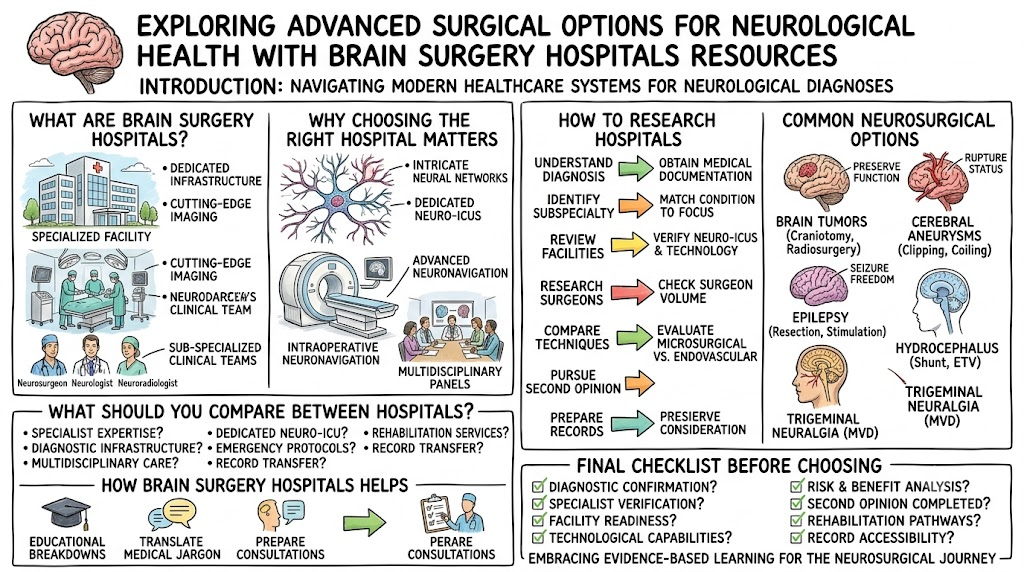
Specialized neurosurgery centers provide advanced diagnostic and surgical care for complex conditions affecting the brain, skull base, and central nervous system. These facilities bring together multidisciplinary teams of brain surgeons, neuro-oncologists, interventional neuroradiologists, critical care nurses, and specialized rehabilitation therapists to manage intricate neurological disorders. Because specific medical centers focus their resources on distinct subspecialties, such as skull-base surgery, vascular malformations, functional neurosurgery, or pediatric neuro-oncology, clinical capabilities vary across institutions. Patients must evaluate facilities based on their exact diagnosis rather than generalized surgical reputations to ensure access to the appropriate clinical technologies and dedicated neurosurgical intensive care units.
Why Choosing the Right Neurosurgery Hospital Matters
Neurosurgical procedures involve delicate neural structures, making specialized surgical experience and advanced institutional infrastructure essential factors for patient safety and procedural success. High-volume clinical centers equipped with intraoperative magnetic resonance imaging, advanced neuro-navigation, continuous electrophysiological monitoring, and dedicated neuro-intensive care units provide immediate medical intervention if perioperative complications arise. Hospital selection should focus on verified departmental case volumes, interdisciplinary tumor boards, and post-operative physical rehabilitation rather than marketing accolades. Confirming that a medical center maintains comprehensive emergency support and specialized subspecialty teams ensures safe, well-coordinated care throughout diagnosis, surgery, and post-operative recovery.
What Does BrainSurgeryHospitals.com Do?
BrainSurgeryHospitals.com serves as an independent healthcare research and educational platform designed to help patients navigate complex neurological conditions, treatment pathways, and institutional resources. The platform organizes publicly verifiable information about neurosurgical procedures, diagnostic testing methods, medical centers, and credentialed neurosurgeons without offering medical diagnoses, formal clinical evaluations, or therapeutic recommendations. Users can review educational guides to prepare for consultations, understand standard medical terminology, and assess various surgical methodologies before meeting with their physicians. By prioritizing accessible, non-promotional healthcare data, the resource enables families to formulate clear, practical questions for their specialists while maintaining realistic expectations regarding neurosurgical care.
How to Research Brain Surgery Hospitals
- Understand the primary diagnosis: Obtain and review all official pathology reports, diagnostic imaging discs, and physician summaries to clearly identify the structural characteristics of your condition.
- Identify subspecialty requirements: Match your confirmed clinical condition with dedicated neurosurgical subspecialties, such as cerebrovascular surgery, neuro-oncology, or functional neurosurgery.
- Review hospital technologies: Verify that prospective centers maintain intraoperative monitoring systems, high-resolution neuronavigation, dedicated neuro-intensive care beds, and advanced imaging suites.
- Assess surgical experience: Research board-certified brain surgeons to evaluate their specific procedural caseloads, subspecialty training, institutional affiliations, and clinical research focus.
- Evaluate multidisciplinary programs: Confirm that the hospital integrates physical therapy, occupational rehabilitation, neuro-oncology, neurology, and social work into standard recovery plans.
- Seek a neurosurgery second opinion: Consult an independent neurosurgeon to evaluate imaging, confirm the initial diagnostic conclusions, and explore alternative interventions.
- Organize documentation and questions: Prepare structured folders containing imaging records, clinical histories, current medications, and a list of questions for your surgeon.
Common Brain Surgery and Neurosurgical Treatment Options
| Condition / Situation | Possible Treatment Categories | Important Considerations |
| Brain Tumors (Gliomas, Meningiomas, Metastases) | Microsurgical resection, stereotactic radiosurgery, chemotherapy, targeted drug therapy, active surveillance | Tumor location, histology, preservation of motor and speech pathways, and multidisciplinary tumor board consensus. |
| Cerebral Aneurysms (Unruptured or Ruptured) | Surgical clipping, endovascular coiling, flow diversion, stent-assisted coiling | Aneurysm size, anatomical shape, neck morphology, rupture risk scores, and immediate neuro-intensive care access. |
| Drug-Resistant Epilepsy | Focal resective surgery, laser interstitial thermal therapy, responsive neurostimulation, vagus nerve stimulation | Comprehensive video-EEG monitoring, precise identification of the epileptogenic zone, and baseline cognitive status. |
| Trigeminal Neuralgia / Movement Disorders | Microvascular decompression, deep brain stimulation, stereotactic radiosurgical rhizotomy | Failed pharmacological trials, symptom severity, patient age, accurate structural localization on high-resolution MRI. |
| Hydrocephalus / Fluid Accumulation | Ventriculoperitoneal shunting, endoscopic third ventriculostomy | Underlying etiology, patient anatomy, risk of shunt dependency, infection monitoring, and regular imaging follow-ups. |
Brain Tumor Treatment
Modern brain tumor treatment plans balance complete lesion removal with the vital preservation of speech, motor, and cognitive neurological function. Multidisciplinary neuro-oncology teams assess tumor histology, genetic markers, anatomical accessibility, and patient health before recommending open microsurgical resection, stereotactic radiosurgery, systemically administered chemotherapy, or watchful observation. Complex interventions often utilize intraoperative cortical mapping and awake functional testing to minimize deficits while resecting abnormal tissue near critical brain structures. Patients diagnosed with benign or malignant lesions must discuss personalized therapeutic combinations with their neurosurgeons to establish realistic treatment timelines, rehabilitation goals, and long-term functional expectations.
Brain Aneurysm Surgery
Cerebral aneurysms require individualized evaluation to determine whether microsurgical clipping or minimally invasive endovascular techniques offer the safest anatomical correction. Open surgical clipping involves placing a specialized titanium clip across the base of the aneurysm, whereas endovascular coiling and flow-diverting stents seal the weakened arterial wall from within the bloodstream. Unruptured aneurysms are monitored or repaired based on size, location, family history, and growth rate, while ruptured aneurysms represent life-threatening medical emergencies that demand immediate critical care and intervention. Patients exploring elective treatment must consult experienced cerebrovascular teams to analyze vascular anatomy and determine appropriate preventative interventions.
Epilepsy Surgery
Surgical intervention serves as a viable therapeutic option for patients with drug-resistant epilepsy whose recurring seizures fail to respond to standard anti-seizure medications. Candidates undergo comprehensive pre-surgical evaluations involving continuous video-EEG monitoring, functional MRI, PET scans, and neuropsychological testing to map the exact epileptogenic focus. Depending on the seizure origin, surgical teams may recommend focal resections, laser interstitial thermal therapy, or neuromodulatory implants like responsive neurostimulation to reduce seizure frequency and severity. Because surgery is not universally suitable for every seizure disorder, comprehensive diagnostic evaluations confirm whether safe surgical margins can be achieved without harming baseline neurological function.
Minimally Invasive Brain Surgery
Minimally invasive neurosurgery utilizes narrow endoscopic instruments, stereotactic navigation, and targeted laser systems to access deep-seated intracranial pathology through smaller incisions. These advanced techniques reduce tissue disruption, lessen blood loss, and shorten post-operative hospital stays when treating specific skull-base tumors, pituitary lesions, and intraventricular abnormalities. However, minimally invasive approaches carry standard surgical risks and remain unsuitable for widespread lesions, extensive vascular malformations, or large tumors requiring broad microsurgical exposure. Candidacy depends entirely on anatomical positioning, tumor characteristics, and the surgeon’s specialized technical training rather than patient convenience alone.
What Should You Compare Between Hospitals?
| Comparison Factor | Questions Patients Should Ask |
| Surgical Specialization & Volume | How many procedures of this specific type does the neurosurgeon perform each year? |
| Advanced Intraoperative Facilities | Does the facility utilize intraoperative MRI, neuro-navigation, and continuous neuromonitoring? |
| Multidisciplinary Tumor Boards | Is every patient case reviewed collaboratively by neuro-oncologists, radiologists, and surgeons? |
| Neuro-Intensive Care Infrastructure | Does the hospital have a dedicated neuro-ICU staffed by board-certified neuro-intensivists? |
| Post-Operative Rehabilitation | Are inpatient neurological physical, occupational, and speech therapies available immediately on-site? |
| Second-Opinion Support | Does the clinical department facilitate easy transfer and external review of diagnostic imaging data? |
| Emergency Neurological Coverage | Are cerebrovascular teams and operating suites accessible around the clock for acute complications? |
How BrainSurgeryHospitals.com Can Help With Research
BrainSurgeryHospitals.com provides accessible educational overviews, structural comparisons, and procedural guides to help individuals research complex neurological care options objectively. Patients can use the platform after receiving a new diagnosis to clarify unfamiliar medical terms, understand surgical procedures, and discover pertinent questions for clinical discussions. The directory helps users learn about institutional capabilities, subspecialty divisions, and technological advancements without replacing direct professional clinical assessments. By serving as an organized educational resource, the platform enables families to prepare for consultations, arrange their diagnostic records, and make informed choices throughout their medical journeys.
Real-Life Scenario: Researching a Brain Tumor
Consider an adult patient who receives an unexpected diagnosis of a low-grade glioma after experiencing intermittent headaches and localized sensory changes. Rather than selecting the nearest local hospital, the patient gathers all digital MRI scans, official radiology reports, and clinical notes to seek specialized neuro-oncological care. Using educational resources to understand the role of intraoperative cortical mapping and awake craniotomies, the patient prepares detailed questions regarding functional speech preservation. Seeking a second opinion at a dedicated brain tumor surgery hospital confirms the surgical boundaries, helping the family understand recovery protocols, post-surgical monitoring schedules, and rehabilitation needs before moving forward.
How to Use BrainSurgeryHospitals.com Responsibly
Patients should utilize online educational platforms as supplementary research tools designed to foster productive, informed dialogues with their personal healthcare providers. Readers can begin by researching their specific diagnosis, clarifying terminology regarding surgical techniques, and noting facility considerations outlined in procedural guides. This educational material must never be used for self-diagnosis, emergency assessment, or as a substitute for professional clinical treatment plans developed by licensed physicians. Patients should organize their digital radiology discs, pathology reports, and symptom logs to review online findings with qualified neurosurgical specialists.
What, Why and How Framework
| Phase | Core Clinical Focus | Practical Patient Action |
| WHAT: Define the Condition | Accurate identification of pathology, structural staging, and anatomical location. | Collect all imaging scans, laboratory results, and primary specialist summaries. |
| WHY: Assess Clinical Rationale | Understanding the risks of non-intervention versus surgical and medical therapies. | Discuss treatment goals, expected outcomes, and procedural risks with clinicians. |
| HOW: Evaluate Provider Options | Identifying hospitals equipped with specialized subspecialty teams and technologies. | Compare surgical volumes, multidisciplinary programs, and neuro-ICU facilities. |
| REVIEW: Seek a Second Opinion | Validating initial diagnostic findings, margins, and treatment recommendations. | Consult an independent specialist to review imaging and confirm surgical approaches. |
| DECIDE: Finalize Treatment Plan | Establishing informed consensus with the primary neurosurgical team. | Select the appropriate surgical or conservative pathway based on clinical advice. |
| FOLLOW-UP: Plan for Recovery | Managing long-term rehabilitation, functional recovery, and routine surveillance. | Coordinate physical therapy, follow-up imaging schedules, and post-operative care. |
Final Checklist Before Choosing a Neurosurgery Provider
- Confirm that the definitive diagnosis, pathology staging, and imaging interpretations are verified by qualified specialists.
- Verify that the selected neurosurgeon is board-certified, subspecialty-trained, and experienced in your specific condition.
- Ensure the chosen hospital features a dedicated neuro-intensive care unit staffed by certified neuro-intensivists.
- Discuss every available surgical and non-surgical alternative, including observation, stereotactic radiosurgery, and medical therapy.
- Review potential intraoperative risks, expected neurological deficits, and anticipated recovery timelines with your surgical team.
- Obtain a formal second opinion from an independent neurosurgeon to evaluate imaging and confirm the recommended procedure.
- Organize all physical and digital medical records, including baseline MRI/CT scans, blood panels, and current medications.
- Establish a structured post-operative recovery plan incorporating physical, occupational, or speech therapy services if required.
Real-Life Scenarios and Experiences
- Evaluating an Unruptured Aneurysm: A patient diagnosed with an incidental cerebral aneurysm consults both open neurovascular surgeons and endovascular specialists. By reviewing anatomical morphology, rupture statistics, and stent-assisted coiling techniques, the patient makes an informed decision focused on minimally invasive management.
- Managing Drug-Resistant Seizures: A young adult experiencing persistent temporal lobe seizures undergoes comprehensive inpatient video-EEG mapping at a comprehensive epilepsy center. The resulting surgical resection stops seizure activity while preserving memory and baseline cognitive functions.
- Addressing Spinal Cord Compression: An individual facing severe cervical myelopathy reviews multiple surgical approaches, weighing anterior versus posterior decompression. Seeking a second opinion clarifies the optimal stabilization technique, preventing permanent neurological deficits through timely intervention.
Common Mistakes to Avoid
- Relying Exclusively on General Rankings: Broad hospital marketing rankings often fail to reflect the depth of specialized subspecialty neurosurgical departments.
- Prioritizing Proximity Over Expertise: Choosing a local general hospital rather than traveling to a dedicated high-volume neurosurgical center can limit access to advanced technologies.
- Overlooking Non-Surgical Pathways: Failing to discuss radiosurgery, targeted systemic therapy, or active surveillance can lead to unnecessary or premature surgical procedures.
- Neglecting Second Opinions: Skipping an independent review of imaging and pathology reports increases the risk of misdiagnosis or selecting suboptimal surgical approaches.
- Believing Guarantees of Outcome: Trusting medical providers or commercial platforms that promise risk-free procedures can create dangerous and unrealistic clinical expectations.
- Delaying Emergency Treatment: Spending critical time browsing web pages during acute neurological emergencies, like stroke or aneurysm rupture, delays life-saving interventions.
How to Prepare for a Neurosurgery Consultation
Arriving prepared for a clinical consultation helps maximize the value of your discussion with the neurosurgical team. Patients should bring physical compact discs containing high-resolution MRI and CT scans, printed official radiology reports, recent laboratory results, pathology slides, a comprehensive list of all prescription medications, and a chronological history of symptoms. During the meeting, ask direct questions regarding the surgeon’s annual procedural volume, the specific risks associated with the tumor or lesion location, expected post-operative recovery milestones, and potential non-surgical management alternatives.
Frequently Asked Questions
1. How do I know if I need brain surgery?
The necessity of brain surgery depends entirely on comprehensive diagnostic imaging, symptomatic presentation, and clinical evaluations conducted by qualified neurosurgeons. Conditions such as aggressive brain tumors, ruptured aneurysms, progressive neurological deficits, or medically refractory epilepsy frequently require surgical evaluation. Non-surgical alternatives like observation or targeted radiotherapy are often prioritized when lesions are stable and asymptomatic.
2. What questions should I ask a brain surgeon?
Patients should ask about the surgeon’s specific board certifications, fellowship training, and annual procedural volume for their exact condition. Inquire about the goals of the surgery, potential risks to motor or speech functions, expected hospitalization duration, and whether non-surgical options exist. Clarifying post-operative rehabilitation needs and emergency coverage protocols is also essential.
3. What is the difference between a neurologist and a neurosurgeon?
A neurologist specializes in diagnosing, evaluating, and managing neurological disorders using pharmacological treatments, lifestyle adjustments, and non-surgical therapies. A neurosurgeon is a surgical specialist trained to perform operative procedures on the brain, spine, and peripheral nervous system. Both specialists frequently collaborate within multidisciplinary teams to manage complex conditions like epilepsy and movement disorders.
4. Why should I get a neurosurgery second opinion?
Seeking an independent second opinion confirms the initial diagnosis, validates the surgical necessity, and exposes patients to alternative procedural approaches like minimally invasive techniques. Different neurosurgeons may have distinct subspecialty experience that influences their recommended management strategy. A second consultation provides peace of mind and ensures treatment plans align with established medical safety standards.
5. What are the main risks of brain surgery?
Potential complications depend on the location of the lesion and include infection, intracranial bleeding, cerebrospinal fluid leaks, post-operative seizures, and temporary or permanent neurological deficits. Advanced surgical technologies like intraoperative monitoring and neuro-navigation help minimize these risks. Your surgical team will evaluate your personal health factors to determine individual risk levels.
6. How long is the typical recovery period after neurosurgery?
Recovery timelines vary widely depending on the complexity of the procedure, the patient’s baseline health, and whether minimally invasive or open techniques were utilized. Hospital stays range from one to two days for minor procedures to over a week for complex craniotomies. Full functional recovery and return to normal activities often require several weeks to months of guided rehabilitation.
7. What makes a hospital a specialized neurosurgery center?
Dedicated neurosurgery centers feature specialized diagnostic imaging, intraoperative navigation, high-resolution surgical microscopes, dedicated neuro-intensive care units, and experienced multidisciplinary clinical teams. These facilities maintain high annual case volumes and offer 24/7 coverage from specialized neuro-intensivists and cerebrovascular teams. They also integrate comprehensive inpatient rehabilitation services into daily recovery protocols.
8. Is minimally invasive brain surgery safer than traditional open surgery?
Minimally invasive neurosurgery can reduce incision size, blood loss, tissue disruption, and post-operative recovery times for appropriately selected anatomical conditions. However, it is not inherently risk-free and cannot replace open craniotomies for broad, vascular, or highly complex tumors. Safety and efficacy depend entirely on accurate patient selection, tumor location, and specialized surgical expertise.
9. What medical records do I need for a neurosurgical evaluation?
Patients should bring digital copies of all recent MRI and CT scans on CD or flash drive, accompanying official radiology reports, and biopsy pathology slides. Additionally, provide a complete list of current medications, relevant laboratory results, past surgical summaries, and a detailed chronological record of neurological symptoms to ensure a thorough assessment.
10. Can benign brain tumors require surgical removal?
Yes, non-cancerous or benign brain tumors like meningiomas and acoustic neuromas often require surgical resection if they compress vital brain structures, impair cranial nerves, or cause mass effect. Even non-malignant growths can elevate intracranial pressure and cause significant neurological deficits if left untreated. Treatment depends on the tumor’s growth rate, size, and anatomical accessibility.
11. What is the role of an awake craniotomy?
Awake craniotomies are specialized surgical procedures performed while the patient is conscious to map and protect critical speech, motor, and cognitive pathways in real time. The surgical team communicates with the patient during tumor resection near functional brain areas to prevent permanent neurological damage. Local anesthesia ensures the patient remains comfortable and pain-free throughout the functional mapping.
12. How should I prepare my home for post-surgical recovery?
Prepare your living environment by removing tripping hazards, installing safety rails in bathrooms, arranging ground-floor sleeping accommodations, and stocking easy-to-prepare nutritious meals. Ensure clear pathways for mobility aids and designate a family member or caregiver to assist with daily activities and medication schedules. Keep emergency clinical contact numbers easily accessible at all times.
Conclusion
Navigating complex neurological care requires patients and families to approach diagnostic findings, treatment modalities, and institutional options with thorough research and clear clinical guidance. Evaluating specialized centers, understanding advanced surgical technologies, and obtaining independent second opinions empower individuals to make well-informed decisions tailored to their specific conditions. Educational healthcare resources like BrainSurgeryHospitals.com support this process by providing structured, accessible information that helps patients organize records and prepare detailed questions for their specialists. Ultimately, collaborative discussions with credentialed neurosurgeons ensure treatment plans prioritize patient safety, preserve vital neurological function, and support successful long-term recovery.
