Introduction
Receiving a neurological diagnosis can feel overwhelming, especially when surgical intervention becomes a serious consideration. Patients and their families frequently face unfamiliar terminology, complex imaging reports, and difficult medical decisions while navigating an unfamiliar healthcare landscape. Under these circumstances, understanding the exact nature of a condition, available clinical pathways, and specialist expertise becomes essential before committing to any major procedure. Gathering clear information about medical facilities, surgical approaches, and multidisciplinary teams helps families make thoughtful, well-informed choices rather than rushed selections during stressful moments. By exploring structured healthcare resources, organizing medical records early, and considering independent clinical assessments, individuals can evaluate their options with clarity. Dedicated platforms like BrainSurgeryHospitals help bridge this information gap by providing educational resources and structured directories for medical research.
What Are Brain Surgery Hospitals?
Specialized neurosurgical medical centers focus on the diagnosis, comprehensive management, and surgical intervention of complex conditions affecting the brain, skull base, spinal cord, and central nervous system. These facilities bring together dedicated neurosurgical operating suites, advanced intraoperative imaging systems, neurological intensive care units, and outpatient consultation clinics under one coordinated healthcare system. Within these institutions, dedicated subspecialists collaborate closely, including vascular neurosurgeons, neuro-oncologists, functional neurosurgeons, neuroradiologists, neuropathologists, and specialized neuro-anesthesiologists to deliver tailored clinical pathways. Because specific hospitals often build distinct clinical expertise in targeted subfields—such as skull-base surgery, complex cerebrovascular malformations, or pediatric neurological disorders—matching a patient’s exact diagnosis to a facility’s established area of focus ensures optimal clinical alignment.
Why Choosing the Right Neurosurgery Hospital Matters
Neurosurgical procedures involve delicate, highly eloquent neural tissues where surgical precision, specialized equipment, and institutional experience directly influence functional recovery and long-term quality of life. Facilities with dedicated neurosurgical volume maintain high-resolution diagnostic capabilities, advanced intraoperative neuronavigation tools, continuous intraoperative neurophysiological monitoring, and dedicated neuro-critical care units staffed continuously by specialized intensivists. Furthermore, effective brain care extends beyond the operating room through integrated multidisciplinary tumor boards, prompt emergency intervention services, and dedicated neurological rehabilitation programs that help patients regain cognitive and motor skills. Relying solely on general hospital reputation or broad regional marketing can overlook whether a facility possesses deep case experience in the specific neurological condition being treated.
What Does BrainSurgeryHospitals.com Do?
Operating as an independent healthcare educational and research directory, this informational platform assists patients, families, and caregivers in exploring neurological conditions, surgical techniques, diagnostic imaging, and clinical service providers. Users can research medical terminology, review treatment categories, browse hospital profiles, learn about specialist qualifications, and access comprehensive patient-education guides before attending clinical consultations. The platform serves as a research directory that organizes publicly accessible, attributable medical information, allowing individuals to prepare meaningful questions and better comprehend complex recommendations made by their doctors. The resource does not provide medical diagnoses, offer clinical treatment, deliver subjective doctor rankings, or replace the direct evaluation and individualized medical judgment of licensed physicians.
How to Research Brain Surgery Hospitals
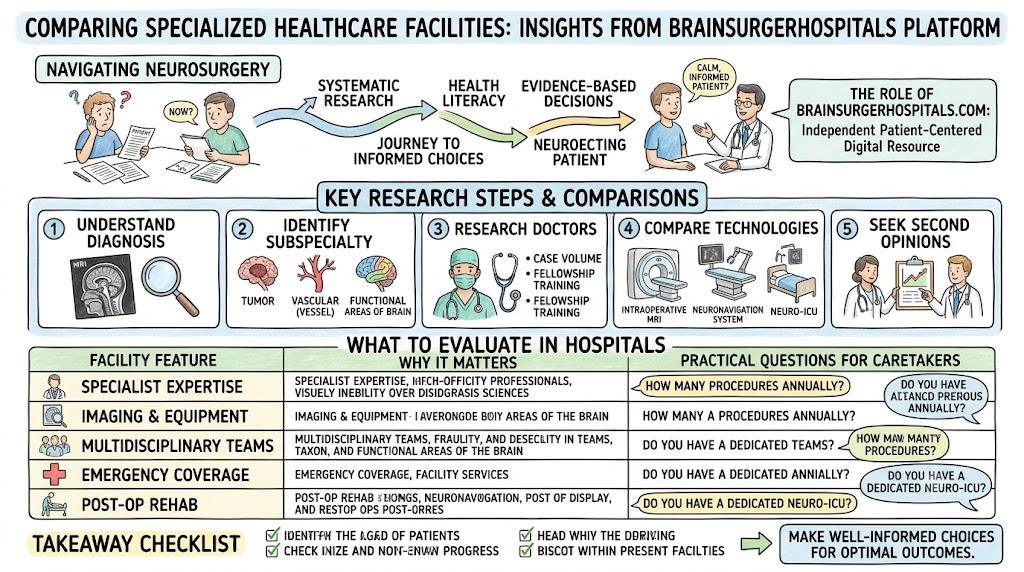
Conducting a structured evaluation of healthcare facilities requires a methodical, step-by-step approach that moves from individual medical understanding to practical provider comparison:
- Clarify the Initial Diagnosis: Obtain complete copies of recent MRI or CT imaging, official radiology reports, and pathology findings to understand the exact anatomical location, size, and characteristics of the condition.
- Identify the Relevant Neurosurgical Subspecialty: Determine whether the condition requires a specialist in neuro-oncology, cerebrovascular neurosurgery, functional neurosurgery, skull-base surgery, or pediatric neurosurgery.
- Evaluate Hospital Infrastructure and Technology: Confirm the facility possesses specialized neuro-intensive care units, 24/7 neuroradiology access, intraoperative monitoring, and dedicated neurological emergency services.
- Investigate Specialist Experience: Review the neurosurgeon’s board certifications, fellowship training, and institutional case volumes related specifically to your precise condition.
- Compare Recommended Treatment Approaches: Examine whether the proposed plan involves open microsurgery, minimally invasive endoscopic techniques, stereotactic radiosurgery, or non-surgical watchful waiting.
- Seek an Independent Clinical Assessment: Arrange a comprehensive second opinion with an unaffiliated specialist to confirm the diagnostic accuracy and evaluate potential alternative approaches.
- Organize Medical Records and Consultation Questions: Compile all digital imaging discs, historical treatment summaries, and a prioritized list of practical questions regarding surgical risks and recovery timelines.
Common Brain Surgery and Neurosurgical Treatment Options
Neurosurgical care encompasses a wide range of open surgical, endovascular, and minimally invasive techniques tailored to the specific anatomical location and severity of the patient’s condition.
| Condition or Scenario | Primary Treatment Approaches | Key Clinical Considerations |
| Brain Tumors (Gliomas, Meningiomas, Metastases) | Surgical resection, biopsy, stereotactic radiosurgery, chemotherapy | Tumor grade, proximity to eloquent brain regions, functional preservation |
| Cerebral Aneurysms | Microsurgical clipping, endovascular coiling, flow diversion | Rupture status, aneurysm neck anatomy, patient age, vascular geometry |
| Drug-Resistant Epilepsy | Resective surgery, laser interstitial thermal therapy, neuromodulation (VNS/RNS) | Concordance of EEG and MRI data, seizure focus localization, neuropsychological impact |
| Hydrocephalus and Cysts | Ventriculoperitoneal (VP) shunting, endoscopic third ventriculostomy (ETV) | Patient age, underlying etiology, cerebrospinal fluid dynamics, infection risk |
| Pituitary Adenomas and Skull Base Lesions | Endoscopic endonasal resection, transsphenoidal surgery, radiation | Endocrine function, visual pathway decompression, skull base reconstruction |
Modern neurosurgery focuses on balancing the maximum therapeutic removal or correction of a lesion with the absolute preservation of motor, sensory, and cognitive functions.
Brain Tumor Treatment
Treatment strategies for brain neoplasms depend heavily on whether a tumor is benign or malignant, its histological classification, its molecular markers, and its proximity to critical brain structures that govern speech, vision, or movement. While surgical resection remains a primary initial step to relieve intracranial pressure and obtain tissue for precise pathological analysis, a biopsy alone may be selected if the lesion resides in deep, delicate brain tissue. Beyond surgery, comprehensive treatment pathways often integrate focused stereotactic radiation, targeted systemic medications, immunotherapy, or clinical observation through regular high-resolution imaging scans for slow-growing, asymptomatic lesions. Multidisciplinary neuro-oncology teams conduct regular case reviews to balance maximal tumor control against the preservation of fundamental neurological and cognitive function.
Brain Aneurysm Surgery
A cerebral aneurysm represents a weakened, bulging area in the wall of an intracranial artery that carries a risk of rupture, potentially causing a life-threatening subarachnoid hemorrhage. Treatment decisions depend on whether the aneurysm is intact or ruptured, its physical dimensions, its structural shape, and its specific anatomical location within the cerebral vasculature. Open microsurgical clipping involves placing a small titanium clip across the aneurysm neck via a craniotomy to prevent blood flow from entering the weakened sac, while endovascular techniques insert soft platinum coils or flow-diverting stents through a catheter inside the blood vessels. Because unruptured aneurysms may sometimes be safely monitored, decisions must be thoroughly personalized based on individual rupture risk models; any sudden, severe headache requires immediate emergency medical evaluation.
Epilepsy Surgery
Surgical evaluation becomes a viable consideration for patients diagnosed with drug-resistant epilepsy, defined clinically as the failure of two or more appropriately chosen and tolerated anti-seizure medications to achieve sustained seizure freedom. Before considering an operation, patients undergo extensive pre-surgical assessments, including continuous video-electroencephalogram monitoring, functional MRI, high-resolution structural neuroimaging, PET scans, and detailed neuropsychological evaluations to isolate the exact epileptogenic zone. Surgical techniques may include focused focal resections, laser interstitial thermal therapy to ablate seizure foci, or the implantation of neurostimulation devices that disrupt abnormal electrical activity. Because surgical intervention is not clinically appropriate for every individual with seizures, candidates require comprehensive evaluation by a multidisciplinary team within a dedicated epilepsy center.
Minimally Invasive Brain Surgery
Advancements in optical engineering, high-definition camera systems, and stereotactic neuronavigation have expanded the role of minimally invasive neurosurgical approaches for select intracranial conditions. Techniques such as endoscopic endonasal surgery access skull base and pituitary lesions naturally through the nasal corridors, while stereotactic laser ablation utilizes tiny thermal probes through small incisions to treat deep-seated lesions under real-time magnetic resonance guidance. Although these approaches can reduce soft-tissue trauma, decrease postoperative discomfort, and shorten initial hospital stays, they remain complex surgical procedures that carry inherent neurological risks. Suitability depends entirely on the underlying pathological diagnosis, the specific anatomical location of the lesion, and the specialized technical expertise of the surgical team.
What Should You Compare Between Hospitals?
Selecting an appropriate neurosurgical care provider requires evaluating both technical capabilities and broader institutional support structures to ensure comprehensive care.
| Evaluation Factor | Critical Questions for Patients to Ask |
| Surgical Case Volume | How many procedures for this exact condition does the neurosurgeon perform annually? |
| Diagnostic Technology | Does the facility utilize advanced intraoperative MRI, CT, and continuous neurological monitoring? |
| Multidisciplinary Structure | Are patient cases routinely evaluated by integrated tumor boards or multidisciplinary panels? |
| Critical Care Capabilities | Is there a dedicated neuro-intensive care unit staffed 24/7 by fellowship-trained neuro-intensivists? |
| Postoperative Rehabilitation | Does the hospital offer integrated acute inpatient physical, occupational, and speech therapy? |
| Second-Opinion Support | Does the clinical team provide clear, structured sharing of digital imaging and medical records? |
| Communication and Follow-Up | How does the care team handle postoperative questions, recovery milestones, and emergency concerns? |
Careful comparison of these parameters helps patients assess whether a hospital possesses the comprehensive resources required to manage their specific neurological condition effectively.
How BrainSurgeryHospitals.com Can Help With Research
Navigating a new neurological diagnosis requires reliable, organized educational resources that assist families in moving from confusion to informed engagement with their clinical care teams. The platform helps patients research medical terms, explore the mechanics of different surgical and non-surgical procedures, and understand the roles of various clinical specialists involved in neurosurgical care. By reading structured hospital and provider directories, individuals can evaluate potential treatment facilities, organize their medical documentation, and prepare targeted lists of practical questions for upcoming surgical consultations. The platform is designed solely to support independent healthcare research and facilitate second-opinion planning; it does not replace individualized diagnostic workups, in-person clinical examinations, or direct medical treatment provided by licensed healthcare professionals.
Real-Life Scenario: Researching a Brain Tumor
A patient presenting with persistent localized headaches and mild cognitive changes undergoes an outpatient brain scan that reveals an unexpected intracranial mass. Rather than immediately scheduling an operation at the nearest general medical clinic, the patient and their family collect all digital DICOM imaging discs and detailed diagnostic reports to systematically review the findings. They research specialized neuro-oncology centers that maintain high surgical volumes for that specific anatomical region, identifying board-certified neurosurgeons experienced in intraoperative functional brain mapping. After formulating a structured list of questions regarding functional preservation, surgical approaches, and recovery expectations, they obtain an independent second opinion to confirm the initial surgical strategy before making their final care decision.
How to Use BrainSurgeryHospitals.com Responsibly
Using online healthcare directories effectively requires maintaining a clear understanding of how informational research integrates with professional clinical guidance:
- Establish Baseline Medical Facts: Begin your research using the exact diagnostic terminology, anatomical descriptions, and staging provided in your official medical records.
- Learn Core Neurological Terminology: Use educational articles to understand standard procedures, imaging modalities, and clinical terms before attending medical appointments.
- Explore Categorized Treatment Options: Review various established surgical, radiation, and medical pathways to understand the broader landscape of modern neurological care.
- Identify Appropriate Subspecialists: Look up regional and specialized institutions equipped with the specific technology, clinical volume, and multidisciplinary teams needed for your diagnosis.
- Organize Records for Clinical Review: Consolidate your digital imaging scans, pathology slides, surgical history, and lab results in an accessible format for specialist evaluation.
- Formulate Focused Discussion Topics: Prepare a written list of specific questions regarding surgical risks, alternatives, expected hospital stays, and rehabilitation protocols.
- Consult Licensed Medical Professionals: Always discuss all gathered information, treatment ideas, and facility options directly with qualified clinicians before making healthcare decisions.
What, Why and How Framework
A structured framework guides patients through the critical phases of neurosurgical decision-making, helping them maintain organization from diagnosis through postoperative care.
| Decision Stage | Core Focus Area | Practical Action Step |
| WHAT to Research | Precise diagnostic classification and anatomical lesion location | Collect official radiology reports and digital MRI/CT imaging discs |
| WHY It Matters | Neurosurgical precision and experience directly affect neurological recovery | Match your condition with specialists possessing verified case volume |
| HOW to Compare | Hospital technology, surgical approaches, and multidisciplinary care | Evaluate neuro-ICU facilities, intraoperative tools, and specialist credentials |
| REVIEW (Second Opinion) | Independent diagnostic confirmation and treatment alternative analysis | Consult an unaffiliated neurosurgeon to compare proposed surgical plans |
| DECIDE with Clinicians | Finalizing the personalized clinical and surgical pathway | Discuss risks, benefits, and functional preservation with your surgical team |
| FOLLOW-UP and Recovery | Postoperative neuro-rehabilitation and long-term surveillance imaging | Establish structured timelines for physical therapy and follow-up scans |
Using this sequential model helps patients systematically navigate complex clinical choices, ensuring every phase of care is thoroughly evaluated and planned.
Final Checklist Before Choosing a Neurosurgery Provider
Before committing to a proposed neurosurgical procedure, patients and caregivers should review a practical checklist to confirm all essential clinical and logistical elements have been addressed:
- Diagnostic Confirmation: You possess a clear understanding of your precise medical diagnosis, anatomical lesion location, and formal imaging interpretations.
- Specialist Credentials: Your neurosurgeon is board-certified, fellowship-trained in the relevant subspecialty, and regularly performs procedures for your specific condition.
- Facility Capabilities: The hospital has a dedicated neurosurgical intensive care unit, advanced intraoperative imaging, and 24/7 specialized neurological nursing support.
- Treatment Understanding: You understand the proposed surgical approach, the primary objectives of the operation, and any non-surgical alternatives available.
- Risk and Benefit Analysis: Your surgical team has clearly explained the potential risks, complications, and anticipated functional outcomes of the procedure.
- Second-Opinion Review: You have considered or completed an independent second opinion to validate the diagnosis and proposed surgical strategy.
- Record Consolidation: All relevant diagnostic imaging files, medical records, and pathology slides have been organized and securely shared with your care providers.
- Rehabilitation and Recovery Plan: A concrete postoperative plan is in place for inpatient or outpatient physical, occupational, and speech therapy as needed.
Real-Life Scenarios / Experiences
Careful research across diverse neurological conditions illustrates how structured preparation and specialized evaluations lead to well-considered treatment decisions:
- Evaluating an Unruptured Aneurysm: An individual discovered an asymptomatic cerebral aneurysm during an evaluation for sinus pain; by consulting both a cerebrovascular neurosurgeon and an endovascular interventionalist, they weighed microsurgical clipping against flow diversion before choosing endovascular treatment based on their specific vascular anatomy.
- Addressing Drug-Resistant Seizures: A patient experiencing persistent seizures despite multiple medications sought evaluation at a comprehensive epilepsy center, where long-term video-EEG monitoring and functional imaging determined they were a candidate for minimally invasive laser ablation of an isolated seizure focus.
- Navigating a Skull Base Lesion: A patient diagnosed with a benign pituitary tumor consulted an interdisciplinary skull-base team consisting of a rhinologist and a neurosurgeon, who successfully planned a collaborative endoscopic endonasal resection to preserve vision while minimizing soft-tissue disruption.
Common Mistakes to Avoid
Navigating neurosurgical care requires objective decision-making; avoiding these common research pitfalls helps protect patient health and ensures realistic care expectations:
- Relying Exclusively on General Rankings: Choosing a facility based solely on broad commercial hospital rankings rather than evaluating the specific volume and expertise of the neurosurgical subspecialty team.
- Prioritizing Cost Over Appropriate Care: Making complex surgical decisions based primarily on low financial quotes rather than the clinical capabilities and critical care infrastructure of the medical center.
- Searching Solely by Procedure Name: Focusing exclusively on a single surgical buzzword rather than determining whether that specific technique is anatomically appropriate for your diagnosis.
- Dismissing Non-Surgical Alternatives: Overlooking conservative medical management, targeted radiation, or watchful waiting when surgery may not be immediately necessary or optimal.
- Neglecting to Consolidate Complete Records: Attending high-level surgical consultations without high-resolution digital imaging discs, previous operative reports, or formal pathology documents.
- Believing Guaranteed Outcome Claims: Trusting promotional statements that promise risk-free operations or complete cures, as all neurosurgical interventions carry inherent clinical risks.
- Treating Directory Listings as Medical Endorsements: Assuming that the presence of a doctor or hospital on an educational directory constitutes an individualized clinical recommendation.
- Delaying Emergency Care for Research: Postponing urgent medical evaluation for acute symptoms—such as sudden severe headaches, acute weakness, or altered consciousness—to perform online research.
How to Prepare for a Neurosurgery Consultation
Arriving fully organized for a neurosurgical consultation ensures that your time with the specialist is productive, focused, and informative. Patients should bring complete digital imaging discs (DICOM format MRI or CT scans), official written radiology reports, relevant pathology summaries from prior biopsies, a comprehensive list of all current medications and dosages, documentation of previous medical treatments or surgeries, and a chronological summary of their symptoms. During the meeting, patients should ask direct questions, such as:
- What are the primary goals of this procedure (e.g., complete removal, debulking, or symptom relief)?
- What specific surgical technique do you recommend, and why is it preferred over other approaches?
- How frequently do you perform this exact procedure each year?
- What are the potential neurological risks, and how are they monitored during surgery?
- What is the expected timeline for hospital stay, intensive care, and overall recovery?
- Will I require specialized inpatient or outpatient physical or cognitive rehabilitation following the operation?
- What non-surgical alternative options exist, and what are the risks of delaying surgery?
Frequently Asked Questions
1. What is the difference between a neurologist and a neurosurgeon?
Neurologists specialize in the diagnosis, medical management, and non-surgical treatment of nervous system disorders, such as migraines, neuropathy, and multiple sclerosis. Neurosurgeons are medical doctors with specialized surgical training who perform operative interventions for structural conditions affecting the brain, spine, and nerves, such as tumors, aneurysms, and traumatic injuries.
2. When is brain surgery considered necessary?
Brain surgery is typically recommended when structural lesions, vascular abnormalities, traumatic hematomas, or uncontrolled seizures cannot be managed safely through medication alone. The primary goals are to relieve life-threatening intracranial pressure, remove pathological tissue, prevent catastrophic bleeding, or restore vital neurological function while minimizing risk to surrounding healthy brain tissue.
3. How do I know if a neurosurgeon is qualified for my condition?
Verify that the surgeon is board-certified in neurological surgery and has completed fellowship training in the relevant subspecialty, such as neuro-oncology or cerebrovascular surgery. Additionally, ask about their specific annual case volume for your condition, their hospital affiliations, and their participation in multidisciplinary clinical review boards.
4. What is a neurosurgery second opinion?
A neurosurgery second opinion involves an independent evaluation of your diagnosis, medical imaging, and treatment options by an unaffiliated specialist. It provides diagnostic confirmation, explores alternative surgical or conservative approaches, and helps patients make informed healthcare choices before undergoing complex, non-emergency brain procedures.
5. What is minimally invasive brain surgery?
Minimally invasive neurosurgery uses advanced technologies, such as endoscopes, stereotactic neuronavigation, and laser ablation, to treat brain conditions through small incisions or natural openings like the nose. These techniques aim to reduce tissue disruption, minimize postoperative discomfort, and shorten recovery times for appropriately selected anatomical cases.
6. What are the main risks associated with brain surgery?
Neurosurgical risks vary depending on the procedure and lesion location, but general risks include bleeding, infection, adverse anesthesia reactions, cerebrospinal fluid leaks, seizures, and localized neurological deficits affecting speech, vision, or motor function. Your surgical team will evaluate your specific anatomical risks during pre-surgical consultations.
7. How long does recovery take after brain surgery?
Recovery timelines depend on the patient’s overall health, the underlying condition, the surgical technique used, and the lesion’s location. Initial hospital stays range from two to seven days, while full recovery, including functional healing and cognitive rehabilitation, often spans several weeks to several months under specialist supervision.
8. What is the difference between open brain surgery and stereotactic radiosurgery?
Open brain surgery involves a craniotomy, where a section of the skull is temporarily removed to physically excise or repair tissue. Stereotactic radiosurgery is a non-invasive outpatient procedure that delivers precisely focused radiation beams to destroy targeted lesions without making physical surgical incisions.
9. Why is pre-surgical planning so important for brain tumors?
Pre-surgical planning utilizes advanced imaging, such as functional MRI and diffusion tensor tractography, to map critical brain regions governing speech, sensation, and motor skills. This mapping helps the neurosurgeon plan the safest trajectory to maximize tumor removal while carefully avoiding damage to eloquent neural pathways.
10. Does insurance cover a neurosurgical second opinion?
Many health insurance plans cover second opinions for major surgical recommendations, particularly for complex neurosurgical procedures. However, patients should contact their insurance provider directly to verify network requirements, referral policies, and pre-authorization rules before scheduling an appointment with an unaffiliated neurosurgeon.
11. Can a brain aneurysm be treated without open surgery?
Yes, many brain aneurysms can be treated using minimally invasive endovascular techniques, such as platinum coiling, stent-assisted coiling, or flow-diverting stents. These procedures are performed from within the blood vessels via a catheter inserted through the femoral or radial artery, avoiding an open craniotomy.
12. What should I look for in a neurosurgery intensive care unit?
A dedicated neuro-intensive care unit (Neuro-ICU) should feature fellowship-trained neuro-intensivists, specialized neuro-critical care nurses, continuous intracranial pressure monitoring, advanced bedside EEG, and 24/7 access to rapid diagnostic imaging to manage complex postoperative neurological recovery safely.
Conclusion
Understanding the scope of modern brain surgery hospitals, subspecialist qualifications, and advanced treatment options enables patients and caregivers to make thoughtful, proactive decisions regarding complex neurological care. By systematically comparing surgical techniques, evaluating institutional critical care capabilities, and seeking independent second opinions, families can navigate challenging medical pathways with clarity and confidence. Leveraging structured educational resources like BrainSurgeryHospitals.com helps individuals organize diagnostic findings and prepare targeted questions for clinical consultations. Ultimately, thorough healthcare research serves as an empowering foundation that supports, rather than replaces, ongoing collaborative discussions with qualified neurosurgical specialists.
