Introduction
Certified DevOps Professional (CDP) is a structured certification designed to validate real-world DevOps skills across tools, processes, and culture. This guide is for engineers, SREs, cloud professionals, and managers who want clarity on whether this certification aligns with their career goals. In today’s cloud-native and platform engineering era, DevOps is not just a role—it’s a capability expected across teams.
This guide helps you understand the value of Certified DevOps Professional (CDP), how difficult it is, what skills it builds, and how it fits into real job roles. It also provides a practical learning path so you can make informed decisions without wasting time or money.
What is the Certified DevOps Professional (CDP)?
Certified DevOps Professional (CDP) represents a practical, production-oriented certification focused on implementing DevOps in real environments. Unlike purely theoretical certifications, it emphasizes hands-on capabilities like CI/CD pipelines, infrastructure automation, monitoring, and collaboration workflows.
It exists to bridge the gap between learning tools and applying them effectively in enterprise systems. The certification aligns with modern engineering practices such as GitOps, Kubernetes-based deployments, and cloud automation.
It reflects how DevOps is actually practiced in companies—integrating development, operations, and security into a unified delivery pipeline. This makes it highly relevant for engineers working in agile and cloud-native environments.
Who Should Pursue Certified DevOps Professional (CDP)?
Certified DevOps Professional (CDP) is ideal for software engineers transitioning into DevOps roles, as well as existing DevOps engineers looking to validate and standardize their skills. SREs, platform engineers, and cloud professionals will also benefit due to its focus on automation and reliability.
Beginners with basic Linux, Git, and cloud knowledge can start at foundational levels, while experienced professionals can directly target professional-level certifications. Engineering managers can use this certification to better understand delivery pipelines and team workflows.
For professionals in India and globally, the certification aligns well with current hiring trends where companies expect multi-skilled engineers who can handle both development and operations responsibilities.
Why Certified DevOps Professional (CDP)
The demand for DevOps skills continues to grow as organizations adopt microservices, Kubernetes, and cloud-native architectures. Certified DevOps Professional (CDP) remains valuable because it focuses on principles and practices rather than just tools.
Even as tools evolve, core DevOps concepts like automation, CI/CD, observability, and collaboration remain constant. This makes the certification future-proof and adaptable across industries.
From a career perspective, it offers strong return on investment by improving employability, salary potential, and role flexibility. Companies value professionals who can reduce deployment time, improve system reliability, and automate infrastructure.
Certified DevOps Professional (CDP) Certification Overview
The program is delivered via Certified DevOps Professional (CDP) and hosted on devopsschool. It is structured to test both theoretical understanding and hands-on implementation skills.
The certification typically includes training modules, practical labs, and assessments focused on real-world scenarios. Candidates are evaluated based on their ability to design, implement, and troubleshoot DevOps pipelines.
Ownership of the certification lies with devopsschool, and it follows a structured progression model from foundational to advanced levels. This ensures learners can grow step-by-step based on their experience.
Certified DevOps Professional (CDP) Certification Tracks & Levels
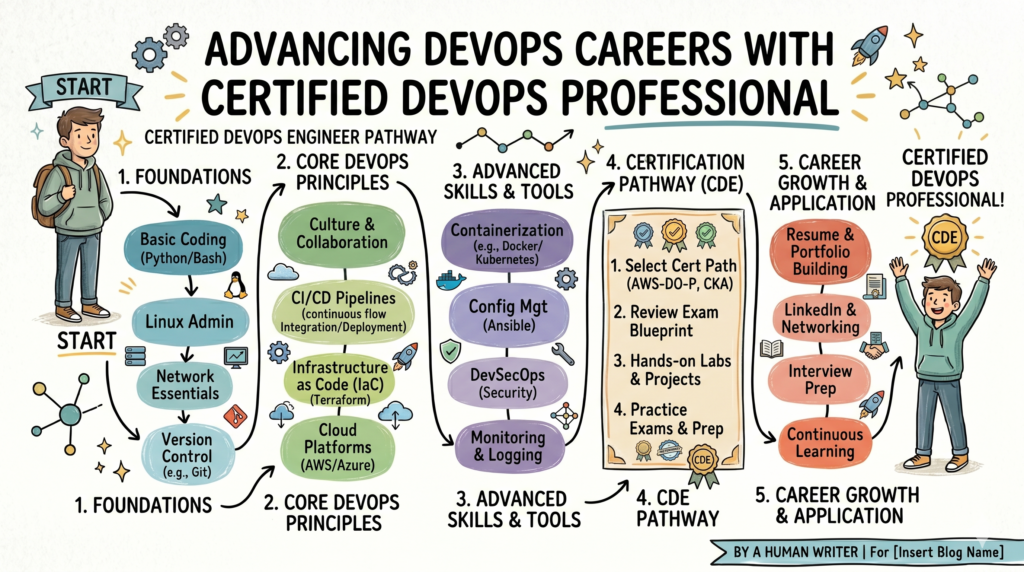
Certified DevOps Professional (CDP) is structured into multiple levels—foundation, professional, and advanced. Each level builds on previous knowledge and introduces more complex real-world challenges.
The foundation level focuses on basic concepts like version control, CI/CD, and containerization. The professional level dives into automation, Kubernetes, and monitoring. Advanced levels include specialization in areas like SRE, DevSecOps, and FinOps.
These levels align with career progression—from entry-level engineers to senior architects and technical leaders. The structure ensures a clear growth path for professionals at different stages.
Complete Certified DevOps Professional (CDP) Certification Table
| Track | Level | Who it’s for | Prerequisites | Skills Covered | Recommended Order |
|---|---|---|---|---|---|
| DevOps | Foundation | Beginners | Basic Linux, Git | CI/CD basics, containers | 1 |
| DevOps | Professional | Mid-level engineers | DevOps basics | Kubernetes, pipelines, automation | 2 |
| DevOps | Advanced | Senior engineers | Strong DevOps experience | Architecture, scaling, reliability | 3 |
| SRE | Professional | SREs | Monitoring basics | Observability, SLIs/SLOs | 2 |
| DevSecOps | Professional | Security engineers | DevOps + security basics | Secure pipelines, compliance | 2 |
Detailed Guide for Each Certified DevOps Professional (CDP) Certification
Certified DevOps Professional (CDP) – Foundation Level
What it is
This certification validates basic understanding of DevOps concepts, tools, and workflows. It focuses on building foundational skills required for modern software delivery.
Who should take it
Beginners, junior engineers, and professionals transitioning into DevOps roles. It is also suitable for students entering cloud and DevOps careers.
Skills you’ll gain
- Version control using Git
- CI/CD pipeline basics
- Containerization with Docker
- Basic cloud deployment
Real-world projects you should be able to do
- Build a simple CI/CD pipeline
- Containerize an application
- Deploy apps on cloud platforms
- Automate basic workflows
Preparation plan
- 7–14 days: Learn Git, Linux basics, and CI/CD concepts
- 30 days: Practice Docker, pipelines, and deployments
- 60 days: Build real projects and simulate production scenarios
Common mistakes
- Ignoring hands-on practice
- Focusing only on tools without understanding concepts
- Skipping Linux fundamentals
Best next certification after this
- Same-track option: Professional Level CDP
- Cross-track option: DevSecOps Certification
- Leadership option: Engineering Management Basics
Certified DevOps Professional (CDP) – Professional Level
What it is
This level validates the ability to design and implement scalable DevOps pipelines in production environments.
Who should take it
Mid-level engineers, DevOps practitioners, and SREs with hands-on experience.
Skills you’ll gain
- Kubernetes orchestration
- Advanced CI/CD pipelines
- Infrastructure as Code (IaC)
- Monitoring and logging
Real-world projects you should be able to do
- Deploy microservices on Kubernetes
- Build automated pipelines
- Implement monitoring systems
- Manage infrastructure using IaC
Preparation plan
- 7–14 days: Revise fundamentals and Kubernetes basics
- 30 days: Practice pipelines, IaC tools, and monitoring
- 60 days: Work on end-to-end DevOps projects
Common mistakes
- Not understanding Kubernetes deeply
- Ignoring monitoring and observability
- Over-relying on tutorials
Best next certification after this
- Same-track option: Advanced CDP
- Cross-track option: SRE Certification
- Leadership option: DevOps Architect
Certified DevOps Professional (CDP) – Advanced Level
What it is
This certification focuses on enterprise-scale DevOps architecture, reliability, and optimization.
Who should take it
Senior engineers, architects, and technical leaders.
Skills you’ll gain
- System design and scaling
- Advanced Kubernetes strategies
- Reliability engineering
- Cost optimization
Real-world projects you should be able to do
- Design scalable architectures
- Implement SRE practices
- Optimize cloud costs
- Build resilient systems
Preparation plan
- 7–14 days: Review advanced concepts
- 30 days: Practice architecture design
- 60 days: Build enterprise-grade systems
Common mistakes
- Ignoring system design principles
- Lack of real-world experience
- Overlooking cost optimization
Best next certification after this
- Same-track option: DevOps Architect
- Cross-track option: FinOps Certification
- Leadership option: CTO/Engineering Leadership
Choose Your Learning Path
DevOps Path
Focus on CI/CD, containerization, and automation. Start with foundation and move toward advanced levels. This path suits engineers building deployment pipelines and managing infrastructure.
DevSecOps Path
Combine DevOps with security practices. Learn secure coding, compliance, and vulnerability management. Ideal for engineers working in regulated environments.
SRE Path
Focus on reliability, monitoring, and incident management. Learn SLIs, SLOs, and error budgets. This path is ideal for maintaining system uptime.
AIOps / MLOps Path
Integrate AI and ML into operations. Learn automation, predictive monitoring, and ML pipelines. Useful for data-driven organizations.
DataOps Path
Focus on data pipelines, governance, and automation. Ideal for data engineers working with large-scale systems.
FinOps Path
Learn cost optimization and financial management of cloud resources. Suitable for organizations focused on efficiency and budgeting.
Role → Recommended Certified DevOps Professional (CDP) Certifications
| Role | Recommended Certifications |
|---|---|
| DevOps Engineer | Foundation + Professional |
| SRE | Professional + SRE Track |
| Platform Engineer | Professional + Advanced |
| Cloud Engineer | Foundation + Professional |
| Security Engineer | DevSecOps Track |
| Data Engineer | DataOps Track |
| FinOps Practitioner | FinOps Track |
| Engineering Manager | Advanced + Leadership |
Next Certifications to Take After Certified DevOps Professional (CDP)
Same Track Progression
Deepen your expertise by moving into advanced DevOps and architecture certifications. Focus on scaling systems and optimizing performance.
Cross-Track Expansion
Expand into SRE, DevSecOps, or FinOps. This helps you become a multi-skilled engineer capable of handling diverse challenges.
Leadership & Management Track
Transition into leadership roles by learning system design, team management, and strategic planning. This is ideal for senior professionals.
Training & Certification Support Providers for Certified DevOps Professional (CDP)
DevOpsSchool offers structured training programs focused on hands-on learning and real-world projects. Their courses are designed to simulate production environments, helping learners gain practical experience. They provide mentorship, labs, and certification guidance, making them suitable for both beginners and experienced professionals.
Cotocus provides enterprise-focused DevOps training with emphasis on automation and cloud-native practices. Their programs are tailored for professionals working in large-scale environments. They focus on practical implementation and real-world use cases.
Scmgalaxy specializes in DevOps tools and automation training. Their courses cover CI/CD, configuration management, and containerization. They are known for providing detailed technical insights and hands-on labs.
BestDevOps focuses on industry-relevant DevOps skills and certifications. Their training includes practical scenarios and project-based learning. They aim to bridge the gap between theory and real-world implementation.
devsecopsschool provides specialized training in DevSecOps practices. They focus on integrating security into DevOps pipelines. Their courses are useful for professionals working in security-sensitive environments.
sreschool offers training focused on Site Reliability Engineering. Their programs cover monitoring, observability, and reliability practices. They are ideal for engineers managing production systems.
aiopsschool focuses on AI-driven operations and automation. Their training includes predictive monitoring and machine learning integration. They are suitable for advanced professionals.
dataopsschool provides training on data pipeline automation and management. Their courses focus on data engineering and governance. They are ideal for data professionals.
finopsschool specializes in cloud cost optimization and financial management. Their training helps organizations manage cloud spending effectively. They are suitable for FinOps practitioners.
Frequently Asked Questions (General – 12 questions)
Is Certified DevOps Professional (CDP) difficult?
It depends on your experience level. Beginners may find it challenging, but with consistent practice, it becomes manageable.
How long does it take to prepare?
Typically 30–60 days depending on your background and hands-on experience.
Do I need coding skills?
Basic scripting knowledge is helpful but not mandatory for entry-level certifications.
Is it suitable for beginners?
Yes, especially the foundation level which covers basic concepts.
What tools are covered?
Common tools include Git, Docker, Kubernetes, Jenkins, and cloud platforms.
Is it globally recognized?
It is recognized in many organizations, especially those focused on practical DevOps skills.
Does it include hands-on labs?
Yes, practical learning is a key component.
What is the cost?
Costs vary depending on training and certification packages.
Can managers take this certification?
Yes, it helps managers understand DevOps workflows.
Is it better than cloud certifications?
It complements cloud certifications rather than replacing them.
Does it expire?
Some certifications may require renewal based on industry updates.
What jobs can I get after this?
Roles include DevOps Engineer, SRE, and Platform Engineer.
FAQs on Certified DevOps Professional (CDP) (8 Focused Q&A in 100 words)
What makes Certified DevOps Professional (CDP) unique?
It focuses on real-world implementation rather than theory.
Is Kubernetes mandatory?
Yes, especially for professional-level certifications.
Can I skip foundation level?
Experienced professionals can directly attempt higher levels.
Is this certification tool-specific?
No, it emphasizes concepts over specific tools.
Does it help in salary growth?
Yes, DevOps roles are among the highest paying.
Is it suitable for freelancers?
Yes, it improves credibility and project opportunities.
What industries value this certification?
IT, finance, e-commerce, and cloud-based companies.
How practical is the exam?
It includes real-world scenarios and hands-on tasks.
Final Thoughts: Is Certified DevOps Professional (CDP) Worth It?
If your goal is to work in modern engineering environments where automation, cloud, and continuous delivery are standard, Certified DevOps Professional (CDP) is a strong investment. It is not just about passing an exam—it’s about building skills that directly impact how software is delivered and maintained. However, the certification alone won’t make you job-ready. The real value comes from hands-on practice and applying what you learn in real projects. If you treat it as a learning journey rather than a credential, it can significantly accelerate your career in DevOps and beyond.
