Introduction
Most mainstream Indian holiday circuits leave travelers trapped in noisy crowds, inflated hotel tariffs, and souvenir traps. Far away from chaotic tourist conveyor belts lies Ranchi, an authentic plateau retreat rooted in ancient tribal heritage, forested escarpments, and cascading rivers.
Here, the air is laced with the petrichor of sal forests and the earthy aroma of roasting seasonal roots. Choosing this serene highland allows families and conscious wanderers to unplug, reconnect with untouched nature, and experience genuine Chota Nagpur warmth.
Why Ranchi is a must-visit city
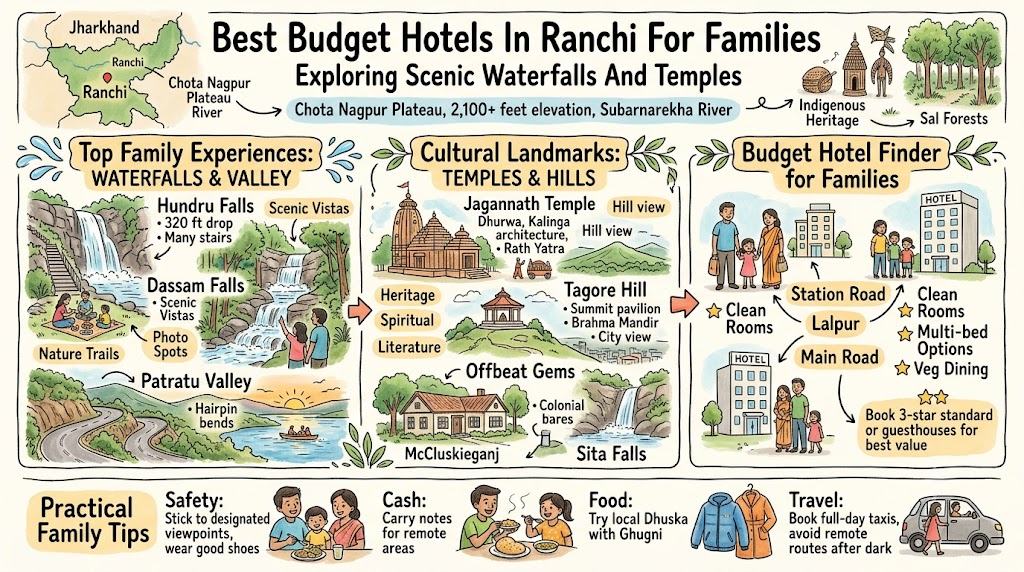
Perched at an elevation of over 2,100 feet on the Chota Nagpur Plateau, Ranchi serves as Jharkhand’s soulful heartbeat. Historically the summer capital of colonial Bihar, the region unites deep-rooted indigenous traditions, colonial architectural relics, and geological formations shaped over billions of years.
Modern Ranchi combines accessible infrastructure with untamed wilderness. Well-paved expressways, direct railway lines to major metros, and Birsa Munda Airport connect the city directly to serene valleys and dramatic falls within an hour’s drive.
| Indicator | Regional Feature |
|---|---|
| Geographic Identity | Chota Nagpur Plateau Highland, Subarnarekha River Basin |
| Primary Attractions | Subarnarekha Waterfall Loop, Ancient Shrines, Hill Lookouts |
| Key Transport Hubs | Birsa Munda Airport (IXR), Ranchi Junction (RNC), Hatia (HTE) |
| Best Travel Season | October through March (Pleasant, crisp winter breezes) |
| Signature Local Delicacy | Dhuska with Ghugni, Arsa Roti, and Bamboo Shoot Curry |
Best Places or Experiences
Hundru Falls
Plunging 320 feet down sheer metamorphic cliffs, Hundru Falls represents the sheer hydraulic power of the Subarnarekha River. Over millennia, the surging water has polished surrounding gneiss rocks into smooth sculptures, forming foaming natural plunge pools framed by dense sal tree lines.
Visitors descend over 700 paved stone stairs to reach the base gorge, where water mist fills the cool river canyon. The thunderous roar of the cascade provides an acoustic sanctuary that instantly washes away modern city fatigue.
The dramatic drop at Hundru Falls.
- Location: Angara Block, 45 km northeast of Ranchi city center.
- Why it is worth visiting: It is the highest waterfall along the Subarnarekha River circuit, offering dramatic geological formations.
- Best things to do: Photograph the sunrise rainbow through the mist, hike along the granite boulders, and sample hot pakoras from local stalls.
- Best time to visit: October to February for clear waters and safe riverbed walks.
- Ideal for whom: Adventure enthusiasts, photographers, and family groups.
- Travel tip: Wear sturdy sports shoes with high traction, as moist stone steps become slippery near the base basin.
Dassam Falls
Also known locally as Da-song, Dassam Falls drops 144 feet over craggy rock tiers formed by the Kanchi River. The indigenous Mundari name translates to “pouring of water,” capturing the intense, sheer volume of water churning down into the green canyon below.
The canyon surrounding Dassam features manicured viewpoints, protective metal railings, and natural forested picnic zones. The interplay of sunlight on the crystal spray creates mesmerizing natural lighting that attracts landscape shutterbugs from across the country.
Rocky tiers at Dassam Falls. Source: Wikipedia
- Location: Near Taimara village on the Ranchi-Tata National Highway, 40 km southeast of Ranchi.
- Why it is worth visiting: Powerful multi-tiered cascade nestled within a dramatic forest gorge.
- Best things to do: Watch water plunge from designated high balconies, picnic under shaded groves, and spot native riverine birds.
- Best time to visit: Post-monsoon months (September to January) for optimum water levels and lush greenery.
- Ideal for whom: Couples, road trippers, and nature lovers.
- Travel tip: Avoid swimming in the plunge pool because underwater currents and hidden rock crevices make the river basin dangerous.
Patratu Valley
Winding like an emerald serpent through the Ramgarh hills, the engineering marvel of Patratu Ghat road rivals iconic European mountain passes. Thickly forested hill slopes drop away on both sides, unveiling panoramic expanses of the shimmering Patratu Dam reservoir below.
As twilight falls, streetlamps illuminate the hairpin bends, turning the valley into a glittering ribbon amidst shadowy hills. The cool mountain breeze at the top viewpoints makes it the premier scenic drive in Eastern India.
Hairpin curves across Patratu Valley.
- Location: Patratu Ghat section, approximately 35 km north of Ranchi.
- Why it is worth visiting: Breathtaking aerial panoramic vistas, thrilling switchbacks, and lake watersports.
- Best things to do: Stop at designated valley viewpoints for photographs, rent a motorboat at the Patratu Lake Resort, and savor roasted sweet corn on the cliffside.
- Best time to visit: Early mornings for mist-covered ridges or late afternoons for spectacular sunsets.
- Ideal for whom: Motoring enthusiasts, photography lovers, and family day-trippers.
- Travel tip: Exercise disciplined driving along the hairpin turns, especially during heavy weekend traffic.
Jagannath Temple, Dhurwa
Crowning a solitary hillock in Dhurwa, this 17th-century architectural jewel was constructed in 1691 by King Ani Nath Shahdeo of the Barkagarh estate. Styled after the world-famous shrine in Puri, Odisha, the temple displays classic Kalinga shikhara architecture carved entirely from sturdy white stone blocks.
Ascending the stone steps rewards visitors with sweeping panoramic views of the modern HEC township and distant plateau horizons. The atmosphere vibrates with devotional hymns, ringing brass bells, and tranquil morning breezes
.
Historic Jagannath Temple in Dhurwa.
- Location: Dhurwa hilltop, about 11 km southwest of Albert Ekka Chowk.
- Why it is worth visiting: A three-century-old architectural sanctuary that anchors the annual Chota Nagpur Rath Yatra.
- Best things to do: Admire the stone sanctum art, enjoy peaceful meditation in the hilltop courtyard, and view the city skyline.
- Best time to visit: Early morning hours (6:00 AM to 8:30 AM) or sunset.
- Ideal for whom: Heritage seekers, spiritual pilgrims, and architecture buffs.
- Travel tip: A convenient vehicular ramp leads to the rear gate, allowing elderly visitors to bypass the steep front stairs.
Tagore Hill
Rising 300 feet above the northern plains of Ranchi, Tagore Hill (Morabadi Hill) preserves a deep literary and spiritual legacy. Jyotirindranath Tagore, the elder brother of Nobel Laureate Rabindranath Tagore, made this peaceful summit his permanent hermitage in 1912.
The quiet summit holds the historic Brahma Mandir monument and the Shanti Dham pavilion where Jyotirindranath completed literary translations. Surrounded by canopy trees, the hill offers an elevated escape right within the city limits.
- Location: Morabadi, approximately 4 km north of Ranchi Railway Station.
- Why it is worth visiting: A peaceful historical hill retreat deeply connected to Bengal’s Renaissance and the Tagore family.
- Best things to do: Climb the historic steps to the Brahma Mandir, watch the sunrise over Morabadi, and explore the nearby Ramakrishna Mission ashram grounds.
- Best time to visit: 6:00 AM to 9:00 AM or 4:30 PM to 6:00 PM.
- Ideal for whom: Writers, solo travelers, and culture buffs.
- Travel tip: Combine your morning visit with a walking tour around the vibrant open food markets of Morabadi Ground below.
Offbeat Exploration: Hidden Gems Tourists Miss
McCluskieganj: The Anglo-Indian Colonial Enclave
Located 65 km west of Ranchi, this sleepy hamlet was founded in the 1930s by Ernest Timothy McCluskie as a global homeland for Anglo-Indians. Shaded by dense stands of eucalyptus and mahogany, charming colonial cottages with sloping red-tile roofs, open fireplaces, and overgrown gardens transport visitors back a century.
Pithoria Fort and the Kanke Valley Outskirts
A short detour through northern rural lanes brings you to the ruined stone bastions of the centuries-old Pithoria Fort. Local folklore links this moss-covered stone ruin to ancient Nagvanshi kings, while nearby farm tracks offer peaceful birdwatching across rolling mustard fields.
Sita Falls & Tribal Artisan Pockets
Hidden beyond the popular tourist radar near Jonha, Sita Falls drops dramatically down a pristine rocky gorge fed by the Radhu River. The surrounding tribal hamlets provide a rare look into traditional Sohrai and Khovar mud wall paintings, organic millets, and handcrafted bamboo basketry.
Detailed Practical Guidance for Travelers
| Destination | Standard Entry Fee | General Timings | Best Local Food Options Nearby | Recommended Nearby Attractions |
|---|---|---|---|---|
| Hundru Falls | ₹30 per adult | 6:00 AM – 5:00 PM | Local tea stalls, steaming Maggi, boiled country eggs | Jonha Falls, Getalsud Dam |
| Dassam Falls | ₹25 per adult | 8:00 AM – 5:00 PM | Dhuska stalls, roasted seasonal corn, fried fish | Surya Mandir Bundu, Panchghagh Falls |
| Patratu Valley | Free public road access | Open 24 Hours (Best in Daylight) | Lake Resort Restaurant, roadside pakora joints | Patratu Dam Lake, Boating Pier |
| Jagannath Temple | Free entry | 5:00 AM – 12:00 PM, 3:30 PM – 8:00 PM | Khaja sweets, fresh peda stalls outside gates | Dhurwa Dam, Ring Road scenic stretch |
| Tagore Hill | ₹10 maintenance fee | 6:00 AM – 6:00 PM | Morabadi street food stalls, litti chokha carts | Rock Garden, Kanke Dam Reservoir |
Logistics & On-Ground Navigation
Local Transport Options
- Pre-booked Private Taxis: Booking an app-based cab or private taxi remains the most reliable option for full-day tours covering outer waterfall circuits like Hundru or Dassam.
- Shared Auto-Rickshaws: These run fixed point-to-point lines across the city core (Ranchi Station to Ratu Road or Kanke) for nominal fares ranging between ₹15 and ₹30 per seat.
- Battery E-Rickshaws (Totos): The quietest and greenest way to cover short neighborhood hops inside Morabadi, Lalpur, and Doranda.
- Self-Drive Two-Wheelers: Rental agencies around the central railway hub offer gearless scooters on daily deposits, ideal for budget solo travelers tackling Patratu Valley.
Budget Planning
Budget & Backpacking Tier (₹1,000 – ₹1,600 per day): Stay in budget family guest houses or clean railway-adjacent lodges (₹600–₹900/night). Eat hearty meals of litti chokha, dhuska, and tribal thalis at neighborhood joints (₹300/day). Use shared autos and local buses for transport.
Mid-Range & Family Comfort Tier (₹3,000 – ₹5,500 per day): Choose three-star business and family hotels around Main Road, Lalpur, or Kadru (₹2,200–₹3,500/night with breakfast). Enjoy sit-down regional thali restaurants and reserve private day-cabs for countryside waterfall circuits (₹1,800–₹2,500/day).
Safety and Inclusivity Tips
- For Families: Stick to designated viewpoints at major waterfalls, keep young children away from slippery boulders, and pack motion sickness medicine for the winding Patratu curves.
- For Couples: Most tourist spots are welcoming; however, plan your return from outer waterfalls before sunset, as rural connecting roads have sparse street lighting.
- General Safety: Drink only packaged or filtered water, withdraw cash before heading into forested areas, and always follow lifeguard markers along fast-running riverbeds.
Strategic Travel Planning Guardrails
Travel Planning Tips for Ranchi
- Book family-friendly budget hotels in central areas like Station Road, Lalpur, or Main Road for seamless access to both transport and dinner spots.
- Carry ample paper cash (₹100 and ₹200 notes) because mobile connectivity can drop in deep river gorges and rural forest highways.
- Pack breathable cotton shirts for sunny afternoons alongside a medium jacket, as plateau evenings bring crisp drops in temperature between November and February.
- Hire registered tourist guides at major heritage spots like Jagannath Temple to support local livelihoods and hear authentic oral folklore.
- Reserve full-day rental vehicles at least 24 hours in advance on weekends to secure clean family cars and experienced hill drivers.
Common Mistakes to Avoid
- Packing your itinerary with too many distant waterfalls in a single afternoon; the routes take longer than GPS estimates suggest.
- Venturing out onto slippery rocks near waterfall plunge basins despite posted safety barriers and warning signage.
- Assuming digital payments will work smoothly at remote parking lots and roadside fruit vendors deep in the rural blocks.
- Skipping traditional local dishes like dhuska, chilka roti, and marua rotis in favor of generic fast-food chains.
- Delaying your departure from rural waterfalls until after dark, when highway truck traffic increases significantly.
Suggested Itinerary Blueprints
- Day Quick Dash (The Capital Highlights Loop): Designed for travelers with just 24 hours. Start at dawn climbing Tagore Hill, head south to worship at the magnificent Jagannath Temple in Dhurwa, stop for a local lunch of litti chokha, and spend your golden sunset cruising the serene Patratu Valley switchbacks.
- Day Deep-Dive (The Cascading Waters Circuit):
- Day 1: Explore the grand waterfalls—begin with the 700-step hike at Hundru Falls, followed by a relaxing picnic lunch near Jonha Falls, ending with the calm sunset waters of Getalsud Dam.
- Day 2: Discover city heritage—start at Jagannath Temple, stroll through Rock Garden overlooking Kanke Dam, shop for authentic tribal tussar silk at Jharcraft, and take an evening food walk along Morabadi Ground.
- Complete Weekend Travel Plan (The Ultimate Plateau Escape):
- Friday Evening: Arrive in Ranchi, check into your hotel, and enjoy street-side snacks like spicy aloo chana and crisp dhuska along Lalpur Chowk.
- Saturday: Take a full-day countryside excursion to Dassam Falls, admire the unique Surya Mandir architecture in Bundu, and return for a relaxing dinner featuring tender regional mutton curry.
- Sunday: Wake early for an exhilarating drive through Patratu Valley, enjoy motorboating on the reservoir, and wrap up with heritage exploration at Tagore Hill before your evening train or flight.
Common Tourist Mistakes to Avoid
- Geographic Blunders: Grouping Hundru Falls and Dassam Falls on the same hurried morning. They sit along completely different highway corridors; rushing between them wastes hours on connecting rural bypasses.
- Commercial Traps: Spending afternoon downtime wandering generic, enclosed shopping malls when tranquil open-air locations like Rock Garden and Kanke Dam are minutes away.
- Neglecting Modern/Alternative Zones: Skipping the vibrant cafe scene and cultural book corners emerging around Morabadi and Ashok Nagar, which showcase the youthful creative pulse of the city.
- Transport Overpayment: Agreeing to unmetered auto fares outside the main railway station without checking standard rates or checking rideshare apps for fair price benchmarks.
- Luxury Dining Bias: Eating exclusively inside corporate hotel buffets while missing out on authentic street stalls serving steaming litti chokha roasted over charcoal embers.
Frequently Asked Questions
1. What is the best season to plan a family vacation to Ranchi?
The most rewarding window to visit Ranchi runs from October through March. Winter days remain comfortably sunny with temperatures hovering between 15°C and 24°C, perfect for outdoor hiking, hill lookouts, and waterfall picnics. Monsoons (July–September) bring swollen, roaring cascades, but slippery stone steps require extra caution with children.
2. Which areas in Ranchi offer the best budget hotels for families?
Central neighborhoods such as Station Road, Lalpur, and Main Road provide the finest budget-friendly accommodations for visiting families. Staying in these pockets guarantees reliable access to clean multi-bed family rooms, vegetarian dining outlets, pharmacy stores, and immediate public transport without paying luxury suburban rates.
3. Is Ranchi a safe destination for tourists and solo travelers?
Ranchi is generally peaceful, welcoming, and safe for families, couples, and solo travelers. People across the Chota Nagpur belt are hospitable and helpful. Standard urban precautions apply: avoid deserted rural forested routes late at night, and ensure you head back toward town before nightfall when visiting remote waterfalls.
4. How many days are ideal for an all-round trip to Ranchi?
A 3-day, 2-night itinerary is the sweet spot for an immersive trip to Ranchi. This timeframe lets you explore two premier waterfalls without rushing, drive through the winding Patratu Valley, visit iconic heritage temples, and sample delicious tribal cuisine at a relaxed, rejuvenating pace.
5. What is the most famous authentic local dish one must eat in Ranchi?
Dhuska is the undisputed culinary king of Ranchi street food. Made from a deep-fried fermented batter of ground rice and chana dal, these golden, fluffy delights are served piping hot alongside spicy kala chana ghugni and tangy tomato-coriander chutney at nearly every morning street cart.
6. Can one visit Hundru and Dassam waterfalls together in one day?
While theoretically possible, pairing both waterfalls on the same day is physically exhausting and logistically inefficient. They lie in opposite directions off different arterial highways. Splitting them across two days allows you to navigate the long stairways comfortably and enjoy peaceful picnics without spending all day driving.
7. How far is Patratu Valley from Ranchi and what is the best way to travel there?
Patratu Valley sits roughly 35 km north of Ranchi city center. The most convenient way to reach it is by private cab, hired auto, or personal vehicle along the well-surfaced Kanke-Patratu road. The scenic mountain drive takes about one hour each way through smooth, picturesque hairpin bends.
8. Are credit cards and UPI digital payments widely accepted across Ranchi?
Within city limits, UPI digital payments and debit cards work reliably across hotels, retail outlets, and restaurants. However, cash is essential when venturing out to rural waterfall sites, village handicraft stands, toll booths, and roadside snack vendors where mobile internet connectivity can be intermittent.
9. What local handicrafts and souvenirs should travelers buy in Ranchi?
Ranchi is an exceptional place to purchase authentic tribal artifacts, particularly certified Tussar silk sarees and stoles from state-run Jharcraft emporiums. Other prized souvenirs include handcrafted bamboo baskets, Dokra brass metal figurines, terracotta pottery, and natural organic forest honey produced by regional tribal cooperatives.
10. Is an advance permit required to visit major waterfalls around Ranchi?
No advance government permits are needed to visit standard tourist spots like Hundru, Dassam, Jonha, or Sita Falls. Visitors simply purchase nominal entry and vehicle parking tickets directly at the managed entrance gates on arrival. Always retain your paper entry receipt throughout your visit.
11. How accessible are the waterfalls for elderly travelers with limited mobility?
Major falls like Hundru require descending hundreds of steep masonry stairs to reach the water level, which can challenge travelers with knee pain. However, elderly family members can still enjoy panoramic views of the cascading waters and surrounding forests directly from paved upper lookout pavilions.
12. What transport options are best for getting around the city core?
For short trips within the central city, battery-powered e-rickshaws (Totos) and shared auto-rickshaws provide inexpensive, readily available transport. For full-day sightseeing tours covering outer destinations like Patratu Lake and peripheral waterfalls, booking a dedicated private taxi ensures safety, comfort, and schedule flexibility.
Conclusion
Traveling to Ranchi offers an enriching escape from predictable tourist corridors, rewarding curious travelers with cascading river canyons, tranquil hilltop sanctuaries, and living indigenous traditions. Standing atop mist-shrouded plateau cliffs as temple bells echo across the sal forests reveals a slower, deeply grounding rhythm of life. Choosing this highland capital will refresh your senses, spark appreciation for authentic regional culture, and leave you with family memories far richer than any standard package tour.
