Introduction
While mainstream monsoon destinations across India groan under gridlocked traffic, inflated hotel tariffs, and elbow-to-elbow crowds, Ranchi Click to open side panel for more information offers a radically different rhythm. Perched gracefully on the southern edge of the Chota Nagpur Plateau, this highland capital awakens between July and September into a mist-draped sanctuary of thundering gorges, sal forests, and ancient tribal heritage.
Here, the monsoon is not an inconvenience to dodge—it is the soul of the landscape. Instead of queuing behind selfie sticks at commercialized viewpoints, travelers find themselves standing beside roaring granite cliffs, sipping steaming kulhad chai while low-hanging clouds drift across terraced paddy fields.
Why Ranchi is a must-visit city
Known across eastern India as the City of Waterfalls, Ranchi Click to open side panel for more information sits at an average elevation of 2,140 feet above sea level, giving it a naturally crisp, breezy microclimate even during the peak of summer. When the southwest monsoon sweeps over the Chota Nagpur Plateau, dozens of seasonal streams swell into dramatic cataracts, transforming the surrounding forests into an emerald amphitheater.
Beyond its geological drama, the region carries immense cultural and historical weight as the heartland of Jharkhand’s indigenous Munda, Oraon, and Santhal communities. From seventeenth-century stone temples to colonial-era hill retreats, the city balances deep-rooted traditions with modern urban comfort.
Getting to the plateau is effortless for every kind of traveler:
- By Air: Birsa Munda Airport, Ranchi Click to open side panel for more information sits just 7 kilometers from the city center, offering direct daily flights from Delhi, Mumbai, Bengaluru, Kolkata, and Hyderabad.
- By Rail: Ranchi Junction Click to open side panel for more information connects seamlessly to major eastern and northern rail corridors, including high-speed Vande Bharat and Shatabdi expresses.
- By Road: Smooth four-lane highways (NH-33 and NH-20) link the capital to Jamshedpur, Bokaro, and Hazaribagh, making weekend road trips remarkably scenic.
The travel circuit radiates outward like spokes on a wheel—combining eastern waterfall corridors, northern valley switchbacks, and southern reservoir horizons into easily manageable day loops.
| Key Metric | Essential Details for Travelers |
|---|---|
| Elevation | 651 meters (2,140 feet) above sea level |
| Peak Monsoon Window | July to September (post-monsoon greenery lasts through November) |
| Average Monsoon Temp | 21°C to 28°C with cool evening breezes |
| Primary Languages | Hindi, Nagpuri, Kurukh, Mundari, and English |
| Signature Local Dishes | Dhuska, Chilka Roti, Rugra (wild monsoon mushrooms), Handia, and Thekua |
| Ideal Trip Duration | 2 to 3 days for waterfalls, valleys, and heritage circuits |
Best Places to Visit in Ranchi During Monsoon

Hundru Waterfall
Hundru Waterfall
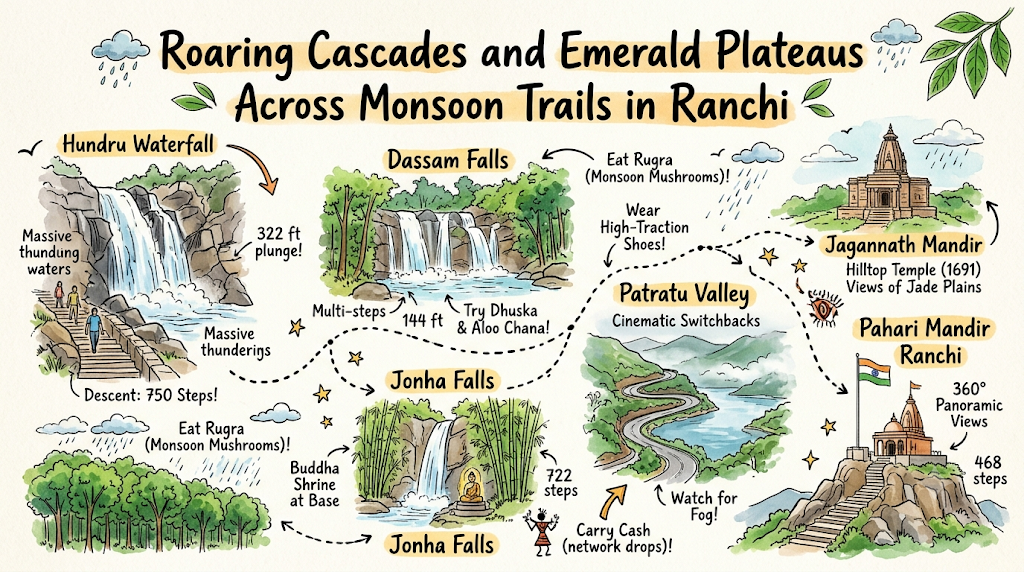
Carved by the Subarnarekha River as it plunges 322 feet over jagged gneiss rock formations, Hundru Waterfall Click to open side panel for more information is the undisputed titan of Jharkhand’s monsoon circuit. During the rains, the usually segmented streams merge into a single, thunderous curtain of white foam that sends plumes of cool spray rising high above the gorge.
Surrounded by dense deciduous woodland, the descent down nearly 750 stone steps reveals shifting perspectives of the chasm, where geological strata millions of years old glisten under cascading water. The sheer acoustic roar of the river hitting the granite boulders below creates an unforgettable sensory immersion.
- Location: Angara block, roughly 45 kilometers east of central Ranchi via the Ranchi-Purulia highway.
- Why it is worth visiting: It is one of the highest and most powerful waterfalls in eastern India, offering dramatic canyon views when fed by monsoon rains.
- Best things to do: Descend the stone staircase to the mid-level viewing decks, photograph the misty gorge from Hundru Fall view point Click to open side panel for more information , and sample roasted corn sold by local villagers near the upper gate.
- Best time to visit: Early morning between 8:30 AM and 11:00 AM for soft light and thinner crowds.
- Ideal for whom: Nature photographers, adventure seekers, and trekking enthusiasts.
- Travel tip: Wear high-traction trekking shoes; the stone steps become slick with mist, and entering the main plunge pool is strictly prohibited during heavy monsoon flow.

Dassam Falls
Dassam Falls
Fed by the Kanchi River, a tributary of the Subarnarekha, Dassam Falls Click to open side panel for more information derives its name from the Mundari word Da:Song, meaning the act of pouring water. Unlike single-drop cataracts, this 144-foot waterfall splits into ten distinct, symmetrical streams across a wide terraced rock shelf during the rainy season.
The surrounding landscape feels wild and elemental, framed by red laterite soil, dense sal trees, and terraced fields cultivated by local Munda communities. When monsoon clouds hang low over the valley, the contrast between the muddy ochre river surge and the brilliant emerald foliage creates a painter’s palette.
- Location: Taimara village, 40 kilometers southeast of Ranchi along NH-33 (Ranchi-Jamshedpur highway).
- Why it is worth visiting: Its wide, multi-stream cascade offers breathtaking panoramic symmetry without requiring an exhausting trek.
- Best things to do: Walk to the fenced cliffside viewpoints, visit Dassam Falls Top View Point Click to open side panel for more information for sweeping valley vistas, and enjoy hot pakoras at the forest-edge stalls.
- Best time to visit: Mid-morning to late afternoon, especially right after a fresh rain shower when mist rises from the gorge.
- Ideal for whom: Families, road-trippers, and landscape photographers.
- Travel tip: Respect all red warning flags and barricades; sudden upstream rainfall can cause rapid water surges without warning.

Jonha Falls
Jonha Falls
Tucked inside a tranquil forested valley, Jonha Falls Click to open side panel for more information —also revered locally as Gautamdhara—is a classic example of a hanging valley waterfall where the Raru River drops 141 feet over the edge of the Ranchi plateau. Local legend holds that Lord Buddha once meditated beside these waters, and a serene shrine dedicated to him sits near the base.
Reaching the bottom requires descending roughly 722 well-maintained concrete steps flanked by bamboo groves and wild ferns. Along the way, small hillside eateries run by local women’s self-help groups serve fresh herbal tea and regional snacks.
- Location: Guridih village, approximately 40 kilometers east of Ranchi off the Ranchi-Purulia road.
- Why it is worth visiting: It combines lush botanical beauty and spiritual tranquility with safer, tiered rock formations than steeper gorges.
- Best things to do: Walk down to the Buddhist shrine at the foot of the falls, admire the bamboo-lined canyon trails, and pair the trip with nearby Sita Falls Click to open side panel for more information just 5 kilometers away.
- Best time to visit: Between 9:00 AM and 3:00 PM so you have ample daylight for the climb back up.
- Ideal for whom: Slow travelers, spiritual seekers, and active couples.
- Travel tip: Carry light rain ponchos rather than umbrellas, as gusty canyon winds near the waterfall base easily invert standard umbrellas.

Patratu Valley
Patratu Valley
If you crave the thrill of a Himalayan mountain drive without leaving eastern India, Patratu Valley Click to open side panel for more information delivers pure cinematic magic during the monsoon. This serpentine ghat road winds down from the plateau through dozens of hairpin bends, offering uninterrupted views of mist-shrouded hills and deep emerald valleys.
At the foot of the ghat lies the expansive Patratu Dam reservoir, where storm clouds reflect off glassy waters ringed by forested hills. As rain sweeps across the ridge, clouds literally drift through your car windows along the upper viewpoints.
- Location: Kanke-Patratu Road, about 35 to 40 kilometers north of central Ranchi.
- Why it is worth visiting: It features one of India’s smoothest and most dramatic monsoon hill drives, culminating in a scenic lakeside promenade.
- Best things to do: Stop at the famous hairpin viewpoints for misty valley photography, stroll along the Patratu Lake Resort promenade, and savor street-side maggi and ginger tea at the ridge stalls.
- Best time to visit: Late afternoon between 3:30 PM and 6:00 PM to watch dramatic monsoon clouds roll over the valley at dusk.
- Ideal for whom: Bikers, road-trip enthusiasts, couples, and families.
- Travel tip: Drive cautiously in second or third gear on the steep descent, as thick monsoon fog can reduce visibility to under 20 meters near the summit.

Jagannath Mandir
Jagannath Mandir
Crowning a scenic hilltop on the southern outskirts of the city, Jagannath Mandir Click to open side panel for more information stands as a testament to seventeenth-century Kalinga-style temple architecture. Built in 1691 by King Ani Nath Shahdeo of the Nagvanshi dynasty, its whitewashed spire rises dramatically against dark monsoon skies.
During the rainy season, the surrounding plains turn a vivid shade of jade, turning the temple courtyard into a peaceful vantage point overlooking the sprawling cityscape. If your visit coincides with July, you may even witness the vibrant local Rath Yatra festivities that draw devotees from across Jharkhand.
- Location: Jagannathpur, Dhurwa, roughly 10 kilometers southwest of central Ranchi.
- Why it is worth visiting: It offers a captivating blend of 330-year-old royal heritage, intricate stone craftsmanship, and sweeping hilltop views.
- Best things to do: Climb the wide stone steps to the main sanctum, admire the panoramic monsoon skyline from the outer terrace, and explore the nearby Dhurwa Dam Click to open side panel for more information shoreline afterward.
- Best time to visit: Early morning at 7:00 AM or late afternoon around 4:30 PM when the temple bells echo through the cool air.
- Ideal for whom: History buffs, architecture lovers, and cultural travelers.
- Travel tip: Note that the temple closes between 12:00 PM and 3:00 PM daily, so plan your afternoon visit accordingly.

Pahari Mandir Ranchi
Pahari Mandir Ranchi
Rising 350 feet above the bustling heart of the city, Pahari Mandir Ranchi Click to open side panel for more information sits atop an ancient rocky outcrop known historically as Richi Buru. Dedicated to Lord Shiva, this revered shrine is reached by ascending 468 steps carved into the hillside, offering a 360-degree aerial panorama of Ranchi under monsoon clouds.
The hill also carries profound patriotic history; during the British Raj, freedom fighters were hanged on this summit, and today the Indian Tricolor flies proudly from one of the tallest flagpoles in the country right beside the temple. During the auspicious monsoon month of Shravan, the air fills with devotional chants and the scent of wet earth and incense.
- Location: Ratu Road, Kumhartoli, right in the central zone of Ranchi (4 kilometers from Ranchi Junction).
- Why it is worth visiting: It provides the finest bird’s-eye view of the city skyline while uniting spiritual devotion with Indian independence history.
- Best things to do: Climb the 468 steps through the shaded canopy, witness the massive national flag fluttering against storm clouds, and watch sunset light break through the overcast western horizon.
- Best time to visit: 4:30 PM to 6:30 PM for cool breezes and dramatic golden-hour cloudscapes.
- Ideal for whom: Spiritual travelers, photographers, and solo explorers.
- Travel tip: Mondays during the monsoon month of Shravan attract massive pilgrim crowds; visit on a weekday morning or late afternoon for a calmer experience.
Offbeat Exploration: Hidden Gems Tourists Miss
Sita Falls
Located just a short forest detour from Jonha, Sita Falls Click to open side panel for more information remains blissfully quiet compared to its famous neighbor. Surrounded by dense bamboo thickets and terraced hills, this 140-foot cascade plunges into a rocky basin where local tribal legends tell of Goddess Sita resting during her exile. Because fewer tour buses venture down its narrow approach road, you often have the mist-filled viewpoint entirely to yourself.
McCluskieganj
Roughly 60 kilometers northwest of Ranchi lies Mccluskieganj Click to open side panel for more information , a sleepy, rain-washed hamlet founded in the 1930s as a homeland for India’s Anglo-Indian community. During the monsoon, moss-covered colonial bungalows, red-tiled roofs, and orchard lanes look straight out of an English countryside novel. Staying overnight in a heritage homestay here lets you wake up to birdsong, wildflower meadows, and old-world hospitality.
Panchghagh Falls
Tucked away south of the city near Khunti, Panchghagh Falls Click to open side panel for more information is formed by the Banai River splitting into five distinct streams cascading over low, broad rock ledges. Unlike towering cliff waterfalls, its gentler gradient creates a soothing symphony of rushing water surrounded by untouched sal forests, making it an ideal spot for quiet nature contemplation away from weekend crowds.
Detailed Practical Guidance for Travelers
| Destination | Standard Entry Fee | General Timings | Best Local Food Options Nearby | Recommended Nearby Attractions |
|---|---|---|---|---|
| Hundru Waterfall | INR 20–50 per person (plus parking) | 10:00 AM – 4:00 PM | Hot pakoras, boiled salted corn, and kulhad chai at upper gate stalls | Jonha Falls Click to open side panel for more information and Getalsud Dam |
| Dassam Falls | INR 20–50 per person | 8:00 AM – 6:00 PM | Dhuska with aloo chana curry and ginger tea at Taimara highway dhabas | Sun Temple (Bundu) and Panchghagh Falls Click to open side panel for more information |
| Jonha Falls | INR 20–50 per person | 8:00 AM – 5:00 PM | Homemade chilka roti and herbal tea at women-run SHG kiosks | Sita Falls Click to open side panel for more information and Hundru Waterfall Click to open side panel for more information |
| Patratu Valley | Free (Lake Park entry INR 20–50) | Open 24 Hours (Park: 9:00 AM – 6:00 PM) | Steaming maggi, momos, and fresh paneer pakoras at ghat viewpoints | Kanke dam Click to open side panel for more information and Rock Garden Click to open side panel for more information |
| Jagannath Mandir | Free | 6:30 AM – 12:00 PM & 3:00 PM – 7:30 PM | Traditional peda sweets and puri-sabzi near Jagannathpur Chowk | Dhurwa Dam Click to open side panel for more information and JSCA Stadium |
| Pahari Mandir Ranchi | Free | 4:30 AM – 9:00 PM | Litti chokha, samosa chaat, and malpua along Ratu Road | Kanke dam Click to open side panel for more information and Rock Garden Click to open side panel for more information |
Logistics & On-Ground Navigation
Local Transport Options
- Private Cab Rentals: Hiring a full-day chauffeur-driven sedan or SUV (INR 2,200 to INR 3,500 per day) is by far the smartest way to visit waterfalls, as return transport from remote gorges is scarce once rain sets in.
- App-Based Cabs & Autos: Ola, Uber, and Rapido operate reliably within central Ranchi neighborhoods like Lalpur, Doranda, Hinoo, and Kanke Road for city temples and dams.
- Shared Auto-Rickshaws & E-Rickshaws: Ideal for short hops along Main Road, Ratu Road, and Station Road at INR 10 to INR 30 per ride, though they do not run out to rural waterfall circuits.
- Two-Wheeler Rentals: Local bike rental agencies near Ranchi Junction offer geared motorcycles and scooters for INR 600 to INR 1,000 per day—fantastic for riding the Patratu Valley Click to open side panel for more information curves on dry mornings.
Budget Planning
- Budget / Backpacking Tier (INR 1,500 – INR 2,500 per day): Includes clean guesthouses or hostels near Station Road or Lalpur (INR 800–1,200), street-level Jharkhandi meals and highway dhaba thalis (INR 400), and shared transit or scooter rentals (INR 500).
- Mid-Range / Comfort Tier (INR 4,500 – INR 7,500 per day): Covers boutique hotels on Kanke Road or Radium Road (INR 2,500–4,000), a dedicated private AC cab for waterfall circuits (INR 2,500), and dining at heritage or contemporary local restaurants (INR 1,000).
Safety and Inclusivity Tips
- For Families: Stick to viewpoints with sturdy railings such as Dassam Falls Click to open side panel for more information and Patratu Lake Park, and keep a close hold on children near wet stone steps.
- For Couples: Aim to wrap up rural waterfall visits by 4:30 PM so you return to well-lit city roads before heavy evening downpours begin.
- General Monsoon Safety: Never step onto smooth, dark wet rocks near riverbeds—moss-covered granite is extraordinarily slippery, and flash floods can raise water levels within minutes.
Local Insider Secret: Most waterfall zones have patchy mobile data inside deep gorges. Always download offline Google Maps for the Ranchi district and save your cab driver’s direct phone number before leaving the main highway.
Strategic Travel Planning Guardrails
Travel Planning Tips for Ranchi
- Book Stays Strategically: Choose hotels along Kanke Road for quick access to Patratu Valley Click to open side panel for more information and Kanke dam Click to open side panel for more information , or Station Road / Kokar for faster exits toward eastern waterfalls.
- Carry Small Cash Denominations: While UPI works smoothly across Ranchi city, rural parking gates, forest entry booths, and village tea stalls frequently lose network connectivity and require INR 10, INR 20, and INR 50 notes.
- Respect Tribal Heritage & Etiquette: Always ask permission before photographing local Munda or Oraon villagers, and avoid littering in sacred forest groves (Sarna sites).
- Pack Monsoon-Smart Gear: Bring quick-dry synthetic clothing, non-slip sandals or trail shoes, a waterproof phone pouch, and a lightweight windcheater.
- Taste Seasonal Forest Produce: Ask local eateries for Rugra (earthy, truffle-like wild mushrooms harvested exclusively during the monsoon) and Bamboo Shoot curry (Kareel), true culinary treasures of Jharkhand.
Common Mistakes to Avoid
- Leaving Waterfalls After Sunset: Rural approach roads to Hundru and Jonha lack streetlights and traverse dense forests; always head back toward the city before dusk.
- Underestimating Stair Climbs: Both Hundru and Jonha involve over 700 steep steps each way—attempting both back-to-back without pacing yourself will exhaust your legs.
- Wearing Smooth-Soled Sneakers: Standard flat-soled canvas shoes turn into ice skates on wet laterite paths and moss-slick stairs.
- Skipping Authentic Tribal Cuisine: Relying solely on generic North Indian hotel buffets means missing out on crispy dhuska, tilkut, and wild monsoon mushrooms.
- Ignoring Weather Alerts: Heavy red-alert rain days can temporarily close lower gorge access; keep flexible indoor alternatives like museums or cafes ready.
Suggested Itinerary Blueprints
- 1-Day Quick Dash (The Cascading Ridge Loop): Built for time-crunched business travelers or weekend transit visitors. Start at 7:30 AM heading east to Jonha Falls Click to open side panel for more information and Hundru Waterfall Click to open side panel for more information while morning mist lingers in the gorges, break for a traditional Jharkhandi lunch in the city, and catch sunset clouds from Pahari Mandir Ranchi Click to open side panel for more information before an evening flight.
- 2-Day Deep-Dive (Waterfalls, Valleys & Royal Heritage):
- Day 1: Dedicate the morning to the eastern gorge circuit covering Hundru Waterfall Click to open side panel for more information , Jonha Falls Click to open side panel for more information , and nearby Sita Falls Click to open side panel for more information , returning by late afternoon for street food at Firayalal Chowk.
- Day 2: Visit seventeenth-century Jagannath Mandir Click to open side panel for more information and Dhurwa Dam Click to open side panel for more information in the morning, then spend the afternoon winding through the misty switchbacks of Patratu Valley Click to open side panel for more information .
- 3-Day Complete Weekend Travel Plan (The Ultimate Chota Nagpur Monsoon Odyssey):
- Friday: Arrive in Ranchi, check into a Kanke Road hotel, explore Rock Garden Click to open side panel for more information overlooking Kanke dam Click to open side panel for more information , and climb Pahari Mandir Ranchi Click to open side panel for more information at dusk.
- Saturday: Tackle the grand eastern waterfall circuit (Hundru Waterfall Click to open side panel for more information + Jonha Falls Click to open side panel for more information followed by an authentic tribal dinner featuring dhuska and rugra curry.
- Sunday: Drive south to Dassam Falls Click to open side panel for more information in the morning, explore the colonial lanes of Mccluskieganj Click to open side panel for more information or Patratu Valley Click to open side panel for more information in the afternoon, and pick up Dokra brass handicrafts before departure.
Common Tourist Mistakes to Avoid
- Geographic Blunders: Trying to combine southern Dassam Falls Click to open side panel for more information (NH-33), eastern Hundru Waterfall Click to open side panel for more information (Purulia Road), and northern Patratu Valley Click to open side panel for more information on a single day traps you in over six hours of cross-city transit.
- Commercial Traps: Spending precious monsoon afternoons inside generic shopping malls on Main Road instead of experiencing open-air viewpoints, reservoir promenades, and local tribal craft markets like Jharcraft.
- Neglecting Modern/Alternative Zones: Overlooking quieter residential and cafe-centric pockets around Kanke Road, Bariatu, and Lalpur, where cozy artisanal coffee shops offer warm sanctuaries during heavy afternoon cloudbursts.
- Transport Overpayment: Accepting unverified flat rates from unmetered autos outside Ranchi Junction Click to open side panel for more information without checking Ola, Uber, or Rapido fares first can easily double your local transit spend.
- Luxury Dining Bias: Eating exclusively inside five-star dining rooms deprives you of Ranchi’s vibrant street-food soul—where hot dhuska, chana ghugni, and litti chokha served on sal-leaf plates capture the true warmth of Jharkhand.
Frequently Asked Questions
1. Is it safe to visit waterfalls in Ranchi during heavy monsoon rains?
Yes, visiting Ranchi’s waterfalls during the monsoon is safe if you follow forest department guidelines and stay behind fenced viewing decks. Avoid descending to the water’s edge during heavy downpours, wear high-grip footwear on wet steps, and always exit waterfall gorges before sunset.
2. Which month offers the best monsoon experience in Ranchi?
August and September provide the most dramatic scenery across Ranchi. By August, every waterfall flows at peak volume, the surrounding sal forests turn brilliant emerald, and intermittent sunshine creates vivid rainbows across the misty gorges without continuous all-day washouts.
3. Can I visit Hundru, Jonha, and Dassam Falls on the same day?
While technically possible in a private car with an early 7:00 AM start, cramming all three into one day is exhausting. Hundru and Jonha sit along the same eastern corridor and pair easily, whereas Dassam lies on a separate southern highway better suited for another day.
4. What kind of footwear is best for Ranchi’s monsoon trails?
Choose lightweight trekking shoes or monsoon sandals with deep rubber lugs and strong ankle support. Both Hundru and Jonha require climbing over 700 stone steps slick with waterfall spray, so smooth-soled sneakers or leather footwear should be completely avoided.
5. Are there good vegetarian and local tribal food options near the waterfalls?
Yes, small village-run stalls near Jonha, Hundru, and Dassam serve freshly fried dhuska (rice-lentil fritters), aloo chana curry, roasted corn, and ginger tea. Inside Ranchi city, look for seasonal rugra mushroom dishes and chilka roti at traditional Jharkhandi eateries.
6. How many days are ideal for a monsoon trip to Ranchi?
A well-paced 3-day weekend itinerary allows you to experience the major waterfalls, drive the misty switchbacks of Patratu Valley, visit historic hilltop temples, and enjoy local cuisine without rushing through long highway stretches.
7. Is mobile network and UPI payment reliable at Ranchi’s tourist spots?
Mobile networks and UPI payments work reliably throughout Ranchi city and along main highways. However, signal drops inside deep forested gorges at Hundru and Jonha, so carry at least INR 500 to INR 1,000 in small cash notes for parking and snacks.
8. What is the distance from Birsa Munda Airport to major waterfalls?
Birsa Munda Airport, Ranchi Click to open side panel for more information is roughly 45 kilometers from Dassam Falls, 48 kilometers from Jonha Falls, and 52 kilometers from Hundru Waterfall. Depending on city traffic, expect a scenic 75-to-90-minute drive to reach any of these cascades.
9. Are changing rooms and washrooms available at Hundru and Jonha Falls?
Basic public washrooms and changing areas are maintained near the upper parking plazas at both Hundru and Jonha Falls. Facilities become sparse once you descend into the gorges, so use the amenities near the entrance gate before starting your climb down.
10. Is Patratu Valley safe to drive during monsoon fog?
Patratu Valley features a well-paved, wide ghat road, making it safe for careful drivers. However, dense monsoon clouds often roll across the upper bends, so keep headlights on low beam, maintain slow speeds around hairpin turns, and avoid overtaking on blind curves.
11. Where can I buy authentic Jharkhand souvenirs in Ranchi?
Visit the state-run Jharcraft emporiums on Main Road or Ratu Road for authentic handloom Tussar silk sarees, intricate Dokra lost-wax brass figurines, bamboo crafts, and traditional tribal Sohrai paintings directly supporting local artisans.
12. Do I need any special permits to visit waterfalls or McCluskieganj?
No special government permits are required for domestic tourists visiting Ranchi’s waterfalls, dams, temples, or McCluskieganj. You only need to pay nominal eco-tourism entry and vehicle parking fees at designated forest department gates.
Conclusion
Choosing Ranchi Click to open side panel for more information during the monsoon is an invitation to trade manufactured tourist checklists for raw, elemental wonder. As thunderous cascades carve through ancient granite and mist curls gently around sal-forested hills, the Chota Nagpur Plateau reminds you what travel is meant to feel like—unhurried, deeply rooted, and alive with the pulse of the earth.
