Introduction
Most travel itineraries funnel tourists into congested viewpoints, cookie-cutter theme parks, and hurried selfie corridors. Ranchi resists that superficial pace entirely. Cradled across the undulating Chota Nagpur Plateau, this capital city thrives on profound geological antiquity, indigenous soul, and intellectual quietude.
Rather than chasing fleeting spectacles, a student journey here invites grounded reflection and hands-on discovery. Walking through Ranchi means stepping into quiet sal-wood clearings, engaging with interactive scientific halls, and understanding centuries of tribal ingenuity. It is an authentic regional encounter where curiosity meets living heritage.
Why Ranchi is a must-visit city
Ranchi anchors the educational, scientific, and geopolitical pulse of Jharkhand. Geologically resting on a weathered plateau elevated roughly 650 meters above sea level, its moderate climate and green swathes have historically fostered contemplative, scholarly pursuits. From the pioneering agricultural research hubs of Kanke to state-of-the-art interactive science parks and world-class tribal archives, the city functions as an expansive, open-air laboratory.
Connecting to Ranchi is straightforward for student cohorts, solo researchers, and family travelers alike. Birsa Munda Airport connects directly to primary Indian aviation hubs, while Ranchi Junction and Hatia stations link vital national railway arteries. Smooth four-lane expressways like NH 20 and NH 33 streamline inter-district movement. Accommodations range from budget youth hostels and student dormitories to secure mid-range business hotels.
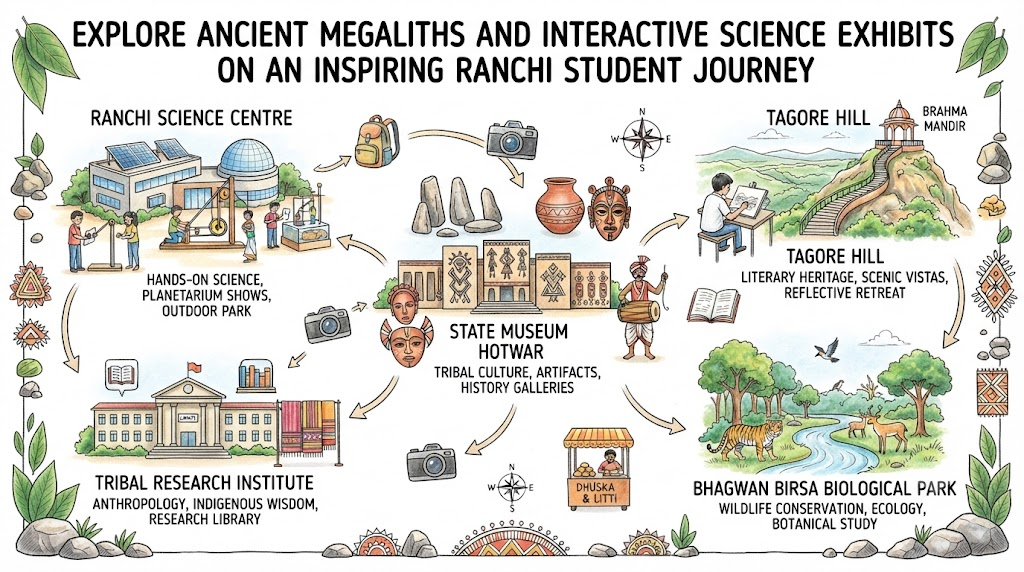
The city’s primary educational travel circuit divides naturally into three coherent corridors: the northern academic-natural belt (Morabadi, Tagore Hill, and Kanke), the eastern cultural-curatorial cluster (Hotwar Sports Complex and the State Museum), and the southern environmental conservatories (Dhurwa and Ormanjhi).
| Parameter | Details & Practical Facts |
|---|---|
| Geographic Zone | Chota Nagpur Plateau, South Chotanagpur Division |
| Primary Focus | Indigenous Heritage, Applied Physics, Paleontology, Biodiversity |
| Best Travel Period | October through March (Crisp mornings, pleasant afternoons) |
| Transit Hubs | Ranchi Railway Station (RNC), Birsa Munda Airport (IXR) |
| Ideal Trip Duration | 2 to 3 Full Days |
| Language Dynamics | Hindi, Nagpuri, Mundari, Kurukh, English |
Best Places or Experiences
Ranchi Science Centre
Spread over an expansive 13-acre campus in Chiraundi, the Ranchi Science Centre serves as Eastern India’s standout destination for hands-on, non-formal science education. Inaugurated through collaboration between the National Council of Science Museums and the Government of Jharkhand, the modern double-storey facility strips away the intimidation of textbook equations, transforming physics, biomechanics, and resource ecology into tactile experiments.
Ranchi Science Centre in Morabadi.
Inside, three dedicated thematic galleries—Fun Science, How Things Work, and Wealth of Jharkhand—capture the imagination. The natural wealth gallery gives learners a three-dimensional perspective on regional mineral veins, coal seam extraction, and Chota Nagpur’s rich biodiversity. Outdoors, a manicured science park features working levers, acoustic whisper dishes, optical illusion stations, and prehistoric dinosaur models.
- Location: Chiraundi Village, Near Morabadi, roughly 8 km from Ranchi Railway Station.
- Why it is worth visiting: It bridges foundational scientific theories with interactive, tactile apparatuses and dedicated galleries displaying Jharkhand’s geological riches. Ranchi
- Best things to do: Attend a digital show at the on-site Taramandal planetarium, operate the pulley and pendulum systems in the outdoor science park, and observe the underground coal seam demonstration. Discover India
- Best time to visit: Weekday mornings between 10:30 AM and 1:30 PM to avoid larger afternoon school excursions.
- Ideal for whom: School learners, STEM students, young innovators, and curious families.
- Travel tip: Book entry tickets along with the planetarium and 3D theatre package right at the central counter upon entry to secure seats before batches sell out. Discover India
State Museum Hotwar
The State Museum at Hotwar, officially named the Jharkhand State Museum, stands as the premier institutional vault documenting the anthropological, artistic, and martial histories of the plateau. Housed in a grand architectural complex within the Mega Sports Complex precinct, this institution organizes thousands of years of regional human existence into eleven meticulously curated galleries.
State Museum Hotwar campus exterior.
Students wander through extensive displays featuring prehistoric stone tools unearthed across Chota Nagpur river basins, ancient terracotta seals, copper hoards, and delicate medieval sculpture. The crown jewel for cultural learners is the ethnographic wing: full-scale life installations demonstrate authentic indigenous tribal dwellings, ancestral fishing baskets, brass jewelry, musical instruments, and traditional hunting gear across the Santhal, Munda, Oraon, and Ho communities.
- Location: Khelgaon Mega Sports Complex, Hotwar, about 10 km northeast of the Ranchi city center.
- Why it is worth visiting: It preserves rare megalithic artifacts, 6th-century classical sculptures, and authentic installations depicting ethnic tribal life and customary arts.
- Best things to do: Study the ancient Asur iron-smelting technology exhibits, sketch authentic Sohrai and Kohbar murals, and examine the Numismatics gallery’s historic coin displays.
- Best time to visit: Tuesday through Friday from 11:00 AM to 3:00 PM for calm, uncrowded study sessions.
- Ideal for whom: History majors, sociology researchers, art students, and archaeology enthusiasts.
- Travel tip: The museum remains strictly closed on Mondays and national gazetted holidays; carry student identification cards to access nominal ticketing rates.
Tagore Hill
Perched serenely atop an isolated granite outcrop rising 300 feet above the plateau, Tagore Hill (known locally as Morabadi Hill) fuses deep literary history with contemplative solitude. The pavilion was acquired and built by Jyotirindranath Tagore, the elder brother of Nobel laureate Rabindranath Tagore, who chose this breezy hilltop as his final artistic hermitage and spiritual retreat.
Tagore Hill structure in Morabadi.
Reaching the summit requires scaling roughly 100 well-laid stone steps shaded by dense trees. At the top sits Brahma Mandir, an open-pillared monument where Jyotirindranath composed literary translations and observed starry skies, alongside the historic residential bungalow Shanti Dham below. The panoramic 360-degree vista reveals Ranchi’s changing topography, offering students a calm space for creative writing, nature sketchbooks, and historical reflection.
- Location: Morabadi, approximately 4 km north of the Ranchi city center.
- Why it is worth visiting: It holds century-old cultural connections to the Bengali Renaissance while providing an elevated geographic viewpoint over the northern plateau floor.
- Best things to do: Photograph the vintage British-era colonial masonry, read poetry inside the quiet pavilion, and observe urban rock formations from the edge.
- Best time to visit: Early dawn (6:00 AM to 8:00 AM) or sunset to catch soft natural lighting and calm breezes.
- Ideal for whom: Literature scholars, architecture and design students, nature photographers, and solo thinkers.
- Travel tip: Wear sturdy walking footwear with good grip, as the granite stone steps can turn slick right after seasonal afternoon showers.
Tribal Research Institute and Museum
Located in the heart of Morabadi, the Dr. Ram Dayal Munda Tribal Welfare Research Institute (TRI) is an elite academic facility dedicated to documenting indigenous wisdom systems. Unlike generic tourist spots, this center serves primarily as an active field-research and documentation body, making it an invaluable resource for advanced learners investigating socio-cultural systems, environmental conservation, and linguistics.
The institute’s adjoining museum displays rare ceremonial artifacts, traditional textiles, Dokra metal castings, and ritual bamboo vessels that are seldom displayed publicly. Informative bilingual wall panels illustrate the self-governance institutions of regional tribes, including the Parha Panchayat and Manki-Munda systems. It offers visitors a deep lesson in community ecology, forest conservation ethics, and centuries-old sustainability models practiced by local forest-dwelling communities.
- Location: Near Morabadi Ground, around 5 km from Ranchi Railway Station.
- Why it is worth visiting: It presents academic research, living linguistic charts, and verified ethnographic field documentation of Jharkhand’s 32 tribal groups.
- Best things to do: Study the working models of traditional sacred groves (Jaherthan/Sarna), review archival research monographs in the reference library, and examine indigenous musical instruments.
- Best time to visit: Weekdays between 11:00 AM and 4:00 PM when research fellows and curatorial staff are available to assist.
- Ideal for whom: Anthropology candidates, social science researchers, environmental ethics students, and folklorists.
- Travel tip: Inquire politely at the administrative desk for permission to view the archival research library if you are compiling formal field notes or college theses.
Bhagwan Birsa Biological Park
Encompassing over 104 hectares of native scrub forest along National Highway 20, Bhagwan Birsa Biological Park (commonly called Ormanjhi Zoo) is an active center for ex-situ conservation and ecological pedagogy. Intentionally partitioned by the scenic Sapahi River, the facility mirrors natural habitat zones, ditching small concrete cages in favor of expansive, vegetation-rich open moats.
Students of zoology, veterinary medicine, and environmental science can closely observe keystone sub-Himalayan and central Indian species. The zoo houses Royal Bengal tigers, Asiatic lions, leopards, Indian gaurs, and diverse deer species. A dedicated botanical conservatory, medicinal plant nursery, and modern aquatic life aquarium give students practical exposure to botany, animal nutrition programs, and species survival plans.
- Location: Ormanjhi, NH 20, roughly 22 km north of central Ranchi.
- Why it is worth visiting: It delivers direct lessons in conservation biology, wildlife behavior, and botanical taxonomy across a native sal ecosystem.
- Best things to do: Walk the self-guided botanical nursery trail, study the veterinary rehabilitation enclosure practices, and visit the freshwater aquarium gallery.
- Best time to visit: Mid-November to February, from 9:30 AM to 1:00 PM when animals remain active in open-air paddocks.
- Ideal for whom: Life sciences students, wildlife conservationists, veterinary aspirants, and eco-clubs.
- Travel tip: Hire an electric golf cart at the main entrance if conducting timed botanical sampling, as walking the full forested loop covers over five kilometers.
Jharkhand Biodiversity Park
Nestled in the southern suburbs of Lalgutwa, the Jharkhand Biodiversity Park represents one of the state’s most ambitious field-biology projects. Managed with a focus on conservation research, this vast green lung protects regional flora facing urban and industrial pressures. The park is carefully arranged into specialized botanical zones, including a medicinal plant quadrant, a bamboo garden displaying multiple endemic bamboo varieties, an arboretum, and an orchid house.
For students exploring botany, pharmacy, and environmental studies, the living herbal repository serves as an educational goldmine. Each plant specimen is cataloged with clear scientific taxonomy, vernacular names, and therapeutic applications rooted in traditional indigenous healing systems. Paved walking tracks and clear canopy heights also make it a prime hotspot for avian census projects and insect biodiversity documentation.
- Location: Lalgutwa, Near Ring Road, around 15 km southwest of Ranchi Railway Station.
- Why it is worth visiting: It acts as a live ecological repository of endangered Chota Nagpur flora and medicinal plants.
- Best things to do: Document species in the medicinal herb nursery, examine diverse bamboo species, and join early-morning birdwatching trails around the wetland zone.
- Best time to visit: 8:00 AM to 11:30 AM during autumn or spring when flowering species are in full bloom.
- Ideal for whom: Botany students, pharmacy and ayurveda researchers, nature club members, and macro photographers.
- Travel tip: Bring a field notebook, a magnifying lens, and water; commercial kiosks are intentionally absent inside the conservation core to prevent litter.
Offbeat Exploration: Hidden Gems Tourists Miss
McCluskieganj Heritage Settlement
Tucked approximately 60 km northwest of Ranchi lies McCluskieganj, a colonial Anglo-Indian enclave founded in the 1930s by the Colonisation Society of India. Students of modern history and colonial architecture can tour historic red-brick bungalows, English cottages, and timber-framed community halls nestled under quiet fruit orchards. Beyond its nostalgic architecture, the town provides an intriguing case study on social geography, cultural evolution, and post-colonial community identity.
Getalsud Dam Research & Aquaculture Enclave
While day-trippers gather around the main reservoir spillway for quick picnics, the eastern banks host dedicated fisheries research, hydro-monitoring stations, and cage-aquaculture operations. Engineering and limnology students can observe water harvesting models, reservoir silt management, and inland fisheries science. Visiting during dawn offers a calm view of water-management systems framed by mist-covered hillocks.
Tupudana Dokra Craft Workshops
Located in the peri-urban fringes south of Hatia, small artisan clusters preserve the lost-wax casting technique (Dokra), which dates back to the Indus Valley Civilisation. Design, art, and metallurgy students can watch generational artisans sculpt clay cores, wind beeswax threads, encase forms in river silt, and pour molten brass. Engaging directly with master artisans reveals ancient metallurgical insights that typical museums cannot duplicate.
Detailed Practical Guidance for Travelers
| Destination | Standard Entry Fee | General Timings | Best Local Food Options Nearby | Recommended Nearby Attractions |
|---|---|---|---|---|
| Ranchi Science Centre | ₹20 per person (Extra for 3D/Planetarium) | 10:00 AM – 5:30 PM (Closed Mondays) | Street litti-chokha & roll stalls near Morabadi Ground | Tagore Hill, Tribal Research Institute |
| State Museum Hotwar | ₹10 for adults, ₹5 for students | 10:30 AM – 4:30 PM (Closed Mondays) | Khelgaon canteen, Highway dhabas along Booty More | Mega Sports Complex, Remnants of Gonda rock cuts |
| Tagore Hill | Free entry | 6:00 AM – 6:30 PM (Daily) | Local tea shops, Morabadi breakfast stalls, Dosa kiosks | Ranchi Science Centre, Rock Garden |
| Tribal Research Institute | Free entry / Academic permit | 10:30 AM – 5:00 PM (Weekdays only) | Morabadi street-food hub, Indian Coffee House | Morabadi Ground, Ranchi Lake |
| Bhagwan Birsa Biological Park | ₹30 per adult, ₹15 for children | 9:00 AM – 4:30 PM (Closed Mondays) | Local dhabas along NH 20 serving Dehati chicken & rice | Rukka Dam, Getalsud reservoir banks |
| Jharkhand Biodiversity Park | ₹20 per person | 9:00 AM – 5:00 PM (Daily) | Kathal More sweet outlets, roadside traditional tiffin | Jagannath Temple Dhurwa, Ring Road dhabas |
Logistics & On-Ground Navigation
Local Transport Options
Navigating Ranchi requires matching the right mode of transit to the city’s varied terrain:
- Shared Auto-Rickshaws (Tempos): The everyday transit choice for students. Fixed-route shared autos run frequently along main arteries (Ratu Road, Main Road, Hinoo, Kantatoli, Booty More), charging modest fares between ₹10 and ₹25.
- E-Rickshaws (Totos): Ideal for short, quiet connections within neighborhoods like Morabadi, Kanke, and Ashok Nagar.
- Ride-Hailing Apps: Services like Ola, Uber, and Rapido bike taxis operate reliably across the urban core, serving as the quickest choice for solo researchers traveling between distant campuses.
- Private Auto Charters: For suburban sites like Hotwar or Ormanjhi, negotiate a round-trip day rate with a local auto driver before setting out.
- Car Rentals / Self-Drive: Renting an economy vehicle is best for full-day group trips linking outer sites like McCluskieganj, Ormanjhi, and the southern ring road.
Budget Planning
Ranchi remains one of India’s most affordable state capitals for educational travel:
- Budget / Student Tier (₹700 – ₹1,200 per day):
- Stay: Youth hostels, student guest houses, or budget lodges around Station Road (₹400 – ₹700/night).
- Meals: Nutritious local thalis, dhuska snacks, and street litti-chokha (₹200 – ₹300/day).
- Transit: Shared tempos and electric totos (₹100 – ₹150/day).
- Entry Fees: Student-discounted entry passes (₹50/day).
- Mid-Range / Comfort Tier (₹2,500 – ₹4,500 per day):
- Stay: Reputable 3-star business hotels near Lalpur, Main Road, or Kadru (₹1,800 – ₹3,000/night).
- Meals: Sit-down meals at regional dining rooms and modern cafes (₹500 – ₹800/day).
- Transit: App-based cabs or private day-hired cars (₹800 – ₹1,400/day).
- Activities: Combined entry, planetarium shows, photography permits, and local craft shopping (₹200 – ₹300/day).
Safety and Inclusivity Tips
- For Families: The open green campuses at Ranchi Science Centre, Ormanjhi Zoo, and the Biodiversity Park are stroller-friendly and safe for children. Keep track of show timings to avoid long ticket lines on hot afternoons.
- For Couples & Solo Explorers: Suburban spots like Tagore Hill and Biodiversity Park are peaceful and scenic during the day. However, wrap up visits by dusk when illumination along outskirts roads becomes sparse.
- General Health and Security: Tap water should not be consumed directly; carry a refillable filtered water bottle. Dial 112 for unified emergency assistance. Keep emergency cash handy, as remote suburban ticket kiosks occasionally face network downtime for UPI scanners.
Strategic Travel Planning Guardrails
Travel Planning Tips for Ranchi
- Target the Winter Window: Plan your itinerary between November and mid-February to enjoy cool 12°C to 24°C days, which are ideal for outdoor walks and open-air science centers.
- Carry Physical Student Identification: Always keep your official high school or university ID card in your backpack to unlock discounted entry rates across museums and science parks.
- Keep Balanced Payment Methods: While UPI digital payments work at central city retail counters, small roadside eateries, suburban parking booths, and regional artisan sheds still run exclusively on small cash notes (₹10, ₹20, and ₹50).
- Dress for Variable Microclimates: Because Ranchi sits on an elevated plateau, pleasant daytime temperatures drop sharply after sunset; pack a lightweight fleece jacket or wool shawl.
- Respect Sacred Spaces: When visiting tribal cultural sites or sacred groves (Sarna sthals), step quietly, avoid disturbing marked rock altars, and always ask permission before taking photographs.
Common Mistakes to Avoid
- Underestimating Travel Distances: Do not schedule Ormanjhi Zoo in the morning and Biodiversity Park in the afternoon; traversing city traffic from north to south can take over 90 minutes.
- Visiting Museums on Mondays: Never plan museum excursions on Mondays, as the State Museum, Tribal Research Institute, and Science Centre are closed for weekly maintenance.
- Relying Only on App Cabs for Rural Return Legs: Avoid booking one-way app cabs to distant spots like Ormanjhi or Getalsud; drivers rarely accept return pickups from rural borders. Always retain your driver on a waiting basis.
- Skipping Indigenous Street Foods: Do not default solely to generic fast-food franchises. Missing fresh steamed marua flatbreads, spiced dhuska, and charcoal-roasted litti means missing the city’s culinary soul.
- Overpacking the Daily Schedule: Avoid scheduling more than three academic destinations per day; dense museum collections require unhurried observation and reading time.
Suggested Itinerary Blueprints
1. Day Quick Dash (The Morabadi Intellectual Sprint)
Target Audience: Solo students, transit travelers, and weekend researchers with limited hours.
- 08:00 AM – 10:00 AM: Climb Tagore Hill for morning panoramas and explore the historic Jyotirindranath Tagore heritage structures.
- 10:30 AM – 01:30 PM: Tour the Ranchi Science Centre; explore interactive physics halls and attend the morning planetarium show. Discover India
- 01:30 PM – 02:30 PM: Enjoy a traditional lunch of dhuska-ghugni and tea near Morabadi Ground.
- 02:30 PM – 04:30 PM: Explore the Tribal Research Institute and Museum, taking notes on traditional architecture and regional crafts.
- 05:00 PM: Finish with an evening walk around Ranchi Lake or the handicraft emporiums on Main Road.
2. Day Deep-Dive (Heritage, Ecology & Applied Science)
Target Audience: College student groups, science clubs, and cultural researchers.
- Day 1: Applied Physics and Living Anthropology
- Morning: Explore the Ranchi Science Centre and outdoor science park exhibits. Ranchi
- Midday: Visit Tagore Hill for architecture and quiet reflection.
- Afternoon: Spend 3 hours browsing ethnographic and archaeological galleries at the State Museum Hotwar. Discover India
- Evening: Sample local street cuisine and browse handicraft books in Lalpur.
- Day 2: Flora, Fauna, and Traditional Arts
- Morning: Head north to Bhagwan Birsa Biological Park in Ormanjhi for biodiversity studies.
- Afternoon: Return via Kanke to observe agricultural research nurseries and dam catchment areas.
- Late Afternoon: Tour the Tupudana Dokra artisan hamlet to watch traditional lost-wax casting.
3. Complete Weekend Travel Plan (The Comprehensive Ranchi Scholar Circuit)
Target Audience: Families, outstation academic delegations, and curious weekend explorers.
- Friday: Historic Arrival and Urban Overview
- Arrive by midday and check into your stay near Morabadi or Lalpur.
- Take a late-afternoon walk up Tagore Hill to take in the city’s topography.
- Browse regional history books at local bookshops on Main Road.
- Saturday: The Scientific and Anthropological Heart
- Spend your morning exploring the interactive galleries at Ranchi Science Centre. Ranchi
- Have a traditional lunch of rice, seasonal saag, and dehati dal.
- Dedicate your afternoon to the comprehensive collections at State Museum Hotwar. Discover India
- Wrap up with dinner at an authentic local restaurant serving Jharkhandi thalis.
- Sunday: Living Ecosystems and Sustainable Craft
- Set out early for the Jharkhand Biodiversity Park in Lalgutwa for a guided botany and birding walk.
- Head to Tupudana to study lost-wax metal craft directly from artisan families.
- Purchase GI-tagged Sohrai art souvenirs and genuine Dokra keepsakes from official tribal cooperative outlets before your evening train or flight.
Common Tourist Mistakes to Avoid
- Geographic Blunders: Combining northern destinations like Ormanjhi Zoo with southern hubs like Biodiversity Park on the same afternoon leads to hours stuck in city traffic bottlenecks. Group your stops into tight, sensible geographic pockets.
- Commercial Traps: Spending afternoons in modern malls on Kanke Road strips away the city’s unique regional charm. Dedicate your hours instead to authentic open-air campuses, local nurseries, and tribal heritage museums.
- Neglecting Modern/Alternative Zones: Skipping the evolving creative cafes, independent studios, and quiet residential lanes around Ashok Nagar and Morabadi overlooks the vibrant contemporary youth culture flourishing across modern Ranchi.
- Transport Overpayment: Always confirm tempo routes before boarding, and cross-reference auto quotes using app-based ride services to ensure fair rates.
- Luxury Dining Bias: Sticking only to hotel buffets means missing out on quintessential local flavors. Try street-side vendors preparing crisp dhuska with black-chana curry, seasonal bamboo shoot curries (karil), and fire-roasted litti.
Frequently Asked Questions
1. What makes the Ranchi Science Centre particularly useful for school and college students?
The centre uses an interactive learning approach with over sixty working exhibits in galleries like Fun Science and How Things Work. Rather than just reading textbook theories, students can directly test physical principles, learn about the state’s geology, and attend informative shows inside the digital planetarium.
2. Where can students explore authentic tribal culture and historical artifacts in Ranchi?
The State Museum at Hotwar and the Tribal Research Institute in Morabadi are the two best spots. They house genuine ethnographic displays, prehistoric stone tools, traditional music instruments, and life-size dioramas of tribal households.
3. Are there student discounts available for entry tickets at educational sites across Ranchi?
Yes, institutional places like the State Museum Hotwar, Ranchi Science Centre, and Birsa Biological Park offer discounted admission for students. Always carry an official, valid school or college identification card to show at the ticket counter.
4. How can students travel affordably between educational spots in Ranchi?
Shared auto-rickshaws (tempos) and electric rickshaws (totos) are the most economical choice, charging between ₹10 and ₹25 on fixed routes. For groups carrying project gear, booking round trips through app-based cabs keeps travel reliable and budget-friendly.
5. What is the historical and educational significance of visiting Tagore Hill?
Tagore Hill is the historic site where Jyotirindranath Tagore lived and translated literary classics into Bengali. It offers students an inspiring look at colonial architecture and a breezy vantage point for nature study and sketch sessions.
6. Which educational spot in Ranchi is ideal for studying plant biology and medicinal species?
Jharkhand Biodiversity Park in Lalgutwa is the premier spot for plant studies. It features dedicated plots for medicinal plants, diverse bamboo species, and an arboretum, with each plant clearly labeled by its botanical name and traditional uses.
7. Can students watch traditional crafts being made near Ranchi?
Yes, the artisanal village of Tupudana near Hatia allows students to see the traditional lost-wax casting technique (Dokra) up close. Visitors can observe local artisans crafting brass sculptures from clay cores, natural wax, and metal.
8. What is the best season to organize an educational tour to Ranchi?
The best months run from October through March, when daytime temperatures stay between 15°C and 25°C. This pleasant weather allows student groups to walk through expansive outdoor sites like the science park, zoo, and botanical gardens comfortably.
9. Are guided educational tours available at the State Museum Hotwar?
Curatorial attendants and educational guides are often available on-site to assist pre-booked student groups. Contacting the museum administration in advance helps arrange a walkthrough focused on regional archaeology, numismatics, or tribal customs.
10. What local food options are recommended for students traveling on a budget?
Local staples like dhuska served with spiced chickpea curry, roasted litti-chokha, and marua roti are nutritious, widely available, and cost between ₹30 and ₹60. The food stalls around Morabadi Ground offer safe, freshly cooked choices.
11. Is photography permitted inside educational museums and science galleries in Ranchi?
Personal mobile photography is generally allowed in outdoor parks and general halls, though some galleries charge a nominal camera fee. Specialized artifact rooms and planetarium shows restrict flash photography to protect exhibits and viewing quality.
12. Why should students add McCluskieganj to their regional travel itinerary?
McCluskieganj offers an engaging case study in community history and architecture. Visiting this unique Anglo-Indian settlement lets history, geography, and literature students explore old European-style cottages and learn about historical cooperative societies.
Conclusion
Traveling through Ranchi as an intentional learner offers a welcome alternative to predictable, commercialized tourist routes. Here, education is not confined to glass cases or dry placards; it breathes through the rustling sal leaves atop Tagore Hill, resonates in the rhythm of tribal drums preserved across Hotwar, and sparks curiosity within the interactive halls of the Science Centre. Choosing this journey across the ancient Chota Nagpur Plateau rewards students with genuine insights, cultural appreciation, and a fresh enthusiasm for exploration that outlasts any ordinary vacation.
