Introduction
Most mainstream vacation circuits funnel crowds through homogenized commercial corridors and identical souvenir stalls. Ranchi stands apart as an ancient plateau country where red loam, sal canopies, and living indigenous heritage shape every highway and hillock.
This is not a passive sightseeing stopover. Setting foot in Ranchi means connecting directly with stone shrines carved centuries ago, sacred tribal hillocks, and evocative memorials that honor fierce anti-colonial resistance.
Why Ranchi is a must-visit city
Ranchi serves as the intellectual and geographical gateway to the Chhota Nagpur Plateau. Its history weaves together medieval dynastic architecture, pioneering anti-colonial tribal rebellions, and the literary footprint of the Bengal Renaissance. Geologically situated on elevated tablelands, it combines dramatic rocky outcrops with ancient monsoon-fed water channels that sustained complex tribal kingdoms for generations.
Getting here is seamless for modern travelers. Birsa Munda Airport (IXR) links directly to major metros like Delhi, Mumbai, and Kolkata, while Ranchi Junction (RNC) connects extensive railway routes. Broad national highways run across the plateau, flanked by reputable hospitality chains, government guest houses, and scenic homestays.
The regional heritage circuit splits cleanly into two axes: an inner urban heritage belt celebrating literary retreats and tribal revolutions, and an outer circuit containing 17th-century Nagvanshi royal fortresses and medieval temple complexes.
| Feature | Details | Travel Relevance |
|---|---|---|
| Regional Terrain | Elevated Chhota Nagpur Granite Plateau | Mild plateau breezes, scenic rocky knolls |
| Key Historical Periods | Nagvanshi Dynasty, British Raj, Ulgulan Tribal Resistance | Diverse architectural styles and archaeological sites |
| Primary Airport | Birsa Munda Airport (IXR) | 15–20 minutes drive to city center |
| Primary Railhead | Ranchi Junction (RNC) / Hatia (HTE) | Direct superfast connectivity across India |
| Best Exploring Months | October through March | Pleasant daytime walking weather |
Best Places or Experiences
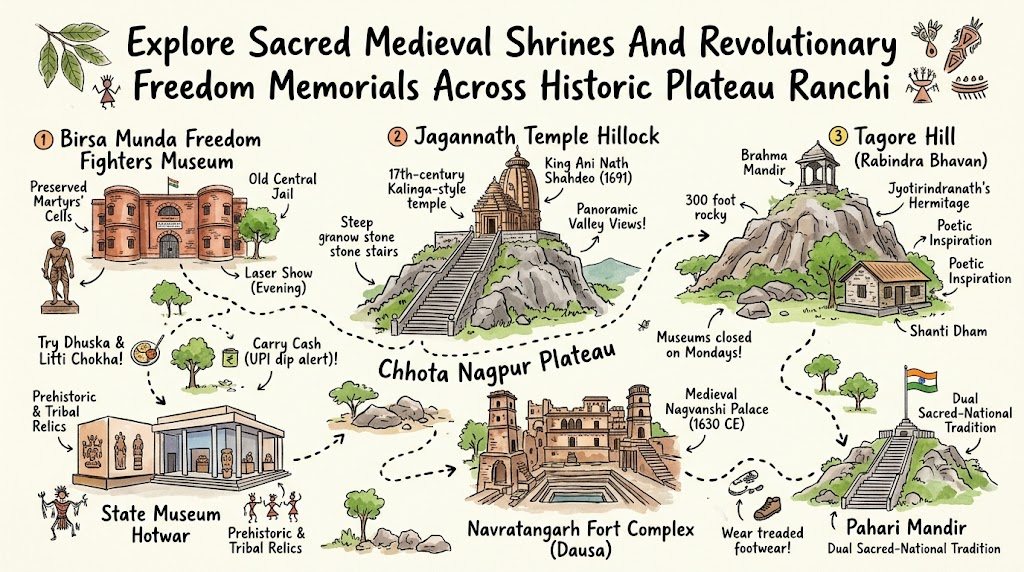
Bhagwan Birsa Munda Smriti Udyan and Freedom Fighters Museum
This sprawling memorial complex occupies the meticulously restored Old Central Jail, where the tribal freedom fighter Birsa Munda was imprisoned and attained martyrdom in 1900. The historic cellblocks have been converted into an immersive historical learning space that details the legendary Ulgulan (Great Tumult) movement against colonial land exploitation.
Walking through the preserved barracks reveals life-size bronze statues, multimedia galleries, and curated archival displays dedicated to indigenous leaders who rebelled against foreign rule. It provides an indispensable foundation for understanding the spirit and grit of Jharkhand’s tribal heritage.
- Location: Jail More, Ahirtoli, central Ranchi.
- Why it is worth visiting: It is the sacred epicentre of tribal resistance history, preserving the authentic brick cell of Birsa Munda. RanchiOrbit
- Best things to do: Walk the silent interior of Birsa Munda’s memorial cell, explore the 13 monumental statues of regional tribal heroes, and attend the evening musical laser fountain show. RanchiOrbit
- Best time to visit: Late afternoon between 3:00 PM and 6:00 PM for comfortable courtyard walking followed by the light-and-sound exhibition.
- Ideal for whom: History students, families, solo cultural travelers, and photographers.
- Travel tip: > Notice: Large camera tripods require specialized security clearance at the front desk; stick to hand-held photography gear.
Historic Jagannath Temple hillock.
Jagannath Temple Hillock
Perched on a prominent granite hill in southwest Ranchi, this 17th-century architectural marvel was commissioned in 1691 CE by King Ani Nath Shahdeo of the Chotanagpur Nagvanshi dynasty. Built with visual parallels to the legendary Puri Jagannath Temple, its soaring towers dominate the horizon.
The stone complex survived significant structural collapses over the centuries and underwent painstaking heritage restoration. Ascending the elevated flagstone steps rewards travelers with a serene open-air courtyard and panoramic views of the HEC industrial valley below.
- Location: Jagannathpur, approximately 10 kilometers southwest of Ranchi Railway Station.
- Why it is worth visiting: Rare blend of Kalinga-inspired temple architecture built under royal Chhota Nagpur patronage.
- Best things to do: Inspect the ancient masonry on the central sanctum, witness the evening brass-lamp aarti, and observe the starting point of the historic annual Rath Yatra festival.
- Best time to visit: Early morning at 6:30 AM for undisturbed prayer and quiet sunrise light over the plateau.
- Ideal for whom: Architecture enthusiasts, spiritual travelers, and landscape sketchers.
- Travel tip: Wear slip-on shoes; footwear must be deposited at the base before climbing the stone stairway.
Tagore Hill Brahma Mandir pavilion.
Tagore Hill (Rabindra Bhavan)
Rising 300 feet above the Morabadi residential plain, this solitary rocky hillock served as a quiet philosophical hermitage for Jyotirindranath Tagore, elder brother of Nobel laureate Rabindranath Tagore. Jyotirindranath spent his final years here, commissioning the stone Brahma Mandir at the peak and the Shanti Dham cottage at its base.
Rabindranath Tagore visited this quiet promontory, drawing creative inspiration from the sweeping plateau horizons and pristine breezes. Today, the site balances quiet literary contemplation with historic architecture, featuring restored plaques displaying original poetry and biographical archives.
- Location: Morabadi, roughly 4 kilometers north of Ranchi city center.
- Why it is worth visiting: Exceptional literary heritage landmark showcasing the Tagore family’s cultural connection to Jharkhand.
- Best things to do: Climb the historic flight of stone stairs, examine the architectural cupola of the hilltop Brahma Mandir, and read the preserved Bengali inscriptions along the summit terrace.
- Best time to visit: 6:00 AM to 8:00 AM for soft morning light and clear birdsong.
- Ideal for whom: Literature enthusiasts, solo writers, and heritage walkers.
- Travel tip: The summit staircase lacks continuous handrails in some sections, so take deliberate steps on morning dew.
State Museum Hotwar (Jharkhand State Museum)
The State Museum at Hotwar is the premier repository of archaeological and anthropological relics in the state. Its expansive galleries house polished stone axes from the prehistoric Chhota Nagpur belt, rare copper hoards, terracotta seals, and medieval sculptures from early dynasties.
Beyond ancient archaeology, the museum features life-size dioramas detailing the lifestyle, agricultural tools, ancestral musical instruments, and traditional housing structures of the Santhal, Munda, Oraon, and Ho tribes.
- Location: Khelgaon Sports Complex road, Hotwar, 8 kilometers east of main Ranchi.
- Why it is worth visiting: Comprehensive historical bridge connecting prehistoric stone-age Jharkhand to the modern tribal commonwealth.
- Best things to do: Study the ancient sculptural gallery, explore authentic tribal hunting apparatus, and review the rare copper-plate epigraphs.
- Best time to visit: Midday between 11:30 AM and 3:00 PM, making it an ideal indoor learning respite.
- Ideal for whom: Academic researchers, students, and culture-focused travelers.
- Travel tip: The museum remains closed on Mondays; plan your visit from Tuesday to Sunday.
Navratangarh Fort Complex (Dausa)
Situated just outside Ranchi district, Navratangarh is a magnificent, fortified palace complex built by King Durjan Shah of the Nagvanshi dynasty around 1630 CE. Captured and imprisoned by the Mughal Emperor Jahangir, Durjan Shah was later released due to his gemological expertise in diamonds and relocated his royal capital here.
The ruins feature an ingenious multi-storied palace structure, carved stone gateways, sunken stepwells, and ancient watchtowers engineered from local rubble masonry and lime surkhi. Ongoing excavations by the Archaeological Survey of India continue to uncover subterranean waterways and royal assembly chambers.
- Location: Sisai block, Gumla district, approximately 65 kilometers southwest of Ranchi.
- Why it is worth visiting: The most historically critical medieval secular palace ruin on the Chhota Nagpur Plateau.
- Best things to do: Inspect the stepwell water engineering, photograph the surviving stone jharokhas of the royal treasury, and explore the nearby ancient Kapil Nath Temple.
- Best time to visit: Winter mornings between 9:00 AM and 1:00 PM.
- Ideal for whom: Serious history buffs, archaeology students, and off-grid road trippers.
- Travel tip: > Warning: There are no dining facilities at the archaeological site; pack plenty of drinking water and dry snacks from Ranchi.
Offbeat Exploration: Hidden Gems Tourists Miss
Tilaiya Dam Chhatri & Old Subarnarekha Colonial Outposts
Most travelers head straight to highway resorts, missing the abandoned stone check-posts and colonial-era irrigation outposts lining the upper channels of the Subarnarekha River. These quiet masonry arches offer a stark glimpse into early 20th-century hydrology and mineral transport routes.
Pahar Mandir Colonial Memorial Steps
While widely revered as an ancient Shiva shrine atop Ranchi Hill, this spot carries profound freedom-era history. During the British Raj, freedom fighters were executed here, leading locals to hoist the national tricolor at the peak post-independence—a unique dual sacred-national tradition upheld to this day.
Detailed Practical Guidance for Travelers
| Destination | Standard Entry Fee | General Timings | Best Local Food Options Nearby | Recommended Nearby Attractions |
|---|---|---|---|---|
| Birsa Munda Freedom Fighters Museum | ₹50 per person | 10:00 AM – 6:30 PM (Closed Mon) | Traditional Thali, Sattu drink at Jail Road | Nucleus Mall, Ranchi War Cemetery |
| Jagannath Temple | Free entry | 5:00 AM – 12:00 PM, 3:30 PM – 8:00 PM | Steaming Dudh Pitha, hot Jalebi stalls | Dhurwa Dam, Ring Road lookouts |
| Tagore Hill | Free entry | 6:00 AM – 6:30 PM | Morabadi street vendors (Litti Chokha, Kulhad Chai) | Tribal Research Institute Museum, Morabadi Ground |
| State Museum Hotwar | ₹20 per adult | 10:30 AM – 4:30 PM (Closed Mon) | Simple local dhabas along Booty More | Khelgaon Mega Sports Complex |
| Navratangarh Fort | Free (ASI Monument) | Sunrise to Sunset | Fresh rural Dhuska and fried chana in Sisai | Kapil Nath Temple, Palkot Wildlife Sanctuary |
Logistics & On-Ground Navigation
Local Transport Options
- App-Based Cabs: Uber and Ola operate reliably within Ranchi municipal boundaries, ideal for hops between museums and city hillocks.
- Auto-Rickshaws & E-Rickshaws: Abundant and cost-effective; share autos ply fixed routes along Ratu Road, Main Road, and Morabadi for ₹15–₹30.
- Outstation Private Hires: Renting a private taxi with a driver for the day (₹2,200 to ₹3,500) is essential for visiting distant sites like Navratangarh Fort.
Budget Planning
- Budget/Backpacking Tier: ₹1,000 – ₹1,500 per day. Covers stays in clean backpacker lodges or dorms, public transit via shared autos, and local street cuisine like Dhuska and Litti Chokha.
- Mid-Range/Comfort Tier: ₹3,500 – ₹6,000 per day. Covers boutique hotel stays, private chauffeur-driven vehicles, sit-down ethnic dining, and museum entry passes.
Safety and Inclusivity Tips
- Families: Most sites feature wide paved surfaces, though historical staircases at Tagore Hill and Jagannath Temple require steady supervision for toddlers and elderly relatives.
- Couples: Central city heritage venues are safe and welcoming; avoid unlit outer forest ruins after twilight.
- General Safety: Carry physical cash; UPI network connectivity can dip near ancient stone walls or rural districts outside Ranchi city limits.
Strategic Travel Planning Guardrails
Travel Planning Tips for Ranchi
- Prioritize the Winter Window: Plan your itinerary between November and February when day temperatures stay below 24°C.
- Carry Liquid Cash: Keep ₹1,500 to ₹2,000 in paper currency for regional toll plazas, parking stands, and rural village tea stalls. RanchiOrbit
- Respect Sacred Rituals: Modest attire covering shoulders and knees is mandatory inside sanctum courtyards at Jagannath Temple and Pahari Mandir.
- Pre-Book Peripheral Cabs: Reserve outstation transport at least 24 hours in advance if venturing into deep Gumla or Khunti heritage belts.
- Wear Treaded Footwear: Ancient granite hillocks and stone stairways get slippery during light morning precipitation.
Common Mistakes to Avoid
- Overpacking the Day: Trying to visit both eastern forest ruins and western fortresses on the same day causes long transit fatigue.
- Skipping Regional Cuisine: Don’t default to hotel room service; missing street-side Dhuska, Arsa roti, and seasonal bamboo shoots skips Ranchi’s living food heritage.
- Arriving on Closed Days: Forgetting that major public museums remain closed every Monday leads to wasted trips.
- Ignoring Sunrise Hours: Missing early morning visits leaves you exposed to intense midday sun on elevated stone hillocks.
- Neglecting Village Courtesies: Always ask permission before photographing tribal family courtyards or sacred Sarna groves.
Suggested Itinerary Blueprints
- Day Quick Dash (Urban Heritage & Cultural Core): Designed for business visitors and weekenders. Start at 7:30 AM with a tranquil climb up Tagore Hill. Spend midday touring the Birsa Munda Freedom Fighters Museum, refuel with a local thali, and close your evening watching the sunset from the Jagannath Temple courtyard. RanchiOrbit
- Day Deep-Dive (Dynastic Legacy & Forest Archaeology): For history enthusiasts. Day 1 covers the core city monuments (Hotwar State Museum, Tagore Hill, Birsa Munda Museum). Day 2 ventures outward on an early-morning expedition to the medieval stone fortress of Navratangarh, returning through rural artisan hubs in the late afternoon. ranchiorbit.com
- Complete Weekend Travel Plan (Plateau Heritage Grand Loop):
- Friday Evening: Check into your hotel, stroll through the vibrant tribal art exhibits at Morabadi, and sample hot evening Dhuska. RanchiOrbit
- Saturday: Explore the Birsa Munda Museum, the archaeological halls of Hotwar State Museum, and end with twilight aarti at Jagannath Temple. RanchiOrbit
- Sunday: Take a morning road trip to the royal ruins of Navratangarh, stopping at local rural markets before your evening departure flight or train.
Common Tourist Mistakes to Avoid
- Geographic Blunders: Group your destinations by geographic corridor. Pair Jagannath Temple with southern routes, and group Tagore Hill with the northern Morabadi cultural institutions to minimize crosstown city traffic.
- Commercial Traps: Avoid spending your afternoons inside glass shopping malls on Main Road; authentic tribal handicrafts and Dokra bell-metal artifacts are found with genuine artisans at state-run emporiums.
- Neglecting Modern/Alternative Zones: Ranchi features thriving bohemian cafes and cultural centers in Morabadi and Lalpur that celebrate contemporary tribal literature and poetry.
- Transport Overpayment: Always verify auto-rickshaw fares with locals or check estimated rates on ride-sharing apps before boarding unmetered vehicles outside railway hubs.
- Luxury Dining Bias: Dining exclusively at high-end hotel chains isolates you from iconic culinary institutions serving hand-pounded Chana Ghugni, Dudh Pitha, and sal-leaf roasted snacks.
Frequently Asked Questions
1. What is the most historically significant monument inside Ranchi city?
The Bhagwan Birsa Munda Freedom Fighters Museum in the restored Old Central Jail holds premier significance. It documents the 19th-century tribal uprisings against colonial British exploitation, preserving the authentic brick cell where Birsa Munda died. It also honors over a dozen regional tribal heroes with dedicated galleries and life-size bronze statues.
2. How old is the Jagannath Temple in Ranchi?
Ranchi’s Jagannath Temple was constructed in 1691 CE by King Ani Nath Shahdeo of the Chotanagpur Nagvanshi royal line. Modeled after the famous Puri temple in Odisha, this architectural landmark has crowned its southwest granite hillock for more than three centuries.
3. Why is Tagore Hill linked to Rabindranath Tagore?
Tagore Hill gained fame when Rabindranath Tagore’s elder brother, Jyotirindranath Tagore, made it his permanent contemplative ashram in the early 1900s. Rabindranath Tagore stayed here for quiet creative retreats. The hilltop still preserves the Brahma Mandir and historic living quarters built during that literary era.
4. What days are the historical museums in Ranchi closed?
Both the Birsa Munda Freedom Fighters Museum and the State Museum at Hotwar remain closed to visitors every Monday. They welcome guests Tuesday through Sunday from 10:00 AM or 10:30 AM onward, making midweek trips ideal to avoid local weekend foot traffic.
5. How far is the medieval Navratangarh Fort from central Ranchi?
Navratangarh Fort sits roughly 65 kilometers southwest of Ranchi near Sisai in Gumla district. Driving by private car or hired cab takes about 1.5 to 2 hours along smooth plateau highways, making it an easy and rewarding day trip for heritage enthusiasts.
6. Can elderly travelers comfortably visit the hilltop heritage sites?
Tagore Hill and Jagannath Temple require climbing steep stone stairs that may challenge travelers with limited mobility. However, the Birsa Munda Museum and Hotwar State Museum offer step-free access, smooth paved promenades, and wide elevators that cater comfortably to all visitors.
7. What tribal crafts are historically unique to the Ranchi region?
Ranchi is renowned for ancient Dokra bell-metal lost-wax casting and exquisite Sohrai-Khovar wall-painting traditions. Visitors can also find hand-carved bamboo ware and organic tussar silk fabrics across certified state artisan emporiums throughout the city.
8. Is it safe to hire a taxi for rural historical ruins outside the city?
Hiring registered cabs or pre-booked private tour vehicles is completely safe for day trips to outstation sites like Navratangarh. Just ensure you begin your return drive by mid-afternoon so you reach Ranchi city limits well before nightfall.
9. What local historical dish should travelers taste while exploring Ranchi?
Travelers should try Dhuska, a crisp, savory deep-fried cake made from fermented rice and split-chana batter, accompanied by spicy black-gram curry. Other traditional staples include coal-baked Litti Chokha and seasonal stir-fried bamboo shoots (Rugda and Sandhna).
10. What clothes are recommended for touring Ranchi’s heritage landmarks in winter?
Winter daytime temperatures are comfortable, requiring only a light cotton shirt or linen kurta. Because the plateau loses heat rapidly after sundown, carry a warm woolen pullover or fleece jacket if you plan to stay out past 5:30 PM.
11. Is photography permitted inside Ranchi’s historical museums?
Handheld smartphone photography is allowed across most galleries at the Birsa Munda Museum and Hotwar State Museum. Professional DSLR setups, video rigs, or tripods require prior written permission or small equipment fees at the admissions desk.
12. Which historical spot offers the best sunset view over Ranchi?
The summit flagstone terrace of Jagannath Temple provides the most spectacular sunset vista across Ranchi’s southern skyline. The golden evening light reflects off the distant Dhurwa Dam waters while temple bells ring for twilight prayers.
Conclusion
Traveling through Ranchi’s historical sanctuaries offers an antidote to predictable vacation itineraries. Standing on high granite ridges where medieval royals ruled, exploring quiet literary ashrams, and paying tribute to fearless tribal revolutionaries connects you directly with the living soul of the Chhota Nagpur Plateau. It is a journey that replaces hurried sightseeing with lasting cultural insight.
