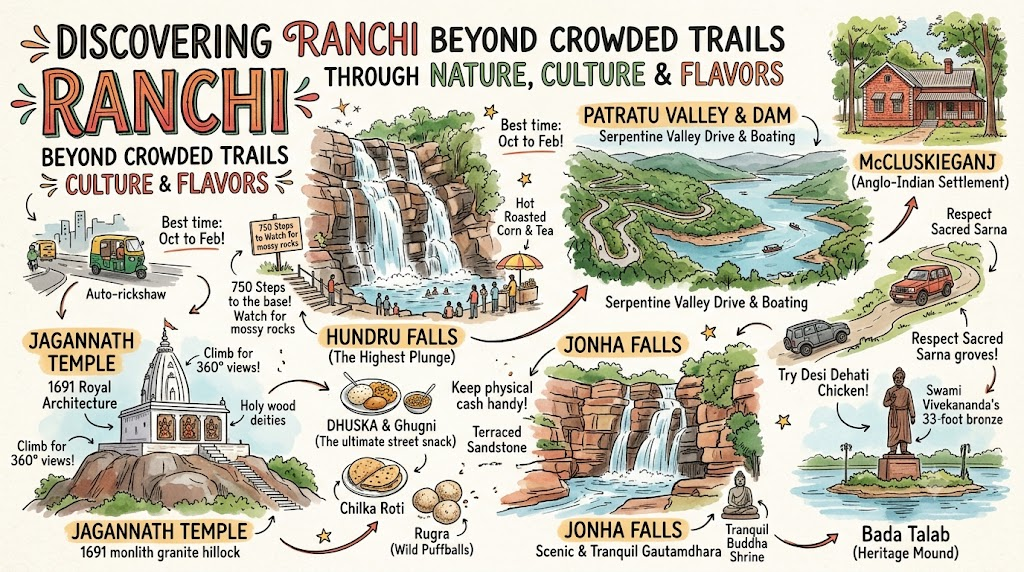
Introduction
Most mainstream vacation circuits funnel travelers into commercialized resort strips, sterile tourist complexes, and endless souvenir lines. Ranchi shatters that mundane holiday mold by offering unfiltered authenticity across the sal-covered plateaus of eastern India. Here, morning mist clings to ancient rocky knolls while the scent of wild forest greens and hot earthen griddles fills the crisp plateau air.
Perched at an elevation of 651 meters, the capital of Jharkhand preserves an organic rhythm where tribal heritage and untamed waterways define daily life. You do not come here for artificial glitz; you travel here to touch red soil, hear roaring plunge cascades, and connect with living cultural roots. It is a haven for mindful travelers craving honest hospitality and unscripted outdoor discovery.
Why Ranchi is a must-visit city
Ranchi anchors the southern edge of the Chota Nagpur Plateau, serving as a civilizational cradle where indigenous traditions have thrived for millennia. During British administration, its temperate climate made it Bihar’s summer capital, leaving behind distinctive colonial bungalows and forested enclaves. Today, it offers an approachable gateway where modern arterial highways meet rugged deciduous valleys, wildlife corridors, and sprawling water bodies.
The regional travel circuit splits naturally into three distinct geographic spokes: the northern ghats winding into lush valleys, the eastern waterfall loop carved by the Subarnarekha River, and the southern heritage belt dotted with sacred shrines and vast reservoirs. Modern rail connectivity, expanding commercial flight operations at Birsa Munda Airport, and smooth four-lane state corridors make navigating these diverse terrains seamless for solo backpackers, road-trippers, and multigenerational families alike.
| Dimension | Details & Regional Significance |
| Geographic Setting | Chota Nagpur Plateau (approx. 651 m elevation), rolling granite terrain |
| Primary River Systems | Subarnarekha, South Koel, Juar, and Kanchi basins |
| Climate Profile | Humid subtropical; mild summers, crisp winters (7°C to 22°C), wet monsoons |
| Major Transit Hubs | Birsa Munda Airport (IXR), Ranchi Junction (RNC), Hatia (HTE) |
| Culinary Signatures | Dhuska, Chilka Roti, Rugra (wild puffballs), Arsa, Bamboo Shoot curries |
| Cultural Heritage | Munda, Oraon, and Ho indigenous traditions, Sarhul and Karma festivals |
Best Places or Experiences
Hundru Falls
Hundru Falls represents one of the Chota Nagpur Plateau’s most breathtaking geological spectacles. Here, the holy Subarnarekha River plummets over 98 meters across stepped metamorphic gneiss, creating a deafening roar and sending fine plumes of water vapor into the surrounding canopy.
The descent toward the foot pool traverses nearly 750 concrete steps carved into the hillside. At the bottom, weathered black rocks cradle frothing pools where local fishermen navigate the shallows, while vendors serve hot roasted corn brushed with mustard oil and sea salt.
- Location: Angara block, approximately 45 km northeast of Ranchi city center.
- Why it is worth visiting: It stands as the highest plunge waterfall easily accessible from the urban center, showcasing striking basaltic rock formations carved over geological epochs.
- Best things to do: Descend the stone steps for wide-angle landscape photography, sample fresh hot tea at the canyon rim, and examine ancient stone strata at the riverbed.
- Best time to visit: October to February when water volume remains robust and trails dry out.
- Ideal for whom: Adventure travelers, landscape photographers, and active road-trippers.
- Travel tip: Wear shoes with deep rubber tread because moss makes the wet rocks near the base pool dangerously slick.
Patratu Valley and Dam
Carved through the Ramgarh-Ranchi border range, Patratu Valley offers an engineering marvel of hair-raising hairpin bends slicing through dense teak and sal forests. As your vehicle navigates these spiraling switchbacks, panoramic vistas open up over emerald ridges descending toward the expansive Patratu Dam reservoir below.
The waterfront promenade delivers a tranquil escape with motorized boating, quiet walking piers, and sweeping sunset perspectives. In the late afternoon, golden light casts deep amber hues across the quiet waters, making the valley drive one of the most celebrated road trips in eastern India.
- Location: Patratu basin, roughly 38 km north of Ranchi via Kanke Road.
- Why it is worth visiting: Provides dramatic serpentine highway vistas that rival international coastal and alpine drives, paired with an expansive aquatic leisure zone.
- Best things to do: Stop at designated valley viewpoints for photographs, rent a motorboat to tour the dam islands, and drive the sweeping curves during twilight.
- Best time to visit: Late afternoon (3:30 PM to 6:00 PM) to witness the sunset over the reservoir.
- Ideal for whom: Motorcyclists, weekend road-trippers, couples, and photography enthusiasts.
- Travel tip: Avoid lingering at isolated roadside turns after dusk; stick to the well-lit dam promenade and marked lookout cafes.
Jagannath Temple
Erected in 1691 by Thakur Ani Nath Shahdeo, the king of Barkagarh Jagannathpur, this historic temple mirrors the Puri Jagannath architectural idiom atop a monolithic granite hillock. Its striking whitewashed spire commands the southern Ranchi horizon, radiating serene spiritual weight over the surrounding plains of Hatia.
Reaching the inner sanctum involves climbing a gentle flight of stone steps bordered by banyan canopies. Inside, the deities of Lord Jagannath, Balabhadra, and Subhadra are carved from sacred wood, honoring ancient tribal and Vaishnavite syncretic traditions celebrated during the monumental annual Rath Yatra festival.
- Location: Jagannathpur, approximately 10 km southwest of Ranchi railway station.
- Why it is worth visiting: It preserves over three centuries of regional royal architecture and offers an uninhibited 360-degree panoramic vista across the city.
- Best things to do: Attend the tranquil morning aarti, climb the rocky plateau flanks behind the shrine for panoramic views, and explore the lower chariot grounds.
- Best time to visit: Early morning (6:30 AM to 8:30 AM) for cool breezes and quiet contemplation.
- Ideal for whom: Cultural heritage seekers, architectural photographers, and families.
- Travel tip: Leave footwear at the lower staging counter and carry a pair of thick socks to protect your feet from scorching sun-heated stone slabs by noon.
Jonha Falls (Gautamdhara)
Jonha Falls—traditionally known as Gautamdhara—is an idyllic edge-of-plateau cascade where the Raru River drops 43 meters across terraced sandstone terraces. Local folklore holds that Lord Gautama Buddha bathed in these soothing waters, giving rise to an adjacent Buddhist shrine and ashram founded nearby.
The surrounding forest preserves wild silence broken only by falling water and songbirds. Exploring the rocky banks below the main drop reveals natural wading pools and shady groves that provide an intimate alternative to larger, louder tourist sites.
- Location: Purulia Road highway circuit, 40 km east of central Ranchi.
- Why it is worth visiting: Combines therapeutic river scenery with monastic Buddhist lore and uncrowded picnic spaces.
- Best things to do: Visit the tranquil Gautam Buddha shrine, relax on the lower rocky terraces, and taste seasonal forest fruit sold by village elders.
- Best time to visit: November to February, during sunny mornings when light illuminates the falls.
- Ideal for whom: Nature lovers, meditation practitioners, and walking enthusiasts.
- Travel tip: The 500-step ascent can strain unconditioned knees; take regular breathers at the covered shade shelters built along the stairway.
Tagore Hill
Rising solitary above the Morabadi neighborhood, Tagore Hill (Morabadi Hill) stands as a monument to art, literature, and quiet contemplation. Jyotirindranath Tagore, the elder brother of Nobel laureate Rabindranath Tagore, chose this rocky hillock for his twilight years, constructing the historic Shanti Dham hermitage and Brahmo Mandir pavilion at its summit.
The 300-foot granite hill offers sweeping views over green city avenues and the Ranchi Gymkhana grounds. Ascending the winding stairway reveals why the Tagore family drew sustained creative inspiration from Ranchi’s tranquil breezes and unhurried rhythms.
- Location: Morabadi, just 5 km north of the Albert Ekka Chowk commercial center.
- Why it is worth visiting: It weaves Bengal’s 19th-century cultural renaissance with the geological solitude of the Chota Nagpur terrain.
- Best things to do: Tour the restored Shanti Dham pavilion, watch the sunset over Morabadi ridge, and stroll down into the nearby Ramakrishna Mission grounds.
- Best time to visit: 5:00 PM to 6:30 PM to catch cool breezes and panoramic sunset vistas.
- Ideal for whom: Solo travelers, readers, history enthusiasts, and sunset seekers.
- Travel tip: Combine this visit with an evening snack trail around the open street food lanes of the Morabadi Football Stadium complex right below.
Dhurwa Dam and Ring Road Circuit
Constructed across the Subarnarekha River tributary system to supply industrial Hatia, Dhurwa Dam has evolved into the city’s favorite open-air waterscape. Its earthen embankments stretch across miles of unbuilt shoreline, fringed by pine plantations and wide four-lane Ring Road corridors.
During winter, migratory Siberian birds nest along its shallow inlets, attracting birders and cyclists. Free from blaring commercial stalls, this waterfront feels like an expansive seaside retreat dropped into the heart of Jharkhand.
- Location: Dhurwa-Hatia periphery, roughly 13 km south of the Main Road market area.
- Why it is worth visiting: Delivers unobstructed horizontal horizons, cool reservoir breezes, and exceptional open-road cycling routes.
- Best things to do: Take sunset drives along the dam wall, spot migratory water birds through binoculars, and grab earthen cups of spiced chai from makeshift stalls.
- Best time to visit: Winter evenings (4:00 PM to 6:00 PM) or foggy early mornings.
- Ideal for whom: Cyclists, leisure walkers, couples, and birdwatching hobbyists.
- Travel tip: There are no safety barriers along certain stretches of the rocky riprap slope, so keep children away from slippery water embankments.
Offbeat Exploration: Hidden Gems Tourists Miss
McCluskieganj Anglo-Indian Settlement
Tucked 60 kilometers northwest of Ranchi, McCluskieganj was established in the 1930s by Ernest Timothy McCluskie as a dedicated homeland for the Anglo-Indian community. The settlement preserves old-world European charm through sprawling brick cottages, gabled roofs, fruit orchards, and deep silence beneath towering sal trees.
Wandering through its forgotten lanes feels like stepping into a vintage novel. You can visit the historic railway station, stop by charming red-brick churches, and stay in converted colonial homestays serving Anglo-Indian roast dishes and fresh baked goods.
Ranchi Lake and Bada Talab Heritage Mound
While most motorists speed past the bustling downtown corridors of Lake Road, few stop to explore the historic depths of Bada Talab. Dug in 1842 by British commissioner Colonel Thomas Wilkinson to stabilize city groundwater, this massive man-made water reservoir spans over 50 acres in the dense city core.
Rising from an island in its center stands a towering 33-foot bronze statue of Swami Vivekananda, accessible via an arched pedestrian bridge. Visiting during early dawn rewards you with absolute calm, reflecting colorful morning skies over the placid surface before city markets awaken.
Getalsud Dam Backwaters
While casual tourists crowd the main spillway of Getalsud Dam near Ormanjhi, local adventurers head to the quiet eastern backwaters near Angara. Here, the reservoir splinters into fingers of shallow red-earth inlets, framed by quiet farming hamlets and patches of undisturbed forest.
This hidden zone features no loud commercial vendors or ticket kiosks. Instead, you will find fishermen casting nets from wooden skiffs, open fields suited for private day picnics, and some of the best stargazing conditions around the plateau.
Detailed Practical Guidance for Travelers
| Destination | Standard Entry Fee | General Timings | Best Local Food Options Nearby | Recommended Nearby Attractions |
| Hundru Falls | ₹30 per adult | 6:00 AM – 5:00 PM | Fried local Fish stalls, Dhuska vendors at parking | Jonha Falls, Sita Falls |
| Patratu Valley & Dam | Free (Boating ₹100–₹400) | Open 24/7 (Boating 9 AM – 5:30 PM) | Lakeview Dhaba chicken, earthen kulhad chai | Patratu Thermal Lake, Palani Falls |
| Jagannath Temple | Free entry | 5:00 AM – 12:00 PM, 3:30 PM – 8:30 PM | Hot Kachori-Jalebi at temple stairs, Chana Bhatura | Dhurwa Dam, JSCA International Stadium |
| Jonha Falls | ₹20 per adult | 6:30 AM – 4:30 PM | Fresh boiled eggs, roasted corn, seasonal forest guavas | Gautam Buddha Ashram, Sita Falls |
| Tagore Hill | ₹10 per adult | 6:00 AM – 6:00 PM | Morabadi street food stalls, Litti Chokha kiosks | Tribal Research Institute Museum, Rock Garden |
| Dhurwa Dam | Free entry | Open 24/7 (Best in daylight) | Earthen tea stalls, roasted gram (chana zor garam) | Parasnath Hillock, Jagannath Temple |
| McCluskieganj | Free exploration | Daylight hours | Homestay Anglo-Indian roasts, countryside tea stalls | Don Bosco Academy, Duga Duggi River |
Logistics & On-Ground Navigation
Local Transport Options
Getting around Ranchi requires a mix of transit options depending on whether you are navigating dense markets or exploring distant waterfalls:
- App-Based Cabs & Autos: Services like Ola and Uber operate reliably across urban centers (Main Road, Lalpur, Doranda, Morabadi, and the Airport). They work well for city hops but seldom accept one-way drop requests to distant waterfalls like Hundru or Dassam.
- Auto-Rickshaws & E-Rickshaws (Totos): Shared auto-rickshaws run fixed routes along major arteries for ₹10 to ₹30 per passenger. For short, congested intra-city hops between alleys and markets, battery-operated e-rickshaws provide the cheapest, greenest ride.
- Hired Private Taxis: For rural waterfall and valley loops, reserve a full-day private cab (hatchbacks or SUVs) from the station or local travel desks. Rates typically run between ₹2,200 and ₹3,500 per day including fuel and driver allowances.
- Two-Wheeler Rentals: A handful of bike rental providers near Ranchi Railway Station offer automatic scooters and cruisers for ₹500 to ₹1,000 per day, which is ideal for road-tripping Patratu Ghats.
Budget Planning
Planning your expenses in Ranchi is straightforward thanks to honest local pricing:
- Budget/Backpacking Tier (₹1,200 – ₹1,800 per day): Stay in budget guesthouses or railway retiring rooms near Station Road (₹700–₹1,000/night). Rely on street food like Dhuska, Litti, and local thalis (₹200–₹350/day). Use shared auto-rickshaws and public buses for transit (₹150–₹250/day), alongside nominal monument tickets.
- Mid-Range/Comfort Tier (₹3,500 – ₹6,500 per day): Stay in quality business hotels or boutique stays around Morabadi, Main Road, or Kadru (₹2,500–₹4,200/night). Dine at heritage family restaurants and contemporary cafes (₹800–₹1,400/day). Use dedicated private cabs for full-day excursions (₹2,500/day split between companions).
Safety and Inclusivity Tips
Ranchi is generally peaceful, courteous, and safe, but navigating varied outdoor terrain calls for common sense:
- For Families: Always carry basic motion-sickness remedies when tackling the winding turns of Patratu Valley. When visiting waterfall sites, keep young children within arm’s reach; wet river rocks lack continuous safety railings.
- For Couples: Public spaces and parks like Patratu Promenade, Tagore Hill, and Dhurwa Dam welcome couples. Exercise modest public decorum in deeply traditional rural and temple zones.
- General Safety: Wrap up excursions to remote waterfall circuits like Hundru, Dassam, or Jonha by late afternoon so you can return to national highway corridors before complete darkness sets in.
Strategic Travel Planning Guardrails
Travel Planning Tips for Ranchi
- Target the Winter Window: Plan your itinerary between October and March. The post-monsoon greenery endures, days remain bright and crisp, and waterfall volumes remain high without the danger of seasonal flash floods.
- Carry Tangible Cash: While UPI digital payments are accepted across city retail counters, cellular connectivity drops in forested gorges like Hundru and Jonha. Keep ₹1,500 to ₹2,500 in physical cash for parking fees, forest tolls, and local snack stalls.
- Pack Proper Footwear: Leave dress shoes and smooth sandals at your hotel. Touring cascades and granite knolls demands sturdy walking shoes with aggressive grip.
- Respect Sacred Sarnas: When touring tribal hamlets, never disturb sacred groves marked by sal trees (Sarna Sthal). These untouched patches hold deep religious significance for indigenous communities.
- Sample Fresh Hyper-Local Produce: Between November and January, look out for unique seasonal delicacies like Rugra (earthy wild puffball mushrooms) and Bamboo Shoots (Karil) cooked in fragrant mustard oil.
Local Secret: Visit small road dhabas around the Ormanjhi-Sikidiri forest stretch for authentic Desi Dehati Chicken paired with steamed rice; the meat is slow-cooked over wood fires using freshly crushed whole spices.
Common Mistakes to Avoid
- Venturing Past Safety Chains at Waterfalls: Disregarding warning signs to climb slippery mid-river rocks has led to fatal drownings; sudden reservoir releases upstream can swell currents within minutes.
- Overbooking Waterfall Circuits in One Day: Packing Hundru, Jonha, and Dassam into a single day leaves you exhausted from climbing thousands of steep stone steps. Limit yourself to one or two per outing.
- Relying Exclusively on App Cabs for Outstation Trips: Booking an Uber or Ola out to Patratu or Hundru without arranging round-trip wait times leaves you stranded without return transport.
- Dismissing Local Street Food: Skipping street-side Dhuska, Ghugni, and Dudhori in favor of standard multi-cuisine hotel buffets robs you of Ranchi’s true culinary character.
- Expecting Late-Night Party Strips: Ranchi winds down early compared to coastal metropolises. Most kitchens close by 10:30 PM, so finish your evening dining before the city settles for the night.
Suggested Itinerary Blueprints
1. Day Quick Dash (The Capital Express Route)
Target Audience: Business travelers, transit visitors, or solo trippers with under 24 hours.
- Morning (7:30 AM – 11:00 AM): Begin early with a peaceful climb up Jagannath Temple for morning blessings and horizon views. Head down to Hinoo or Doranda for hot, crispy Dhuska and spiced chana ghugni.
- Midday (11:30 AM – 2:30 PM): Explore the rich indigenous tribal exhibits at the State Museum Hotwar, followed by an authentic regional lunch featuring mutton curry or local seasonal vegetarian thali on Kanke Road.
- Afternoon & Sunset (3:30 PM – 6:30 PM): Take an exhilarating drive up to Patratu Valley. Sip hot kulhad chai at the valley viewpoint while watching the highway lights switch on as dusk falls. Return to the city for dinner.
2. Two-Day Deep-Dive (Waterfalls & Heritage Loop)
Target Audience: Weekend explorers, families, and culture enthusiasts.
- Day 1: The Cascading Eastern Circuit
- 8:00 AM: Depart central Ranchi along the Purulia Highway toward Hundru Falls.
- 10:30 AM: Descend the steps, marvel at the rock formations, and take photos of the Subarnarekha drop.
- 1:30 PM: Drive across to Jonha Falls; rest under shady trees and enjoy freshly prepared roadside village snacks.
- 4:30 PM: Return toward Ranchi, stopping at the tranquil lakefront of Ranchi Lake to admire the Vivekananda monument at sunset.
- 8:00 PM: Dinner at a traditional restaurant on Main Road sampling Litti Chokha and Mitha Khaja.
- Day 2: City Vistas & The Serpentine Valley
- 8:00 AM: Climb the shaded steps of Tagore Hill in Morabadi; explore the Brahmo Mandir and soak in the hilltop breezes.
- 11:00 AM: Discover handicrafts, Dokra metal art, and Tussar silk at Jharcraft Emporium.
- 2:00 PM: Head north for a scenic afternoon around Patratu Dam; enjoy a peaceful boat ride across the reservoir.
- 6:00 PM: Navigate the switchbacks during twilight, returning to Morabadi for evening street foods.
3. Complete Weekend Travel Plan (Plateau Nature & Countryside Escape)
Target Audience: Road-trippers, nature lovers, and long-weekend travelers.
- Friday: Arrival & Urban Horizons
- Arrive via flight or rail; settle into your hotel near Morabadi or Kadru.
- Spend an easy afternoon around Dhurwa Dam, catching reservoir breezes.
- Evening dinner enjoying local village-style curries cooked in mustard gravy.
- Saturday: The Wild Waterscapes
- Full-day expedition dedicated to Dassam Falls (on the Tata highway corridor) and Hundru Falls.
- Picnic on packed meals or roadside dehati dhaba spreads along the national highway.
- Evening unwind with coffee and music at contemporary cafes along Morabadi.
- Sunday: Colonial Countryside Day Trip
- Take an early morning scenic country drive to McCluskieganj (60 km).
- Tour vintage Anglo-Indian stone cottages, historic churches, and walk beneath tall sal forests.
- Return by late afternoon for souvenir shopping on Main Road before your evening departure.
Common Tourist Mistakes to Avoid
- Geographic Blunders: Grouping Dassam Falls (located far south on the Jamshedpur highway) with Patratu Valley (perched far north) on the same day forces you to spend five stressful hours stuck in urban transit traffic. Keep your itineraries clustered by geographic quadrant.
- Commercial Traps: Spending your precious vacation hours inside crowded shopping malls around Lalpur rather than visiting open cultural spaces like the Tribal Research Museum or bustling Sunday weekly haats (village markets).
- Neglecting Modern/Alternative Zones: Overlooking Ranchi’s thriving modern expansions. Neighborhoods like Morabadi and Kanke Road offer tranquil tree-lined walking tracks, open-air football stadium cafes, and charming artisanal bakeries.
- Transport Overpayment: Agreeing to arbitrary roadside auto-rickshaw fares outside Ranchi Junction without checking standard shared route rates or verifying app-based estimates first.
- Luxury Dining Bias: Sticking exclusively to standard continental hotel buffets. You will completely miss the soul of Jharkhand, which lives in street-corner Dhuska-Chana, roadside Chilka Rotis, sweet Arsa pitha, and tender sal-leaf leaf platters.
Frequently Asked Questions
1. What is the best time of year to explore Ranchi’s waterfalls?
The most rewarding window spans from October through February. The torrential monsoon rains retreat, leaving rivers crystal-clear and waterfall cascades running at impressive volume. Temperatures remain comfortably cool during the daytime, and surrounding forest paths dry out, making descents down canyon steps safe and enjoyable.
2. How do I travel from Birsa Munda Airport to downtown Ranchi?
Birsa Munda Airport lies roughly 5 kilometers south of Hinoo and 7 kilometers from central Main Road. Prepaid taxi booths operate directly outside the arrivals terminal, while app-based services like Ola and Uber offer reliable pickups. The drive to most central hotels takes between 15 and 25 minutes.
3. Is it safe to drive across Patratu Valley after dark?
While the main highway over Patratu Ghat has good pavement and lighting along key bends, evening fog and sharp hairpin turns can reduce visibility. It is best to complete your descent before 7:30 PM to avoid driving through unfamiliar mountain switchbacks in pitch black.
4. What signature regional dishes should I try in Ranchi?
Prioritize Dhuska, a deep-fried savory cake made of soaked rice and lentils served with spicy chickpea curry. Be sure to sample Chilka Roti, wild seasonal Rugra mushrooms, fragrant bamboo shoot curry, and traditional sweet delicacies like Arsa and Dudhori sold at neighborhood sweet shops.
5. Are auto-rickshaws metered across Ranchi?
Most auto-rickshaws throughout Ranchi do not operate by digital meters. Shared autos follow fixed, standardized corridor fares ranging from ₹10 to ₹30. If hiring a private three-wheeler, always negotiate and settle the total fare before stepping inside the vehicle to prevent misunderstandings.
6. Can senior citizens easily access Hundru and Jonha Falls?
Reaching the foot pools of both Hundru and Jonha requires descending over 500 to 700 steep, concrete steps. Senior citizens with joint issues or limited mobility can enjoy scenic viewpoints from the upper canyon rim, but should skip the physically demanding trek to the bottom.
7. Where can I buy authentic tribal handicrafts and Tussar silk in Ranchi?
Visit the flagship government-run Jharcraft Emporiums situated along Main Road and Kadru. They offer authentic, ethically sourced Dokra brass figurines, hand-painted Sohrai tribal artwork, handloom Tussar silk sarees, and handcrafted wooden decor at fixed, fair prices.
8. Is McCluskieganj feasible as a single-day excursion from Ranchi?
Yes, McCluskieganj sits approximately 60 kilometers northwest of Ranchi and takes around two hours each way by private taxi or car. Leaving around 8:00 AM gives you ample time to tour historic colonial cottages, visit churches, enjoy lunch at a homestay, and return by late afternoon.
9. Are permits required to visit waterfalls and rural tribal areas?
Standard tourist destinations like Hundru, Dassam, Jonha, and Patratu require no special travel permits for Indian or foreign nationals. You simply pay nominal municipal parking or entry tickets ranging between ₹10 and ₹30 at the main approach gates.
10. How many days are ideal for a complete trip to Ranchi?
A three-day, two-night itinerary is ideal for first-time visitors. This allows you to explore the eastern waterfall circuit at a relaxed pace, take a scenic drive through Patratu Valley, tour historic temples, and dive into local food trails without rushing.
11. Is online mobile payment widely accepted around tourist spots?
Yes, UPI digital payments through QR codes are standard at most urban shops, restaurants, and roadside stalls across Ranchi. However, cellular reception drops deep inside river gorges and waterfall bases, so carry physical cash for rural transactions.
12. What clothing is appropriate when visiting Ranchi during winter?
Because Ranchi sits high on the Chota Nagpur Plateau, winter nights turn surprisingly chilly, with temperatures dropping between 7°C and 10°C. Pack warm woolen sweaters, a windproof jacket for morning drives, and light layers you can shed during sunny afternoons.
Conclusion
Traveling through Ranchi shifts your perspective on what makes a journey memorable. Far from crowded tourist trails, this plateau capital rewards travelers with thundering waterfalls, quiet colonial hamlets, warm earthen food, and deep indigenous heritage. When you stand on the windswept heights of Tagore Hill or watch evening light dance across Patratu Dam, you will realize Ranchi’s true charm lies in its honest, wild serenity.
