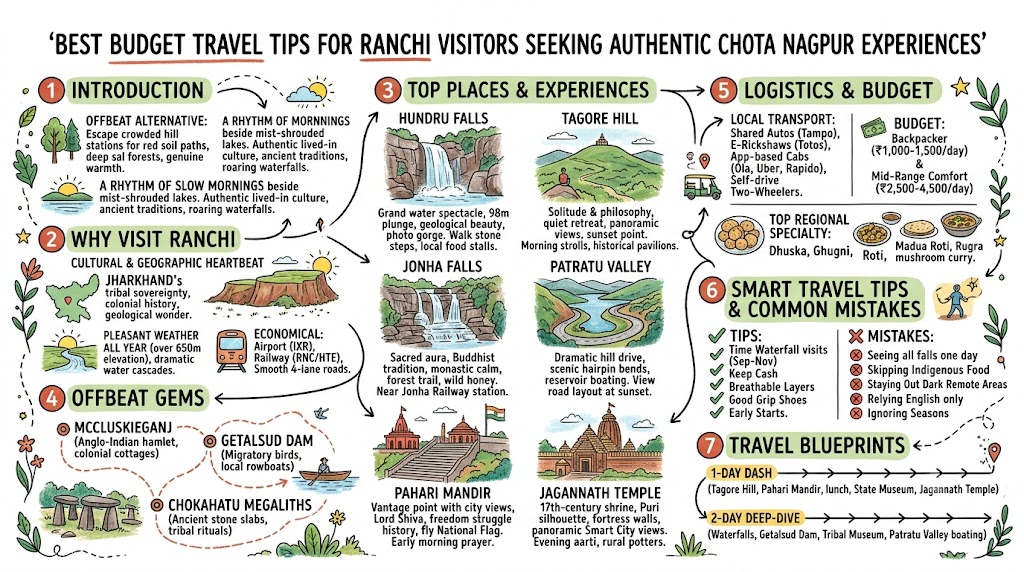
Introduction
Most holiday travelers rush toward the saturated hill stations of the north, trading traffic jams at home for crowded mall roads and inflated hotel tariffs. Ranchi offers an entirely different rhythm. Perched on the southern edge of the Chota Nagpur plateau, this city welcomes visitors with genuine warmth, red soil paths, and deep sal forests.
Here, your travel rupees stretch further, unlocking ancient tribal traditions, roaring seasonal waterfalls, and slow mornings beside mist-shrouded lakes. You will not find commercial tourist traps or artificial entertainment strips. Instead, you encounter a lived-in authenticity where community markets still trade in forest produce and ancient rock shelters whisper forgotten histories.
Why Ranchi is a must-visit city
Ranchi is the cultural and geographic heartbeat of Jharkhand, holding immense regional weight as an intersection of tribal sovereignty, colonial history, and geological wonder. Long before it served as the summer capital of the colonial Bihar province, indigenous communities revered these plateau hills and sacred groves. Its elevation over 650 meters delivers pleasant weather for much of the year, shielding it from the extreme tropical heat that grips lower plains nearby.
The city anchors a spectacular water circuit formed by the Subarnarekha River and its swift tributaries, which tumble over rocky plateau escarpments in dramatic cascades. Reaching Ranchi is remarkably economical: Birsa Munda Airport connects directly to national metros, while the Ranchi and Hatia railway stations run daily express trains across India. A network of smooth four-lane national highways makes road access straightforward for backpackers and self-drive explorers alike.
| Key Metric | Details & Practical Insights |
| Geographic Elevation | 651 meters (2,136 feet) above sea level |
| Primary Transit Hubs | Birsa Munda Airport (IXR), Ranchi Junction (RNC), Hatia (HTE) |
| Peak Visiting Season | October to March (Crisp air, full waterfalls, clear skies) |
| Average Daily Budget | ₹1,200 (Backpacker) to ₹3,500 (Mid-Range Comfort) |
| Dominant Languages | Hindi, Nagpuri, Mundari, Kurukh, English |
| Top Regional Specialty | Dhuska with Ghugni, Madua Roti, Rugra mushroom curry |
Top Places or Experiences
Hundru Falls
Hundru Falls is one of the grandest water spectacles on the Chota Nagpur plateau, where the Subarnarekha River plunges 98 meters down sheer gneiss rock faces. Over countless millennia, the force of the falling water has carved rounded stone pools, micro-canyons, and polished boulder fields that look like modern sculptures.
During the post-monsoon period, the roar of the falls echoes across surrounding forests, creating a fine mist that cools the entire gorge. Walking down the stone stairway takes you past native flora and village stalls where local women prepare hot tea and puffed rice snacks over wood fires.
- Location: Purulia Road, Anigara, approximately 45 kilometers northeast of the city center.
- Why it is worth visiting: The highest vertical water drop close to town, offering geological beauty and scenic gorge photography.
- Best things to do: Descend the 750 stone steps to the plunge pool base, photograph the swirling rock pools, and sample fresh fried snacks at the trail head.
- Best time to visit: October through January for roaring water volume and clear walking tracks.
- Ideal for whom: Landscape photographers, active walkers, and budget backpackers.
- Travel tip: Wear shoes with deep tread, as river mist keeps the lower stone stairs damp and slick.
Tagore Hill (Morabadi)
Rising 300 feet above the surrounding residential plains of Morabadi, Tagore Hill stands as a quiet tribute to art, solitude, and philosophy. Jyotirindranath Tagore, the elder brother of Nobel laureate Rabindranath Tagore, fell in love with this lonely granite outcrop in the early twentieth century and built his retreat, Brahma Sthal, atop the summit.
The hill offers an uninterrupted panoramic view across Ranchi’s tree-lined suburbs and distant blue ridges. The walk up is gentle, shielded by thick canopy, and leads to historical pavilions where Jyotirindranath once completed his literary translations.
- Location: Morabadi, roughly 4 kilometers north of Ranchi Railway Station.
- Why it is worth visiting: A peaceful historical vantage point tied directly to the literary renaissance of Bengal and early twentieth-century philosophy.
- Best things to do: Climb the stone pavilion for sunset views, explore the small cultural display museum at the base, and read in the quiet shade.
- Best time to visit: 5:30 AM to 8:00 AM for soft sunrise lighting, or late afternoon around 4:30 PM.
- Ideal for whom: Solo travelers, writers, sketch artists, and peace seekers.
- Travel tip: Combine your morning visit with a casual stroll through the adjoining Morabadi ground markets to grab fresh sattu drinks.
Jonha Falls (Gautamdhara)
Jonha Falls, also known as Gautamdhara, carries a sacred aura rooted in regional Buddhist tradition. Legend holds that Lord Buddha bathed in these waters, and an active monastery and shrine built by the Birla family sits right near the precipice.
The Gunga River drops around 43 meters here across hanging valleys, cascading down stepped tiers of rock. The surrounding landscape is blanketed by dense sal, mahua, and bamboo groves, making the descent feel like an expedition deep into undisturbed woodland.
- Location: Ranchi-Purulia Highway, about 40 kilometers east of main city limits.
- Why it is worth visiting: A peaceful blend of natural river steps and monastic calm, less congested than nearby highway stops.
- Best things to do: Visit the hilltop Buddhist ashram, walk the shaded trail down to the water basins, and buy wild honey from local vendors.
- Best time to visit: November through February during early morning hours.
- Ideal for whom: Spiritual travelers, culture lovers, and picnic groups.
- Travel tip: Trains running the Ranchi-Muri line stop at the nearby Jonha railway station, making this accessible without hiring a private taxi.
Patratu Valley
While technically sitting just across the district line in Ramgarh, Patratu Valley is an essential road excursion for anyone visiting Ranchi. The highway descends into the valley through an intricate series of dramatic hairpin bends engineered across steep emerald hillsides.
At the bottom of this winding pass lies the vast Patratu Dam reservoir, an expansive body of emerald-green water fed by the Nalkari River. Modern scenic viewing corridors along the route allow you to pause and gaze across the sweeping snake-like turns of the ghat section below.
- Location: Patratu Ghat Road, approximately 35 kilometers north of Kanke Road.
- Why it is worth visiting: One of Eastern India’s most dramatic hill driving routes, rivaling high-altitude ghat roads at a fraction of the travel cost.
- Best things to do: Ride through the hairpin bends at golden hour, rent a budget boat on the reservoir, and photograph the road layout from the designated lookouts.
- Best time to visit: October to February, particularly between 3:30 PM and 6:00 PM for sunset over the hills.
- Ideal for whom: Motorcyclists, driving enthusiasts, road trippers, and couples.
- Travel tip: Avoid driving back after dark if you are on an unfamiliar two-wheeler, as heavy industrial truck traffic picks up along the ghat at night.
Pahari Mandir
Rising steeply from the urban sprawl of central Ranchi, Pahari Mandir sits on top of Ranchi Hill (Phansi Tongri), a vantage point steeped in religious devotion and freedom struggle history. Dedicated to Lord Shiva, pilgrims climb hundreds of steps to offer prayers at the ancient sanctum.
Historically, British colonial administrators used this solitary high rock to execute regional freedom fighters. Following Independence, locals began raising the Indian National Flag at the temple summit alongside the religious flags, a rare and moving patriotic tradition that continues during national holidays.
- Location: Ratu Road, around 2.5 kilometers west of Ranchi Main Road.
- Why it is worth visiting: Exceptional 360-degree aerial views across the skyline, Ranchi Lake, and distant forest lines.
- Best things to do: Climb the historic steps during early morning prayer bells, read historical plaques about the freedom fighters, and view the entire city layout.
- Best time to visit: 6:00 AM to 8:30 AM before daytime heat sets in.
- Ideal for whom: Devotees, urban landscape photographers, and history buffs.
- Travel tip: The staircase requires a sustained climb; leave your footwear at the designated base stalls and carry water for the ascent.
Jagannath Temple (Dhurwa)
Constructed in 1691 by King Ani Nath Shahdeo of the Barkagarh estate, this historic seventeenth-century shrine mirrors the architectural silhouette of the Jagannath Temple in Puri. Built atop a rounded hillock in Dhurwa, the stone temple dominates the surrounding landscape with its imposing spires and fortified boundary walls.
During the annual Rath Yatra festival, hundreds of thousands of tribal and rural pilgrims assemble across the surrounding plains, turning the area into a massive carnival of folk music, traditional toys, and rural handicrafts. On normal days, the grounds remain quiet and breezy.
- Location: Jagannathpur, Dhurwa, roughly 11 kilometers south of the central post office.
- Why it is worth visiting: More than 300 years of living historical architecture, panoramic views of the modern Smart City developments, and deep cultural roots.
- Best things to do: Study the weather-worn stone carvings, join the evening aarti ceremony, and browse the rural potters working near the hill foot.
- Best time to visit: Late afternoons (4:00 PM to 6:30 PM) when the stone steps have cooled down.
- Ideal for whom: Architecture enthusiasts, heritage travelers, and spiritual wanderers.
- Travel tip: Combine this trip with a detour to the quiet banks of nearby Dhurwa Dam for a relaxed sunset by the water.
Offbeat Exploration: Hidden Gems Tourists Miss
McCluskieganj Heritage Circuit
Tucked around 60 kilometers northwest of Ranchi lies McCluskieganj, the world’s only purpose-built Anglo-Indian homeland, founded in the 1930s by Ernest Timothy McCluskie. Today, it stands as an atmospheric forest hamlet filled with colonial brick cottages, overgrown gardens, quiet railway crossings, and old brick churches. Spending a day cycling under its ancient sal trees reveals a peaceful, forgotten pocket of Eurasian heritage that mass tourism completely overlooks.
Getalsud Dam Shorelines & Angara Village
While crowds flock directly to the Hundru tourist complex, smart travelers branch off onto the country lanes winding along the untamed shores of Getalsud Dam near Angara. Here, the reservoir water recedes to expose sandy banks where migratory birds forage during winter. Local fishermen are often happy to take travelers out on traditional wooden rowboats for a modest fee, providing a serene water journey free from motorized noise.
The Megalithic Site of Chokahatu
Located towards Sonahatu, this ancient megalithic burial ground contains hundreds of upright stone slabs (menhirs) erected by the Munda community over centuries. These stone monuments preserve the memory of departed ancestors through ancient tribal rituals still practiced today. Visiting with a respectful attitude offers a profound, uncommercialized look into indigenous mortuary customs and prehistoric continuity.
Detailed Practical Guidance for Travelers
| Destination | Standard Entry Fee | General Timings | Best Local Food Options Nearby | Recommended Nearby Attractions |
| Hundru Falls | ₹10 per person | 6:00 AM – 5:00 PM | Village stalls: Fried Chana, Pokoras, Maggi | Getalsud Dam, Jonha Falls |
| Tagore Hill | Free entry | 6:00 AM – 6:00 PM | Morabadi street vendors: Litti Chokha, Sattu | Tribal Research Institute Museum |
| Jonha Falls | ₹10 per person | 7:00 AM – 5:00 PM | Small tea stalls serving tea, boiled eggs, biscuits | Sita Falls, Gautamdhara Ashram |
| Patratu Valley | Free road access | 24 Hours (Day recommended) | Lakeside Dhabas: Handi Mutton, Dehati Chicken | Patratu Lake Resort, Dam Reservoir |
| Pahari Mandir | Free entry | 5:00 AM – 8:00 PM | Ratu Road stalls: Kachori, Jalebi, Fresh Juice | Ranchi Lake, Nakshatra Van |
| Jagannath Temple | Free entry | 5:00 AM – 12:00 PM, 3:00 PM – 7:30 PM | Dhurwa road vendors: Dhuska with chana sabzi | Dhurwa Dam, Ring Road lookouts |
Logistics & On-Ground Navigation
Local Transport Options
- Shared Auto-Rickshaws (Tampo): The most economical way to move along the city’s main corridors, such as Kanke Road, Ratu Road, Main Road, and Doranda. Fares typically run between ₹10 and ₹30 per trip.
- E-Rickshaws (Totos): Best for short neighborhood journeys under 3 kilometers. They are quiet, cheap (₹10 to ₹20), and easily hailed in residential areas like Morabadi and Lalpur.
- App-Based Cabs & Autos: Ola, Uber, and Rapido operate reliably throughout urban Ranchi. Booking a bike taxi on Rapido is the fastest, cheapest way for solo backpackers to slip through peak-hour Main Road traffic.
- Self-Drive Two-Wheelers & Private Cabs: For waterfall circuits like Hundru and Jonha, hiring a private vehicle or booking a daily cab from Ranchi Station stands is the most efficient choice. Daily taxi hires range from ₹2,000 to ₹2,800 depending on the vehicle type.
Budget Planning
- Backpacker Tier (₹1,000 – ₹1,500 per day): Stay in budget guest houses or railway retiring rooms near Ranchi Junction (₹500 to ₹800 per night). Rely on shared tempos, public city buses, and app-based bike taxis. Enjoy hearty street meals of Dhuska, Litti Chokha, and daily rice thalis (₹200 to ₹300 per day).
- Mid-Range Comfort Tier (₹2,500 – ₹4,500 per day): Book reliable three-star business hotels near Station Road, Lalpur, or Hinoo (₹1,800 to ₹3,000 per night). Hire an air-conditioned cab for out-of-town waterfall runs (₹2,000 split across travelers), and dine at established regional dining rooms (₹600 to ₹1,000 per day).
Safety and Inclusivity Tips
- For Families: The urban areas and main public parks like Nakshatra Van are very welcoming. Stick to daylight hours when visiting out-of-town waterfalls, and plan to head back toward the city by 4:30 PM.
- For Couples: Public spaces are generally conservative. Avoid displaying open physical affection at quiet scenic viewpoints or lakeside walks to prevent unwanted scrutiny from passersby.
- General Outdoor Safety: Plateau rivers are dangerous swimming grounds. Sudden upstream dam discharges can quickly raise water levels at Hundru, Dassam, and Jonha. Never ignore warning signs or climb past safety railings onto algae-slick wet stones.
Local Caution: The granite surfaces near the edges of Ranchi’s waterfalls become slick as glass due to mist and natural moss. Stay well back from unfenced drop-offs, especially when composing camera angles.
Strategic Travel Planning Guardrails
Travel Planning Tips for Ranchi
- Time Your Waterfall Visits Wisely: The waterfalls are at their fullest right after the monsoons from September to November. By late spring (April to June), many cascades thin down to modest trickles.
- Keep Cash on Hand for Rural Stalls: While UPI QR payments work across almost every shop inside Ranchi city, forest trail stalls and rural highway fruit vendors often deal in cash due to spotty mobile reception.
- Dress in Breathable Layers: Winter mornings (December to January) can be surprisingly cold with temperatures dropping near 7°C, yet daytime afternoons under direct plateau sunshine turn comfortably warm.
- Carry Walking Shoes with Grip: Exploring rocky waterfall gorges and climbing temple hills requires sturdy sports shoes. Flat slippers or smooth sandals make negotiating wet stone stairs risky.
- Embrace Early Starts: Traffic across central arteries like Albert Ekka Chowk jams heavily by midday. Hitting the highways before 7:30 AM helps you clear urban bottlenecks smoothly.
Common Mistakes to Avoid
- Assuming You Can See All Waterfalls in One Afternoon: Hundru, Dassam, and Jonha sit in different directions across rocky terrain; trying to pack three into a single day leaves you stuck in a car rather than enjoying the sites.
- Skipping Indigenous Food Traditions: Settling for standard hotel Mughlai food causes you to miss incredible regional dishes like Kurthi Dal, bamboo shoot fry, and fresh rice flours.
- Staying Out After Dark in Remote Forest Areas: The plateau highways are well-maintained, but rural linking roads lack illumination and vehicle repair assistance late at night.
- Relying Exclusively on English: Hindi is universally spoken and understood across the region. Learning a few polite Hindi or Nagpuri greetings will earn you smiles and helpful directions from local residents.
- Ignoring the Changing Seasonal Scenery: Ranchi transforms radically across seasons. Expect lush green valleys and roaring cascades in autumn, misty peaceful mornings in winter, and flaming orange Palas flowers across the hills in spring.
Suggested Itinerary Blueprints
1. Day Quick Dash (Urban Heritage & Vistas)
Designed for business travelers or weekend visitors with only twelve daylight hours to spare:
- Morning (7:30 AM – 11:30 AM): Climb Tagore Hill for a panoramic city introduction, followed by fresh sattu drinks and a walk around Morabadi. Drive south to Pahari Mandir to take in the urban views.
- Afternoon (12:00 PM – 3:30 PM): Enjoy an authentic regional lunch of Dhuska, Ghugni, and Litti near Ratu Road, followed by a quiet walkthrough of the State Museum in Hotwar.
- Evening (4:00 PM – 7:00 PM): Head down to Jagannath Temple in Dhurwa, marvel at the 17th-century masonry, and watch the sun set over the waters of Dhurwa Dam before departing.
2. Day Deep-Dive (Waterfalls & Plateau Culture)
A balanced weekend exploration split neatly between rural landscapes and urban life:
- Day 1: The Great Cascades & Waterways
- Depart early at 7:00 AM toward Hundru Falls. Spend the morning descending the gorge steps and watching the river plunge.
- Stop by Getalsud Dam for a rural lunch at a roadside dhaba.
- Head toward Jonha Falls in the early afternoon, visit the serene Buddhist monastery, and return to town by dusk for street food at Lalpur Market.
- Day 2: Vistas, Road Trips & Heritage
- Spend the morning at Tagore Hill and visit the nearby Tribal Research Institute Museum to learn about Jharkhand’s distinct indigenous heritages.
- Pack a picnic lunch and drive north across the magnificent hairpin turns of Patratu Valley.
- Spend the late afternoon boating on Patratu Lake, returning up the ghat section as the roadside lights turn on.
3. Complete Weekend Travel Plan (Plateau Explorer Loop)
A comprehensive three-day route for travelers who want to experience the best of the city and its surrounding countryside:
- Friday: Arrive at Ranchi, settle into your base, and spend the afternoon taking in the city views from Pahari Mandir. Wind down your evening walking around the central market at Albert Ekka Chowk, sampling authentic street foods.
- Saturday: Dedicate the day to an adventurous water loop: take the Purulia Road route down to Hundru Falls, traverse cross-country lanes to Jonha Falls, and drop down toward Sita Falls if time permits. Return to Ranchi for a traditional dinner featuring local Mutton Curry or seasonal Rugra mushrooms.
- Sunday: Drive north across the Patratu Ghat route for lakeside morning walks and reservoir boating. Head back through Kanke, stop at the rock gardens, and pick up local handicrafts like Paitkar paintings or tribal brass metal crafts at regional emporiums before heading home.
Common Tourist Mistakes to Avoid
- Geographic Blunders: Many travelers look at a map and plan to visit Hundru Falls and Dassam Falls on the exact same morning. While they appear close as the crow flies, navigating the rural roads and hiking down into both gorges demands hours of physical effort. Pick one major waterfall per day to truly appreciate the landscape.
- Commercial Traps: Spending your precious travel evenings wandering modern, glass-fronted shopping malls on Kanke Road wastes your time in Ranchi. Head instead to traditional neighborhood markets like Daily Market or Morabadi to discover locally harvested wild honey, tamarind blocks, and seasonal forest fruits.
- Neglecting Modern and Alternative Zones: Travelers often overlook the creative, open public parks and university spaces around Kanke and Morabadi. These leafy neighborhoods host quiet artisan cafes, open-air jogging paths, and community nurseries that show the city’s green, relaxed side.
- Transport Overpayment: Auto drivers waiting directly at the main exit gates of Ranchi Junction frequently quote inflated flat rates to arriving travelers. Walk fifty meters out to the main road to catch metered autos, use shared tempos, or simply book through ride-hailing apps like Ola or Rapido to pay the correct local fare.
- Luxury Dining Bias: Sticking solely to high-end multi-cuisine hotel restaurants denies you the real culinary soul of Jharkhand. The true flavors of the Chota Nagpur plateau thrive at simple open-air street stalls where kachoris, litti, and dhuska are cooked fresh in front of you over hot iron skillets.
Frequently Asked Questions
1. What is the single best month to visit Ranchi for great weather and full waterfalls?
November is easily the finest month to plan your journey. The vigorous monsoon rains have tapered off, leaving the surrounding forests verdant and the waterfalls flowing with strong volume. Daytime temperatures remain pleasant and sunny, hovering around 24°C, while evenings become crisp and cool, making extensive outdoor sightseeing comfortable without the chill of deep winter.
2. How do I get to Hundru Falls without spending money on a private taxi?
Backpackers can take a shared passenger bus or tempo from Ranchi’s Kantatoli Bus Stand heading along the Purulia route toward Angara or Sikidiri. From the rural turn-off junction, shared local three-wheelers ferry passengers directly to the falls entrance. This route takes longer than a cab, but it keeps your one-way travel costs well under ₹70 per person.
3. Is Ranchi a safe destination for solo female travelers?
Yes, Ranchi is generally welcoming and tranquil for solo women travelers. The local people are humble and helpful. Basic common-sense precautions apply: avoid traveling along unlit rural roads or isolated forest waterfall zones after twilight, choose well-reviewed accommodations close to Lalpur or the main train station, and rely on app-tracked rides like Uber or Rapido when returning to your hotel late.
4. What exactly is Dhuska, and where can I find the best plate in the city?
Dhuska is Jharkhand’s most famous breakfast specialty, made from a batter of ground rice and chana dal that is deep-fried into a savory, golden puff. It is traditionally served piping hot with spicy potato-black gram curry (ghugni) and green coriander chutney. You can find excellent, freshly made dhuska at the morning food stalls lined up around Albert Ekka Chowk and Morabadi Ground.
5. Do I need special permits to enter the waterfalls or tribal villages around Ranchi?
No special inner-line permits or government permissions are required for domestic or foreign tourists visiting the standard tourist circuits, lakes, public temples, or major waterfalls like Hundru, Jonha, and Dassam. Modest entry tickets costing ₹10 to ₹20 per visitor are collected at formal parking gates by regional tourism maintenance committees.
6. Which railway station should I choose when booking tickets: Ranchi Junction or Hatia?
Both railway stations serve the city efficiently and sit just five kilometers apart. Ranchi Junction (RNC) is closer to the central commercial district, main hotels, and budget guest houses. Hatia (HTE) lies slightly further south, closer to Dhurwa and the airport. Choose the station where your direct long-distance train offers the most convenient arrival and departure timings.
7. Can travelers take a boat ride on Patratu Lake on a budget?
Yes, you can easily enjoy boating on Patratu Lake without spending heavily on private speedboats. The official tourism complex offers scheduled shared motorboat and pontoon rides starting around ₹100 to ₹150 per passenger during daytime hours. If you travel with a group, hiring a private pedal boat or small rowboat works out to a very reasonable rate per person.
8. Is it possible to explore the sights of Ranchi entirely using public transport?
You can easily cover all urban sights, such as Tagore Hill, Pahari Mandir, Ranchi Lake, and the local museums, using shared tempos and e-rickshaws for under ₹150 a day. However, out-of-town waterfalls like Dassam or Hundru run on sparse public transport schedules; hiring a two-wheeler or sharing a private auto with fellow travelers is far more practical for distant day trips.
9. What are the best authentic local souvenirs to purchase before leaving Ranchi?
Look for tribal handicraft treasures made using the ancient Dokra (lost-wax metal casting) method, hand-carved wooden and bamboo household items, and vibrant Sohrai or Paitkar folk art paintings. You should also pick up raw forest goods like wild organic honey, tamarind, and seasonal bamboo shoot pickles from the state-run Jharcraft emporiums or authentic weekly rural tribal haats.
10. How physically demanding are the walks down to Ranchi’s major waterfalls?
Reaching the plunge pools at Hundru and Jonha requires walking down several hundred concrete and stone steps (around 700 steps at Hundru). The walk down is simple, but the return climb up can be demanding for travelers with joint troubles or low cardiovascular stamina. Take slow, steady breaks on shaded stair landings, carry drinking water, and use bamboo walking sticks if needed.
11. Are digital payments through UPI widely accepted across the city?
Yes, UPI apps like Google Pay, PhonePe, and Paytm work seamlessly throughout Ranchi city, from high-end departmental stores to small pushcart fruit sellers and roadside chai shops. However, once you travel deep into rural forest areas or out toward distant waterfall ticket stalls, mobile internet coverage can be patchy; always keep a few hundred rupees in physical cash ready.
12. Is it safe to swim in the natural plunge pools beneath the waterfalls?
Swimming in the plunge pools is strictly discouraged and often barred by local authorities. The river beds contain submerged boulders, strong undercurrents, and deep drop-offs that are impossible to spot from the surface. Enjoy wading along the designated shallow stone shallows if water levels are low, but never jump into deep waterfall basins.
Conclusion
Choosing Ranchi over a conventional tourist hub is an invitation to discover travel in its purest, most grounding form. Here, the journey is defined by quiet moments: standing before an ancient stone shrine surrounded by whistling bamboo, feeling the cool spray of a forested waterfall on your face, or sharing a simple meal of hot dhuska with welcoming locals. It is a destination that does not overwhelm you with synthetic attractions, but instead rewards mindful curiosity with the quiet dignity, living traditions, and rugged natural beauty of the Chota Nagpur plateau.
