Introduction
When mainstream commercial hubs succumb to overwhelming crowds, commercialized streets, and identical tourist traps, Ranchi stands out as a breath of fresh air. Nestled on the mineral-rich Chota Nagpur Plateau, the capital of Jharkhand preserves an untamed, earthy rhythm that modern consumerism has not diluted. Here, primeval Sal forests whisper ancient tribal lore, towering cascades carve through Precambrian granite, and every street corner radiates unpretentious hospitality.
Exploring this plateau city means stepping into a living landscape where indigenous culture thrives alongside quiet colonial echoes and bustling roadside bazaars. Instead of manufactured spectacles, you encounter genuine warmth, organic agrarian flavors, and mist-draped hill paths. It is an authentic pause for travelers seeking soulful journeys over packaged vacations.
Why Ranchi is a must-visit city
Ranchi serves as the beating cultural and geographic heart of Jharkhand. Perched at an elevation of roughly 650 meters (2,140 feet) above sea level, the city enjoys a subtropical highland climate that historically earned it the status of the summer capital of the Bihar-Bengal province under British administration. Its geographical setting creates an astonishing landscape of scarp retreats and sudden plateau drops, giving rise to its enduring moniker: the City of Waterfalls.
Culturally, Ranchi offers an irreplaceable window into the vibrant traditions of the Munda, Oraon, Ho, and Santhal communities. From traditional Sohrai and Khovar wall murals to spirited harvest celebrations like Sarhul, the city’s identity remains rooted in an intimate reverence for nature.
Practically, Ranchi is remarkably accessible. Birsa Munda Airport (IXR) connects directly to major Indian metros like Delhi, Mumbai, Bengaluru, and Kolkata. The city’s well-networked railway stations (Ranchi Junction and Hatia) handle high-speed express trains, while smooth four-lane national highways connect smoothly to Jamshedpur, Bokaro, and Patna. Modern boutique hotels, heritage homestays, and budget guesthouses ensure every traveler archetype finds comfortable lodging.
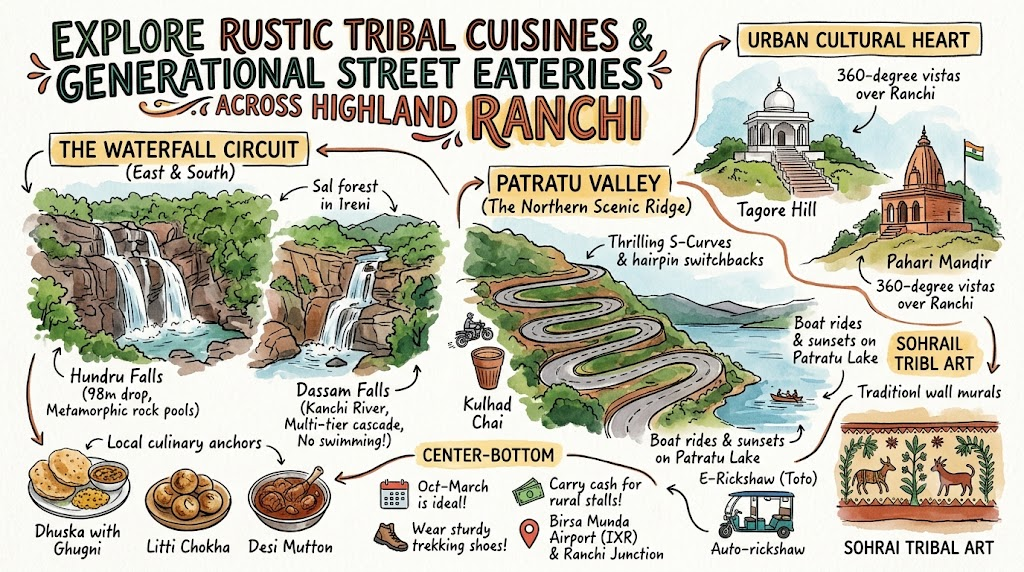
The city’s travel circuit splits into three distinct spatial corridors:
- The South-Eastern Waterfall Circuit: NH-43 / Purulia Road (Dassam, Hundru, and Jonha Falls).
- The Northern Scenic Ridge: Kanke Road and the serpentine sweeps of Patratu Valley.
- The Urban Cultural Heart: Central Ranchi (Tagore Hill, Ranchi Lake, Pahari Mandir, and vibrant local markets).
| Metric / Parameter | Key Detail |
| Elevation | ~650 m (2,140 ft) above sea level |
| Geographic Zone | Chota Nagpur Plateau, Jharkhand |
| Primary Transit Hub | Birsa Munda Airport (IXR) & Ranchi Junction (RNC) |
| Signature Local Dish | Dhuska with Ghugni and Desi Mutton |
| Ideal Exploration Window | October to March (Post-monsoon crisp chill) |
Best Places or Experiences
Hundru Falls
Formed by the mighty Subarnarekha River plunging from a height of 98 meters (322 feet) down steep rocky escarpments, Hundru Falls is arguably Ranchi’s most dramatic natural spectacle. Over millennia, the torrential water has sculpted the underlying metamorphic rocks into smooth pools, deep gorges, and fascinating eroded stone terraces.
During the post-monsoon months, the cascade roars with raw power, sending cold plumes of mist into the surrounding green canopy. Walking down the stone steps toward the riverbed offers sweeping panoramic perspectives of the Chota Nagpur scarp, making it a masterclass in raw geological artistry.
- Location: Angara Block, approximately 42 km east of Ranchi Railway Station.
- Why it is worth visiting: It is one of the highest waterfalls in Jharkhand, showcasing dramatic Precambrian rock formations carved by the Subarnarekha River.
- Best things to do: Descend the 700-step stone staircase to the base pool, photograph the eroded natural stone amphitheaters, and sample freshly fried local river fish at the viewpoint shacks.
- Best time to visit: October to February; mornings between 8:00 AM and 11:00 AM provide soft light and cooler temperatures.
- Ideal for whom: Adventure enthusiasts, landscape photographers, and geology buffs.
- Travel tip: Wear sturdy trekking shoes with solid grip; the damp moss on the rocky steps near the base can be extremely slippery.
Dassam Falls
Also celebrated as Dassam Ghagh, this natural wonder is formed by the Kanchi River, a key tributary of the Subarnarekha, as it hurtles 44 meters (144 feet) down a sheer rock face. The indigenous name originates from the Mundari word Da-song, referring to the act of pouring water cleanly from a pitcher.
The falls are flanked by dense Sal forests and jagged metamorphic cliffs. The multiple streaming chutes converge into a broad, roaring pool at the base, creating a soundtrack of thundering water that reverberates across the forested gorge long before the water comes into view.
- Location: Near Taimara village, NH-33, roughly 40 km south of Ranchi city center.
- Why it is worth visiting: Its unique multi-tier cascade splits into ten natural streams over rugged red-black rock shelves.
- Best things to do: Walk across the cantilevered concrete viewing decks, observe traditional village handicrafts sold by local tribal artisans, and enjoy a quiet shaded picnic among the Sal groves.
- Best time to visit: November to February, when the winter sun casts golden reflections across the spray.
- Ideal for whom: Nature lovers, couples seeking scenic isolation, and bird watchers.
- Travel tip: Adhere strictly to the safety railings; underwater whirlpools and unpredictable currents make swimming strictly prohibited.
Patratu Valley
The drive down into Patratu Valley is one of Eastern India’s most breathtaking engineering and landscape marvels. The modern highway snakes down several hundred vertical feet via sweeping S-curves and hairpin turns, cutting through emerald ridges that border the Ramgarh district.
From the summit observation balconies, travelers look down upon emerald forest ribbons and the sparkling expanse of the Patratu Dam reservoir. Built in the 1960s to supply the nearby thermal power plant, the reservoir has evolved into an expansive watersports and leisure hub surrounded by rolling hills.
- Location: Ramgarh border corridor, roughly 35 km north of Ranchi city via Kanke Road.
- Why it is worth visiting: The theatrical winding ghat road features hairpin switchbacks rivaling famous high-altitude mountain passes.
- Best things to do: Stop at the summit roadside viewpoint for a hot cup of Kulhad Chai, rent a high-speed motorboat on Patratu Lake, and capture long-exposure twilight traffic light trails.
- Best time to visit: Year-round for sunsets, but winter late afternoons (4:00 PM to 6:30 PM) offer unforgettable sunset skies.
- Ideal for whom: Road-trippers, motorcyclists, sunset chasers, and casual weekenders.
- Travel tip: Avoid driving after dark if you are unaccustomed to sharp, unlit mountain switchbacks and sudden heavy truck traffic.
Tagore Hill (Morabadi)
Rising 300 feet above the surrounding urban plateau in Morabadi, Tagore Hill (or Morabadi Hill) is steeped in literary and philosophical heritage. It served as a serene creative retreat for Jyotirindranath Tagore, elder brother of Nobel laureate Rabindranath Tagore, who chose this solitary granite hillock to live out his twilight years after 1912.
At the summit sits Brahmo Mandir, a minimalist white pavilion where Jyotirindranath meditated, translated philosophical texts, and drafted plays. The climb up the gentle stone stairs passes under shady banyan trees, culminating in a breezy hilltop that provides uninterrupted 360-degree vistas over Ranchi’s urban skyline.
- Location: Morabadi, approximately 4 km north of Ranchi Railway Station.
- Why it is worth visiting: It bridges deep Bengali renaissance literature with early 20th-century Chota Nagpur history.
- Best things to do: Explore the restored Shanti Dham heritage complex, read a book inside the breezy hilltop pavilion, and watch early morning mist burn off over the city.
- Best time to visit: October to March, particularly early mornings around 6:00 AM to 8:00 AM.
- Ideal for whom: History buffs, literary scholars, solo travelers, and morning walkers.
- Travel tip: Visit the regional arts and crafts center located at the base of the hill to buy genuine handmade terracotta and bamboo souvenirs.
Jonha Falls (Gautam Dhara)
Revered by spiritual pilgrims and nature lovers alike, Jonha Falls plunges 43 meters (141 feet) along the edge of the plateau where the Raru River drops off sharply. Also named Gautam Dhara, local folklore and Buddhist traditions record that Lord Buddha spent time bathing and meditating near these pristine waters.
A dedicated Buddhist shrine constructed atop the flanking escarpment pays homage to this spiritual heritage. Reaching the river canyon requires descending roughly 700 well-laid steps through dense, fragrant deciduous forest, offering a deeply meditative descent away from modern noise.
- Location: Jonha village, roughly 40 km east of Ranchi on the Purulia rail line.
- Why it is worth visiting: It is a classic hanging valley waterfall combining deep spiritual history with lush wilderness.
- Best things to do: Visit the hilltop Buddhist ashram, marvel at the geological hanging valley formation, and dip your feet in the cool, shallow upper stream beds.
- Best time to visit: September to January, when water volume remains high and forest trails are green.
- Ideal for whom: Spiritual seekers, trekkers, and multi-generational families.
- Travel tip: Climbing the 700 steps back up can test your stamina; keep a bottle of electrolyte water handy and take breaks under the stone rest sheds.
Pahari Mandir & Ranchi Lake
Perched atop Ranchi Hill at an elevation of 2,140 feet, Pahari Mandir is an ancient Shiva temple that carries a unique patriotic legacy. During British colonial rule, freedom fighters were executed from the summit trees; since Independence, citizens have honored their sacrifice by hoisting the Indian National Tricolor at the temple peak every Republic Day and Independence Day.
At the foot of the hill lies Ranchi Lake, an expansive water reservoir excavated by British agent Colonel Ousley in 1842. The climb up 468 stone steps to the temple rewards devotees and travelers with panoramic views of the entire downtown district and the calm waters of the lake below.
- Location: Lower Bazar / Kumhartoli area, approximately 3 km from Albert Ekka Chowk.
- Why it is worth visiting: It is one of the rare religious temples in India that hoists the National Flag alongside traditional temple flags.
- Best things to do: Climb the 468 stairs for panoramic city views, take an evening pedal-boat ride on Ranchi Lake, and sample authentic street chaat along the lake promenade.
- Best time to visit: July to August (during Shravan for festive energy) or November to February for comfortable daytime climbs.
- Ideal for whom: Cultural travelers, devotional pilgrims, and urban photographers.
- Travel tip: Avoid afternoon visits during summer as the uncovered stone steps absorb intense heat, making barefoot walking difficult.
Offbeat Exploration: Hidden Gems Tourists Miss
McCluskieganj
Located approximately 60 km northwest of Ranchi, this sleepy hamlet was founded in 1933 as the world’s only planned homeland for the Anglo-Indian community. Scattered throughout tranquil Sal and Mahua forests are rustic colonial cottages with sloping tiled roofs, mossy chimneys, and overgrown English flower gardens. McCluskieganj offers an atmospheric step back in time, immortalized in regional literature and indie cinema.
Ratu Fort (Ratu Palace)
Situated 15 km west of the city center along the Gumla highway, Ratu Palace served as the seat of the Nagvanshi dynasty, who ruled the Chota Nagpur plateau for centuries. The sprawling palace compound combines traditional British neoclassical pillars with indigenous Chota Nagpur architectural styles. Visiting during the annual Ratu Rath Yatra fair unveils a grand royal spectacle steeped in tribal and classical folk customs.
Getalsud Dam Shoreline (Angara Hinterland)
While tourists crowd the waterfall viewpoints, the quiet eastern backwaters of Getalsud Dam remain largely untouched. The vast reservoir creates peaceful inland beaches fringed by scrub forests and boulder hills. It is an idyllic off-grid spot for birdwatching, tranquil lake sunsets, and unhurried camping away from crowded commercial hubs.
Detailed Practical Guidance for Travelers
| Destination | Standard Entry Fee | General Timings | Best Local Food Options Nearby | Recommended Nearby Attractions |
| Hundru Falls | ₹10 to ₹15 per person | 7:00 AM – 5:00 PM | Village shacks serving desi roasted corn and fried river fish | Getalsud Dam reservoir, Jonha Falls |
| Dassam Falls | ₹15 per person | 8:00 AM – 5:00 PM | Local roadside dhabas serving hot Dal-Roti and country egg curry | Surya Mandir (Bundu), Sita Falls |
| Patratu Valley | Free (Boating ₹150–₹400) | Open 24/7 (Lake: 9 AM – 6 PM) | Highway dhabas with spicy Champaran-style handi meat and Kulhad tea | Patratu Dam, Thermal Power Lakefront |
| Tagore Hill | ₹10 per person | 7:00 AM – 6:00 PM | Morabadi street stalls for fresh Dhuska, Litti Chokha, and Phuchka | Morabadi Ground, Tribal Research Museum |
| Jonha Falls | ₹15 per person | 7:30 AM – 5:00 PM | Local tea stalls with sweet seasonal Pitha and fresh cucumber slices | Gautam Buddha Shrine, Sita Falls |
| Pahari Mandir | Free (Temple entry) | 5:00 AM – 8:30 PM | Upper Bazar sweet shops for Malpua, Kachori-Sabzi, and Lassi | Ranchi Lake, Albert Ekka Chowk markets |
Logistics & On-Ground Navigation
Local Transport Options
- Auto-Rickshaws & E-Rickshaws (Totos): The most economical way to navigate the inner city. Shared autos run fixed routes connecting Albert Ekka Chowk, Ratu Road, Doranda, and Morabadi for ₹10 to ₹25 per passenger. Private reserved autos require upfront fare negotiation.
- App-Based Cabs & Bike Taxis: Both Uber and Ola operate reliably throughout urban Ranchi. Bike taxis are exceptionally fast for navigating narrow market streets in Upper Bazar.
- Outstation & Full-Day Car Rentals: Reaching outer waterfalls like Hundru, Dassam, and Jonha requires booking a private cab for the day. Local travel desks charge ₹2,000 to ₹3,200 for a dedicated 8-hour, 80 km hatchback or sedan package.
- Local City Buses: Managed by the municipal corporation, local buses run along main transit arteries like Kanke Road and Hinoo, though they can be crowded during morning and evening rush hours.
Budget Planning
- Budget / Backpacking Tier (₹1,000 to ₹1,800 per day): Stay in clean guesthouses or dormitory lodges near Ranchi Station (₹600–₹900/night). Rely on shared autos and suburban passenger trains (₹150–₹250/day). Eat authentic street delicacies like Dhuska, Litti, and regional Thalis (₹300–₹500/day).
- Mid-Range / Comfort Tier (₹3,500 to ₹6,500 per day): Stay in comfortable 3-star business or boutique hotels in Lalpur, Morabadi, or Main Road (₹2,200–₹4,000/night). Hire dedicated private AC cabs for day circuits (₹2,200–₹2,800/day). Enjoy multi-course dining at regional specialty restaurants and garden cafes (₹1,000–₹1,500/day).
Safety and Inclusivity Tips
- For Families: The urban areas are welcoming, family-centric, and hospitable. When visiting waterfalls, keep children close and never cross safety barriers or slippery wet rocks. Plan day-trip returns to the city before 7:00 PM.
- For Couples: Tourist parks like Patratu Lake resort and Morabadi open grounds are comfortable and popular with couples. Exercise common sense and avoid isolated, unlit forested trails around outer waterfalls after sunset.
- General Safety: Ranchi is peaceful and community-driven. However, forested rural ghat roads outside the municipal limits have limited cellular connectivity and sparse roadside assistance. Always maintain a full fuel tank before heading into the valleys.
Strategic Travel Planning Guardrails
Travel Planning Tips for Ranchi
- Target the Winter Window: Plan your trip between October and February when crisp morning air and pleasant afternoon sunshine make outdoor hikes delightful.
- Keep Cash Handy: While UPI digital payments work everywhere in the city, rural vendors at waterfall bases and forest check-posts frequently face network dead zones.
- Pack Layered Clothing: Winter evenings drop quickly to 8°C–12°C due to the plateau elevation. Bring a warm fleece or light down jacket for late-evening drives in Patratu.
- Respect Tribal Sacred Groves (Sarna Sthal): These ancient forest patches marked with red-and-white flags are deeply revered. Do not litter, step inside cordoned areas, or disrupt rituals.
- Start Waterfall Drives Early: Leaving your hotel by 7:30 AM helps you beat afternoon tourist groups, secure prime parking, and explore misty trails in peaceful quiet.
Common Mistakes to Avoid
- Ignoring the Sheer Distance Between Waterfalls: Hundru and Dassam lie in completely different directions; trying to rush both on the same afternoon leads to stressful highway driving.
- Underestimating the Stone Staircases: Jonha and Hundru require climbing 500 to 700 steep steps. Visitors with knee issues or heart conditions should pace themselves and use walking sticks.
- Assuming Ride-Hailing Apps Work at Outlying Waterfalls: Cabs booked on app aggregators will drop you off at Dassam or Hundru, but you will not find return rides there. Always book a round-trip vehicle.
- Skipping Indigenous Food: Sticking only to standard hotel buffets means missing iconic local foods like Dhuska, Rugda mushrooms, and Bamboo shoot curry.
- Wading into Unmarked Natural Pools: Submerged granite ledges and sudden underwater dips around waterfall plunge pools pose severe drowning hazards. Stick to designated viewing areas.
Suggested Itinerary Blueprints
1. Day Quick Dash (The Scenic Highlights Circuit)
Target Audience: Business travelers, transit visitors, or day-trippers with limited time.
- 08:00 AM: Kick off with a piping-hot breakfast of Dhuska and Ghugni at a traditional Morabadi vendor.
- 09:30 AM: Ascend Tagore Hill to soak in panoramic city views and explore its peaceful literary past.
- 12:00 PM: Head to an authentic local diner near Lalpur for a traditional Jharkhand tribal thali.
- 02:30 PM: Take an afternoon scenic drive through the winding turns of Patratu Valley.
- 05:00 PM: Sip Kulhad tea by Patratu Lake while watching the fiery sunset, then head back to the city for evening transit.
2. Day Deep-Dive (The Cascades & Heritage Trail)
Target Audience: Weekend travelers, photography enthusiasts, and cultural explorers.
- Day 1 (The Southern Cascades & Cultural Roots): Depart at 8:00 AM for Dassam Falls. Spend the morning photographing the multi-tiered cascades and exploring the rocky gorge. Head to Bundu for a hearty lunch, then visit the architectural Surya Mandir. Return to the city by late afternoon to climb Pahari Mandir for sunset over Ranchi Lake.
- Day 2 (Subarnarekha Splendor & Urban Art): Drive east along Purulia Road to explore the dramatic heights of Hundru Falls. Stop at the quiet backwaters of Getalsud Dam for lunch. Return to town by mid-afternoon to visit the State Museum in Hotwar to admire indigenous Sohrai art, terracotta artifacts, and traditional tribal jewelry.
3. Complete Weekend Travel Plan (The Grand Chota Nagpur Loop)
Target Audience: Slow travelers, road-trippers, and families seeking a complete regional holiday.
- Friday: Arrive in Ranchi, check into your hotel, and spend a relaxing afternoon strolling through Morabadi Ground. Visit Tagore Hill, and spend the evening enjoying authentic street food near Albert Ekka Chowk.
- Saturday: Embark on a full-day eastern waterfall loop covering Jonha Falls (Gautam Dhara) and Hundru Falls. Enjoy a picnic lunch near the riverbed, purchase wild forest honey from local village cooperatives, and return to Ranchi for a relaxed dinner featuring regional Desi Mutton.
- Sunday: Set off early for the dramatic hairpins of Patratu Valley. Spend the morning boating across Patratu Reservoir, stop by the rural artisan workshops on the way back, buy handwoven tussar silk or tribal handicrafts in the city markets, and depart by evening train or flight.
Common Tourist Mistakes to Avoid
Geographic Blunders
A frequent logistical mistake is attempting to group Dassam Falls (located far south along NH-33) and Hundru Falls (located to the far east via Angara) into a single morning rush. While they look close on a map, the rural connecting roads take significant travel time. Pair Hundru with Jonha or Getalsud, and keep Dassam as an independent half-day trip.
Commercial Traps
Spending your evenings wandering sterile, generic shopping malls in Lalpur or Hinoo deprives you of the real spirit of the city. Head instead to the bustling, historic lanes of Upper Bazar, the artisan pavilions of Jharcraft, or the open, energetic avenues of Morabadi. That is where Ranchi’s cultural pulse beats brightest.
Neglecting Modern/Alternative Zones
Many visitors focus exclusively on distant waterfalls and overlook Ranchi’s pleasant residential and creative neighborhoods. Areas like Morabadi, Kanke Road, and the leafy avenues around Mecon Colony feature pleasant art galleries, indie coffee houses, open parks, and lively student bookshops that showcase contemporary city life.
Transport Overpayment
Unmetered auto-rickshaws stationed directly outside Ranchi Junction often quote inflated fares to arriving tourists. Avoid overpaying by stepping out to the main roundabout, cross-referencing fares on ride-hailing apps like Ola or Uber, or choosing shared e-rickshaws that follow regulated local pricing.
Luxury Dining Bias
Confining your meals to generic continental hotel dining rooms is the biggest cultural loss in Jharkhand. The culinary magic of Ranchi lives in street-level cauldrons: crisp deep-fried Dhuska, smoky wood-fired Litti Chokha, seasonal Rugda (wild puffball mushrooms), and tender bamboo shoots. Embrace local roadside eateries for an unforgettable, authentic feast.
Frequently Asked Questions
1. What is the single best time of year to visit Ranchi for waterfalls?
The prime window runs from October to February. During these post-monsoon months, the waterfalls retain strong, roaring flows, the surrounding forests stay lush and green, and the plateau weather remains pleasantly cool with sunny afternoons and crisp evenings.
2. How do I travel safely to outlying waterfalls like Hundru and Dassam?
Book a dedicated, round-trip private cab through your hotel or a reputable local travel agency. Ride-hailing apps will take you there but won’t provide return cabs from rural locations. Always start early and return before nightfall.
3. What are the signature local dishes every traveler must taste in Ranchi?
Do not miss Dhuska (a fried batter cake made from rice and chana dal) served with spicy chickpea ghugni, charcoal-roasted Litti Chokha, seasonal wild Rugda mushrooms, earthy bamboo shoot curries, and regional slow-cooked mutton.
4. Can I comfortably visit Ranchi with elderly family members?
Yes, but select your destinations carefully. While viewpoints like Patratu Valley, Tagore Hill base, and Ranchi Lake offer easy access, cascading waterfalls like Hundru and Jonha require navigating hundreds of steep stone stairs that may tire senior travelers.
5. Is Ranchi a safe destination for solo and women travelers?
Ranchi is generally peaceful, welcoming, and safe. Stick to regular precautions: stay in well-reviewed central neighborhoods, avoid isolated rural ghats after dark, and rely on verified cabs or trusted shared transit for commuting across town.
6. Where can I purchase authentic tribal handicrafts and handloom textiles?
Visit the official state-run Jharcraft (Jharkhand Silk, Textile and Handicraft Development Corporation) emporiums located on Main Road and Kadru. They offer genuine certified Tussar silk, Sohrai painted canvases, brass Dokra artifacts, and bamboo crafts.
7. How many days are ideal for a well-rounded trip to Ranchi?
A 3-day, 2-night itinerary is perfect. This gives you ample time to explore the city’s key waterfall circuit, experience the dramatic sweeping hairpins of Patratu Valley, explore local heritage monuments, and savor authentic regional cuisine.
8. Are credit cards and UPI digital payments widely accepted across Ranchi?
Within the city, digital UPI payments are accepted virtually everywhere, from established restaurants to roadside tea stalls. However, you should carry sufficient physical cash when traveling out to rural waterfall check-posts and village food shacks.
9. What should I pack for a winter holiday in Ranchi?
Pack versatile layers. Daytime winter temperatures hover comfortably around 20°C to 24°C, but nights frequently dip to 8°C–10°C. Carry a medium jacket, sturdy walking shoes with good tread for rocky paths, sunscreen, and a reusable water bottle.
10. How accessible is Patratu Valley from central Ranchi?
Patratu Valley is located roughly 35 km north of the city via Kanke Road. The drive takes about an hour along an excellent, smooth four-lane highway, making it an easy and rewarding half-day excursion.
11. Are there swimming facilities available at the major waterfalls?
No, swimming is strictly prohibited at Hundru, Dassam, and Jonha Falls. The underlying riverbeds conceal unpredictable currents, slippery algae, and hazardous underwater rock chasms. Always remain safely behind the marked viewing barriers.
12. What language is most widely spoken by locals in Ranchi?
Hindi is the universal language for daily business and travel. You will also hear regional languages like Nagpuri (Sadri), Khortha, Mundari, and Kurukh, along with Bengali and English in central commercial establishments.
Conclusion
Traveling through Ranchi is an invitation to slow down and reconnect with the quiet, untamed rhythm of the earth. Long after you leave the Chota Nagpur plateau, the sensory memories linger: the refreshing mist rising from granite river chasms, the scent of morning fog weaving through ancient Sal canopies, the smoky aroma of roadside roasted Litti, and the warm smiles of its indigenous folk. Choosing this highland capital means stepping off the frantic tourist trail and discovering an India that remains deeply grounded, historically rich, and quietly unforgettable.
