Introduction
Mastering the complexities of the PR Points Calculator is a critical milestone for any professional seeking to navigate the competitive landscape of skilled migration. Since the logic of international residency remains grounded in measurable human capital, understanding how specific attributes translate into score totals allows applicants to build a strategic roadmap toward success. This comprehensive guide serves as a foundational resource for evaluating your current standing and identifying the most effective pathways to boost your eligibility. By leveraging the insights found at PR Points Calculator, you can transform a complicated legal framework into a manageable, step-by-step action plan designed for long-term residency achievement.
What Is a PR Points Calculator?
The core logic of a points-based selection system revolves around identifying candidates who possess the highest potential for economic contribution and successful integration into the host society. Rather than relying on a subjective review, these systems utilize a standardized mathematical formula to assign values to specific human capital attributes like age, education, and language skills. This quantitative approach ensures that the selection process remains transparent, predictable, and meritocratic for all global applicants. By using a calculator, prospective migrants can simulate various scenarios to determine if they meet the minimum threshold required to receive an invitation for a permanent visa subclass.
- Standardized Merit Evaluation: The system prioritizes objective data over subjective interviews, ensuring that every applicant is measured against the same rigorous criteria.
- Predictive Success Modeling: Governments design these point values based on longitudinal research showing which traits correlate with high employment rates and rapid social assimilation.
- Tiered Invitation Thresholds: Achieving the minimum score does not guarantee a visa, as invitations are typically issued to the highest-ranking candidates in the current pool.
- Dynamic Eligibility Filtering: The calculator serves as a primary filter, allowing users to see how changing one variable, such as a language test score, impacts their total rank.
PR Points Components: The Building Blocks
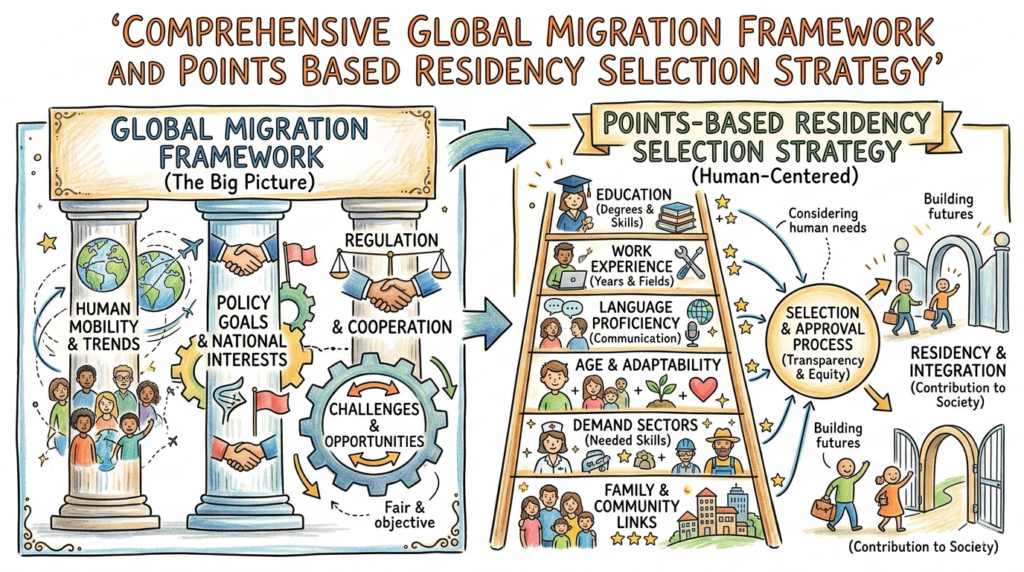
At the heart of any migration points test are human capital factors, which represent the intrinsic value an individual brings to the labor market. Age is often the most significant weight, as younger professionals are viewed as having a longer duration to contribute to the national economy and tax base through their working lives. Beyond youth, the system heavily rewards advanced academic achievements and specialized training that align with national skill needs. These building blocks are non-negotiable; they form the skeletal structure of your profile and determine the baseline from which all other bonus points are calculated.
- Age-Based Tiered Weighting: Maximum points are typically reserved for individuals in their late twenties to early thirties, with scores gradually decreasing as candidates approach the upper age limit.
- Educational Tier Calibration: A tiered hierarchy awards more points for doctoral and master’s degrees compared to diplomas, provided the qualifications are recognized as equivalent to local standards.
- Language Fluency Benchmarks: Superior proficiency in the primary national language can often yield a significant point boost, sometimes making the difference between an invitation and a rejection.
- Verified Professional Tenure: Points are calculated based on the number of years spent in a skilled occupation, with distinctions often made between domestic and international work history.
International Pathways for PR Points
Navigating the various visa subclasses is essential because different categories apply the points test in unique ways to meet specific economic goals. For instance, independent pathways rely solely on the applicant’s own attributes, whereas sponsored pathways allow for additional points through state or family backing. These variations are designed to direct skilled labor toward specific sectors or geographic locations that are experiencing shortages. Understanding which subclass matches your profile is vital, as the “pass mark” or invitation score can fluctuate wildly between a general independent visa and a regional provisional visa.
- Independent Skilled Pathways: These highly competitive categories require the highest point totals since the applicant must succeed purely on their own professional and personal merits.
- State and Territory Nominations: Applicants who secure a nomination from a specific region often receive a mandatory point “top-up,” lowering the total score they need to achieve independently.
- Employer-Linked Integration: Some frameworks allow for points or priority processing if a candidate holds a valid job offer from a domestic business.
- Provisional to Permanent Transitions: Certain subclasses act as a bridge, allowing individuals to live in specific areas while accumulating the necessary points for a final permanent transition.
Advanced Regional Requirements for PR Points
Governments frequently use the points system as a tool for regional development, offering substantial incentives for individuals willing to live and work outside major metropolitan hubs. These regional incentives are not merely “extra credit”; they are strategic weights intended to balance the national population and support local economies. For an applicant, a regional study bonus or a state sponsorship can provide a massive 15-point increase, which is often enough to leapfrog thousands of other candidates in the queue. Mastering these regional nuances is one of the most effective ways to secure a pathway when the general competitive scores are prohibitively high.
- Regional Study Incentives: Completing a degree at a campus located in a designated regional area usually grants a specific point bonus to reward local integration.
- State-Specific Occupation Lists: Every state maintains its own list of in-demand skills, and aligning your profession with these lists is a prerequisite for receiving nomination points.
- Mandatory Residency Obligations: Accepting regional or state points usually comes with a legal commitment to live in that specific area for a predefined number of years.
- Sponsorship Priority Weighting: Candidates with family members in regional areas may be eligible for sponsorship points, providing a unique advantage for those with existing local ties.
The Global Landscape of PR Points
The points-based migration model is a globally recognized standard, pioneered by nations like Canada and Australia to manage large-scale skilled migration. While the core philosophy of “merit over origin” remains consistent, each country fine-tunes its weights to reflect its unique economic challenges, such as aging populations or specific industrial shifts. Comparing these systems reveals that while one country might prioritize youth, another might place a higher value on domestic work experience or high-level language skills. This global context helps applicants understand that their “market value” might be higher in one jurisdiction than another based on how their specific traits are weighted.
- Human Capital Comparison: Some systems favor academic prestige and research output, while others focus more heavily on practical trade skills and immediate employability.
- Market-Driven Fluctuations: Global invitation scores are highly sensitive to economic cycles, with thresholds rising during periods of high labor supply and falling during shortages.
- Integration of Job Offers: Modern frameworks are increasingly moving toward “hybrid” models that combine human capital points with the security of a confirmed employment contract.
- Global Standard for Equivalency: Regardless of the destination, all points-based systems require rigorous third-party verification to ensure international qualifications meet domestic standards.
Benefits of Utilizing a PR Points Calculator
Using a dedicated calculator provides a level of planning precision that is impossible to achieve through manual estimation. It allows for “what-if” modeling, where an applicant can see exactly how much their score would increase if they retook a language exam or completed another year of work. This strategic clarity prevents the waste of significant financial resources on visa applications that have no realistic chance of success. Furthermore, it empowers applicants to identify their weakest areas early in the process, giving them time to undertake professional development or seek state nomination to bridge the gap.
- Objective Self-Assessment: A calculator removes emotional bias, providing a cold, hard look at how a migration department views your professional profile.
- Resource Allocation Efficiency: By knowing your projected score, you can decide whether to invest in expensive skills assessments or focus first on improving your language results.
- Timeline Optimization: Calculating points helps you understand the impact of timing, such as how a birthday might cause a sudden drop in your age-related score.
- Strategic Pathway Selection: The ability to compare scores across different visa subclasses helps you choose the most viable route with the lowest competitive barrier.
Educational Credential Assessment (ECA) Standards
The Educational Credential Assessment is the gatekeeper of the points system, ensuring that your international degrees carry the same weight as locally earned qualifications. Without a valid ECA from an authorized body, your education points are effectively zero in the eyes of the migration authorities. This process involves a meticulous review of the institution’s accreditation, the duration of the program, and the specific curriculum followed. The result of this assessment determines your placement on the points table, making it one of the most critical documents in your entire migration portfolio.
| Education Level | Typical Points Awarded | Common Requirement |
| Doctorate (PhD) | 20 Points | Equivalent to local research standards |
| Master’s Degree | 15 Points | Must include a recognized bachelor degree |
| Bachelor’s Degree | 15 Points | Minimum 3-year full-time equivalent |
| Diploma / Trade | 10 Points | Relevant to the nominated occupation |
- Institutional Accreditation Checks: The assessing authority verifies that the awarding body is recognized by the relevant national education department in the source country.
- Duration and Rigor Analysis: Programs must meet minimum timeframes and credit requirements to be considered equivalent to a full degree or diploma.
- Alignment with Occupation: For some trade roles, the education must be directly relevant to the skills being assessed for the visa.
- Authenticated Document Submission: The process requires certified copies of transcripts and certificates to prevent fraud and maintain the integrity of the selection system.
Step-by-Step Guide to Mastering PR Points
Mastering the calculation process requires a methodical approach to data gathering and evidence verification. You cannot simply guess your points; you must have documentary proof for every claim, from the exact dates of your employment to the specific score on your language test. The process begins with identifying your primary occupation on the relevant demand list, followed by a formal skills assessment. Only once you have these foundations can you accurately use a calculator to determine your total score and decide whether you are ready to submit an Expression of Interest.
- Occupation List Alignment: You must first ensure your profession appears on the current Skilled Occupation List, as this is the prerequisite for using the points test.
- Skills Assessment Verification: Every applicant must undergo a formal evaluation by a designated authority to prove they possess the skills required for their nominated role.
- Documentary Evidence Audit: Collect reference letters, pay slips, and tax records to prove every month of work experience you intend to claim for points.
- Simulated Score Comparison: Use a calculator to compare your “Independent” score against “State Sponsored” scores to determine which pathway offers the fastest route to an invitation.
Strategies to Optimize Your PR Points Score
If your initial calculation falls below the competitive threshold, there are several proactive steps you can take to enhance your profile. Improving your English language score from “Proficient” to “Superior” is often the fastest way to gain 10 additional points without needing a new degree or more work experience. Additionally, pursuing a professional year or looking into state nomination can provide the necessary boost to make your application stand out in a crowded pool. Score optimization is a marathon, not a sprint, and small improvements in multiple areas can lead to a significant overall increase.
- Language Test Maximization: Retaking an approved language exam to reach the highest tier can provide a decisive point boost that offsets a lower age or experience score.
- Partner Skill Integration: If your spouse or de facto partner has a recognized skill and competent English, they can contribute additional points to your total.
- Professional Year Enrollment: Completing a recognized professional year in your field within the host country provides both points and valuable local networking.
- Accredited Community Language: Some systems offer bonus points for fluency in a community language, verified through a specific translation or interpretation exam.
Common Mistakes in the PR Points Process
The most frequent cause of visa rejection is the “over-claiming” of points, where an applicant asserts a score they cannot prove during the final document check. This often happens with work experience, where applicants include internships or periods of employment that the assessing authority does not consider “skilled.” Another common error is failing to monitor the expiration dates of documents like language tests or skills assessments, which must be valid at the time the invitation is issued. An inaccurate calculation in an Expression of Interest can lead to a ban on future applications, making precision absolutely paramount.
- Inaccurate Experience Calculations: Claiming points for work performed before a qualification was completed is a frequent error that leads to score disqualification.
- Expired Test Result Submission: Language test results typically have a limited validity period, and using an expired result will result in an immediate application failure.
- Misunderstanding “Skilled” Employment: Not all work in your field is “skilled”; most authorities require a specific number of years of post-qualification experience to count toward points.
- Inconsistency Between Documents: Any discrepancy between the points claimed in an EOI and the evidence provided in the final application is a major red flag for case officers.
Real-Life Case Scenarios Using PR Points
To understand how these variables interact, it is helpful to look at comparative profiles of successful applicants. A young graduate with a master’s degree but limited experience might rely on high language scores and state nomination to reach the threshold. Conversely, a seasoned professional in their late thirties may have lost points due to age but makes up for it with a decade of verified international experience and a spouse with recognized skills. These scenarios demonstrate that there is no “one-size-fits-all” profile; the points system is flexible enough to accommodate different career stages and backgrounds.
- The High-Potential Graduate: A candidate under 30 with a local degree and superior English can often secure an invitation despite having very little professional experience.
- The Experienced Global Expert: Older professionals can remain competitive by maximizing points for long-term tenure and ensuring their partner’s skills are also assessed.
- The Regional Specialist: Applicants who focus on state-nominated regional pathways can often succeed with lower base scores by leveraging the 15-point nomination bonus.
- The Multilingual Professional: Strategic use of community language points and professional year credits can bridge the gap for those who fall just short of the competitive independent mark.
Frequently Asked Questions (FAQs)
- How many points are required for a permanent residency invitation?While the legal minimum is often 65 points, the actual competitive threshold for an invitation can be 85, 90, or even 100 points depending on the occupation.
- Can I claim points for work experience gained during my studies?Generally, points are only awarded for “post-qualification” work experience that is deemed skilled by the relevant assessing authority.
- How long is a skills assessment valid for the points test?Most skills assessments are valid for three years, but you must ensure it has not expired before you receive an invitation to apply for a visa.
- Does the PR Points Calculator guarantee I will get a visa?No, a calculator is a simulation tool for planning purposes; the final decision rests with the migration department after verifying all your documentation.
- What happens to my points if I have a birthday while my application is pending?Your points are “locked” at the moment you receive an invitation to apply, so a birthday after that date will not affect your eligibility.
- How can my partner help me increase my total score?A partner can contribute points if they have a positive skills assessment in an in-demand occupation and meet the minimum English language requirements.
- Is it better to apply for an Independent visa or a State Sponsored one?An Independent visa offers more freedom, but State Sponsored visas provide extra points and are often easier to obtain if your score is slightly lower.
- Can I use different English tests like IELTS, PTE, or TOEFL?Yes, most systems accept a variety of standardized tests, provided the scores are equivalent to the required proficiency levels.
- Do I need a job offer to claim points for migration?For many skilled independent pathways, a job offer is not required, but it may be a prerequisite for certain state or employer-sponsored categories.
- What is a Professional Year, and how does it help my score?A Professional Year is a structured program for graduates in specific fields like IT or Accounting that provides 5 bonus points and local work culture training.
FINAL THOUGHT
Navigating the landscape of skilled migration requires a blend of professional excellence and strategic planning. The PR points system is designed to reward those who have invested in their education, language skills, and career development, creating a transparent path for talent to flow across borders. By utilizing a PR Points Calculator, you move away from guesswork and toward a data-driven strategy that highlights your strengths while exposing areas for improvement. This journey is undoubtedly demanding, requiring meticulous documentation and a commitment to meeting rigorous international standards. However, the reward of permanent residency offers a stable foundation for your future and the opportunity to contribute your skills to a thriving global economy. Every successful migration story begins with a single, accurate calculation of one’s potential. Stay focused on your professional growth, remain diligent in your documentation, and you will find that the path to residency is well within your reach.
