Introduction
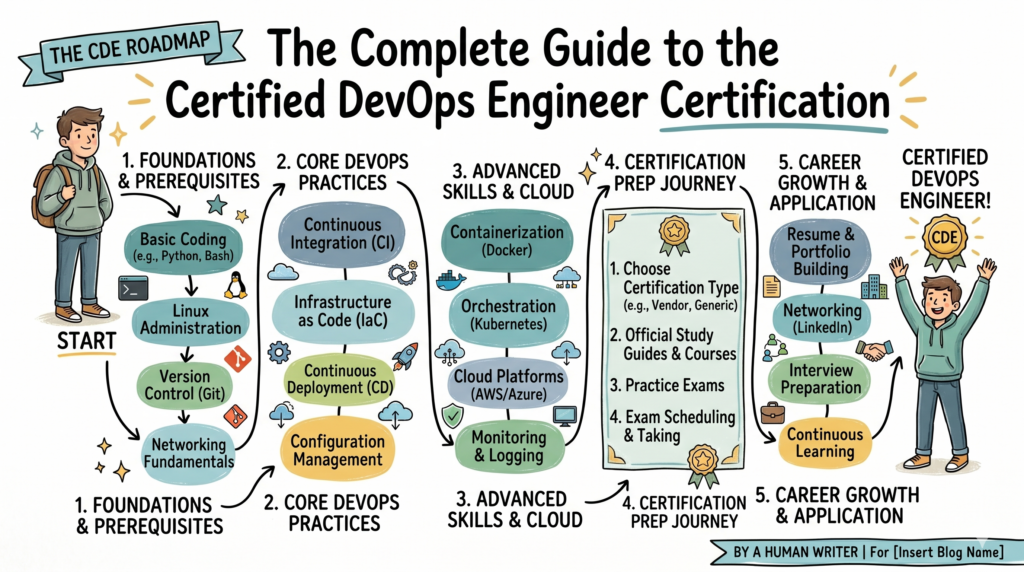
The Certified DevOps Engineer (CDE) is a comprehensive professional validation designed for those who want to master the art of bridging the gap between software development and IT operations. This guide is specifically crafted for engineers and technical leaders who are looking to navigate the complex landscape of cloud-native technologies and platform engineering. As the industry shifts toward high-velocity delivery and resilient infrastructure, understanding the core tenets of the CDE program is essential for making informed career decisions. This roadmap helps you evaluate how this certification fits into your professional growth, ensuring you invest your time in skills that truly move the needle in production environments.
What is the Certified DevOps Engineer (CDE)?
The Certified DevOps Engineer (CDE) represents a gold standard in practical, production-focused engineering education. Unlike theoretical courses that focus only on definitions, the CDE program exists to ensure that practitioners can actually build, manage, and scale complex systems in real-world enterprise settings. It aligns perfectly with modern engineering workflows by emphasizing the integration of automation, continuous delivery, and infrastructure as code. For an engineer, this certification acts as a bridge between basic tool knowledge and the high-level architectural thinking required to maintain stable, efficient deployment pipelines in a fast-paced market.
Who Should Pursue Certified DevOps Engineer (CDE)?
This certification is ideal for a wide range of professionals, starting from software engineers who want to understand the deployment lifecycle to seasoned SREs looking to formalize their expertise. Cloud professionals, security engineers, and data specialists will find the curriculum highly relevant to their daily tasks of managing distributed systems. In both the global market and the rapidly growing tech hubs in India, there is a massive demand for individuals who can manage “the middle” of the stack. Even engineering managers and technical leaders should pursue the CDE to better understand the capabilities and constraints of the teams they lead.
Why Certified DevOps Engineer (CDE)
In 2026, the demand for skilled DevOps practitioners has moved beyond simple scripting to requiring deep architectural intelligence. The Certified DevOps Engineer (CDE) is valuable because it focuses on principles that remain constant even as specific tools evolve or disappear. Enterprise adoption of cloud-native ecosystems continues to grow, and companies are looking for professionals who can ensure long-term system longevity and security. By earning this credential, you demonstrate a commitment to a return on career investment, proving you have the skills to reduce operational overhead and increase deployment frequency regardless of the underlying cloud provider.
Certified DevOps Engineer (CDE) Certification Overview
The formal program is delivered via the Certified DevOps Engineer (CDE) and is hosted on devopsschool. The certification structure is built around a practical assessment approach, where candidates are evaluated on their ability to solve real engineering challenges. It covers multiple ownership levels, from individual contributors to those managing entire organizational platforms. The structure is transparent and rigorous, ensuring that when an employer sees this certification, they know the candidate has been through a program that prioritizes hands-on competence over simple multiple-choice memorization.
Certified DevOps Engineer (CDE) Certification Tracks & Levels
The CDE program is organized into foundation, professional, and advanced levels to cater to different career stages. The foundation level introduces core concepts of CI/CD and automation, while the professional and advanced levels dive deep into specialization tracks like SRE, FinOps, and DevSecOps. These tracks allow engineers to build a modular career path, starting with broad DevOps knowledge and eventually specializing in high-demand niches. By following these levels, a professional can clearly map out their growth from a junior engineer to a principal architect within their chosen organization.
Complete Certified DevOps Engineer (CDE) Certification Table
| Track | Level | Who it’s for | Prerequisites | Skills Covered | Recommended Order |
| Core DevOps | Foundation | Junior Engineers | Basic Linux/Git | CI/CD, Docker, Scripting | 1 |
| Engineering | Professional | Mid-level Admins | 2+ years IT | K8s, Terraform, Jenkins | 2 |
| Architecture | Advanced | Senior Engineers | CDE Professional | Scaling, Security, DR | 3 |
| Operations | SRE Track | SRE/SysAdmins | Core DevOps | Monitoring, SLOs, SLIs | 2 (Parallel) |
| Security | DevSecOps | Security Analysts | Core DevOps | Vault, SAST/DAST, Compliance | 2 (Parallel) |
Detailed Guide for Each Certified DevOps Engineer (CDE) Certification
Certified DevOps Engineer (CDE) – Foundation Level
What it is
This entry-level certification validates a professional’s understanding of the fundamental DevOps lifecycle, including version control, basic automation, and the culture of shared responsibility.
Who should take it
It is suitable for fresh graduates, junior developers, or traditional system administrators who are looking to transition into the modern DevOps world with a solid theoretical and practical base.
Skills you’ll gain
- Mastering Git workflows and branching strategies.
- Understanding the basics of containerization with Docker.
- Setting up simple automated build pipelines.
- Collaborating across development and operations teams.
Real-world projects you should be able to do
- Containerize a legacy web application using Docker.
- Automate the testing and deployment of a static website.
- Manage source code effectively within a team environment.
Preparation plan
- 7–14 Days: Focus on the “DevOps Culture” and basic command-line tools. Use this time to get comfortable with Git commands and basic Linux administration.
- 30 Days: Deep dive into Docker and Jenkins. Build small local projects to see how code moves from a repository to a running container.
- 60 Days: Review the entire CI/CD lifecycle. Take mock tests and participate in lab environments provided by the program to ensure technical readiness.
Common mistakes
- Ignoring the cultural aspect and focusing only on tools.
- Skipping the fundamentals of Linux and networking.
- Not practicing enough with real command-line scenarios.
Best next certification after this
- Same-track option: CDE Professional Level
- Cross-track option: Certified SRE Foundation
- Leadership option: DevOps Team Lead Certification
Certified DevOps Engineer (CDE) – Professional Level
What it is
The Professional Level validates an engineer’s ability to manage production-grade environments using advanced automation, orchestration, and configuration management tools at scale.
Who should take it
This is designed for engineers with a few years of experience who are responsible for maintaining uptime and scaling infrastructure in a cloud-native or hybrid environment.
Skills you’ll gain
- Orchestrating microservices with Kubernetes.
- Implementing Infrastructure as Code (IaC) using Terraform.
- Advanced CI/CD pipeline optimization and security.
- Monitoring and logging with Prometheus and Grafana.
Real-world projects you should be able to do
- Deploy a multi-node Kubernetes cluster on a public cloud.
- Provision an entire environment (Network, DB, App) using code.
- Set up an automated monitoring dashboard with alerting for production services.
Preparation plan
- 7–14 Days: Refresh container knowledge and move into Kubernetes basics. Focus on Pods, Deployments, and Services.
- 30 Days: Spend significant time on Terraform and configuration management. Learn how to manage state and modules effectively.
- 60 Days: Integrate security and monitoring into your pipelines. Practice end-to-step automation from code commit to production monitoring.
Common mistakes
- Hard-coding values instead of using variables in IaC.
- Over-complicating pipelines without proper error handling.
- Underestimating the importance of persistent storage in containers.
Best next certification after this
- Same-track option: CDE Advanced/Expert Level
- Cross-track option: Certified DevSecOps Professional
- Leadership option: Engineering Manager Bootcamp
Choose Your Learning Path
DevOps Path
The DevOps path focuses on the full lifecycle of software delivery. It is designed for those who want to be the engine of the development team, ensuring that code flows smoothly from a developer’s laptop to the production environment. You will spend most of your time mastering CI/CD, automation, and general cloud infrastructure to reduce friction between teams.
DevSecOps Path
In the DevSecOps path, the priority shifts toward integrating security into every stage of the pipeline. You will learn how to automate security scanning, manage secrets securely, and ensure compliance without slowing down the release cycle. This is perfect for those who enjoy the intersection of infrastructure and cybersecurity.
SRE Path
The Site Reliability Engineering (SRE) path is for those obsessed with uptime, performance, and reliability. It focuses on using software engineering principles to solve operations problems. You will learn about error budgets, service level objectives (SLOs), and how to build self-healing systems that can survive major failures.
AIOps / MLOps Path
This path is tailored for the future of data-driven infrastructure. AIOps focuses on using AI to automate IT operations, while MLOps is about building the pipelines that allow machine learning models to be deployed and monitored effectively. It is a highly specialized track for those working with large data science teams.
DataOps Path
DataOps is all about the management and delivery of data. This path teaches you how to apply DevOps principles to data pipelines, ensuring that data is high-quality, accessible, and delivered reliably to the business. It bridges the gap between data engineering and traditional operations.
FinOps Path
The FinOps path addresses the financial side of the cloud. It is designed for professionals who need to optimize cloud costs and ensure that the organization is getting the most value for its spend. You will learn about cloud billing, cost allocation, and how to drive financial accountability in engineering teams.
Role → Recommended (Topic name) Certifications
| Role | Recommended Certifications |
| DevOps Engineer | CDE Professional, Certified Git Professional |
| SRE | CDE Professional, Certified SRE Practitioner |
| Platform Engineer | CDE Advanced, Kubernetes Specialist |
| Cloud Engineer | CDE Professional, Multi-Cloud Architect |
| Security Engineer | CDE Professional, Certified DevSecOps Engineer |
| Data Engineer | CDE Foundation, DataOps Specialist |
| FinOps Practitioner | CDE Foundation, FinOps Certified Practitioner |
| Engineering Manager | CDE Foundation, DevOps Leadership |
Next Certifications to Take After Certified DevOps Engineer (CDE)
Same Track Progression
Once you have mastered the Professional level, the natural step is to move toward the Advanced or Expert tiers. This involves mastering complex architectural patterns, disaster recovery at a global scale, and organizational-wide automation strategies that go beyond a single team.
Cross-Track Expansion
If you want to broaden your skills, consider moving into DevSecOps or SRE. Adding security or reliability expertise to your core DevOps background makes you a “T-shaped” professional, capable of handling a wide variety of challenges across the infrastructure stack.
Leadership & Management Track
For those looking to step away from daily coding, moving into leadership certifications is a wise choice. This involves learning how to manage technical debt, hire high-performing teams, and align technical goals with the broader business strategy of the company.
Training & Certification Support Providers for Certified DevOps Engineer (CDE)
DevOpsSchool
As the primary provider, they offer a deep curriculum that is highly respected in the industry. Their programs are known for being hands-on and very practical for working professionals.
Cotocus
This provider focuses on enterprise-level training and consulting, helping teams adopt the CDE principles within their specific corporate environments and legacy systems.
Scmgalaxy
A community-driven platform that provides a wealth of resources, tutorials, and support for those preparing for the CDE exam, with a focus on source code management.
BestDevOps
They offer streamlined courses that focus on the most high-impact tools and practices, making it a great choice for those who need to upskill quickly.
devsecopsschool
Specializes in the security aspect of the CDE tracks, providing deep dives into automated security testing and compliance for modern pipelines.
sreschool
The go-to resource for the SRE specialization within the CDE program, focusing heavily on monitoring, logging, and system reliability.
aiopsschool
A niche provider that helps engineers transition their CDE skills into the world of AI and automated operations management.
dataopsschool
Provides targeted training for engineers who want to apply the CDE framework to data management and high-volume data pipelines.
finopsschool
Focused specifically on the financial management and cost optimization tracks, helping CDE professionals manage cloud budgets effectively.
Frequently Asked Questions (General)
- Is the CDE certification difficult for beginners? While it covers foundational topics, the practical nature of the assessment requires a basic understanding of Linux and coding.
- How long does it take to get certified? Most working professionals complete the preparation and exam within 2 to 3 months of consistent study.
- Are there any prerequisites? There are no strict prerequisites for the foundation level, but the professional level suggests at least two years of IT experience.
- What is the ROI of this certification? Professionals often see a significant jump in salary and job opportunities due to the high demand for validated DevOps skills.
- Can I take the exam online? Yes, the certification process is designed to be accessible globally through secure online proctoring systems.
- Is the certification recognized globally? Yes, it is recognized by major tech firms in India, the US, Europe, and beyond.
- How often do I need to recertify? Typically, the certification is valid for two to three years, after which a refresher or higher-level exam is recommended.
- Does this cover specific cloud providers like AWS or Azure? It focuses on tool-agnostic principles that can be applied to any major cloud platform.
- Is there a community for CDE students? Yes, there are active forums and groups where candidates share tips and study materials.
- What kind of jobs can I get? You will be qualified for roles such as DevOps Engineer, Site Reliability Engineer, and Cloud Architect.
- Does the exam involve coding? Yes, you should be comfortable with scripting and basic programming logic to pass the practical sections.
- Are mock exams available? Most training providers like DevOpsSchool offer practice tests to help you gauge your readiness.
FAQs on Certified DevOps Engineer (CDE)
Is the Certified DevOps Engineer (CDE) worth it in 2026? Absolutely. As organizations move toward platform engineering, having a validated skill set in automation and infrastructure is a requirement rather than an option. Can I skip the Foundation level? If you have significant production experience, you can move directly to Professional, but the Foundation level ensures no gaps in your knowledge. How does CDE compare to AWS/Azure certs? CDE is tool-focused and vendor-neutral, making it more versatile for engineers working in multi-cloud or hybrid environments. What is the most important skill for CDE? Hands-on automation remains the core skill that candidates must master.
Final Thoughts: Is Certified DevOps Engineer (CDE) Worth It?
From a mentor’s perspective, the Certified DevOps Engineer (CDE) is a solid investment if you are looking for more than just a piece of paper. The industry is tired of “paper engineers” who know the terms but can’t fix a broken pipeline at 3:00 AM. This program focuses on the technical grit required to run modern systems. If you are willing to put in the work and complete the labs, the knowledge you gain will serve you far longer than any single tool’s popularity. It is a practical, honest path to becoming a better engineer in an increasingly automated world.
