Introduction
Most popular holiday corridors across India now present crowded viewpoints, honking bumper-to-bumper traffic jams, and commercial tourist plazas stripped of local soul. Ranchi, the elevated capital of Jharkhand resting on the mineral-rich Chota Nagpur Plateau, offers something increasingly rare: genuine wildness, deep-rooted indigenous tribal heritage, and unhurried natural majesty.
Far from a mere industrial transit hub, Ranchi unfolds as the bona fide “City of Waterfalls,” surrounded by fragrant sal canopy forests, dramatic escarpments, and sacred groves called Sarnas. A weekend spent exploring its rugged topography connects you directly to living folk traditions, ancient stone temples, and untouched river basins where the air smells of moist red earth and woodsmoke
.
Hundru Falls cascading down rocky cliffs.
Why Ranchi is a must-visit city
Ranchi occupies an elevation of roughly 650 meters above sea level, blessing the city with a sub-plateau microclimate that remains noticeably cooler than the surrounding northern plains. Historically the summer capital of the undivided Bihar-Bengal administrative zone during British rule, the city carries deep historical and geopolitical resonance. It is the cradle of the legendary tribal freedom movement spearheaded by Bhagwan Birsa Munda, whose legacy still pulses through local art, weekly haats (village markets), and forest reverence.
Practically, Ranchi is one of the most accessible yet under-explored capitals in Eastern India. The Birsa Munda Airport (IXR) operates frequent non-stop flights connecting Delhi, Mumbai, Bengaluru, and Kolkata. The city sits along well-maintained four-lane national expressways (NH-20 and NH-33) and hosts major railway junctions (Ranchi Junction and Hatia) running superfast Vande Bharat and Rajdhani express trains. Whether you are an adventurous solo backpacker, a road-trip enthusiast, or a family seeking green open spaces, Ranchi accommodates every travel style with modern hospitality infrastructure alongside rustic countryside trails.
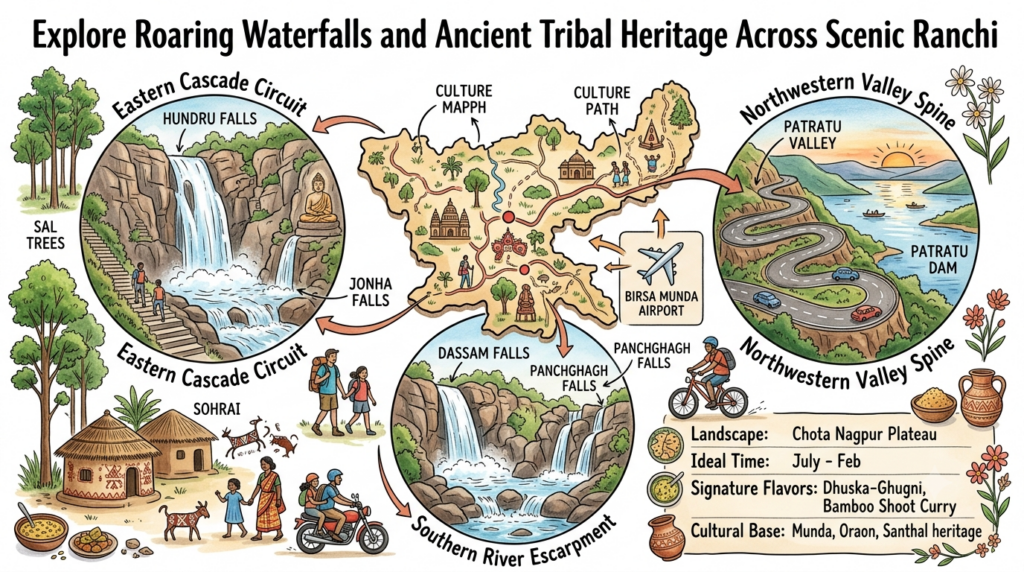
The primary tourism circuit branches into three distinct radial loops: the Eastern Cascade Circuit (Hundru and Jonha Falls), the Southern River Escarpment (Dassam Falls and Panchghagh), and the Northwestern Valley Spine (Patratu Valley and Dam).
| Travel Dimension | Regional Highlight | Practical Detail for Travelers |
|---|---|---|
| Primary Landscape | Chota Nagpur Plateau | Rocky escarpments, plateau waterfalls, Sal & Mahua forests |
| Ideal Trip Window | July to February | Post-monsoon lushness & crisp winter mornings (12°C–25°C) |
| Transit Gateway | Birsa Munda Airport (IXR) | 15–25 minutes drive to city center (Main Road / Morabadi) |
| Signature Flavors | Tribal & Regional Jharkhandi | Dhuska-Ghugni, Litti-Chokha, tender Bamboo Shoot curry, Arsa |
| Core Cultural Base | Munda, Oraon & Santhal heritage | Sohrai & Khovar art forms, terracotta pottery, brass crafts |
Best Places or Experiences
Hundru Falls
Formed by the mighty Subarnarekha River cascading off the plateau edge, Hundru Falls plunges down a sheer vertical drop of 322 feet over tiered gneiss formations. Over centuries, the thundering water has carved smooth, surreal plunge pools and polished rock canyons that look like prehistoric sculptures.
During the late monsoon and winter, the river flows with tremendous force, sending a shimmering mist through the canyon rim. Descending the roughly 700 paved concrete steps into the valley reveals lush flora clinging to granite crevices, offering a sensory spectacle of roaring water framed by dense subtropical greenery.
- Location: Angara Block, Ranchi District; roughly 42 km east of Ranchi city center.
- Why it is worth visiting: The highest water cascade in the immediate Ranchi circuit, offering jaw-dropping geological amphitheaters and pristine river canyon photography.
- Best things to do: Hike down the steps to view the lower spray zone; observe natural rock pools sculpted by centuries of high-velocity erosion; sip local ginger chai served by village vendors near the riverbed.
- Best time to visit: October to January when the post-monsoon water level remains vigorous and the daytime temperature is crisp.
- Ideal for whom: Nature enthusiasts, photography buffs, adventure lovers, and active families comfortable with stair climbs.
- Travel tip: Wear high-traction hiking or running shoes; the wet granite rocks near the water’s edge can become slick as glass without warning.
Dassam Falls cascading into rocky pools.
Dassam Falls
Dassam Falls (originally known as Da-soong in the indigenous Mundari dialect, translating to “pouring water”) is formed by the Kanchi River tumbling down 144 feet over craggy, stepped black stone. The sheer sonic power of the falls reverberates across the surrounding hills long before the water comes into visual frame.
The surrounding forest is dominated by ancient sal, mahua, and tendu trees, giving the entire gorge a secluded, primeval atmosphere. Forest department viewpoints allow travelers to take in panoramic vistas across the ravine while listening to the hypnotic churn of white water crashing against dark bedrock.
- Location: Near Taimara village on the Ranchi-Tata Highway (NH-33); approximately 40 km southeast of Ranchi.
- Why it is worth visiting: Unmatched acoustic and visual drama where the entire river contracts into a ferocious multi-tiered plunge across natural stone terraces.
- Best things to do: Take panoramic landscape shots from the watchtower deck; sample freshly fried, piping-hot Dhuska with spiced chickpea curry from local stallholders; explore the upper river plateau path under local supervision.
- Best time to visit: September to February for optimal water volume and comfortable trekking temperatures.
- Ideal for whom: Landscape photographers, road-trippers, couples, and road travelers cruising between Ranchi and Jamshedpur.
- Travel tip: Respect the warning barriers strictly; undercurrents in the natural pools below Dassam are notoriously treacherous and swimming is strictly prohibited.
Winding switchback roads of Patratu Valley.
Patratu Valley and Dam
The drive from Ranchi to Patratu is easily one of the most stunning ghat road journeys in Eastern India. Carved through the Ramgarh hill range, the smooth blacktop expressway snakes through an intricate series of dramatic hairpin loops, presenting birds-eye views of dense forest slopes rolling down toward the Patratu reservoir.
At the valley floor lies the vast Patratu Dam, an expansive reservoir created by the Nalkari River. Modern landscaped promenades, island parks, and thrilling speed-boating facilities make the waterfront an open, breezy sanctuary where travelers gather to watch amber sunsets reflect across miles of calm water.
- Location: Ramgarh District border; roughly 35 km northwest of Ranchi city.
- Why it is worth visiting: World-class engineered hairpin switchbacks rivaling alpine mountain passes, paired with scenic lake recreation and cool valley breezes.
- Best things to do: Stop at the designated valley viewpoint turnouts for sunset photos; take a speedboat ride across the Patratu Dam reservoir; enjoy traditional roasted corn (bhutta) coated in lime and rock salt at the rim stalls.
- Best time to visit: Late afternoon (3:30 PM to 6:30 PM) all year round, especially between October and March.
- Ideal for whom: Motorcyclists, driving enthusiasts, romantic couples, and weekend leisure seekers.
- Travel tip: Exercise caution on the hairpin turns if driving; local traffic moves fast, so stick to your lane and avoid overtaking on blind curves.
Historic seventeenth-century Jagannath Temple atop a hillock.
Jagannath Temple
Rising majestically atop a solitary granite hillock in Dhurwa, the 17th-century Jagannath Temple was commissioned in 1691 by King Barkar Nath Shahdeo of the Nagvanshi dynasty. Architecturally reminiscent of the celebrated shrine in Puri, its white-washed, curvilinear shikhara (spire) dominates the southwest skyline of Ranchi.
Climbing the long flight of stone stairs leads you into a peaceful open courtyard that delivers panoramic 360-degree vistas overlooking the green plains, the modern legislative assembly complex, and Dhurwa Dam. During the annual Rath Yatra festival, the temple transforms into the spiritual center of Jharkhand, drawing hundreds of thousands of tribal and non-tribal devotees in collective celebration.
- Location: Dhurwa, southwestern Ranchi; approximately 10 km from the city center.
- Why it is worth visiting: A masterwork of Nagvanshi royal architecture combining centuries of spiritual heritage with commanding hill-top vistas of Ranchi.
- Best things to do: Admire the intricate stone craftsmanship and wooden idols of Lord Jagannath, Balabhadra, and Subhadra; witness the evening aarti ritual as temple bells echo across the plains; take in sunset views from the terrace perimeter.
- Best time to visit: Early morning (6:30 AM to 9:00 AM) or late afternoon (4:00 PM to 6:00 PM) for cooler stone steps and pleasant lighting.
- Ideal for whom: Heritage seekers, culture buffs, spiritual travelers, and architecture lovers.
- Travel tip: Wear slip-on footwear as shoes must be deposited at the base; older visitors can use the motorable road that leads near the upper gateway to avoid climbing the full flight of steps.
Jonha Falls (Gautam Dhara)
Jonha Falls is a mesmerizing hanging valley fall where the Gunga River descends 141 feet to join the larger Raru River bed below. The site is steeped in local legend as Gautam Dhara, with tradition holding that Gautama Buddha bathed in these soothing waters during his spiritual journeys through ancient Magadha and the Chota Nagpur forests.
Surrounded by wooded wilderness, a designated ashram dedicated to Lord Buddha rests near the crest of the falls. Traversing the gentle 400-step stone staircase brings you right to the riverbed, where giant smooth boulders invite travelers to rest under the shade of sal canopies while cool mountain mist washes overhead.
- Location: Jonha Village, off the Ranchi-Purulia Road; roughly 38 km east of Ranchi.
- Why it is worth visiting: A peaceful, culturally sacred waterfall enveloped by tranquil forest ridges, featuring accessible river flats ideal for mindful retreats.
- Best things to do: Explore the Buddha temple complex near the gorge head; relax by the rocky river shallows; browse local village handicrafts, including wild honey and wooden combs sold by local craftspeople.
- Best time to visit: October through February, especially on weekday mornings for complete serenity.
- Ideal for whom: Solitude seekers, meditation practitioners, nature walkers, and birdwatching enthusiasts.
- Travel tip: Combine Jonha Falls with Hundru or Sita Falls on the same day loop, as they share the Eastern Ranchi highway corridor.
Tagore Hill (Morabadi)
Rising 300 feet above the vibrant cultural neighborhood of Morabadi, Tagore Hill (Morabadi Hill) holds an extraordinary literary legacy. Jyotirindranath Tagore, the elder brother of Nobel laureate Rabindranath Tagore, fell in love with the serene beauty of the hill, built his retreat named Brahma Mandir atop it in 1912, and spent his twilight years writing and stargazing here.
Rabindranath Tagore himself stayed here on multiple occasions, drawing deep poetic inspiration from the windswept hills and surrounding tribal life. Today, the climb up the stone-cut staircase through wooded terraces leads to a restored heritage pavilion with uninterrupted panoramic views of Ranchi’s cityscape against rolling green horizons.
- Location: Morabadi, northern Ranchi; roughly 5 km from Ranchi Railway Station.
- Why it is worth visiting: A peaceful intersection of Bengali renaissance literature, colonial-era architecture, and bird’s-eye urban vistas.
- Best things to do: Visit the hilltop Brahma Mandir memorial pavilion; explore the Ramakrishna Mission ashram nestled at its base; write, sketch, or read amidst cool hilltop breezes.
- Best time to visit: Sunrise (5:30 AM to 7:00 AM) for soft golden light and morning birdsong.
- Ideal for whom: Literature enthusiasts, solo thinkers, history lovers, and sunset strollers.
- Travel tip: The hill is completely open to breezes; bring a light cardigan or windcheater during winter mornings or evenings.
Offbeat Exploration: Hidden Gems Tourists Miss
McCluskieganj
Known as “Mini England,” McCluskieganj is a unique, nostalgic hamlet nestled inside thick sal forests roughly 60 km northwest of Ranchi. Established in the 1930s by the Colonisation Society of India as a homeland for the Anglo-Indian community, this quiet settlement retains colonial-era stone bungalows, sloping brick roofs, sprawling fruit orchards, and charming antique bakeries. Walking its quiet lanes feels like stepping directly into a tranquil period novel.
Panchghagh Falls
While mainstream crowds flock to Dassam, savvy local travelers head 45 km south toward Khunti to discover Panchghagh Falls. Here, the Banai River fractures into five separate, pristine streams tumbling over gentle rock shelves. Because the water does not plunge into dangerous deep pools, visitors can safely wade into the sparkling, calf-deep stone channels surrounded by fragrant wilderness.
Sohrai Tribal Art Enclaves in Khunti Hinterlands
A short detour south into the rural fringes of Ranchi leads into tribal villages where the walls of mud homes feature authentic Sohrai and Khovar mural art. Created by indigenous women using natural river soils, charcoal, and ochre pigment combs, these ancient geometric motifs celebrate harvest blessings, animal spirits, and ancestral nature worship. Visiting an active village cooperative offers an authentic cultural perspective far removed from standard souvenir shops.
Detailed Practical Guidance for Travelers
| Destination | Standard Entry Fee | General Timings | Best Local Food Options Nearby | Recommended Nearby Attractions |
|---|---|---|---|---|
| Hundru Falls | ₹10 per person | 6:00 AM – 5:00 PM | Local Dhuska-Ghugni stalls, rural snacks near parking | Jonha Falls, Sita Falls, Getalsud Dam |
| Dassam Falls | ₹15 per person | 8:00 AM – 5:00 PM | Freshly fried Mirchi Vada, sweet Arsa, village tea shacks | Panchghagh Falls, Surya Mandir (Bundu) |
| Patratu Valley | Free (Valley); ₹50 (Lake Park) | Open 24/7 (Valley); 9:00 AM – 6:30 PM (Dam) | Lakeside multi-cuisine resort restaurants, roasted sweetcorn | Patratu Dam Lake, Jindal Power Park |
| Jagannath Temple | Free entry | 5:00 AM – 12:00 PM; 3:30 PM – 8:30 PM | Traditional Khaja, sweet pedas, local samosa corners | Dhurwa Dam, Parasnath Hillock, JSCA Stadium |
| Jonha Falls | ₹10 per person | 7:00 AM – 5:00 PM | Forest canteen thalis, fresh coconut water, wild berries | Gautam Dhara Ashram, Hundru Falls |
| Tagore Hill | Free entry | 6:00 AM – 6:00 PM | Morabadi street food stalls, momos, artisanal coffee shops | Morabadi Ground, Tribal Research Institute Museum |
Logistics & On-Ground Navigation
Local Transport Options
- Auto-Rickshaws & E-Rickshaws (Totos): The backbone of inner-city travel. Shared autos run predefined routes along Main Road, Kanke Road, and Ratu Road for ₹10 to ₹30. Private autos operate on negotiation; always agree on the price before boarding.
- App-Based Cabs: Uber and Ola operate extensively within Ranchi urban limits, providing seamless connectivity to the airport, railway station, Morabadi, and Dhurwa.
- Full-Day Private Taxis: For the waterfall circuits and Patratu Valley, hiring a private vehicle for the day is by far the most reliable method. Standard hatchback/sedan rentals range from ₹2,000 to ₹2,800 for an 8-hour, 80 km package.
- Self-Drive Two-Wheelers: Ideal for solo adventurers and couples wanting to experience the winding curves of Patratu Valley at their own pace.
Budget Planning
- Backpacker / Budget Traveler (₹1,000 – ₹1,800 per day):
- Accommodation: Clean budget guesthouse or hostel dorm near Station Road (₹600 – ₹900/night).
- Food: Hearty local meals featuring Dhuska, Litti-Chokha, and local veg thalis (₹250 – ₹400/day).
- Transit: Shared autos and state buses to highway drops (₹200 – ₹400/day).
- Mid-Range / Comfort Traveler (₹3,500 – ₹6,500 per day):
- Accommodation: Well-appointed 3-star or 4-star boutique hotel in Morabadi, Lalpur, or Kadru (₹2,200 – ₹4,000/night).
- Food: Dine-in regional and multi-cuisine meals at established restaurants (₹800 – ₹1,500/day).
- Transit: Dedicated private air-conditioned cab for outstation waterfall circuits (₹2,200 – ₹3,000/day).
Safety and Inclusivity Tips
- For Families: Stick to well-developed access points at waterfalls and hold children’s hands firmly near steep stone staircases. Patratu Lake Resort and Tagore Hill offer the safest, most family-friendly environments.
- For Couples: Most tourist spots are welcoming, but avoid lingering at secluded forest edges or unlit stretches of outstation highways after sunset.
- General Security: While Jharkhand’s rural highway connectivity has improved dramatically over the last decade, aim to complete outstation waterfall visits and return to city limits by 6:00 PM.
Strategic Travel Planning Guardrails
Travel Planning Tips for Ranchi
- Book Ahead for Winter Weekends: The months of November through January see high tourist footfall from neighboring states; secure your hotel rooms and private drivers in advance.
- Carry Cash for Rural Highway Outposts: Digital UPI payments work seamlessly within Ranchi city, but mobile network signals can falter at the base of deep waterfall gorges like Hundru or Dassam.
- Respect Sacred Tribal Sarnas: Sarna groves are protected ancestral sanctuaries marked by sacred Sal trees and red-and-white flags; treat these spaces with quiet reverence.
- Equip Sturdy Footwear: Navigating the waterfalls involves climbing hundreds of uneven, occasionally damp stone steps; leave dress shoes and flip-flops at your hotel.
- Pack Layers for Winter Mornings: Plateau weather changes rapidly; early morning temperatures frequently dip to 10°C before warming up to a sunny 24°C by afternoon.
Common Mistakes to Avoid
- Underestimating Distances Between Waterfalls: Do not assume you can cover Hundru, Dassam, and Patratu on the exact same day; they sit on opposing geographical spokes.
- Ignoring Safety Warnings Along Riverbeds: Never venture past marked safety barriers at Dassam or Hundru; underwater vortex currents around submerged rocks are hazardous.
- Skipping Local Tribal Flavors: Sticking exclusively to generic hotel buffet spreads means missing Ranchi’s signature culinary identity.
- Relying Solely on App Cabs for Remote Waterfalls: Never take an Uber to Dassam or Hundru with the expectation of booking another ride back; drivers will not accept pickups in remote forest locations.
- Traveling Without Sun Protection: The high-elevation plateau sun can be deceptively intense even during crisp winter afternoons.
Suggested Itinerary Blueprints
1. Day Quick Dash (Urban Heritage & Scenic Valley Express)
Target Audience: Business travelers with a free day or transit visitors looking to capture Ranchi’s core essence within 12 hours.
- Morning (8:00 AM – 10:30 AM): Climb Tagore Hill in Morabadi for refreshing morning views, followed by a visit to the Jharkhand Tribal Museum to understand regional heritage.
- Midday (11:00 AM – 1:30 PM): Head southwest to pay homage at the hilltop Jagannath Temple in Dhurwa; grab a quick, authentic lunch of roasted Litti-Chokha nearby.
- Afternoon to Sunset (2:30 PM – 6:30 PM): Drive northwest through the breathtaking hairpin switchbacks of Patratu Valley, taking in the sunset across Patratu Dam before returning to the city for dinner.
2. Day Deep-Dive (The Cascades & Cultural Immersion Circuit)
Target Audience: Weekend vacationers wanting a balanced blend of nature exploration, local flavors, and historic sites.
- Day 1: The Eastern Waterfall Spoke & Heritage
- Morning: Early morning departure to Hundru Falls (beat the midday heat and tourist buses).
- Afternoon: Continue along the scenic country road to Jonha Falls; enjoy a tranquil picnic lunch by the upper riverbed.
- Evening: Return to Ranchi city; stroll through Morabadi ground and sample freshly prepared Dhuska and sweet Thekua.
- Day 2: River Gorges, Temples, and Sunset Vistas
- Morning: Drive south along the Ranchi-Tata highway to witness the raw power of Dassam Falls.
- Afternoon: Head back to Dhurwa to explore Jagannath Temple and enjoy views across the Dhurwa Dam backwaters.
- Sunset: Conclude your trip with an evening tea cruise along the scenic bends of Patratu Valley.
3. Complete Weekend Travel Plan (The Grand Chota Nagpur Loop)
Target Audience: Road-trippers, culture hounds, and photography enthusiasts seeking the ultimate 3-day exploration.
- Friday: Arrival, Literature & Twilight Drives
- Check into your hotel; spend an easy afternoon exploring Tagore Hill and the vibrant cafés of Morabadi.
- Late afternoon road drive down Patratu Valley for golden-hour photography and lakeside boating at Patratu Dam.
- Saturday: The Great Waterfall Expedition
- Depart early (7:30 AM) for Hundru Falls; descend the canyon stairs to view the sculpted granite gorge.
- Travel across country lanes to Jonha Falls (Gautam Dhara) for forest walks and a stop at the Buddha ashram.
- Drive past Getalsud Dam for sweeping lakeside sunset views before heading back to the city for a traditional Jharkhandi thali dinner.
- Sunday: Southern Canyons, Rural Art & Handloom Markets
- Morning visit to the majestic Dassam Falls.
- Head toward the Khunti rural fringe to admire authentic Sohrai mud wall paintings in a traditional village setting.
- Spend your final evening shopping for brass Dokra figurines, bamboo craftwork, and organic forest honey at the state-run Jharcraft Emporium on Main Road.
Common Tourist Mistakes to Avoid
- Geographic Blunders: Attempting to combine Dassam Falls (south) and Hundru Falls (east) with Patratu Valley (northwest) on the same afternoon. You will spend six exhausting hours on highway connections rather than enjoying the sights. Pick one cardinal spoke per half-day.
- Commercial Traps: Spending hours wandering generic shopping malls along Main Road. Instead, head to local cultural spots like the Morabadi handicraft fairs or Jharcraft, where genuine regional artisans display handmade treasures.
- Neglecting Modern/Alternative Zones: Focusing strictly on crowded waterfall parking lots while overlooking Ranchi’s tree-lined avenues, tranquil lake promenades, and contemporary art galleries in the Morabadi and Kanke sectors.
- Transport Overpayment: Agreeing to arbitrary quotes from roadside auto drivers at Ranchi Junction. Cross-check prevailing rates on ride-sharing apps, or negotiate based on standard city route averages.
- Luxury Dining Bias: Restricting your dining choices exclusively to high-end multi-cuisine hotel restaurants. Missing humble street-side specialists serving sizzling Dhuska-Ghugni, smoked Charcoal Litti, and clay-cup Chai deprives you of Ranchi’s authentic culinary pulse.
Frequently Asked Questions
1. What is the best time of year to plan a weekend trip to Ranchi?
The most rewarding window to explore Ranchi is from October through February. During these post-monsoon and winter months, the waterfalls maintain impressive flow, the surrounding forests are vibrant green, and the daytime temperatures hover comfortably between 15°C and 25°C, creating ideal conditions for outdoor hiking and sightseeing.
2. How many days are sufficient to comfortably see the major attractions in Ranchi?
A 2 to 3-day itinerary is perfect for experiencing Ranchi’s top sights without rushing. This timeframe lets you dedicate one full day to the eastern waterfall loop (Hundru and Jonha), one day to Patratu Valley and local heritage sites, and an additional half-day for Dassam Falls and local handicraft shopping.
3. Is it safe for tourists to drive to waterfalls outside Ranchi city limits?
Yes, visiting the popular waterfalls is safe, as the major access highways (NH-20 and NH-33) are well-paved and regularly patrolled. However, travelers should plan their trips to return to Ranchi city limits before nightfall (by 6:00 PM), as rural road stretches lack continuous street lighting and emergency services.
4. What are the signature local dishes every traveler must try in Ranchi?
Do not miss Dhuska, a deep-fried fermented rice and lentil snack served with spicy chickpea (ghugni) curry. Other culinary highlights include traditional Litti-Chokha roasted over cow-dung embers, seasonal bamboo shoot curry (Karil), Chilka Roti, and sweet Arsa or Malpua freshly prepared at local confectionery shops.
5. How far is Patratu Valley from Ranchi and what is the best way to get there?
Patratu Valley is situated approximately 35 km northwest of central Ranchi. The most scenic and convenient way to travel is by hiring a private cab or riding a two-wheeler via the Kanke-Patratu road. The journey takes about an hour and features beautifully engineered hairpin bends descending toward the reservoir.
6. Can senior citizens easily access the main waterfalls in Ranchi?
Most major waterfalls, including Hundru, Jonha, and Dassam, require descending hundreds of concrete steps to reach the water level, which can be strenuous for elderly travelers. However, the upper viewpoints, watchtowers, and landscaped parking terraces at these sites allow visitors to enjoy panoramic valley views without taking the stairs.
7. Are digital payments like UPI widely accepted across Ranchi and its outskirts?
Digital UPI payments (Google Pay, PhonePe, Paytm) work seamlessly across hotels, restaurants, auto-rickshaws, and shops within Ranchi city. However, mobile data coverage can drop inside deep ravines and river valleys, so it is wise to carry at least ₹1,500 to ₹2,000 in cash for entry tickets and snacks.
8. Which airport and railway stations serve as the main gateways to Ranchi?
Ranchi is served by Birsa Munda Airport (IXR), located just 5 km from the city center with daily direct flights to major Indian metros. For train travelers, Ranchi Junction (RNC) and Hatia (HTE) are the primary railheads, hosting superfast Rajdhani, Vande Bharat, and express connectivity across India.
9. Is swimming allowed in the plunge pools at Hundru and Dassam Falls?
Swimming is strictly prohibited at both Hundru and Dassam Falls. The riverbeds feature hidden submerged rocks, slippery algae layers, and powerful underwater vortex currents that pose severe hazards to swimmers. Travelers must stay behind the designated safety railings and respect all posted forest department warnings.
10. What unique authentic souvenirs should I buy when visiting Ranchi?
Look for authentic tribal Sohrai and Khovar paintings, brass Dokra lost-wax figurines, handcrafted bamboo homeware, and handwoven Tussar silk sarees. The best place to buy verified, fairly priced handicrafts is the state-run Jharcraft Megastore located on Main Road or Kadru.
11. Is Ranchi a budget-friendly destination for solo backpackers?
Ranchi is remarkably economical compared to commercial hill stations. Budget travelers can easily manage on ₹1,200 to ₹1,800 per day by utilizing shared auto-rickshaws, staying in budget guesthouses around Station Road, and eating delicious, wholesome local meals at neighborhood eateries and street stalls.
12. Can I find good rental self-drive cars or bikes in Ranchi?
Yes, several local vehicle rental agencies and independent operators in Ranchi offer self-drive hatchbacks, SUVs, and commuter motorcycles. A valid driving license, security deposit, and government identity card are required for verification. Booking your vehicle a couple of days in advance is recommended during peak winter holiday weekends.
Conclusion
A weekend journey to Ranchi is a soul-stirring reminder of what travel felt like before tour coaches and commercialization took over India’s hill escapes. Standing atop granite escarpments where cool river spray catches the afternoon light, cruising down the winding switchbacks of Patratu, or listening to the rustle of ancient sal groves leaves you with a profound sense of grounding. Ranchi invites you to step off the hurried path, breathe in the crisp plateau air, and connect with a raw, generous landscape that stays with you long after the journey home.
