Introduction
Most travelers chasing mountain air or lush wilderness flock toward congested northern hill stations, enduring gridlocked highways and sanitized commercial corridors. Ranchi quietly flips that script, offering an ancient plateau rich with primeval Sal forests, sacred hilltops, and cascading rivers.
Here, authenticity is not staged for tourist buses; it lives in bustling tribal bazaars, roadside earthen pots steaming with Dhuska, and sacred Sarna groves whispering centuries of indigenous lore. Exploring this verdant capital without personal wheels connects you directly to its true pulse, proving that real discovery thrives on public routes and open-air shared transit.
Why Ranchi is a must-visit city
Perched at an elevation of approximately 650 meters above sea level on the Chota Nagpur Plateau, Ranchi possesses a distinct subtropical highland climate that historically earned it the status of Bihar’s summer capital. Its geological antiquity showcases ancient granite domes, sprawling waterfalls fueled by the Subarnarekha river system, and a deep-rooted tribal ethos shaped by Birsa Munda’s legacy.
Reaching and navigating Ranchi is seamless for backpackers, solo explorers, and budget-conscious families. The city is anchored by Birsa Munda Airport (IXR) and major railway junctions like Ranchi Junction (RNC) and Hatia (HTE), supported by a dense, affordable grid of battery-operated e-rickshaws, shared autos, and city bus lines.
The primary urban sightseeing circuit clusters tightly around the city center, Kanke, and Morabadi, making car-free transfers remarkably quick and cost-effective.
| Metric / Attribute | Destination Detail |
|---|---|
| Geographical Zone | Chota Nagpur Plateau, Jharkhand |
| Average Elevation | 651 meters (2,136 feet) |
| Best Travel Season | October to March (Pleasant, crisp weather) |
| Primary Transit Hubs | Ranchi Junction (RNC), Birsa Munda Airport (IXR) |
| Intra-City Transport | Shared Autos, Toto (E-rickshaws), City Buses |
| Iconic Culinary Staples | Dhuska with Ghugni, Litti Chokha, Rugda, Mahua tea |
Best Places or Experiences
Pahari Mandir (Ranchi Hill)
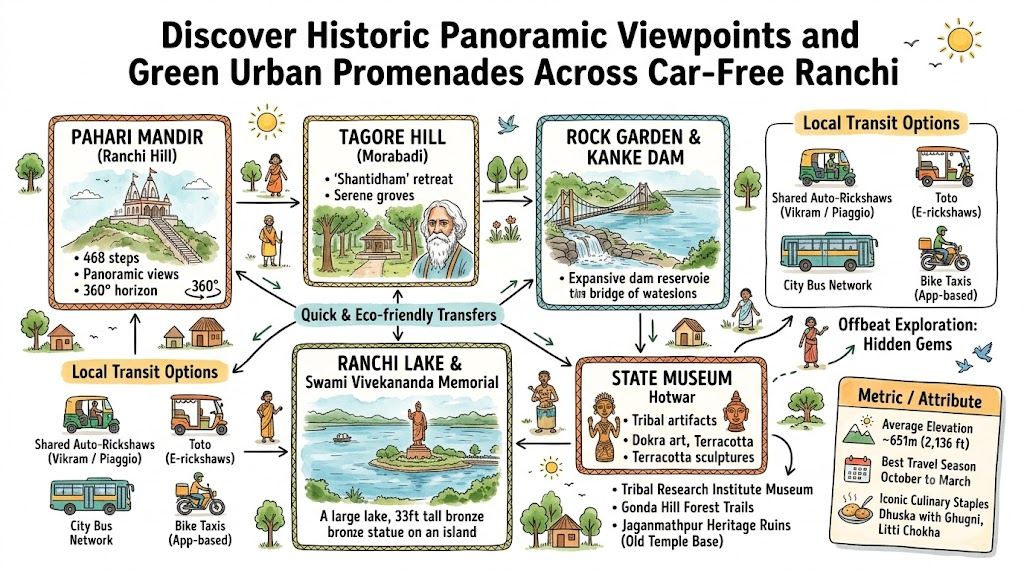
Rising dramatically 2,140 feet above sea level, Pahari Mandir sits atop an ancient volcanic outcrop known as Phansi Tongri. Dedicated to Lord Shiva, the hill holds poignant historical resonance; during colonial rule, British officers executed Indian freedom fighters here.
Honoring that sacrifice, Pahari Mandir remains one of the few religious sites in India where the Tricolor national flag is unfurled on Independence Day and Republic Day. Ascending its 468 stone steps rewards you with a cool plateau breeze and a commanding 360-degree panorama of the entire urban basin.
- Location: Ratu Road, approximately 3.5 km from Ranchi Railway Station.
- Why it is worth visiting: Unmatched aerial views of Ranchi combined with a unique dual identity of spiritual sanctity and national revolutionary history.
- Best things to do: Climb the steps during early dawn to avoid heat, photograph the panoramic horizon from the summit balcony, and seek blessings at the sacred Shiva shrine.
- Best time to visit: October to February; ideally between 6:00 AM and 8:00 AM for soft golden lighting and peaceful climbing.
- Ideal for whom: Fitness enthusiasts, spiritual travelers, photographers, and history buffs.
- Travel tip: Wear slip-resistant footwear and secure all sunglasses and snacks from cheeky resident macaques along the upper stairway.
Tagore Hill (Morabadi)
Tagore Hill is a quiet, contemplative sanctuary rising 300 feet above the vibrant neighborhood of Morabadi. The hill was acquired in the late 19th century by Jyotirindranath Tagore, elder brother of Nobel laureate Rabindranath Tagore, who built the serene retreat ‘Shantidham’ and the monument ‘Brahma Sthal’.
Rabindranath Tagore himself spent restorative time here, drawing literary inspiration from the tranquil plateau vistas. The surrounding groves provide a peaceful barrier against urban chatter, making it an idyllic spot for writers, readers, and evening strollers.
- Location: Morabadi, roughly 7 km north of Ranchi Railway Station.
- Why it is worth visiting: An evocative slice of literary history framed by open-sky architecture and sweeping vistas over green residential valleys.
- Best things to do: Explore the restored heritage pavilion at the summit, sketch or read under the shade of mature trees, and visit the Ramakrishna Mission ashram at the hill’s base.
- Best time to visit: November to March, particularly around 4:30 PM to watch the sunset illuminate the western sky.
- Ideal for whom: Solitary travelers, literature enthusiasts, architecture fans, and couples.
- Travel tip: The stone pathway leading up can become slippery after monsoon drizzles; opt for daytime ascents and avoid staying after dark.
Rock Garden & Kanke Dam
Crafted entirely from the natural gneiss boulders excavated during the creation of Kanke Dam, Rock Garden stands as a testament to creative landscape architecture. Its layered rock formations, waterfalls, walking pathways, and iron footbridges blend cleanly into the rugged hillside contours.
Adjacent to the garden spreads the vast reservoir of Kanke Dam, where cool winds roll across the water against a distant backdrop of rolling hills. It serves as the primary recreational lung for the city’s northwestern quadrant, popular among local artists, students, and walking groups.
- Location: Kanke Road, approximately 8 km from Ranchi City Center.
- Why it is worth visiting: Beautiful integration of indigenous rock art with large-scale water reservoir engineering.
- Best things to do: Walk across the flexible suspension footbridge, enjoy local roasted corn (bhutta) by the lakeside promenade, and capture dramatic long-exposure water photos at dusk.
- Best time to visit: September to February, between 3:00 PM and 6:00 PM.
- Ideal for whom: Families with children, casual walkers, landscape photographers, and budget travelers.
- Travel tip: Board a shared auto heading toward Kanke from Albert Ekka Chowk for less than ₹20, avoiding private taxi markups.
Ranchi Lake and Swami Vivekananda Memorial
Excavated in 1842 by British commissioner Colonel Thomas Wilkinson to regulate the urban water table, Ranchi Lake—locally called Bada Talab—rests at the feet of Ranchi Hill. It represents the historical core of 19th-century municipal planning in the plateau region.
Dominating the center of the lake is an island accessible by bridge, featuring an impressive 33-foot-tall bronze statue of Swami Vivekananda sculpted by Ram V. Sutar. The landscaped lakeside pathway offers a serene, pedestrianized walking loop right in the city center.
- Location: Near Upper Bazar, just 2.5 km from Ranchi Railway Station.
- Why it is worth visiting: A peaceful urban waterfront promenade anchored by exceptional public art honoring youth and introspection.
- Best things to do: Walk the perimeter pathway during evening illuminated hours, observe the central bronze statue from the walkway, and explore neighboring traditional sweet shops.
- Best time to visit: October to March; early morning at 6:30 AM or post-sunset when the lights reflect on the water.
- Ideal for whom: Walkers, architecture admirers, solo wanderers, and cultural explorers.
- Travel tip: Combine this visit directly with Pahari Mandir, as both sites are separated by just a short, flat stroll through Upper Bazar.
State Museum Hotwar (Jharkhand State Museum)
Situated inside the Khelgaon sports complex at Hotwar, this modern repository preserves the extensive anthropological, tribal, and geological heritage of Jharkhand. Its well-curated galleries house ancient stone sculptures, terracotta relics, weapons, and detailed dioramas of regional tribal lifestyles.
The ethnographic wing provides rare insight into the distinctive lifestyles, art forms, music, and hunting implements of the Santhal, Munda, Oraon, and Ho communities. Visiting the museum provides essential cultural grounding before heading into rural and forest travel circuits.
- Location: Hotwar, roughly 9 km northeast of Ranchi Junction.
- Why it is worth visiting: The most comprehensive state collection dedicated to preserving eastern India’s indigenous tribal heritage.
- Best things to do: Study the intricate Dokra brass craft exhibits, examine centuries-old Asur iron smelting artifacts, and view authentic Sohrai wall paintings.
- Best time to visit: Year-round; weekdays between 10:30 AM and 1:30 PM provide crowd-free gallery viewing.
- Ideal for whom: Anthropologists, history students, curious travelers, and families.
- Travel tip: Photography requires a separate, inexpensive ticket at the entrance counter; note that the museum remains closed on Mondays.
Offbeat Exploration: Hidden Gems Tourists Miss
Tribal Research Institute Museum (Morabadi)
While mainstream crowds flock to parks, this unassuming research center quietly documents indigenous linguistic patterns, rare musical instruments, and traditional herbal remedies. Located close to Tagore Hill, it houses genuine artifacts collected directly from indigenous forest communities across Jharkhand without commercial polish.
Gonda Hill Forest Trails
Tucked right behind the Kanke Dam perimeter, Gonda Hill features quiet dirt paths shaded by Mahua and Sal canopies. It is a favored early-morning haunt for local birders looking to spot kingfishers, Asian koels, and parakeets far away from traffic horns.
Jaganmathpur Heritage Ruins (Old Temple Base)
Most travelers know the hilltop Jagannath Temple at Dhurwa, but few explore the moss-covered, 17th-century brick foundations and carved stone pedestals lying along its southern approach. Built in 1691 by King Ani Nath Shahdeo, these weathered outer walls hold quiet historical intrigue in the afternoon sun.
Detailed Practical Guidance for Travelers
| Destination | Standard Entry Fee | General Timings | Best Local Food Options Nearby | Recommended Nearby Attractions |
|---|---|---|---|---|
| Pahari Mandir | Free | 5:00 AM – 8:30 PM | Upper Bazar roadside Litti-Chokha stalls | Ranchi Lake (Bada Talab) |
| Tagore Hill | Free | 6:00 AM – 6:30 PM | Morabadi street vendors (Chana Chur, Jhalmuri) | Tribal Research Institute Museum |
| Rock Garden | ₹30 per adult | 9:00 AM – 7:00 PM | Small cafes outside Kanke Dam gate | Kanke Dam & Reservoir |
| Ranchi Lake | Free | 5:30 AM – 9:00 PM | Dhuska and Kachori shops around Daily Market | Pahari Mandir & Upper Bazar |
| State Museum Hotwar | ₹20 per adult | 10:30 AM – 4:30 PM (Closed Mon) | Local snack kiosks outside Khelgaon entrance | Khelgaon Sports Complex |
Logistics & On-Ground Navigation
Local Transport Options
- Shared Auto-Rickshaws (Vikram / Piaggio): The lifeblood of Ranchi transit. Running fixed arterial routes (e.g., Station to Ratu Road, Overbridge to Kanke, Lalpur to Morabadi), trips cost merely ₹10 to ₹25 per head. Flag them down with a hand wave.
- Toto (E-Rickshaws): Ideal for short hops under 3 kilometers. They run through tight residential streets and Upper Bazar alleys where large autos cannot fit. Fares start around ₹10 per seat.
- City Bus Network: Government and private city buses run straight down Main Road connecting Dhurwa, Birsa Chowk, Station, and Kanke. While crowded during office rush hours, they are exceptionally economical.
- App-Based Cabs & Bike Taxis: Both Ola, Uber, and Rapido operate actively within Ranchi municipal borders. Bike taxis (Rapido) are especially fast and affordable for solo travelers negotiating peak traffic.
Budget Planning
- Backpacker / Solo Tier (₹600 – ₹1,000 per day): Dorm bed or budget guest house near Station Road (₹400–600), shared auto transit (₹80–120), and street food meals featuring Dhuska, Samosa-Chaats, and thalis (₹150–250).
- Mid-Range / Comfort Tier (₹2,200 – ₹3,800 per day): Quality boutique hotel room in Lalpur or Main Road (₹1,600–2,500), point-to-point app-hail auto/cabs (₹400–700), and seated dining at local regional restaurants (₹500–800).
Safety and Inclusivity Tips
- For Families: Stick to well-lit public zones like Morabadi and Main Road past dusk. Keep toddlers close on hill stairs at Pahari Mandir and Tagore Hill.
- For Solo & Female Travelers: Shared daytime transit is safe and normalized. Avoid wandering dimly lit lake banks or unpaved reservoir paths past 8:00 PM.
- General Safety: Keep small change ready for auto fares to avoid handling large bundles of cash at busy street corners.
Strategic Travel Planning Guardrails
Travel Planning Tips for Ranchi
- Time for the Winters: Plan visits between November and February when crisp sunny days give way to cool evenings requiring a light sweater.
- Carry Cash for Transit: While UPI QR codes work at almost every snack vendor, shared auto drivers often prefer physical ₹10, ₹20, and ₹50 notes.
- Footwear Strategy: Pack broken-in walking shoes with rugged soles to comfortably handle steep, unpolished rock steps.
- Respect Sacred Groves: When passing village fringes or hill tops marked with red-and-white flags, avoid trampling stone arrangements—these are sacred Sarna sites.
- Plan Around Monday Closures: The State Museum and certain managed municipal parks remain shut on Mondays.
Common Mistakes to Avoid
- Assuming Distant Waterfalls are Walkable: Iconic falls like Hundru, Jonha, and Dassam sit 35 to 45 km outside the city; do not attempt them without dedicated bus/train timing research.
- Overpaying Auto Drivers for Exclusive Rides: Don’t pay ₹200 for a trip when asking “Shared?” gets you to the same corner for ₹15.
- Skipping Local Tribal Flavors: Avoid eating exclusively at continental multi-cuisine hotels; authentic regional cuisine provides the real cultural context.
- Ignoring Afternoon Sun in Summer: May temperatures can touch 40°C; do not plan open hill ascents between 11:00 AM and 3:30 PM.
- Leaving Luggage at Unattended Junction Corners: Use the official cloakroom facilities available on Platform 1 of Ranchi Junction instead.
Suggested Itinerary Blueprints
1. Day Quick Dash (Urban Heritage Route)
Target Audience: Transit passengers, short business stopovers, or quick weekend visitors.
- Morning (7:30 AM – 11:00 AM): Climb Pahari Mandir for panoramic city views. Walk downhill through Upper Bazar to explore the Swami Vivekananda Memorial at Ranchi Lake.
- Afternoon (11:30 AM – 2:30 PM): Catch a shared auto to Main Road for an authentic Jharkhand lunch thali. Head to State Museum Hotwar to explore tribal heritage galleries.
- Late Afternoon & Sunset (3:30 PM – 6:30 PM): Take an e-rickshaw to Tagore Hill in Morabadi to watch the golden sunset over the plateau, ending your day with street snacks along Morabadi Ground.
2. Day Deep-Dive (Culture & Waterscape Route)
- Day 1 (Spiritual Vistas & Folk Lore):
- Morning: Early climb to Pahari Mandir, followed by hot Dhuska-Ghugni on Ratu Road.
- Midday: Explore the tribal art displays at the Tribal Research Institute Museum and Tagore Hill.
- Evening: Leisurely tea and people-watching at Morabadi Ground.
- Day 2 (Engineering & Nature Sculptures):
- Morning: Shared auto ride out toward Kanke Road; visit the Rock Garden.
- Afternoon: Walk along the banks of Kanke Dam reservoir.
- Evening: Return toward Albert Ekka Chowk for handicraft shopping at Jharcraft followed by traditional Litti Chokha.
3. Complete Weekend Travel Plan (The Complete Plateau Loop)
- Friday: Arrive at Ranchi Junction, check into your stay, and take an evening walk around illuminated Ranchi Lake followed by local sweets in Upper Bazar.
- Saturday: Dedicate the day to North Ranchi. Spend the morning on Tagore Hill, visit the Rock Garden, enjoy sunset by Kanke Dam, and sample street foods along the Morabadi open-air strip.
- Sunday: Head east via local shared transit to State Museum Hotwar. Return via Main Road for souvenir shopping at Kadru/Doranda, concluding with dinner featuring local seasonal preparations like Rugda or bamboo shoot curries.
Common Tourist Mistakes to Avoid
- Geographic Blunders: Grouping the distant peripheral waterfalls (like Dassam or Lodh) with central spots like Pahari Mandir on the same morning. Focus your days by zone: Central/North on foot and shared transit; peripheral waterfalls on dedicated, pre-planned day-long excursions.
- Commercial Traps: Spending afternoons inside chain retail malls on Kanke Road instead of walking through vibrant local markets like Upper Bazar or Firayalal Chowk, where brass crafts, tribal textiles, and spices thrive.
- Neglecting Modern Alternative Zones: Overlooking the contemporary artistic and student pulse of Morabadi, where open-air book readings, marathon runners, and modern cafes flourish alongside traditional street-food carts.
- Transport Overpayment: Agreeing to flat rates demanded by waiting autos outside the main airport or railway gates. Walk 100 meters to the main road to find shared vehicles, or verify fares via Rapido and Ola auto before bargaining.
- Luxury Dining Bias: Restricting dining to hotel banquets. Missing local street vendors serving steaming Dhuska with spiced black gram curry deprives you of the culinary soul of Jharkhand.
Frequently Asked Questions
1. Is it easy to explore Ranchi without owning or renting a car?
Yes, Ranchi features a dense and affordable network of shared auto-rickshaws, e-rickshaws (Totos), and municipal buses connecting all major urban attractions. Major landmarks like Pahari Mandir, Tagore Hill, and Rock Garden lie directly on established shared-transit routes, making private cars unnecessary within the city.
2. What is the cheapest mode of local transit in Ranchi?
Shared auto-rickshaws (locally called Vikrams or Tempos) are the cheapest option. They operate on fixed point-to-point routes across the city with fares ranging between ₹10 and ₹25 per person, depending on the distance traveled.
3. Which area in Ranchi is best for budget accommodations?
Station Road, near Ranchi Junction Railway Station, offers the highest concentration of budget-friendly guest houses, dormitories, and value hotels. Staying here keeps you within walking distance of public transit hubs and diverse local eateries.
4. Can I reach Rock Garden and Kanke Dam using public transport?
Yes. Take a shared auto heading to Kanke from Albert Ekka Chowk or Lalpur for approximately ₹15 to ₹20. Get off directly at the Rock Garden entrance gate on Kanke Road.
5. Is Ranchi safe for solo travelers using shared autos at night?
Ranchi is generally safe and hospitable for solo travelers. However, public shared transit reduces frequency after 9:00 PM. It is best to reach your accommodation by 8:30 PM or use app-based cabs if moving across town later.
6. What is Dhuska, and where can I find the best one in the city?
Dhuska is a deep-fried savory bread made from fermented rice and split chickpea batter, served with spicy potato-gram curry (Ghugni). Excellent, authentic versions are served hot at street stalls around Upper Bazar, Albert Ekka Chowk, and Morabadi Ground.
7. How many steps must one climb to reach Pahari Mandir?
Reaching the Shiva shrine atop Pahari Mandir requires climbing 468 stone steps. The stairway features resting landings and protective handrails, making it manageable for travelers of moderate fitness levels.
8. Can peripheral waterfalls like Hundru or Jonha be visited without a private vehicle?
While possible using regional passenger trains or state buses heading toward Purulia or Muri, departures are infrequent and drop you several kilometers from the falls. For peripheral waterfalls, public transit requires strict timetable management compared to city sights.
9. What should I shop for when visiting Ranchi’s local markets?
Look for Dokra brass metal figurines, Sohrai and Kohbar tribal art paintings, organic tamarind, Mahua honey, and handloom cotton stoles. You can purchase these at government-run Jharcraft emporiums or within local handicraft bazaars.
10. What is the best season for a car-free walking trip in Ranchi?
The optimal period runs from October to March. During these winter months, daytime temperatures hover around a pleasant 18°C to 24°C, providing ideal conditions for climbing hill monuments, walking along lakesides, and exploring street markets on foot.
11. Are ride-hailing bike taxis available in Ranchi?
Yes, Rapido, Uber Moto, and Ola Auto operate widely across Ranchi. Bike taxis are an efficient, economical option for solo travelers seeking to bypass narrow market jams at budget rates.
12. What dress code is suitable for visiting religious hill sites in Ranchi?
Modest, comfortable attire covering shoulders and knees is recommended when visiting sites like Pahari Mandir and Jagannath Temple. Choose breathable cotton clothes, and wear easily removable walking shoes, as footwear must be left at shrine entry points.
Conclusion
Choosing to explore Ranchi on foot and via its vibrant network of shared autos invites you into an unfiltered, authentic rhythm that highway tour buses completely miss. It is an experience felt in the cool morning wind atop Tagore Hill, the resonant prayer bells of Pahari Mandir, and the warm crackle of fresh Dhuska served on a Sal leaf plate. Skipping the insulated bubble of a car opens up the genuine spirit of the Chota Nagpur Plateau—unpretentious, deeply grounded, and richly generous to the observant wanderer.
