Introduction
While the rest of northern India swelters under blistering summer heatwaves and popular Himalayan hill stations choke with bumper-to-bumper traffic, Ranchi Click to open side panel for more information offers an unexpected, deeply rooted alternative. Perched at an elevation of roughly 2,140 feet on the Chotanagpur Plateau, this former summer capital of Bihar carries a natural altitude advantage that softens the afternoon sun and brings crisp, breezy evenings.
Instead of manicured tourist traps and overpriced souvenir rows, visiting here connects you directly to ancient tribal heritage, dense Sal forests, and dramatic granite escarpments. You trade noisy mall roads for the thunderous mist of secluded gorges, terracotta temples, and bustling weekly haats (village markets) where culture lives untouched.
Why Ranchi is a must-visit city
As the capital of Jharkhand, this plateau city sits at the geological and cultural heart of eastern India. Historically revered as a quiet sanatorium town during the British Raj, its identity is forged by indigenous Munda, Oraon, and Ho traditions, deeply intertwined with nature worship and forest conservation.
For travelers, the city serves as a remarkably accessible hub. Birsa Munda Airport connects directly to major Indian metros, Ranchi Junction anchors a vast rail network, and newly expanded four-lane national highways (NH-33 and NH-20) make road trips across the plateau effortless. Whether you are a solo backpacker seeking budget homestays or a family looking for upscale resorts near the dams, the hospitality here feels warm and unhurried.
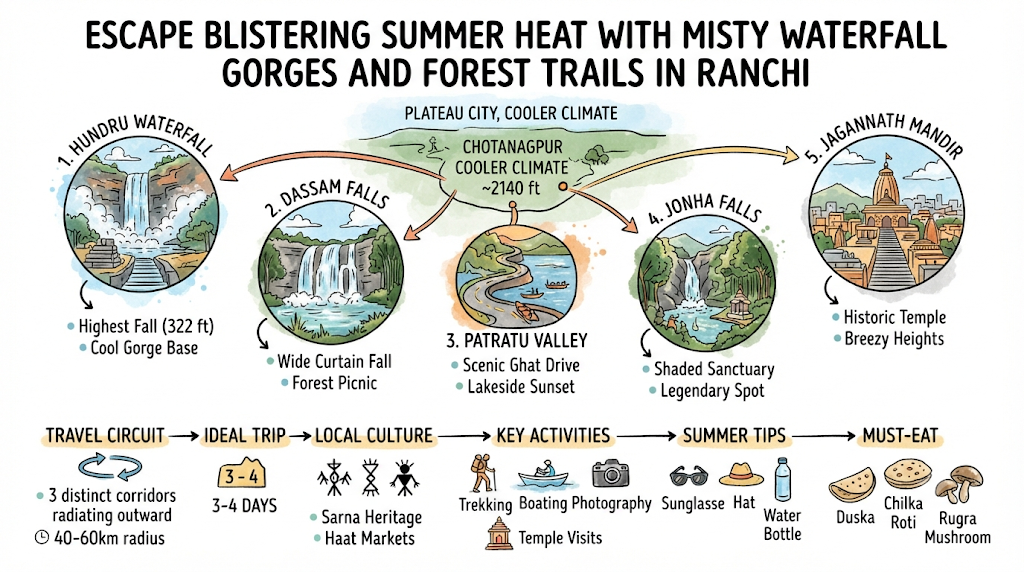
The travel circuit radiates outward like spokes on a wheel. The urban core holds historic hill shrines and reservoirs, while three distinct highway corridors lead to misty waterfalls, winding mountain ghats, and wildlife sanctuaries within a 40-to-60-kilometer radius.
| Key Metric | Regional Details for Summer Travelers |
|---|---|
| Elevation & Climate | ~2,140 ft above sea level; warm days (28°C–36°C) followed by cool, breezy evenings. |
| Primary Transport Hubs | Birsa Munda Airport (IXR), Ranchi Junction (RNC), Hatia Station (HTE), and NH-33. |
| Core Travel Circuits | North-West (Patratu Valley), East (Hundru & Jonha Falls), and South-East (Dassam Falls). |
| Cultural Identity | Indigenous tribal heritage, Sarna traditions, Chhau folk dance, and terracotta crafts. |
| Ideal Trip Duration | 3 to 4 days to comfortably cover both urban landmarks and peripheral waterfall gorges. |
Best Places to Visit in Ranchi
Hundru Waterfall

Hundru Waterfall
Carved by the Subarnarekha River as it plunges 322 feet off the edge of the Ranchi plateau, Hundru Waterfall Click to open side panel for more information is a geological masterclass in erosion and raw power. Even during the summer months, when water volume tapers from its monsoon roar into silver ribbons, the sheer vertical drop against weathered basalt rock formations remains breathtaking.
At the base of the gorge, the cascading water creates a natural mist that drops the ambient temperature by several degrees, offering instant relief from the midday warmth. Surrounding the plunge pool are massive, smooth boulders sculpted over millennia, framed by dense dry-deciduous forest canopy.
- Location: Sikidiri / Malghonghsa area, approximately 45 km east of the city center via the Ranchi–Purulia Road.
- Why it is worth visiting: It is the highest and most dramatic waterfall in the region, featuring a unique natural microclimate at the gorge floor.
- Best things to do: Descend the 700-plus concrete steps to feel the cool spray at the base, photograph the layered rock strata from the Hundru Fall view point Click to open side panel for more information , and sample freshly roasted forest corn sold by local villagers near the entrance.
- Best time to visit: Early morning between 8:00 AM and 10:30 AM before the sun hits the canyon walls directly.
- Ideal for whom: Nature photographers, fitness enthusiasts, and adventure-seeking friend groups.
- Travel tip: Wear shoes with high-traction rubber soles; the stone steps near the bottom stay perpetually damp and slippery, and climbing back up requires steady pacing and hydration.
Dassam Falls

Dassam Falls
Locally known as Da-Song—a Mundari phrase meaning “the act of pouring water”—Dassam Falls Click to open side panel for more information showcases the Kanchi River splitting into ten distinct streams as it drops 144 feet. Unlike narrow canyon falls, Dassam spreads wide across a stepped granite amphitheater, creating a mesmerizing curtain of white water.
The surrounding Taimara valley adds an aura of untamed wilderness to the experience. Thick groves of Sal and Mahua trees shade the approach paths, filling the warm summer air with an earthy, resinous fragrance that contrasts sharply with the crisp aquatic breeze rising from the river basin.
- Location: Near Taimara village along NH-33 (Ranchi–Tata Highway), roughly 40 km southeast of the main city.
- Why it is worth visiting: Its wide, multi-stream cascade and surrounding Sal forest corridor offer one of eastern India’s finest natural panoramas.
- Best things to do: Walk to the Dassam Falls Top View Point Click to open side panel for more information for sweeping valley vistas, relax under the shaded gazebos overlooking the cascades, and browse handmade bamboo crafts at the village stalls.
- Best time to visit: Late afternoon around 3:30 PM to 5:00 PM when golden hour light illuminates the water spray.
- Ideal for whom: Families, road-trippers, and landscape artists.
- Travel tip: Strictly obey the warning signs prohibiting swimming in the main plunge pool; hidden underwater whirlpools and sudden currents make the deep basin hazardous even in summer.
Patratu

Patratu
Driving down into Patratu Click to open side panel for more information feels like stumbling upon a Himalayan pass tucked inside the Chotanagpur hills. The famous Patratu Valley ghat road snakes through lush green hills via dramatic S-curves and hairpin bends, revealing bird’s-eye views of a shimmering reservoir far below.
At the valley floor sits the expansive Nalkari Dam lake, originally built to supply water to the local thermal power station. Today, its manicured lakeside promenade, cool reservoir breezes, and crimson sunsets make it the premier summer evening retreat for locals and travelers alike.
- Location: Ramgarh district border, roughly 40 km northwest of the city via Kanke Road.
- Why it is worth visiting: Combines one of India’s most scenic switchback drives with a breezy lakeside resort atmosphere.
- Best things to do: Stop at the upper valley viewpoints for panoramic photography, take an evening motorboat or paddleboat ride on the reservoir, and walk along the illuminated lakeside boardwalk after dusk.
- Best time to visit: Arrive by 4:30 PM to catch the sunset over the hills and stay until 7:00 PM for the cool night breeze.
- Ideal for whom: Couples, motorcyclists, long-drive enthusiasts, and families with children.
- Travel tip: Avoid driving the hairpin ghat road late at night due to heavy industrial truck traffic on connecting routes; plan your return before 8:30 PM.
Jonha Falls

Jonha Falls
Also revered as Gautamdhara due to local legend stating that Lord Buddha once meditated and bathed in its waters, Jonha Falls Click to open side panel for more information is a classic hanging valley waterfall. Here, the Gunga River leaps over a 141-foot cliff to merge with the Raru River below, creating a serene, shaded sanctuary.
A small Buddhist shrine sits peacefully near the base of the cascade, adding a spiritual dimension to the roaring water. Because the gorge is deeply recessed and flanked by tall trees, the valley floor stays remarkably cool even at the height of May.
- Location: Guridih village off the Ranchi–Purulia highway, approximately 42 km east of the city center.
- Why it is worth visiting: Blends tranquil Buddhist heritage with a lush, deeply shaded river gorge that shields visitors from summer heat.
- Best things to do: Descend the 490 concrete steps to the river confluence, visit the small riverside temple dedicated to Lord Buddha, and enjoy a shaded picnic along the rocky banks.
- Best time to visit: Mid-morning between 9:00 AM and 11:30 AM when sunlight filters diagonally through the forest canopy.
- Ideal for whom: Spiritual travelers, peace seekers, and solo explorers.
- Travel tip: You can easily combine Jonha and Hundru into a single eastern circuit day trip, as they lie only about 25 km apart via scenic rural backroads.
Jagannath Mandir

Jagannath Mandir
Crowning a rocky hillock in the Dhurwa area, Jagannath Mandir Click to open side panel for more information stands as a striking architectural tribute to the famous Puri temple in Odisha. Built in 1691 by King Ani Nath Shahdeo of the Barkagarh estate, its white Kalinga-style shikhara (spire) rises gracefully against the summer sky.
Beyond its spiritual resonance, the hilltop perch serves as a natural wind tunnel, catching steady plateau breezes all afternoon. From the stone courtyard surrounding the sanctum, visitors enjoy sweeping, unobstructed views of the southern city skyline and surrounding green hills.
- Location: Jagannathpur, Dhurwa sector, roughly 10 km southwest of the main railway station.
- Why it is worth visiting: Offers over three centuries of royal Nagvanshi history, intricate Kalinga temple architecture, and refreshing hilltop winds.
- Best things to do: Admire the carved stone pillars and traditional sanctum architecture, climb the temple steps at sunset for a 360-degree view of the city, and witness the rhythmic evening aarti.
- Best time to visit: Between 5:00 PM and 7:00 PM, right after the temple reopens for afternoon prayers.
- Ideal for whom: History buffs, architecture lovers, and cultural travelers.
- Travel tip: Note that the temple closes midday between 12:00 PM and 3:00 PM; time your visit for the late afternoon so you don’t end up waiting in the sun.
Kanke dam

Kanke dam
Resting peacefully at the foot of Gonda Hill, Kanke dam Click to open side panel for more information is the city’s favorite urban waterfront escape. Built across the Jumar River, this expansive reservoir reflects the changing colors of the sky while radiating a gentle, cooling breeze across the surrounding neighborhood.
Adjacent to the water stands Rock Garden Click to open side panel for more information , a creatively landscaped hilltop park carved out of the natural boulders of Gonda Hill. Connected by a graceful footbridge and accented with sculptures, waterfalls, and shaded gazebos, the two landmarks form a seamless urban oasis.
- Location: Gandhi Nagar / Kanke Road area in the northern part of the city, about 7 km from the city center.
- Why it is worth visiting: Delivers effortless lakeside relaxation and panoramic sunset views without leaving city limits.
- Best things to do: Stroll along the dam embankment at dusk, explore the boulder-carved pathways and viewpoints inside Rock Garden, and sample spicy street snacks from vendors outside the gates.
- Best time to visit: Sunset hours from 5:00 PM to 6:45 PM when the lake waters turn molten gold.
- Ideal for whom: Families, evening walkers, and travelers seeking a low-effort sunset spot.
- Travel tip: Parking near the main gate gets congested on weekend evenings; opt for an e-rickshaw or app-based cab to get dropped right at the promenade entrance.
Bhagwan Birsa Biological Park

Bhagwan Birsa Biological Park
Spread across 104 hectares of natural Sal forest terrain in Ormanjhi, Bhagwan Birsa Biological Park Click to open side panel for more information breaks away from cramped urban zoos by housing wildlife inside expansive, semi-natural enclosures. Located right along the Getalsud Dam reservoir edge, the park retains genuine woodland shade that keeps walking trails pleasant.
The park is divided into distinct zoological and botanical sections, making it a living encyclopedia of Chotanagpur flora and fauna. Massive canopy trees, bamboo groves, and lakefront breezes create a restorative environment for a half-day nature walk.
- Location: Chakla, Ormanjhi along NH-33, roughly 20 km north of the city center.
- Why it is worth visiting: One of India’s best-maintained natural habitat parks, offering dense forest shade and lake views.
- Best things to do: Spot Royal Bengal tigers, sloth bears, and gharials in spacious enclosures, take a battery-operated golf cart tour if traveling with elders, and walk through the adjacent botanical garden.
- Best time to visit: Sharp at 9:00 AM opening time when animals are active and morning air is crisp.
- Ideal for whom: Families with kids, wildlife enthusiasts, and botanical lovers.
- Travel tip: The park remains closed every Monday; carry a refillable water bottle, as single-use plastics are strictly banned at the security checkpoint.
Offbeat Exploration: Hidden Gems Tourists Miss
Sita Falls

Sita Falls
Tucked just 6 kilometers away from the much busier Jonha Falls, Sita Falls Click to open side panel for more information remains blissfully quiet and untouched by commercial crowds. Fed by the Radhu River, this cascade drops gracefully through a narrow, forest-lined gorge where the only sounds are rushing water and cicadas. A quaint forest rest house perched above the ravine offers a timeless, colonial-era vantage point for travelers craving solitude.
Dhurwa Dam

Dhurwa Dam
While tourists crowd the northern reservoirs, locals head south to Dhurwa Dam Click to open side panel for more information for vast, horizon-stretching water views that resemble an inland sea. The long, straight embankment road is flanked by open grasslands and gentle hills, making it an extraordinary spot for quiet sunrise drives, birdwatching, and feeling uninterrupted summer crosswinds.
Nakshatra Van

Nakshatra Van
Located directly in front of the Raj Bhavan (Governor’s House), Nakshatra Van Click to open side panel for more information is a thoughtfully designed botanical park rooted in ancient Vedic astrology. The central garden is laid out in concentric circles corresponding to the 27 nakshatras (lunar mansions), with each sector planted with the specific medicinal tree species linked to that zodiac star.
Detailed Practical Guidance for Travelers
| Destination | Standard Entry Fee | General Timings | Best Local Food Options Nearby | Recommended Nearby Attractions |
|---|---|---|---|---|
| Hundru Waterfall | ₹20–₹50 per person (plus nominal parking) | 10:00 AM – 4:00 PM | Village stalls serving Dhuska, boiled eggs, and roasted corn | Getalsud Dam, Jonha Falls |
| Dassam Falls | ₹20–₹30 per person | 8:00 AM – 6:00 PM | Highway dhabas along NH-33 serving Dal Tadka and Litti Chokha | Surya Mandir (Bundu), Panchghagh Falls |
| Patratu | Free (Boat rides ₹150–₹500 extra) | Open 24 hours (Boating 9:00 AM – 6:00 PM) | Lakeside cafes, Patratu Lake Resort restaurant, tea stalls | Pithoria Valley ruins, Kanke Dam |
| Jonha Falls | ₹20–₹40 per person | 8:00 AM – 5:00 PM | Small rustic shacks serving Maggi, Chai, and Pakoras | Sita Falls, Hundru Waterfall |
| Jagannath Mandir | Free entry | 6:30 AM – 12:00 PM & 3:00 PM – 7:30 PM | Dhurwa market sweet shops serving Thekua and Balushahi | Dhurwa Dam, JSCA International Stadium |
| Kanke dam | Free (Rock Garden ~₹30–₹50) | 9:00 AM – 7:00 PM | Kanke Road food trucks serving Chaat, Momos, and Kathi Rolls | Rock Garden, Pahari Mandir Ranchi |
| Bhagwan Birsa Biological Park | ₹50 Adults / ₹20 Children | 9:00 AM – 4:00 PM (Closed Mondays) | Ormanjhi highway eateries serving Handi Mutton and Thali | Crocodile Breeding Centre (Muta) |
Logistics & On-Ground Navigation
Local Transport Options
- App-Based Cabs (Ola & Uber): Widely available within city limits for airport transfers, station pickups, and inner-city hopping, though drivers often cancel long outstation waterfall trips unless negotiated separately.
- Auto-Rickshaws & E-Rickshaws: Shared green-and-yellow autos run fixed routes along Main Road, Kanke Road, and Ratu Road for ₹10 to ₹30 per ride. E-rickshaws are ideal for short neighborhood hops.
- Private Full-Day Cab Rentals: The gold standard for visiting peripheral waterfalls (Hundru, Jonha, Dassam) and Patratu. Booking a dedicated sedan or SUV through your hotel or a local operator ensures the driver waits while you explore remote gorges.
- Two-Wheeler Rentals: Available near Lalpur and Main Road for ₹500 to ₹800 per day, offering thrilling freedom on the Patratu Valley curves for licensed riders.
Budget Planning
- Budget / Backpacking Tier (₹1,500 – ₹2,500 per day): Includes a clean hostel dorm or budget lodge near Station Road (₹700–₹1,000), street breakfasts like Dhuska-Ghugni and local thalis (₹350–₹500), shared autos, and public entry tickets.
- Mid-Range / Comfort Tier (₹4,500 – ₹7,500 per day): Covers a boutique hotel or lakeside resort stay (₹2,500–₹4,000), a dedicated AC cab for day excursions (₹2,200–₹2,800), and dining at heritage restaurants featuring tribal and North Indian cuisine.
Safety and Inclusivity Tips
- For Families: Stick to well-paved viewpoints at waterfalls rather than scrambling over wet boulders with young children, and carry basic motion-sickness medication for the winding Patratu ghat road.
- For Couples: Popular urban parks and lakeside promenades are lively and welcoming until dusk, though it is wise to return from remote forest waterfalls before sunset.
- General Safety: Mobile network coverage (Jio and Airtel) works well across the city and Patratu, but signals frequently drop inside deep waterfall canyons—download offline maps beforehand.
Strategic Travel Planning Guardrails
Travel Planning Tips for Ranchi
- Carry Small Cash Denominations: While UPI digital payments work across almost every city cafe and highway dhaba, parking attendants and rural corn vendors at waterfall entrances often lack network connectivity and prefer ₹10, ₹20, and ₹50 notes.
- Start Waterfall Runs at Dawn: Beat both the midday summer sun and weekend picnic crowds by leaving your hotel by 7:30 AM for eastern or southern gorge circuits.
- Pack Smart Summer Gear: Bring breathable cotton clothing, polarized sunglasses, a wide-brimmed hat, high-SPF sunscreen, and sturdy grip sandals or trail shoes for steep waterfall staircases.
- Savor Local Tribal Gastronomy: Seek out authentic Jharkhandi staples like Dhuska (deep-fried rice-lentil savory pancakes), Chilka Roti (steamed rice crepes), Rugra (wild forest mushrooms), and Madua (finger millet) flatbreads.
- Respect Local Etiquette: Ask permission before photographing indigenous villagers at rural haats or near sacred Sarna groves, and dress modestly when visiting hillside shrines like Pahari Mandir Ranchi Click to open side panel for more information .
Local Insider Secret: Skip generic hotel buffets for lunch and look for local eateries serving Rugra (earthy subterranean mushrooms harvested from Sal forests) paired with Chilka Roti—it is the quintessential seasonal delicacy of the Chotanagpur plateau.
Common Mistakes to Avoid
- Attempting All Waterfalls in One Day: Hundru, Jonha, and Dassam involve climbing hundreds of steep steps in warm weather; cramming all three into a single afternoon leads to severe exhaustion.
- Ignoring the Monday Closure Rule: Both Bhagwan Birsa Biological Park and Nakshatra Van remain closed on Mondays—plan your urban sightseeing around this schedule.
- Underestimating Stair Climbs: Viewing Hundru or Jonha from the top railing misses half their magic, so budget enough time and energy for the descent and ascent.
- Relying on Ride-Share Apps for Return Trips from Falls: You might easily book an Uber to Dassam or Hundru, only to find zero drivers available for the return journey; always book a round-trip cab.
- Skipping Evening Ghat Breezes: Staying indoors after 5:00 PM wastes the best part of a summer day here, when plateau temperatures drop rapidly and lakeside promenades come alive.
Suggested Itinerary Blueprints
- 1-Day Quick Dash (The Valley & Urban Sunset Loop): Ideal for business travelers or weekend transit visitors. Start at 8:30 AM at Bhagwan Birsa Biological Park, grab a hearty highway lunch, drive up to Patratu Valley by 4:00 PM for golden hour hairpin views and boating, and wrap up with street food near Kanke Dam.
- 2-Day Deep-Dive (The Plateau Gorges & Heritage Circuit):
- Day 1: Depart at 7:30 AM for the eastern circuit covering Hundru Waterfall, Jonha Falls, and the secluded Sita Falls, returning to the city by late afternoon for an evening visit to Jagannath Mandir.
- Day 2: Explore Pahari Mandir and Nakshatra Van in the morning, rest during peak afternoon heat, and spend sunset cruising the Patratu Valley ghat road and lakefront.
- Complete Weekend Travel Plan (The 3-Day Chotanagpur Immersion):
- Friday: Arrive by afternoon, check into your hotel, stroll through Rock Garden and Kanke Dam at sunset, and enjoy an authentic Jharkhandi dinner featuring Dhuska and Chilka Roti.
- Saturday: Dedicate the full day to the eastern forest circuit—Hundru Waterfall, Jonha Falls, and Sita Falls—stopping at local village haats along the Purulia road to buy bamboo and terracotta souvenirs.
- Sunday: Head south in the morning to Dassam Falls, visit Jagannath Mandir and the vast Dhurwa Dam embankment in the afternoon, and pick up traditional Thekua sweets before your evening departure.
Common Tourist Mistakes to Avoid
- Geographic Blunders: Trying to combine northwest Patratu Valley with southeast Dassam Falls on the same day forces you to cut across dense city traffic twice, wasting nearly four hours on the road.
- Commercial Traps: Spending precious afternoon hours inside air-conditioned shopping malls on Main Road rather than experiencing open-air tribal haats or breezy dam embankments.
- Neglecting Modern/Alternative Zones: Overlooking the leafy, cafe-lined residential pockets around Lalpur, Morabadi, and Kanke Road, where young local artists and independent coffee roasters showcase the city’s contemporary creative pulse.
- Transport Overpayment: Accepting un-metered flat fares from auto drivers outside the railway station without cross-checking live rates on Uber or Ola first, which often inflates short-distance fares by 50%.
- Luxury Dining Bias: Eating exclusively at upscale hotel restaurants deprives you of the destination’s soul; the crispiest Dhuska, spiciest Aloo Chop, and freshest Litti Chokha are served piping hot from humble roadside carts around Morabadi Ground and Firayalal Chowk.
Frequently Asked Questions
1. Is Ranchi actually pleasant to visit during peak summer months?
Yes, thanks to its 2,140-foot elevation on the Chotanagpur Plateau, summer evenings and early mornings remain remarkably breezy and comfortable. While midday temperatures can touch 35°C, shaded forest gorges, hilltop temples, and expansive reservoirs like Kanke and Patratu offer natural cooling microclimates far milder than the northern plains.
2. Do the waterfalls in Ranchi dry up completely in May and June?
No, major cascades like Hundru, Dassam, and Jonha are fed by perennial plateau rivers and continue flowing throughout summer. While the water volume is gentler than during monsoon, the cascades form clear silver ribbons into cool, mist-filled plunge pools that are safer and far more accessible for photography.
3. How many steps do you have to climb at Hundru and Jonha Falls?
Visitors must descend and climb roughly 700 concrete steps at Hundru Waterfall and around 490 steps at Jonha Falls to reach the riverbeds. While railings and resting benches are provided along the paths, travelers should pace themselves, wear sturdy footwear, and carry sufficient drinking water.
4. What is the safest way to travel between waterfalls for solo travelers?
Booking a full-day private cab through a reputable local agency or your hotel is the safest and most reliable option. Because public transport to remote forest gorges is infrequent and mobile signals drop inside canyons, having a dedicated driver wait at the parking area guarantees hassle-free return travel.
5. Are there any permits required to visit Patratu Valley or the waterfalls?
Indian citizens do not require any special permits to visit Patratu Valley, the dams, or any of the waterfalls around the city. You only need to pay nominal conservation and parking fees (typically ₹20 to ₹50) at official forest department entry gates before descending into the gorges.
6. What authentic local souvenirs should I buy before leaving?
Look for intricate Dokra bell-metal figurines, hand-carved bamboo baskets, Sohrai and Kohvar tribal wall-art prints, and Tussar silk fabrics. You can find genuine, artisan-made pieces at government emporiums like Jharcraft on Main Road or directly from craftspeople at rural weekly village haats.
7. Which local dishes are absolute must-tries for first-time visitors?
Do not leave without tasting Dhuska (savory fried rice-lentil batter) served with spicy black chickpea curry, Chilka Roti paired with roasted tomato chutney, and seasonal Rugra mushrooms. For dessert, pick up freshly fried Thekua or Malpua from traditional sweet shops near Dhurwa and Upper Bazar.
8. Is swimming allowed at Dassam and Hundru waterfalls during summer?
Swimming is strictly prohibited in the main plunge pools of both Dassam and Hundru waterfalls due to treacherous underwater currents, sudden depth drops, and slippery submerged rocks. Visitors may safely dip their feet in shallow, designated downstream edges only where local lifeguards and warning signs permit.
9. What is the best time of day to drive through Patratu Valley?
Aim to reach the upper Patratu Valley viewpoints around 4:30 PM to watch the sun dip behind the surrounding hills while the ghat curves glow in golden light. Stay until dusk to enjoy cool lakefront breezes and illuminated promenades, then head back before heavy night truck traffic begins.
10. How far is Birsa Munda Airport from the main city hotels?
Birsa Munda Airport is remarkably close to the urban center, located just 5 to 7 kilometers south of Main Road and Station Road. Depending on traffic, a prepaid taxi or app-based cab takes only 15 to 25 minutes to reach most centrally located hotels.
11. Are e-rickshaws and autos safe for female solo travelers?
Shared autos and e-rickshaws along major arteries like Kanke Road, Main Road, and Morabadi are heavily used by students and commuters, making them very safe during daytime and early evening hours. After 8:30 PM, switching to app-based cabs like Uber or Ola offers added door-to-door convenience.
12. Can elderly travelers enjoy Ranchi without climbing steep waterfall stairs?
Absolutely. Elderly travelers can easily enjoy scenic viewpoints at Dassam Falls, lakeside walks at Kanke Dam and Patratu, battery-operated golf cart safaris inside Bhagwan Birsa Biological Park, and flat garden strolls through Nakshatra Van without tackling strenuous stairways.
Conclusion
Choosing Ranchi Click to open side panel for more information for your summer escape is a quiet rebellion against cookie-cutter vacations. Here, the reward isn’t found in luxury boutiques or crowded boardwalks, but in the cool mist rising off ancient granite gorges, the earthy aroma of Sal forests after a summer breeze, and the timeless grace of indigenous plateau culture. Step off the beaten track, follow the winding ghat roads, and let the City of Waterfalls remind you how restorative unhurried travel can truly be.
