Introduction
When mainstream travel brochures highlight Jharkhand, they inevitably push you toward monsoon-drenched waterfalls or misty plateaus. Yet, true cultural intimacy is rarely found amid the roaring weekend picnic crowds at crowded scenic lookouts.
Ranchi holds an entirely different, sheltered soul beneath its urban canopy. Step across the thresholds of its quiet galleries, climate-controlled heritage repositories, and modern community sanctuaries, and you will discover ancient forest lore woven directly into tactile artifacts.
Exploring the city indoors allows you to trade scorching midday heat or seasonal downpours for uninterrupted reflection. Here, centuries of indigenous pride, scientific wonder, and contemporary tribal craftsmanship sit unhurried, waiting for curious wanderers to slow down.
Why Ranchi is a must-visit city
Perched on the undulating Chota Nagpur Plateau, Ranchi serves as the administrative, intellectual, and cultural anchor of eastern India’s tribal belt. Its unique geographical elevation blesses it with crisp highland breezes, while its historical narrative stretches from the sacred forest uprisings of Birsa Munda to grand colonial hill-station retreats.
Modern Ranchi bridges historical authenticity and seamless travel logistics. Smooth four-lane expressways, the expanded Birsa Munda Airport, and a robust railway grid make entering the plateau effortless for solo wanderers, multi-generational families, and researchers alike.
The local travel circuit functions as an intertwined network of ethnographic marvels, contemplative heritage centers, interactive educational complexes, and lively artisan arcades.
| Metric / Aspect | Key Information |
| Geographical Elevation | 651 meters (2,136 feet) above sea level |
| Best Travel Season | October to March (pleasant, dry, and cool) |
| Primary Transit Hub | Birsa Munda Airport (IXR) & Ranchi Junction (RNC) |
| Signature Local Dish | Dhuska with Ghugni, Chilka Roti, and Bamboo Shoot Curry |
| Core Cultural Trademark | Sohrai-Khovar painting and Dokra brass craft |
Best Places or Experiences
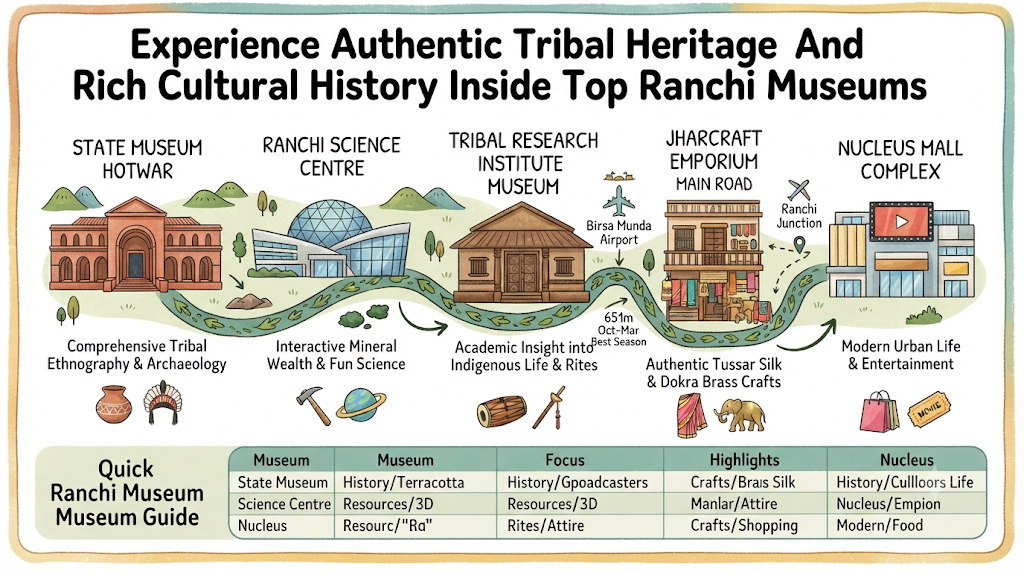
State Museum Hotwar
Spanning across the sprawling Khelgaon sports complex zone, the State Museum Hotwar stands as an architectural tribute to Jharkhand’s vast prehistoric and contemporary legacy. Its vaulted stone corridors house sixteen dedicated galleries ranging from early Stone Age terracotta to medieval Buddhist sculptures unearthed from rural excavation pits.
Walking through its ethnographic wing reveals life-sized dioramas representing the state’s major indigenous communities, including the Santhal, Munda, Oraon, and Ho. The exhibits showcase authentic bridal ornaments, traditional hunting gear, musical instruments, and sacred terracotta shrines with remarkable preservation.
- Location: Hotwar, Khelgaon, roughly 8 km northeast of Ranchi Railway Station.
- Why it is worth visiting: It is the most comprehensive repository of tribal ethnography and eastern plateau archaeology in India.
- Best things to do: Study the ancient carved terracotta tablets, view the Dokra brass casting display, and examine the rare 10th-century Pala dynasty sculptures.
- Best time to visit: 10:30 AM to 1:30 PM, when gallery natural lighting is optimal and school tours have cleared out.
- Ideal for whom: History buffs, cultural researchers, anthropologists, and families.
- Travel tip: Wear slip-on walking shoes; the galleries cover extensive floor acreage and require substantial walking across polished stone floors.
Ranchi Science Centre
Set against a tranquil hillock near Chiraundi, the Ranchi Science Centre turns scientific concepts into tactile play across 42,000 square feet of curated indoor halls. Designed by the National Council of Science Museums, the campus blends cutting-edge scientific engagement with dedicated regional geography modules.
Inside the Jharkhand: Resources and Technology hall, travelers discover interactive mining dioramas, geology cross-sections, and models showing how coal and iron reserves power the nation. The fun science galleries, mirror mazes, and indoor 3D theater offer an engaging refuge from afternoon rain.
- Location: Chiraundi, Morabadi, approximately 5 km north of the city center.
- Why it is worth visiting: It explains the complex subterranean mineral wealth of the plateau through interactive physical models.
- Best things to do: Experience the 3D space film, interact with the whispering dish acoustics, and test your reflexes on the interactive physics stations.
- Best time to visit: 11:00 AM on weekdays to explore interactive exhibits without weekend crowds.
- Ideal for whom: Inquisitive children, students, science enthusiasts, and family groups.
- Travel tip: Book the 3D show ticket at the main entry counter right away, as theater seating fills quickly.
Tribal Research Institute Museum
Tucked quietly behind the lush avenues of Morabadi, the Dr. Ramdayal Munda Tribal Welfare Research Institute Museum offers an authentic, academic look into indigenous heritage. Unlike commercial tourist displays, this center preserves living memories through ancestral attire, ceremonial headdresses, and sacred domestic tools.
The curation documents the architectural ingenuity of rural adivasi homes, displaying mud-plastering techniques, hand-carved wooden doors, and musical instruments like the Mandar and Nagada. Visiting this indoor space provides essential historical context before you interact with tribal artisans across the plateau.
- Location: Morabadi ground perimeter, 4 km from Ranchi Junction.
- Why it is worth visiting: It offers an unvarnished, scholarly look into the social structures and sacred rites of indigenous communities.
- Best things to do: Admire intricate bone and cowrie-shell jewelry, inspect ancient hand-carved agricultural tools, and study regional musical percussion variations.
- Best time to visit: 2:00 PM to 4:30 PM for quiet reading and unhurried gallery exploration.
- Ideal for whom: Cultural storytellers, art historians, and mindful solo travelers.
- Travel tip: Ask the desk curator for available archival monographs or regional folk-art monographs available for purchase at nominal prices.
Jharcraft Emporium Main Road
Stepping into the multi-storied Jharcraft Emporium on Main Road is an immersive cultural encounter rather than a standard retail trip. Managed by the state handloom corporation, this air-conditioned showroom serves as a living gallery for thousands of rural village weavers, potters, and metal artisans.
Floor after floor exhibits genuine Kuchai Tussar silk sarees, unstitched organic yardage, handmade tribal quilts, and intricate Sohrai-Khovar wall art. You can examine delicate Dokra (lost-wax metal casting) brass statues and tribal bamboo crafts, knowing each piece comes with direct geographical origin authenticity.
- Location: Main Road, Kadru Diversion intersection, 2 km from Ranchi Station.
- Why it is worth visiting: It provides direct, government-certified access to authentic indigenous textiles and rural handicrafts under one roof.
- Best things to do: Compare organic wild tussar weaves against spun silks, purchase authentic Dokra figurines, and browse regional lac jewelry.
- Best time to visit: 12:00 PM to 3:00 PM when sales counters are calm and staff can explain the lineage of handloom motifs.
- Ideal for whom: Ethical shoppers, interior designers, collectors, and textile enthusiasts.
- Travel tip: Inspect the fabric’s Silk Mark tag to confirm origin, and request handloom certification for high-value silk investments.
Nucleus Mall Complex
Situated on bustling Circular Road, Nucleus Mall is a premier example of Ranchi’s modern urban social scene. Far from a faceless shopping box, its multi-tiered indoor architecture serves as a central social venue where locals gather during monsoon downpours or hot summer afternoons.
Inside, visitors find a premier multi-screen cinema, extensive air-conditioned arcades, and a sprawling upper-deck food hall. It offers a fascinating glimpse into the aspirations of contemporary Jharkhand youth, balancing international retail outlets with regional culinary favorites.
- Location: Circular Road, Lalpur, roughly 3.5 km north of Ranchi Main Station.
- Why it is worth visiting: It showcases the city’s modern retail energy, entertainment culture, and contemporary gathering spaces.
- Best things to do: Catch a regional or national movie screening, sample tribal-infused fast-casual dining, and browse modern design shops.
- Best time to visit: 1:00 PM to 4:00 PM to avoid the heavy evening footfall from neighboring university colleges.
- Ideal for whom: Couples, teenagers, modern lifestyle shoppers, and leisure seekers escaping rain.
- Travel tip: Park outside if using local e-rickshaws, as the subterranean basement parking ramp faces congestion during weekend rush hours.
Offbeat Exploration: Hidden Gems Tourists Miss
Munda-Oraon Heritage Cell at Morabadi
Located adjacent to university administrative offices, this understated archive preserves original linguistic field recordings, early script attempts (Ol Chiki and Tolong Siki), and sacred palm-leaf records. Visitors can listen to recorded oral folk epics sung by elders from remote forest hamlets.
Chotanagpur Art Research Centre Interior Vaults
Tucked down a residential alley near Bariatu, this private studio and archive exhibits traditional Kohbar bridal chamber wall paintings. The resident artists demonstrate how natural river clays, charred straw, and wild ochres are hand-applied using comb teeth and chewed twigs.
The Ramkrishna Mission Sanatorium Indoor Chapel
Located in quiet Tupudana, this historical spiritual sanctuary maintains silent, teak-lined meditation chambers. Its sheltered library houses rare comparative philosophical texts, century-old colonial forestry journals, and tranquil reading alcoves far removed from urban commotion.
Detailed Practical Guidance for Travelers
| Destination | Standard Entry Fee | General Timings | Best Local Food Options Nearby | Recommended Nearby Attractions |
| State Museum Hotwar | ₹20 per adult | 10:30 AM – 4:30 PM (Closed Mondays) | Hotwar Canteen snacks, Khelgaon Chowk tea stalls | Birsa Munda Athletics Stadium |
| Ranchi Science Centre | ₹25 general, ₹20 3D theatre | 10:00 AM – 5:00 PM (Closed Mondays) | Morabadi street vendors (Litti Chokha), Kaveri Restaurant | Tagore Hill & Ashram |
| Tribal Research Institute | Free / Nominal ₹10 | 11:00 AM – 5:00 PM (Weekdays only) | Morabadi Maidan Kiosk for Dhuska & spicy Aloo Chana | Morabadi Football Ground |
| Jharcraft Emporium | Free access | 10:30 AM – 8:00 PM (Open all days) | Yellow Sapphire, Punjab Sweet House on Main Road | GEL Church Compound |
| Nucleus Mall Complex | Free entry | 10:30 AM – 9:30 PM (Daily) | Mall Food Court, Prana Lounge, Lalpur street food | Oxygen Park Morabadi |
Logistics & On-Ground Navigation
Local Transport Options
- App-Based Cabs (Ola/Uber): Dependable throughout Central Ranchi, Morabadi, and Lalpur for point-to-point journeys.
- Shared Auto-Rickshaws (Tempos): Run set corridors (e.g., Overbridge to Kanta Toli, or Ratu Road to Kanke) for ₹10 to ₹25 per passenger.
- Private E-Rickshaws (Totos): Best for short indoor-hopping hops across busy lanes without exhaust fumes; always negotiate a flat rate upfront.
- Pre-Booked Private Taxis: Ideal for heading out to Hotwar or outer perimeter sites, costing roughly ₹1,500 to ₹2,200 for a full day.
Budget Planning
- Backpacker / Cultural Explorer Tier (₹1,000 – ₹1,600 per day): Stays in comfortable budget guesthouses around Station Road; utilizes shared autos and e-rickshaws; enjoys local canteen meals of Dhuska, Litti, and Thalis; spends modestly on museum admissions.
- Mid-Range / Comfort Tier (₹3,200 – ₹6,000 per day): Boutique hotel stays near Lalpur or Morabadi; relies on private app-based cabs; dines at air-conditioned family restaurants; shops for authenticated Tussar silk and Dokra bronzes at official emporiums.
Safety and Inclusivity Tips
- Family Comfort: Major indoor museums feature broad ramps, but call ahead regarding wheelchair loan availability as historic annexes may have threshold steps.
- Couples & Solo Travelers: Central Ranchi is welcoming and safe; keep evening walks to brightly lit commercial corridors such as Circular Road and Main Road.
- General Health Precautions: Carry your own insulated water flask; regional museum facilities have clean filtered water dispensers, reducing reliance on single-use plastics.
Strategic Travel Planning Guardrails
Travel Planning Tips for Ranchi
- Schedule around Monday closures: Almost all government-run cultural institutions, including Hotwar and the Science Centre, remain closed on Mondays.
- Carry crisp paper currency: While UPI and QR-code payments work across retail shops and malls, entry ticket booths at smaller cultural centers often require exact cash.
- Respect museum photography rules: High-end mirrorless cameras often require paid permits; always ask the gallery custodian before snapping tribal jewelry up close.
- Dress respectfully in heritage archives: Opt for modest, breathable cotton clothing that covers shoulders and knees when visiting cultural research centers.
- Plan your indoor visits during the midday heat: Save sheltered museum exploration for 11:30 AM to 3:30 PM to avoid peak heat or afternoon rains.
Common Mistakes to Avoid
- Assuming all museums sit near each other: Hotwar and Chiraundi lie on opposing sides of the urban sprawl; do not lump them into a rushed single morning.
- Relying solely on street-hailed autos after dark: Auto frequency drops sharply around Hotwar past 6:00 PM; pre-book your return ride before entering late exhibits.
- Overlooking authentic museum handloom shops: Skipping certified emporiums to buy tribal crafts from unregulated roadside stalls often results in synthetic brass mixtures or machine-made polyester blends.
- Skipping regional culinary stops: Do not limit yourself to standard continental hotel fare when local eateries serve fresh Chilka Roti and spiced Rugra mushrooms.
- Underestimating time needed for historical galleries: Glancing through the Hotwar galleries in thirty minutes leaves three-quarters of the regional narrative unseen.
Suggested Itinerary Blueprints
1. Day Quick Dash (The Culture & Craft Circuit)
Designed for business travelers or short layovers needing an efficient cultural snapshot.
- Morning (10:00 AM – 1:00 PM): Arrive at Tribal Research Institute Museum in Morabadi for an overview of regional folklore, then take an e-rickshaw to Ranchi Science Centre for early interactive exhibits.
- Afternoon (1:30 PM – 4:00 PM): Head to Main Road for an authentic thali lunch, followed by two hours of handloom exploration at Jharcraft Emporium.
2. Day Deep-Dive (Heritage, Science & Modernity)
- Day 1: Ethnography & Plateau Archaeology
- Morning: Dedicate three full hours to the sixteen historical galleries of State Museum Hotwar.
- Lunch: Enjoy traditional Litti Chokha and mutton curry near Khelgaon Chowk.
- Afternoon: Visit the Munda-Oraon Heritage Cell archives in Morabadi; finish the day with sunset refreshments overlooking Morabadi ground.
- Day 2: Science, Craft & Urban Pulse
- Morning: Explore the interactive installations and 3D geological planetarium shows at Ranchi Science Centre.
- Afternoon: Browse curated Dokra bronzes at Jharcraft Emporium on Main Road.
- Evening: Unwind with coffee, retail leisure, and an evening movie screening at Nucleus Mall Complex.
3. Complete Weekend Travel Plan (The Plateau Sanctuary Loop)
- Friday Evening: Check into your hotel in Lalpur; take an easy orientation walk through Nucleus Mall and dine at a rooftop restaurant.
- Saturday: Spend a quiet morning studying tribal artifacts at the Tribal Research Institute, followed by a visit to the Chotanagpur Art Research Centre to watch Sohrai painting. Finish with dinner in Morabadi.
- Sunday: Head northeast to State Museum Hotwar for an unhurried morning viewing Pala-era bronzes, stop by local handloom cooperatives, and conclude with authentic shopping at Jharcraft.
Common Tourist Mistakes to Avoid
- Geographic Blunders: Attempting to combine the eastern outskirts of Hotwar with western ring-road temples in one morning creates hours of unnecessary transit through dense market intersections.
- Commercial Traps: Spending an entire afternoon inside generic suburban retail chains leaves you with the same mass-market goods found across any metro, missing out on local artisanal creations.
- Neglecting Modern/Alternative Zones: Focusing only on historic downtown overlooks charming artisan studios, coffee roasters, and serene library archives in Morabadi and Bariatu.
- Transport Overpayment: Hailing private autos outside prime rail stations without confirming meter calculations or cross-checking app fares usually leads to paying double the local rate.
- Luxury Dining Bias: Sticking exclusively to generic five-star hotel buffets deprives your palate of authentic tribal delicacies like slow-simmered Dhuska, Marua Roti, and seasonal wild greens.
Frequently Asked Questions
1. What are the best indoor places to visit in Ranchi during the monsoon season?
The State Museum at Hotwar and the Ranchi Science Centre in Chiraundi offer the most comfortable indoor experiences during heavy rains. Both feature extensive, fully sheltered galleries, educational displays, and indoor seating where you can explore local heritage and science without worrying about muddy outdoor trails or sudden plateau cloudbursts.
2. Are museums in Ranchi accessible for elderly travelers and wheelchair users?
Major venues like the State Museum Hotwar and modern shopping complexes like Nucleus Mall feature step-free ground ramps and wide hallways. However, smaller archival institutions such as the Tribal Research Institute have raised thresholds and lack dedicated mobility equipment, making a travel companion helpful for navigating older entrances.
3. Which indoor spots in Ranchi are best suited for children and families?
The Ranchi Science Centre stands out as the premier destination for children thanks to its interactive physics stations, 3D science cinema, and outdoor-indoor mineral garden. Nucleus Mall also provides family-friendly entertainment with dedicated modern gaming zones, soft play arenas, and casual multi-cuisine dining options.
4. Can I purchase authentic tribal handicrafts directly inside Ranchi’s indoor cultural centers?
While research museums preserve artifacts strictly for exhibition, the state-run Jharcraft Emporium on Main Road provides certified, direct purchases of tribal crafts. You can safely buy authentic lost-wax Dokra brass castings, hand-painted Sohrai home accents, and certified Tussar silk sarees created directly by rural cooperative artisans.
5. How much time should I allocate to explore the State Museum Hotwar thoroughly?
Plan for at least two to three uninterrupted hours to appreciate the State Museum Hotwar properly. The expansive complex houses sixteen distinct galleries covering prehistoric stone tools, classical stone carving, tribal arms, jewelry, and life-size village dioramas that require substantial walking to take in.
6. Is photography permitted inside the historical and cultural museums of Ranchi?
Casual mobile phone photography is generally permitted inside the public galleries of State Museum Hotwar and Ranchi Science Centre, though using flash around delicate tribal textiles is restricted. Professional setups, tripods, and commercial filming require advance written clearance and separate permit fees from the museum office.
7. Are guided tours available inside the Tribal Research Institute Museum?
Official audio guides are not offered, but on-site curators and archival caretakers are happy to answer specific historical questions. If you are traveling as an educational group, booking in advance through the welfare institute allows an assigned research assistant to guide you through the collections.
8. What is the typical entry fee for major indoor attractions across Ranchi?
Ticket prices across Ranchi’s public indoor venues are remarkably affordable. Standard entry to the State Museum Hotwar costs ₹20 per adult, while the Ranchi Science Centre charges ₹25 for general access and an extra ₹20 for 3D film screenings. Research institute archives are usually free or charge a nominal ₹10 entry.
9. Which indoor destinations in Ranchi showcase authentic local Sohrai and Khovar art?
The Tribal Research Institute Museum and the Chotanagpur Art Research Centre preserve authentic examples of traditional wall-art techniques. You can also view and purchase framed canvas adaptations and silk motifs rendered by native village artists inside the central Jharcraft Emporium galleries.
10. How can I travel between central Ranchi hotels and the State Museum Hotwar?
The easiest way to reach the State Museum Hotwar is by booking an app-based cab or hiring a private auto-rickshaw for a round trip. Because return autos can be scarce around the Khelgaon sports complex in late afternoon, arrange for your driver to wait outside during your visit.
11. What attire is recommended when visiting educational and cultural institutions in Ranchi?
Comfortable, modest everyday attire made from breathable cotton is ideal for exploring Ranchi’s cultural spaces. Wearing practical slip-on walking shoes makes navigating expansive stone-floor galleries effortless, while carrying a light shawl helps in air-conditioned movie halls and archival reading rooms.
12. Are there quality dining facilities inside Ranchi’s museum complexes?
Most public museums offer modest canteen counters serving bottled water, chai, and packaged snacks rather than full restaurant meals. For substantial meals, head toward nearby commercial hubs: Morabadi offers popular street kiosks serving hot Dhuska, while Circular Road and Main Road feature comfortable family restaurants.
Conclusion
Choosing to explore Ranchi’s sheltered cultural spaces offers a rewarding connection to the living roots of the Chota Nagpur Plateau. Stepping past the busy street corners into its quiet galleries, you discover that the soul of this ancient land is not defined merely by its rolling hills, but by the resilient hands that shape brass, weave wild forest silk, and preserve sacred memories across generations.
