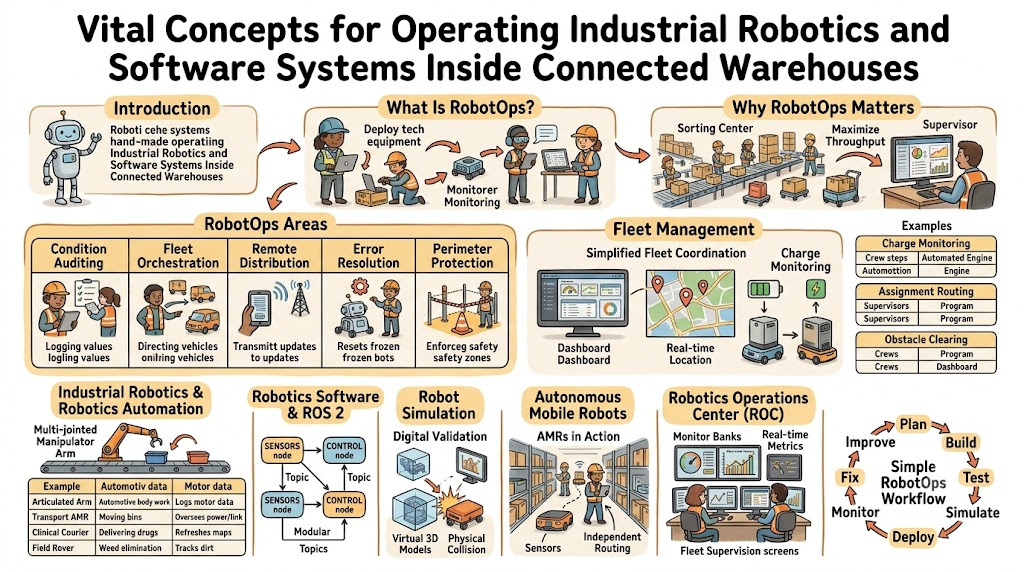
Introduction
Modern supply chains rely on automated machines to lift pallets, sort inventory, and assemble electronics. Behind every functional machine sits the active field of Robotics Operations, widely called RobotOps. Computer programmers write intricate guidance logic, but physical hardware battles constant ground friction, dust, and electrical heat. Moving joints experience steady wear, so engineering teams protect software programs and metal bodies equally. Routine inspection keeps these devices moving reliably during busy factory shifts. Support teams perform continuous safety checks, read live telemetry, broadcast software patches, and resolve mechanical jams. Specialized control software also directs large machine clusters through structured Robot Fleet Management. Readers seeking clear guidance on practical operational workflows can explore RobotsOps.com, an open educational website teaching modern system lifecycle control.
What Is RobotOps?
RobotOps governs an active machine throughout its complete functional life inside factories. Engineers first design movement algorithms and test them within safe computer models. Next, field teams release the units onto noisy assembly floors. Duty technicians inspect data streams every minute to catch mechanical friction early. Systems staff send new firmware patches through local radio networks to squash program bugs. They also inspect rubber belts, hydraulic seals, and metal gears for visible stress. When a spill blocks an aisle, remote technicians quickly clear the hazard with directional controls. Looking after physical machines demands far more vigilance than monitoring web servers. A crashed internet server simply shows an error screen to web visitors. A rogue machine can hit storage shelves, damage inventory, or endanger floor workers. Therefore, RobotOps enforces strict safety rules to protect surrounding workers.
Why RobotOps Matters
Supervising a lone machine rolling along a single aisle requires little work. An operator can quickly replace its battery pack, wipe its lens, and adjust speed limits. Managing two hundred self-driving units across several regional warehouses creates massive operational hurdles. High metal shelves often block radio signals, which triggers sudden communication loss. Electric motors consume more power during fast pallet-carrying runs. Drifting dust settles on optical glass and blinds vision sensors. A stopped carrier quickly causes long line jams in narrow factory aisles. Maintenance workers cannot sprint across vast warehouses to inspect individual units. Instead, automated control hubs monitor the entire fleet from one main console. RobotOps provides the exact tools that teams need to stop expensive factory delays.
RobotOps Areas
| RobotOps Area | Simple Meaning | Main Goal |
| Telemetry Tracking | Reading active machine sensor signals continuously | Detect worn bearings before mechanical failure occurs |
| Wireless Deployment | Distributing binary patches across local networks | Install improvements without plugging in physical cables |
| Rapid Recovery | Resolving blocked navigation paths via remote control | Restore normal plant traffic within seconds |
| Spatial Dispatch | Directing floor transit rights among nearby units | Prevent mechanical collisions at high-traffic intersections |
Robot Fleet Management Made Simple
Robot Fleet Management directs large machine groups through a unified software console. Operators supervise every active unit across the warehouse without leaving their chairs. The main screen marks live vehicle positions on a plant map. It also reports battery charge levels and current order assignments. The program highlights sudden stalls immediately with bright visual alerts. Technicians use remote joysticks to steer trapped machines past obstacles. The system also verifies that every machine runs identical software packages. This steady oversight keeps the entire equipment roster dependable throughout the workday.
| Task | Doing It by Hand | Using RobotOps Fleet Tools |
| Code Deployment | Connect physical data cables to every chassis | Broadcast verified firmware packages over the air |
| Battery Oversight | Check voltage meters on individual units | Read all power levels on a single dashboard |
| Obstacle Recovery | Walk through the warehouse to locate stalled units | Receive instant map alerts and drive units remotely |
Industrial Robotics and Robotics Automation
Industrial Robotics includes heavy automated systems that manufacture products inside high-output factories. Multi-joint metal arms bolt securely to concrete pads to handle intense daily duties. Optical sensors scan incoming parts while computer controllers guide fast servo motors. These mechanical arms handle high-heat tasks like spot welding, sheet metal stamping, and carton palletizing. High-speed Robotics Automation multiplies factory output while removing human workers from dangerous assembly stations. Heavy equipment still encounters mechanical wear under continuous production schedules. RobotOps platforms analyze thermal trends, motor resistance, and vibrational data around the clock. By identifying elevated bearing friction early, maintenance crews repair components before lines halt unexpectedly.
Real-World Robot Examples
| Robot Type | Common Work | RobotOps Need |
| Articulated Arm | Joins structural vehicle frames along assembly lines | Records joint torque and flags thermal anomalies |
| Mobile Carrier | Transports heavy pallets toward shipping bays | Balances battery depletion and avoids congestion |
| Hospital Courier | Transports sterile supplies between clinic floors | Navigates crowded halls and opens automated doors |
| Agricultural Flyer | Scans farm acreage to evaluate plant hydration | Tracks flight telemetry and avoids sudden gusts |
Robotics Software and ROS 2
Robotics Software supplies the internal logic that allows machines to perceive, calculate, and move. Many engineering groups build their applications using ROS 2, the open-source Robot Operating System framework. ROS 2 does not replace desktop operating systems like Linux. Instead, it provides modular libraries that bind microcontrollers, sensors, and steering motors together. Individual modules called nodes execute specific operational roles across the robot. A camera node tracks obstacles while a drive node powers the drive wheels. Nodes exchange dynamic sensor data through communication channels called topics. Long-running routines execute through structured command pathways known as actions. RobotOps teams harness ROS 2 structures to query machine health and distribute operational commands.
Robot Simulation Before Real Deployment
Robot Simulation evaluates operational algorithms within computer-generated testing worlds before physical construction begins. Designers build detailed digital twins of warehouse floors, conveyor lines, and storage racks. They place virtual machine models inside these synthetic 3D scenes to stress-test their code. This lets developers examine steering geometry, verify camera ranges, and refine pathfinding logic. Engineers also test dangerous edge cases without breaking costly mechanical hardware. They intentionally trigger sensor dropouts or path obstructions to verify emergency stop routines. Conducting thousands of simulated runs uncovers edge-case bugs early. Virtual tests cannot mimic every floor slick or lighting shift, however. Teams always validate machine behaviors on physical factory floors after simulation trials conclude.
Autonomous Mobile Robots
Autonomous Mobile Robots, commonly called AMRs, traverse busy commercial properties without fixed floor guides. Unlike older automated guided vehicles that track floor tape, AMRs map spaces dynamically. Integrated light-detection sensors and stereo vision cameras identify workers, cargo boxes, and heavy forklifts. Logistics facilities deploy AMRs to haul heavy shelving pods directly to packing personnel. When energy reserves dip, the machines automatically dock with charging terminals. RobotOps software matches open delivery tickets to the nearest available machine. The platform routes traffic smoothly to keep facility corridors open and safe.
Robotics Operations Center
A Robotics Operations Center functions as a centralized control room for automated facilities. Expansive display monitors show active fleet distributions, floor congestion, and battery levels. Technicians track incoming telemetry streams sent continuously from onboard machine computers. The main display highlights warning alerts whenever a machine encounters a persistent route block. Duty engineers examine onboard visual feeds and maneuver units manually through remote links. They also review operational metrics to spot corridors that consistently trigger transit delays. As companies scale their machine counts, this central control setup ensures steady operational uptime.
Real-Life Scenarios
- A transport carrier loses its network connection behind structural steel posts, prompting onboard fail-safes to stop the drive motors safely. Central monitoring flags the offline state, allowing an operator to restore the link without interrupting nearby traffic.
- A heavy assembly arm registers elevated temperatures inside its wrist actuator during high-speed sorting. The operations platform generates a high-priority work order, prompting technicians to grease the bearing before gears strip.
- Several hospital supply rovers discover that workers blocked a central corridor for deep cleaning. The fleet server updates the digital facility map instantly, diverting incoming carriers toward clear secondary pathways.
Common Mistakes to Avoid When Choosing Delhi Events
- Reserving a banquet hall without verifying on-site vehicle parking capacity for attendees.
- Scheduling outdoor garden gatherings during extreme summer heatwaves or thick winter smog spells.
- Neglecting municipal sound permits for live musical performances extending past standard evening hours.
- Overlooking severe traffic bottlenecks near major ring roads during peak commuting periods.
- Selecting an older venue whose electrical distribution panels cannot handle high-draw lighting setups.
- Finalizing service agreements with decorators and caterers without signed milestone contracts.
- Omitting covered pavilion arrangements to protect outdoor banquets from sudden seasonal rains.
- Choosing a gathering spot that sits far from rapid transit lines and metro stations.
How RobotsOps.com Helps Learners
RobotsOps.com offers thorough educational resources covering contemporary machine operations and fleet maintenance. The site presents core principles of Robotics Operations and Robot Fleet Management through practical examples. Readers study technical articles detailing Robotics Software, ROS 2 architectures, and Robot Simulation practices. Course materials also investigate factory hardware, including Industrial Robotics and Autonomous Mobile Robots. Students discover how a modern Robotics Operations Center supervises hardware groups across logistics networks. By reviewing structured tutorials on Robotics Automation, engineers master the operational skills needed to support machines in production.
A Simple RobotOps Workflow
Every production machine moves through an eight-stage lifecycle that connects software with physical hardware.
Plan → Build → Test → Simulate → Deploy → Monitor → Fix → Improve
Teams first specify mechanical tasks and assemble the physical chassis. Developers next code core control routines and validate their logic in physics-based simulations. Engineers then release the physical units onto active production floors. Fleet servers collect diagnostic signals and track component health throughout every shift. When a machine reports an error, technicians isolate the fault and resolve the disruption. Developers incorporate field findings into new software releases to elevate machine performance. This cyclic process ensures that automated operations grow stronger with every work cycle.
Frequently Asked Questions
1. What core responsibilities define RobotOps work?
Engineering teams use RobotOps to oversee machines after manufacturing and deployment finish. The discipline balances ongoing software maintenance, predictive hardware repairs, and fleet monitoring. While cloud applications require server administration, physical machines demand mechanical upkeep alongside code management. This steady operational attention keeps automated equipment working safely around human staff across factories and distribution hubs.
2. Why does physical robotics need different operational methods than cloud software?
Digital software operates entirely inside server racks and user browser windows. A software crash produces an error dialog or triggers an automated container reboot. Operating machines possess heavy metal chassis that navigate alongside factory staff and machinery. A malfunctioning vehicle might strike equipment racks or damage inventory, making physical safety the primary operational goal.
3. Which functions belong to Robot Fleet Management platforms?
Fleet platforms centralize control of numerous automated machines through a consolidated software interface. Technicians monitor remaining battery charge, locate specific units on floor maps, and assign movement orders. The software also distributes new operating system images across the network simultaneously. Central oversight eliminates the need for manual inspection walks across sprawling commercial warehouses.
4. How does virtual simulation help engineers before field deployment?
Simulation enables programmers to validate machine logic within simulated testing worlds. Developers construct digital obstacle courses to verify sensor coverage and refine navigation routines. The virtual space lets teams observe severe collision scenarios without denting expensive metal frames. Finding programming oversights inside computer models preserves client capital and speeds project completion.
5. In what ways do Autonomous Mobile Robots navigate facilities?
Autonomous Mobile Robots read their immediate surroundings using onboard lidar scanners and optical depth sensors. Rather than following fixed floor markers, these machines build live spatial maps. The navigation system steers around fallen pallets, structural columns, and approaching employees. Logistics operations use them to transport heavy merchandise safely across large retail distribution centers.
6. Where does ROS 2 fit into operational robotics stacks?
Engineers adopt ROS 2 as an open-source middleware layer that standardizes internal machine communications. It connects camera drivers, drive motor microcontrollers, and pathfinding modules through structured communication channels. Programmers use its built-in interfaces to organize complex movement commands cleanly. RobotOps teams leverage ROS 2 data formats to harvest machine telemetry and push task updates.
7. What duties do technicians handle in a Robotics Operations Center?
Technicians inside a control center monitor live operational data across every active machine. Wall-mounted monitors track facility maps, warning flags, and battery reserves in real time. When a vehicle halts, remote operators inspect the incident through onboard video links. They resolve spatial conflicts with remote controls and resume production without sending technicians onto the floor.
8. Why do stationary manufacturing arms require continuous operational oversight?
Stationary arms execute repetitive, high-load fabrication tasks like spot welding auto bodies. Extended operating hours introduce bearing wear, motor heating, and cable fatigue across mechanical joints. Operational platforms monitor these physical parameters constantly through sensitive vibration and temperature probes. Catching friction increases early lets crews replace components before an entire assembly line stalls.
9. How do maintenance crews install code updates without physical cables?
Technicians broadcast encrypted firmware packages over secure facility wireless channels. Central fleet software verifies that targeted machines are stationary and safely parked before flashing code. The local computer applies the software image and runs automatic health checks before returning to service. This remote method avoids the labor-intensive chore of cabling individual machines by hand.
10. What operational issues cause factory machines to stall most often?
Machines typically stop because of drained batteries, obscured optical lenses, or weak wireless signals. In high-traffic storage facilities, airborne grime easily coats cameras and disrupts spatial tracking. Physical obstacles like stray packaging wrap can also bind rolling casters. Fleet management software isolates these anomalies immediately so technicians can clear the floor.
11. Can smaller businesses benefit from implementing RobotOps practices?
Small businesses operating just a few automated units gain substantial value from structured operational monitoring. Facilities like medical supply rooms, retail stores, and small machine shops avoid manual tracking burdens. Central dashboards prevent staff from wandering across properties to locate stopped units. Establishing structured operational workflows allows companies to expand their fleets smoothly over time.
12. What educational materials does RobotsOps.com provide for students and engineers?
RobotsOps.com supplies clear educational tutorials explaining modern machine management, ROS 2 development, and simulation strategies. The portal breaks complex software patterns, industrial hardware maintenance, and fleet supervision into beginner-friendly guides. Learners discover how to deploy, observe, and optimize production machinery through realistic technical examples. These open materials prepare engineers to manage real-world automated systems effectively.
Conclusion
Keeping modern industrial machinery dependable requires continuous vigilance beyond basic hardware assembly and initial coding. Plant operators must oversee wireless firmware updates, manage battery reserves, isolate unexpected jams, and synchronize multi-vehicle traffic. Pairing fleet coordination tools, ROS 2 messaging structures, virtual testing runs, and active telemetry feeds safeguards both autonomous carts and articulated arms. As modern factories automate core operations, mastering life-cycle management becomes an indispensable technical skill. Knowledge platforms such as RobotsOps.com supply clear educational paths that help developers, technicians, and operations leads operate reliable automation at scale.
