Introduction
Modern software delivery relies on continuous deployment, rapid iteration, and cloud-native technologies to release features in minutes rather than months. However, as engineering teams adopt cloud infrastructure, microservices, containerization, Kubernetes, APIs, and extensive open-source dependencies, their operational attack surface expands exponentially. Traditional security practices—which rely on manual security reviews and end-stage penetration testing right before release—create massive bottlenecks and fail to catch vulnerabilities early. To solve this friction, organizations adopt DevSecOps to integrate automated security controls directly across the entire software development lifecycle. By treating security as an automated, continuous, and shared engineering responsibility, teams can protect pipelines and runtime workloads without slowing down business innovation. This comprehensive guide covers everything from core DevSecOps principles, cloud and supply chain security, to practical implementation frameworks, assessment methodologies, and continuous security automation. Learn how DevSecOpsNow helps enterprises modernize their delivery pipelines.
Understanding DevSecOps
DevSecOps seamlessly embeds security practices, controls, and compliance checks into the core DevOps workflow rather than treating security as an isolated, final gate. At its foundation, DevSecOps establishes a culture of shared security responsibility, ensuring that developers, platform engineers, and operations teams actively collaborate on application protection. The primary technical mechanism behind this approach is shifting security left, which introduces testing early in the planning, coding, and building phases. Through security automation, feedback on vulnerabilities is delivered directly into developer tools in real time. Organizations execute this strategy by deploying automated tools such as Static Application Security Testing (SAST) for source code analysis, Dynamic Application Security Testing (DAST) for runtime evaluation, Software Composition Analysis (SCA) for open-source library tracking, secrets scanning to prevent credential leaks, Infrastructure as Code (IaC) scanning, container scanning, Software Bill of Materials (SBOM) tracking, policy-as-code enforcement, and continuous runtime monitoring.
Why Organizations Are Adopting DevSecOps
Modern application delivery relies on dynamic tooling ecosystems, including Git repositories, automated CI/CD pipelines, Docker containers, Kubernetes orchestrators, Terraform scripts, and multi-cloud providers like AWS, Azure, and Google Cloud. While these technologies enable rapid scaling, they also introduce complex risks through public APIs, microservices architectures, open-source libraries, and third-party artifact repositories. Organizations adopt DevSecOps to counter these challenges by moving away from reactive patching toward continuous protection. Integrating automated security controls yields immense operational benefits: development teams detect vulnerabilities early when they are cheapest to fix, automated security testing removes manual deployment gates, cross-team collaboration improves, and executive leadership gains complete security visibility. Furthermore, embedded compliance frameworks simplify regulatory governance, allowing organizations to achieve significantly faster vulnerability remediation times while maintaining rapid code release velocities across enterprise engineering environments.
DevSecOps Consulting Services
Navigating a complete security transformation across complex cloud-native environments requires clear architecture, pragmatic strategy, and proven technical governance. Engaging expert DevSecOps Consulting Services provides organizations with the high-level guidance needed to align security practices with rapid software delivery goals. Professional consulting begins with a thorough analysis of existing development workflows, pipeline architectures, cloud environments, and compliance requirements. Security architects evaluate tool stacks, review CI/CD security controls, design robust cloud and Kubernetes security frameworks, and select fit-for-purpose security automation technologies. Consulting engagements help business leadership define a clear transformation roadmap, design security governance structures, and maintain regulatory compliance across platforms. Organizations typically seek external consulting expertise when scaling engineering teams, migrating legacy architectures to cloud-native platforms, recovering from security incidents, or addressing persistent operational friction between security personnel and software developers.
DevSecOps Implementation Services
Translating high-level security strategies into reliable, automated operational realities requires hands-on technical integration across every stage of the software lifecycle. Through DevSecOps Implementation Services, organizations integrate specialized security scanners, policy engines, and feedback loops directly into developer IDEs, Git workflows, build runners, and deployment environments.
Static Application Security Testing – SAST
Static Application Security Testing analyzes application source code, binaries, and bytecodes for security flaws without executing the underlying program. By scanning raw code during developer commits or pull requests, SAST tools identify common programming vulnerabilities such as SQL injection, cross-site scripting, buffer overflows, and insecure cryptography. Integrating SAST directly into Git repositories and CI/CD pipelines allows engineers to receive immediate feedback, enabling rapid code fixes within their familiar development environments before changes are merged into primary branches.
Dynamic Application Security Testing – DAST
Dynamic Application Security Testing evaluates running applications from an external perspective, simulating real-world attacker techniques to uncover exploitable vulnerabilities in active staging or test environments. Unlike static scanners, DAST tools analyze application behavior, exposed HTTP endpoints, authentication mechanism flaws, session management weaknesses, and server-side injection vulnerabilities. Integrating automated DAST workflows into CI/CD deployment stages allows engineering teams to detect runtime security defects and web application vulnerabilities before releasing software updates to live production environments.
Software Composition Analysis – SCA
Software Composition Analysis automatically inventory and evaluate third-party open-source components, libraries, and external dependencies integrated into modern software applications. SCA platforms scan project manifest files to identify known common vulnerabilities and exposures (CVEs), track transitive dependencies, and flag risky open-source software licenses. By embedding SCA into automated pipelines, organizations mitigate software supply chain risks, block compromised or outdated packages, and ensure legal and regulatory compliance across all open-source software assets used within their products.
Secrets Scanning
Secrets scanning continuously inspects source code repositories, commit histories, build logs, container files, and developer environments to prevent sensitive credentials from leaking. Automated secrets scanners use pattern matching, entropy analysis, and regular expressions to identify hardcoded passwords, API keys, private certificates, SSH keys, and cloud provider tokens. Detecting secrets instantly upon commit prevents credential exposure in public or internal repositories, triggers automated token revocation, and eliminates one of the most common vectors for cloud account compromise.
Infrastructure as Code Security
Infrastructure as Code security automates the static analysis of cloud provisioning scripts, including Terraform manifests, CloudFormation templates, Ansible playbooks, and ARM templates. IaC security tools analyze infrastructure files before deployment to catch critical cloud misconfigurations, such as publicly accessible storage buckets, overly permissive security groups, unencrypted databases, and exposed management ports. Enforcing automated IaC scanning within pull request reviews ensures that cloud environments remain secure, compliant, and correctly configured before any physical resources are provisioned.
Container Security
Container security focuses on protecting application containers across their entire lifecycle, from initial image creation through storage to live runtime execution. Automated image scanning tools examine base images and container layers within build pipelines and artifact registries to detect vulnerable OS packages, embedded secrets, and malware. Additionally, container security platforms support image signing, enforce secure registry access policies, and deploy runtime security controls to detect unexpected process execution or unauthorized system calls inside running container environments.
Kubernetes Security
Managing containerized workloads at scale introduces unique architectural challenges that require dedicated Kubernetes Security Consulting Services to ensure end-to-end protection. Protecting cluster infrastructure demands practical configurations across multiple operational layers, ranging from control plane components to individual workload pods.
RBAC
Role-Based Access Control regulates permissions within Kubernetes clusters by binding specific role definitions to users, service accounts, and group identities. Enforcing the principle of least privilege ensures that cluster administrators, developers, and automated CI/CD runners only hold the minimal permissions required for their tasks, drastically reducing the risk of administrative privilege escalation or unauthorized cluster access.
Network Policies
Kubernetes Network Policies act as internal cluster firewalls that control traffic flow between pod namespaces, workloads, and external networks. By implementing explicit default-deny network rules, security teams restrict lateral pod-to-pod communication, isolate sensitive microservices, prevent unauthorized network access, and contain potential perimeter breaches within isolated environment segments.
Admission Controls
Admission Controllers inspect, modify, and validate API requests entering the Kubernetes control plane before objects are persisted into cluster storage. Leveraging validating and mutating webhook controllers allows organizations to block non-compliant deployments, enforce organizational policy requirements, mandate secure user contexts, and prevent unvetted container configurations from executing on cluster nodes.
Secrets Management
Kubernetes secrets management secures sensitive configuration data, such as database credentials, API tokens, and TLS certificates, away from application code. Organizations strengthen cluster security by replacing default base64-encoded secrets with external key management vaults, implementing automated secret rotation, enabling envelope encryption at rest, and injecting credentials dynamically into container memory at runtime.
Container Image Security
Container image security within Kubernetes environments guarantees that nodes only pull and execute trusted, scanned, and authorized container images. Implementing image signature verification via admission controllers blocks unsigned or unverified images from executing, while automated registry scanning prevents vulnerable container builds from deploying into active production namespaces.
Kubernetes Configuration Security
Kubernetes configuration security focuses on hardening cluster control plane settings, worker node operating systems, API server flags, and workload manifest parameters. Regular configuration reviews ensure that API servers disable anonymous access, kubelets enforce secure authentication, control plane components log activity, and workloads avoid running with elevated host system privileges.
Runtime Security
Runtime security provides continuous monitoring and threat detection for active container workloads executing on Kubernetes nodes. Modern runtime protection platforms analyze system calls, process activity, file access patterns, and network socket connections in real time, detecting anomalies such as unexpected shell spawns, privilege escalation attempts, or unauthorized binary executions inside live containers.
Cluster Access Management
Cluster access management establishes centralized identity management, authentication controls, and access boundaries for administrative teams operating Kubernetes infrastructure. Integrating cluster authentication with enterprise Single Sign-On (SSO) providers, enforcing multi-factor authentication, issuing short-lived client certificates, and auditing API access logs ensures full accountability across all administrative cluster operations.
Cloud Security
Modern enterprises rely heavily on cloud platforms, necessitating specialized Cloud Security Consulting Services to build robust defense-in-depth strategies across AWS, Azure, Google Cloud, and hybrid cloud environments. Maintaining strong security posture across dynamic cloud infrastructures requires continuous enforcement of baseline security architectures.
Identity and Access Management
Identity and Access Management forms the primary security perimeter within cloud environments by defining user identities, service roles, and granular resource permissions. Organizations maintain strong IAM hygiene by enforcing multi-factor authentication, leveraging short-lived role credentials, conducting regular access reviews, and applying strict least-privilege access policies across all cloud environments.
Cloud Network Security
Cloud network security establishes secure boundaries, isolates sensitive network segments, and controls ingress and egress traffic flow across virtual networks. Security teams deploy Virtual Private Clouds (VPCs), network security groups, Web Application Firewalls (WAFs), transit gateways, and dedicated private endpoints to prevent direct internet exposure of internal services and critical database workloads.
Cloud Configuration Security
Cloud configuration security continuously monitors cloud resource settings to identify misconfigurations, compliance drift, and exposed assets. Implementing automated scanning tools ensures that public storage access is blocked, administrative interfaces are restricted, default encryption keys are rotated, and all provisioned cloud infrastructure aligns strictly with organizational baseline configurations.
Encryption
Cloud data protection relies on comprehensive end-to-end encryption strategies across both data-at-rest and data-in-transit scenarios. Organizations leverage managed Cloud Key Management Services (KMS) to manage customer-managed keys, mandate TLS encryption for all internal and external network communications, and automatically encrypt cloud storage, object stores, and database volumes.
Logging and Monitoring
Logging and monitoring systems consolidate security telemetry, audit logs, and network flow data across distributed cloud infrastructures into centralized monitoring platforms. Enabling continuous log aggregation from cloud trail audits, network firewalls, and application gateways gives security operations teams the real-time visibility required to detect anomalous behavior, investigate incidents, and maintain regulatory audit readiness.
Infrastructure as Code Security
Integrating security directly into IaC frameworks prevents cloud infrastructure misconfigurations from being provisioned in live environments. By running automated static analysis checks against IaC code repositories, platform engineering teams automatically enforce encryption standards, tag mandates, and network access limits before Terraform or CloudFormation scripts apply changes.
Workload Security
Cloud workload security protects physical servers, virtual machines, serverless functions, and containerized applications executing across public cloud providers. Deploying host-based endpoint protection, automated patch management, vulnerability management platforms, and runtime behavior monitoring ensures that cloud compute resources remain hardened against external exploitation attempts.
Cloud Security Posture Management
Cloud Security Posture Management (CSPM) platforms provide continuous visibility, risk assessment, and compliance tracking across multi-cloud environments. CSPM tools automatically evaluate cloud assets against industry security benchmarks, identify security drifts, generate prioritized risk reports, and offer automated remediation capabilities to keep multi-cloud infrastructures continuously secure.
Software Supply Chain Security
Modern applications rely on complex ecosystems of open-source packages, third-party build tools, and automated distribution channels, making Software Supply Chain Security Services essential for enterprise protection. Attacks targeting build platforms and code dependencies have increased, making software supply chain hardening a top operational priority. Organizations must secure third-party dependencies, monitor public package repositories, protect automated build runners, enforce secure artifact repository controls, secure CI/CD platforms, and restrict container registries. Additionally, implementing cryptographic code signing and verification mechanisms guarantees artifact integrity throughout software distribution workflows, ensuring that compiled binaries and container images remain unaltered from build output to production deployment.
Understanding Software Bill of Materials
A Software Bill of Materials (SBOM) acts as a comprehensive, machine-readable inventory listing every open-source library, module, dependency, license, and author involved in building a software application. Modern organizations require SBOMs to achieve granular visibility into their software supply chains, evaluate license compliance risks, and track third-party software exposure. When new zero-day vulnerabilities are disclosed, security teams leverage SBOM inventories to rapidly search their entire software portfolio, identify affected application versions, and accelerate emergency vulnerability responses. Implementing standardized SBOM formats such as CycloneDX or SPDX significantly enhances transparency across engineering organizations and simplifies vendor software risk evaluations.
CI/CD Pipeline Security
Continuous Integration and Continuous Deployment (CI/CD) pipelines are high-value targets for malicious actors because they possess elevated access privileges to cloud environments and source repositories. Securing CI/CD platforms requires restricting pipeline access, enforcing branch protection rules, running build runners inside isolated networks, and storing sensitive production credentials in dedicated secrets management vaults rather than plain-time environment variables. Engineering teams must mandate cryptographic artifact verification, deploy granular deployment permissions, implement peer-approval deployment workflows, enable immutable pipeline audit logging, and run automated security scanning tools at every pipeline stage to prevent unauthorized code injection or malicious pipeline tampering.
Policy-as-Code
Policy-as-code enables engineering teams to define, manage, and enforce security controls using programmatic code rather than manual governance checklists. By leveraging policy engines such as Open Policy Agent (OPA) or Kyverno, security requirements are automatically evaluated during code checks, build pipelines, and cluster deployments. Practical policy examples include blocking containers from running as root, mandating encryption for all cloud storage buckets, enforcing approved container registry sources, validating Kubernetes resource limits, and restricting cloud network configurations. Automating policy enforcement ensures consistent policy application across environments, eliminates manual review delays, accelerates release velocity, and maintains transparent audit records.
DevSecOps Assessment Services
Evaluating an organization’s existing security standing across people, processes, and technology requires structured DevSecOps Assessment Services. A thorough maturity assessment evaluates application security practices, CI/CD pipeline automation, cloud configuration hygiene, Kubernetes security, secrets protection mechanisms, third-party dependency tracking, vulnerability management workflows, governance frameworks, and engineering culture. Security assessors review current developer practices, analyze existing tool integrations, and identify systemic operational gaps. The output of a DevSecOps assessment provides executive leadership with a prioritized, risk-adjusted transformation roadmap, outlining clear technical steps to mature security controls, reduce operational friction, and enhance overall engineering resilience.
DevSecOps Maturity Model
Achieving mature DevSecOps operational capabilities is an incremental journey requiring aligned progress across organizational culture, process automation, and technology integration. The following maturity framework illustrates how organizations evolve from reactive security checks to continuous optimization.
| Level | Characteristics |
| Initial | Mostly manual security checks, isolated security teams, ad-hoc testing, security treated as a final gateway. |
| Developing | Basic security scanning added to projects, initial SAST or dependency checks, siloed vulnerability tracking. |
| Integrated | Security tools automated inside CI/CD pipelines, automated secrets scanning, developer security feedback loops. |
| Automated | Comprehensive security automation, policy-as-code enforcement, standardized container and IaC security, SBOM tracking. |
| Optimized | Continuous metrics tracking, real-time runtime protection, automated remediation, proactive security engineering culture. |
Advancing through these maturity levels depends heavily on fostering collaborative culture, streamlining automated processes, adopting scalable technologies, maintaining practical governance, and empowering developers—proving that successful DevSecOps adoption relies on culture and alignment rather than tool purchasing alone.
Vulnerability Management
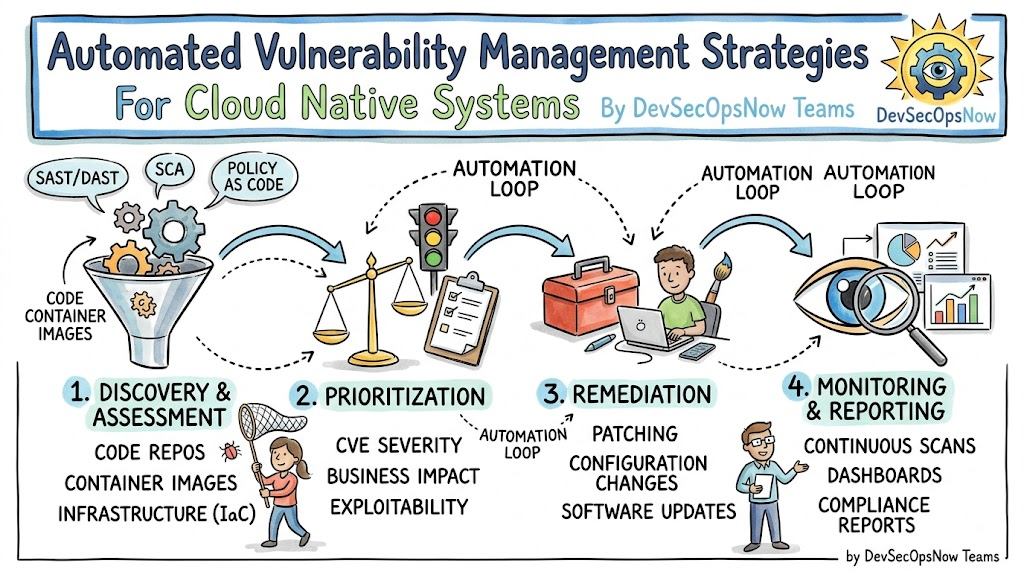
Vulnerability management is a continuous process that ensures security findings across code repositories, containers, cloud assets, and endpoints are systematically resolved. The vulnerability lifecycle follows defined stages: discovery via automated scanners, technical validation, risk classification, task prioritization, ticket assignment to engineering teams, code remediation, patch verification, executive reporting, and continuous monitoring. Because modern tools generate high scan volumes, organizations must prioritize risks using Contextual CVSS scores, exploitability data, application exposure levels, business criticality, data sensitivity, and public internet access. Risk-based prioritization prevents developer alert fatigue by focusing remediation efforts on vulnerabilities that pose genuine operational risks.
DevSecOps Managed Services
Maintaining robust cloud security, evolving pipeline scanners, and continuously updating security policies can strain internal engineering resources. Engaging DevSecOps Managed Services provides enterprises with ongoing security engineering support, continuous pipeline monitoring, and dedicated operational expertise. Managed service teams handle security platform maintenance, tune scanner rules to reduce false positives, manage vulnerability backlogs, update policy-as-code rules, provide developer remediation guidance, and continuously optimize cloud and Kubernetes monitoring platforms. This ongoing operational model ensures that organizations maintain strong, updated security posture without overburdening their internal platform engineering and software development teams.
Penetration Testing Services
While automated security scanners excel at identifying known software bugs and misconfigurations, comprehensive security assurance requires manual Penetration Testing Services. Skilled security testers conduct controlled, simulated cyberattacks against web applications, REST/GraphQL APIs, cloud environments, internal networks, Kubernetes clusters, container deployments, and authentication systems. Penetration testing complements automated scanning by uncovering complex business logic flaws, authorization bypasses, chaining multi-stage exploits, and testing real-world defense responses. Combining automated pipeline controls with periodic manual penetration testing provides organizations with complete validation of their technical security controls.
DevSecOps Training
Building a resilient, security-minded engineering organization requires continuous education through tailored DevSecOps Training programs. Effective educational curricula cover critical modern domain topics, including secure SDLC methodologies, CI/CD pipeline hardening, SAST and DAST tool usage, Software Composition Analysis, cloud platform security, Kubernetes hardening, container isolation, and secrets management strategies. Engineers also learn practical Infrastructure as Code security, SBOM generation, software supply chain defense, policy-as-code implementation, and automated vulnerability management. Providing teams with deep, practical knowledge transforms security from an external compliance requirement into a native engineering capability across software delivery teams.
Corporate DevSecOps Training
To maximize enterprise impact, organizations implement role-based Corporate DevSecOps Training customized for specific engineering functions across software delivery units. Role-focused learning pathways ensure that teams acquire skills directly applicable to their day-to-day tooling and responsibilities:
- Developers: Focus on secure coding patterns, IDE scanner integration, static analysis fix workflows, and open-source vulnerability remediation.
- DevOps Engineers: Learn pipeline hardening, secrets management integration, automated build security, and CI/CD security controls.
- Security Engineers: Master policy-as-code design, security scanner rule tuning, vulnerability triage automation, and threat modeling workflows.
- Platform Engineers: Focus on Kubernetes RBAC, policy enforcement webhooks, base container image hardening, and service mesh security.
- Cloud Engineers: Focus on IaC security scanning, cloud IAM least-privilege design, KMS encryption setup, and posture management integration.
- Engineering Managers: Learn security risk metrics evaluation, compliance reporting, developer workflow optimization, and security culture building.
These tailored training modules incorporate hands-on lab environments featuring real-world tools such as Jenkins, GitHub Actions, GitLab CI/CD, Docker, Kubernetes, Terraform, AWS, Azure, GCP, and SonarQube, ensuring teams gain actionable, practical expertise.
Example DevSecOps Pipeline
A modern, automated security pipeline integrates continuous checks across every phase of software delivery, from local code creation to live production deployment.
Developer Commit → Secrets Scan → SAST → Dependency Scan → Build → Container Scan → IaC Scan → Test Deployment → DAST → Policy Validation → Production → Runtime Monitoring
- Developer Commit: Code changes are pushed to source control repositories, triggering automated pipeline webhooks.
- Secrets Scan: Commits are instantly checked for hardcoded credentials, API keys, or private security tokens.
- SAST: Static code analysis inspects source files for underlying programming flaws and application security bugs.
- Dependency Scan: SCA tools evaluate third-party packages and libraries for known CVEs and license risks.
- Build: Source code is compiled into executable software artifacts or container images upon passing checks.
- Container Scan: Container images are evaluated for OS package vulnerabilities and base image misconfigurations.
- IaC Scan: Infrastructure templates are analyzed to verify secure cloud resource provisioning parameters.
- Test Deployment: Hardened artifacts are deployed into isolated staging or testing environments.
- DAST: Dynamic security tools perform automated vulnerability scans against running test application endpoints.
- Policy Validation: Policy engines verify that deployment configurations meet security and compliance standards.
- Production: Approved, fully validated software builds are released to live production infrastructure environments.
- Runtime Monitoring: Live workloads are continuously protected by runtime threat detection and behavioral analysis engines.
DevSecOps Implementation Roadmap
Transforming an enterprise security posture requires a phased, pragmatic implementation strategy that balances risk reduction with engineering speed.
- Phase 1 – Assessment & Strategy: Evaluate existing maturity, audit software pipelines, map architecture, and establish security goals.
- Phase 2 – Foundation & Secrets: Deploy automated secrets scanning across Git repositories and establish centralized key management.
- Phase 3 – Pipeline Scanning: Integrate SAST and SCA tools into CI/CD pipelines to establish developer security feedback loops.
- Phase 4 – Infrastructure & Containers: Implement IaC scanning, container image analysis, and secure base image management registries.
- Phase 5 – Cloud & Kubernetes: Hardening cloud IAM configurations, deploy network policies, RBAC rules, and Kubernetes admission controllers.
- Phase 6 – Policy Automation: Deploy policy-as-code frameworks to enforce automated governance across pipeline and cloud deployments.
- Phase 7 – Runtime Protection: Implement runtime security monitoring, continuous logging, and automated threat detection platforms.
- Phase 8 – Continuous Optimization: Track operational security metrics, conduct training, refine scanner policies, and tune automated response rules.
Common DevSecOps Challenges
Implementing automated security workflows frequently encounters operational hurdles that require thoughtful management and strategic technical decisions.
- Security Alert Overload: Excessive false positives create developer fatigue. Address this by fine-tuning scanner rule sets, filtering low-severity findings, and prioritizing contextual risks.
- Developer Resistance: Security controls that slow down releases cause pushback. Resolve this by integrating security tools into existing developer IDEs and Git workflows.
- Tool Fragmentation: Deploying disjointed, isolated scanners creates operational silos. Consolidate telemetry into centralized security management dashboards.
- Lack of Security Ownership: Unclear boundaries lead to unaddressed risks. Establish shared responsibility frameworks and train developers on security practices.
- Skills Gaps: Lack of specialized cloud and security expertise delays adoption. Invest in practical, hands-on role-based training programs.
- Poor Tool Integration: Standalone scanners create manual review overhead. Ensure all security tools support native API and CI/CD pipeline automation.
- Excessive Pipeline Delays: Slow scanning pipelines reduce release velocities. Optimize performance by running heavy security scans asynchronously.
- Inconsistent Security Policies: Manual policy reviews cause governance drifts. Automate policy enforcement using policy-as-code engines.
DevSecOps Metrics
Tracking meaningful engineering metrics ensures that security automation investments deliver measurable improvements in security outcomes and delivery speed.
| Metric | Purpose |
| Mean Time to Remediate (MTTR) | Tracks average duration required to patch and resolve identified vulnerabilities. |
| Critical Vulnerabilities | Monitors total volume of unresolved high and critical findings across assets. |
| Security Test Coverage | Measures percentage of application pipelines executing automated security checks. |
| Secrets Detected | Tracks instances of committed credentials to measure developer security awareness. |
| Dependency Risk | Evaluates open-source software exposure by tracking vulnerable third-party components. |
| Policy Violations | Monitors non-compliant infrastructure or workload deployment attempts. |
| Secure Deployment Rate | Tracks percentage of production code releases passing all pipeline security gates. |
Collecting and acting on these metrics ensures continuous refinement of technical security controls, preventing useless scanning while focusing engineering efforts on genuine risk reduction.
Choosing a DevSecOps Service Model
Selecting the appropriate service engagement model depends on an organization’s internal technical capabilities, existing team capacity, infrastructure complexity, and strategic security maturity targets:
- DevSecOps Consulting Services: Ideal for organizations needing strategic guidance, enterprise security architecture design, tool selection, and digital transformation roadmaps.
- DevSecOps Assessment Services: Designed for enterprises seeking an independent technical audit of their current pipeline, cloud, container, and security posture maturity.
- DevSecOps Implementation Services: Suited for teams needing hands-on technical assistance integrating security tools, pipeline controls, and policy engines.
- DevSecOps Managed Services: Best for organizations seeking ongoing operational management, continuous pipeline monitoring, and vulnerability triage support.
- Cloud Security Consulting Services: Essential for businesses migrating workloads or needing specialized architecture security across AWS, Azure, or GCP.
- Kubernetes Security Consulting Services: Recommended for platform engineering teams scaling containerized workloads requiring cluster hardening.
- Software Supply Chain Security Services: Critical for organizations protecting complex software dependencies, automated builds, and distribution channels.
- Penetration Testing Services: Important for businesses requiring thorough manual security validation and simulated cyberattack assessments.
- DevSecOps Training & Corporate Training: Necessary for enterprises upskilling software development, platform engineering, and operations teams in secure practices.
Frequently Asked Questions
1. What is the difference between DevOps and DevSecOps?
DevOps focuses on automating software delivery to increase feature velocity and release efficiency. DevSecOps builds upon this model by embedding automated security controls, vulnerability scanning, and compliance validation directly throughout the CI/CD pipeline, ensuring that speed does not compromise system security.
2. How does DevSecOps help reduce software development costs?
By shifting security checks left into the initial coding phases, vulnerabilities are identified and remediated early in development. Fixing code flaws during development is significantly cheaper and less disruptive than patching security defects found late in testing or after production deployment.
3. Why is automated security testing essential in CI/CD pipelines?
Manual security testing cannot match the rapid pace of continuous deployment pipelines. Automated security testing performs real-time code, dependency, container, and configuration checks on every commit, providing fast developer feedback without creating operational release bottlenecks.
4. What is the purpose of Software Composition Analysis (SCA)?
Software Composition Analysis automatically inventories open-source components used in application codebases. SCA tools identify known security vulnerabilities in third-party libraries, track indirect transitive dependencies, and flag risky software licenses to protect software supply chains.
5. How does policy-as-code improve cloud security compliance?
Policy-as-code automates governance by defining security rules in programmatic code files. Automated engines evaluate infrastructure manifests against these rules prior to deployment, preventing non-compliant configurations, such as unencrypted databases or exposed ports, from reaching live environments.
6. What role does Kubernetes play in a DevSecOps strategy?
Kubernetes orchestrates containerized workloads, making cluster hardening essential to DevSecOps protection. Securing Kubernetes requires managing role-based access controls, enforcing network isolation policies, implementing admission control webhooks, rotating secrets, and continuously monitoring container runtime environments.
7. Why is secrets scanning critical for cloud security?
Developers can accidentally commit cloud credentials, API tokens, or SSH keys into source code repositories. Automated secrets scanning constantly inspects code pushes, repository histories, and build logs to detect exposed secrets instantly and trigger rapid credential revocation.
8. How does a Software Bill of Materials (SBOM) enhance supply chain security?
An SBOM provides a clear inventory of all open-source packages, components, and dependencies contained within a software product. This visibility enables organizations to rapidly locate and evaluate vulnerability exposure whenever novel zero-day threats emerge in third-party libraries.
9. Can automated security scanners replace manual penetration testing?
No, automated security scanners excel at discovering known vulnerabilities and technical misconfigurations quickly, but manual penetration testing is required to uncover complex business logic flaws, permission bypasses, multi-stage attack paths, and nuanced security weaknesses that automated tools miss.
10. What metrics best indicate DevSecOps success?
Key metrics include Mean Time to Remediate (MTTR), critical vulnerability volumes, security test pipeline coverage rates, detected secrets count, policy violation trends, and the overall percentage of production deployments passing automated security gates successfully.
11. How do organizations overcome developer resistance to DevSecOps?
Organizations reduce developer resistance by providing native security feedback directly inside developer IDEs and Git workflows, tuning tools to minimize false positives, offering role-based hands-on training, and fostering a collaborative engineering culture with shared security responsibility.
12. What are the key stages of an effective vulnerability management process?
An effective vulnerability management lifecycle includes automated discovery, technical validation, contextual risk prioritization based on business impact, task assignment, developer code remediation, automated fix verification, executive reporting, and continuous runtime asset monitoring.
Conclusion
Building a successful DevSecOps practice requires integrating security across every phase of software development and infrastructure operations. By automating vulnerability testing within CI/CD pipelines, enforcing strong cloud and Kubernetes controls, protecting software supply chains, and prioritizing real-world operational risks, organizations achieve rapid release velocity alongside enterprise-grade protection. Realizing the full potential of DevSecOps depends on continuous improvement, role-based hands-on training, cross-team collaboration, and aligned security governance. Ultimately, embedding continuous security controls into automated engineering workflows empowers business teams to innovate rapidly with confidence and long-term resilience.
