Introduction
While commercialized tourist hubs crumble under the weight of endless crowds and homogenized experiences, Ranchi offers an authentic breath of fresh air. Tucked neatly away on the Chota Nagpur Plateau, Jharkhand’s capital city balances wild natural grandeur with deep-rooted cultural soul.
Here, monsoon-fed rivers drop precipitously off granite cliffs, ancient tribal customs shape daily life, and the crisp plateau air carries a serene stillness missing from India’s mega-cities. Stepping into Ranchi is not just another weekend vacation; it is an immersive connection to nature, legend, and untamed Indian heritage.
Why Ranchi is a must-visit city
Ranchi acts as the ecological and cultural heartbeat of the Chota Nagpur region. Sitting at an elevation of roughly 650 meters, its unique topography creates a temperate climate surrounded by dense Sal forests, pristine river basins, and dramatic plateau escarpments. Historically a sacred landscape for indigenous tribes like the Munda, Oraon, and Santhal, the region retains a deep spiritual reverence for nature that permeates its local art, cuisine, and festivals.
Logistically, Ranchi is surprisingly accessible for every archetype of modern traveler. Birsa Munda Airport connects directly to major metros like Delhi, Mumbai, Bengaluru, and Kolkata. The city is equally well-served by Ranchi Junction railhead and clean four-lane national highways, making it an effortless road-trip target for regional travelers.
| Metric / Parameter | Details |
| Best Season | October to March (Cool weather and post-monsoon full-stream waterfalls) |
| Ideal Trip Duration | 3 Days / 2 Nights |
| Nearest Airport | Birsa Munda Airport (IXR) (5 km from city center) |
| Top Circuit Highlights | Hundru, Dassam, Jonha, Patratu Valley, Tagore Hill, Pahari Mandir |
| Local Culinary Staples | Dhuska with Chana Ghugni, Pittha, Rugra, bamboo shoot curry |
Best Places or Experiences
Patratu Valley and Dam
Carved straight through emerald-green hills, Patratu Valley features an iconic hair-pin turn road that snakes down toward a vast mirror-like reservoir. The engineering marvel of the winding ghats combined with the serene expanse of the Patratu Dam makes this the ultimate scenic drive in the region.
The reservoir area has evolved into a premier eco-tourism hub offering modern speedboats, peaceful pontoon rides, and broad promenades. Watching the morning mist lift off the water while sipping hot kulhad tea from roadside shacks is a memory that stays with you forever.
- Location: Patratu District, approximately 40 km north of central Ranchi.
- Why it is worth visiting: Unmatched panoramic valley views, thrilling serpentine driving roads, and high-quality boating facilities.
- Best things to do: Drive down the hairpin bends, take a sunset speedboat ride across Patratu Dam, and sample fresh local fish fry at lakeside stalls.
- Best time to visit: Early morning (6:30 AM – 9:00 AM) for clear weather drive or late afternoon (4:00 PM – 6:30 PM) for sunset.
- Ideal for whom: Couples, road-trip enthusiasts, photography buffs, and families.
- Travel tip: Drive cautiously on the hairpin curves as local freight trucks take wide turns.
Hundru Falls
Plummeting dramatically from a height of nearly 320 feet, Hundru Falls is created where the Subarnarekha River tumbles over jagged rock formations. Over thousands of years, the churning waters have sculpted unique rock pools and cavernous gorges at the base of the cascade.
Ascending and descending the steps carved into the hillside offers mesmerizing vantage points of the mist rising into the forest canopy. The surrounding Sal forests fill the air with an earthy aroma, framing one of Jharkhand’s most formidable natural spectacles.
- Location: Anagara Block, around 45 km east of main Ranchi city.
- Why it is worth visiting: Highest waterfall circuit drop near Ranchi with dramatic rock formations and natural pools.
- Best things to do: Descend the 750-plus paved steps to the riverbed, photograph the roaring main cascade, and explore the rocky shoreline.
- Best time to visit: 10:00 AM to 3:00 PM when the sun reaches the deep ravine base.
- Ideal for whom: Adventure seekers, trek lovers, and nature photographers.
- Travel tip: Do not attempt to swim near the base foam pool, as underwater currents around the rocks can be surprisingly strong.
Dassam Falls
Also known as Taimara Falls, Dassam is formed by the Kanchi River breaking into ten distinct cascading streams over a broad, stepped cliff face. The sheer volume and thunderous roar of the falling water generate a perpetual cool spray across the viewing decks.
The surrounding forest environment remains delightfully rugged, maintaining an untouched wilderness atmosphere. Dedicated walkways and safe watchtowers allow travelers to soak in the views without disturbing the natural terrain.
- Location: Taimara Village, Bundu block, roughly 34 km south-east of Ranchi.
- Why it is worth visiting: Unique ten-stream cascade architecture creating an immense soundscape and mist cloud.
- Best things to do: View the ten streams from the multi-level watchtowers, enjoy a forest picnic on designated grounds, and spot native birds.
- Best time to visit: November to February, when water clarity is high and temperatures are pleasant.
- Ideal for whom: Families, group travelers, and landscape photographers.
- Travel tip: Wear sturdy footwear with non-slip grips, as mist makes the stone stairways wet and slippery.
Tagore Hill
Named after Nobel laureate Rabindranath Tagore’s family, this tranquil hilltop stands 300 feet tall, offering a peaceful respite right inside the urban bounds. Rabindranath’s elder brother, Jyotirindranath Tagore, chose this isolated rock outcrop to build his retreat house, ‘Brahma Sthal’, drawn by its quiet solitude.
A short flight of stairs leads to the top monument, where panoramic views of Ranchi’s skyline unfold beneath open skies. It serves as both a historic literary shrine and a prime location for catching gentle evening breezes.
- Location: Morabadi area, just 4 km north of Ranchi Railway Station.
- Why it is worth visiting: Intimate literary history fused with panoramic city vistas.
- Best things to do: Climb to the summit shrine, read under the shade of ancient trees, and capture golden-hour cityscapes.
- Best time to visit: 5:00 PM to 6:30 PM for cool evening winds and sunset views.
- Ideal for whom: Solo travelers, history buffs, writers, and couples.
- Travel tip: Combine your visit with the nearby Ranchi Tribal Museum located in Morabadi.
Jonha Falls (Gautamdhara)
Legend holds that Lord Buddha spent time meditating near these serene falls, earning Jonha its sacred alternative moniker, Gautamdhara. Water drops gracefully down a 140-foot slope, framing a tranquil river valley surrounded by rolling green hillocks.
A nearby monastery adds a spiritual layer to the natural site, attracting pilgrims alongside nature lovers. Descending into the valley floor places you right alongside smooth river stones and shaded forest clearings.
- Location: Jonha Village, approximately 40 km east of Ranchi city.
- Why it is worth visiting: Sacred mythological connections blended with gentle, scenic waterfall cascades.
- Best things to do: Visit the hillside Buddha temple, walk down to the riverbed rocks, and enjoy local fried snacks at village stalls.
- Best time to visit: Morning hours (8:30 AM to 12:00 PM) for quiet reflection before day-tripper crowds arrive.
- Ideal for whom: Peace seekers, spiritual travelers, and picnic lovers.
- Travel tip: Take advantage of the tourist rest house facility at the top for clean restrooms and refreshments.
Pahari Mandir
Perched atop the standalone Ranchi Hill at an elevation of 2,140 feet, Pahari Mandir is dedicated to Lord Shiva. Historically significant, this hill was once a site where freedom fighters were hanged during the colonial era; today, it holds the unique tradition of hoisting the Indian National Flag alongside the religious flag on Independence and Republic Days.
Climbing the 468 stone steps leads to an ancient cave shrine and an unobstructed 360-degree view of Ranchi city and Ranchi Lake below.
- Location: Center of Ranchi City, near Ranchi Lake (Bada Talab).
- Why it is worth visiting: Historical patriot significance combined with panoramic city views and a sacred Shiva cave temple.
- Best things to do: Ascend the historic stone stairwell, pay respects at the hill shrine, and view Ranchi Lake from above.
- Best time to visit: Early morning (6:00 AM) for spiritual quiet or sunset for city lights.
- Ideal for whom: Pilgrims, culture enthusiasts, and fitness minded travelers.
- Travel tip: Remove footwear at the base designated counters before beginning the main temple staircase climb.
Offbeat Exploration: Hidden Gems Tourists Miss
Panch Gagh Falls
Unlike its high-vertical cousins, Panch Gagh breaks into five soft, parallel streams that flow gently over flat, wide granite beds. Because there are no steep drops, the water flows safely through shallow pools where visitors can wade comfortably. It remains a tranquil local secret free from heavy tourist noise.
Rock Garden and Kanke Dam
Modeled loosely after Chandigarh’s Rock Garden, this retreat is sculpted entirely out of the rocks of Gondo Hill. Located right on the banks of Kanke Dam, it blends stone statues, iron bridges, and terraced seating that look out over vast sunset reflections on the lake surface.
McCluskieganj
Located roughly 60 km from Ranchi, this quiet township was established in the 1930s as a haven for the Anglo-Indian community. Walking through its overgrown pine avenues reveals colonial-era bungalows, quaint churches, and a timeless atmosphere that feels completely detached from modern city life.
Detailed Practical Guidance for Travelers
| Destination | Standard Entry Fee | General Timings | Best Local Food Options Nearby | Recommended Nearby Attractions |
| Patratu Valley | Free (Boating ₹150–₹500) | 6:00 AM – 7:00 PM | Lakeside fish fry, Dhuska, Tea | Patratu Thermal Park |
| Hundru Falls | ₹10–₹20 per person | 8:00 AM – 5:00 PM | Village stall Maggi, Pakaoda, Sattu | Getalsud Dam |
| Dassam Falls | ₹10–₹20 per person | 8:30 AM – 5:00 PM | Local Chana Ghugni, Fresh Cucumber | Sun Temple (Taimara) |
| Tagore Hill | Free | 6:00 AM – 6:30 PM | Morabadi street food stalls, Tea | Ranchi Tribal Museum |
| Jonha Falls | ₹10–₹20 per person | 8:30 AM – 5:00 PM | Fried snacks, Roasted corn | Sita Falls |
| Pahari Mandir | Free | 4:30 AM – 8:30 PM | Local sweet shops, Kachori stalls | Ranchi Lake (Bada Talab) |
Logistics & On-Ground Navigation
Local Transport Options
- Auto-Rickshaws & E-Rickshaws: Shared autos dominate short-distance city routes along main veins like Main Road, Lalpur, and Kanke Road. They are ultra-budget friendly (₹10–₹30 per route segment).
- App-Based Taxis: Uber and Ola operate reliably within Ranchi municipal boundaries, offering stress-free transit to airport, railway station, and inner-city spots.
- Outstation Private Rentals: For waterfall circuits (Hundru, Dassam, Jonha) or Patratu drives, renting a private cab for the full day (₹2,000–₹3,200) is the most practical option.
Budget Planning
- Backpacker / Budget Tier: ₹1,000 – ₹1,800 per day. Includes stay in clean budget guesthouses, travel via shared autos/buses, and eating street food and local thalis.
- Mid-Range / Comfort Tier: ₹3,500 – ₹6,000 per day. Includes 3-star hotel accommodations, private full-day cab rentals for outstation circuits, and dining at modern multi-cuisine restaurants.
Safety and Inclusivity Tips
- For Families: Stick to daytime hours (8:00 AM to 5:00 PM) for waterfall excursions; rural forest routes lack light after dusk.
- For Couples: Stick to main tourist zones at Patratu Dam promenade and Tagore Hill; avoid isolated forest trails late in the evening.
- General Safety: Cell service can dip in deep river ravines like Hundru; inform your hotel desk or cab driver about your itinerary before heading out.
Strategic Travel Planning Guardrails
Travel Planning Tips for Ranchi
- Time Your Waterfall Visits Post-Monsoon: Visit between September and December when waterfalls run at full flow under clear blue skies.
- Carry Cash for Rural Spots: Digital payments via UPI work great in Ranchi city, but network glitches in waterfall ravines make physical cash essential.
- Pack Rubber-Sole Footwear: Granite rocks near riverbeds are smoothed by water and can be exceptionally slippery.
- Start Waterfall Days Early: Leaving your hotel by 8:00 AM allows you to finish two major falls comfortably before afternoon heat.
- Respect Tribal Art & Custom: When visiting rural villages, ask permission before photographing tribal homes decorated with Sohrai or Khovar paintings.
Common Mistakes to Avoid
- Overpacking the Daily Itinerary: Trying to see Patratu Valley and Hundru Falls on the same day leads to hours trapped in transit; keep them on separate days.
- Swimming in Unmarked River Zones: Undercurrents around waterfall plunge pools are notoriously unpredictable; stay within designated safe zones.
- Ignoring Local Breakfast Staples: Skipping local street stalls means missing out on freshly fried Dhuska, Jharkhand’s iconic savory rice-and-lentil bread.
- Relying Solely on Public Buses for Nature Sites: Buses to rural waterfall blocks operate on sparse schedules; rent a taxi or bike instead.
- Leaving Outer Destinations After Dark: Avoid driving through remote forest stretches like Dasam-Bundu interior roads past 7:00 PM.
Suggested Itinerary Blueprints
Day Quick Dash (Urban Highlights & Patratu Sunset)
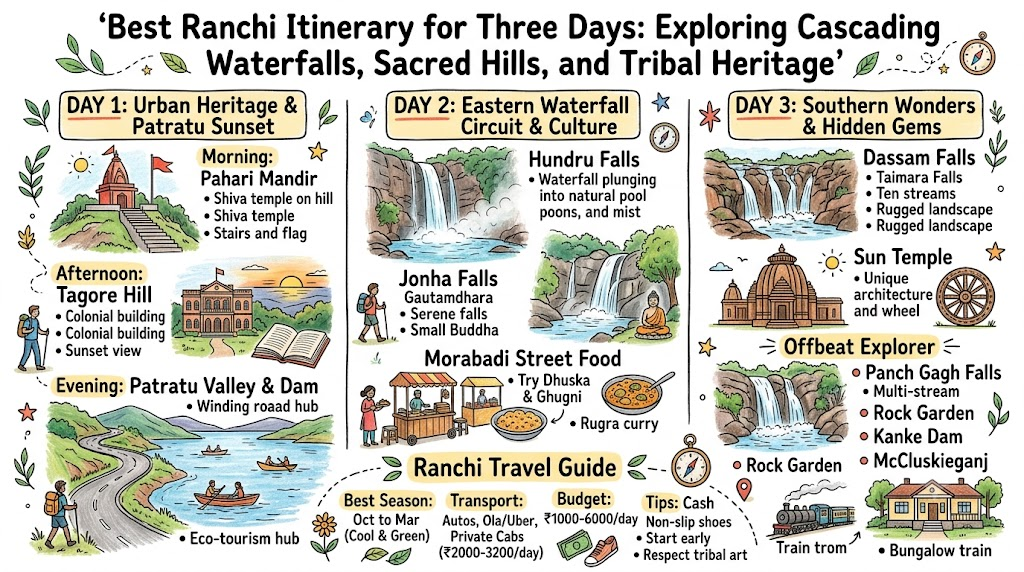
- Morning: Start early at Pahari Mandir for panoramic city views, followed by a cultural walk around Tagore Hill.
- Afternoon: Enjoy a traditional Jharkhand thali in town, then embark on the scenic 40 km drive to Patratu Valley.
- Evening: Experience a sunset boat cruise at Patratu Dam, returning to Ranchi for dinner.
Day Deep-Dive (The Great Waterfall Circuit)
- Day 1 (Waterfalls & Culture): Drive the eastern waterfall circuit covering Hundru Falls and Jonha Falls. End the day exploring Morabadi Street Food Hub.
- Day 2 (Scenic Valleys & Temples): Head south to marvel at Dassam Falls, stop at the Sun Temple in Bundu, and finish with a relaxed evening around Kanke Dam and Rock Garden.
Complete Weekend Travel Plan (The Ultimate Ranchi & Beyond Loop)
- Friday: Arrive in Ranchi, check into your hotel, visit Pahari Mandir, and explore local markets around Main Road for handicraft shopping.
- Saturday: Full-day excursion along the Hundru – Jonha – Getalsud Dam circuit. Return to town for evening dining.
- Sunday: Morning drive to Patratu Valley and Dam, lunch by the reservoir, and visit Rock Garden before heading to the airport or railway station.
Common Tourist Mistakes to Avoid
- Geographic Blunders: Don’t attempt to mix Patratu Valley (North) with Dassam Falls (South-East) in a single morning. Group your days by compass directions to save transit time.
- Commercial Traps: Avoid spending your evenings in air-conditioned shopping malls. Instead, head to local cultural spots like Morabadi Ground or Firayalal Chowk for vibrant night energy.
- Neglecting Modern/Alternative Zones: Ranchi is expanding rapidly; don’t miss out on modern residential hubs like Kanke Road and Lalpur, home to boutique art cafes and lively eateries.
- Transport Overpayment: Auto drivers at the railway station may quote inflated prices. Always cross-reference prices using ride-hailing apps before negotiating local rides.
- Luxury Dining Bias: Sticking only to hotel buffets deprives you of Ranchi’s food soul. Sample street-side Dhuska, Chana Ghugni, and Litti Chokha from long-standing local vendors.
Local Food Secret: Look for small eateries serving Dhuska with mutton gravy or chana ghugni in the morning near Lalpur Chowk—it is the quintessential Ranchi breakfast experience.
Frequently Asked Questions
1. What is the absolute best time of year to visit Ranchi for waterfalls?
The post-monsoon months from September to February offer the best experience. Water levels remain full and roaring from monsoon runoff, while the winter skies stay crisp, clear, and comfortable for trekking around stone staircases.
2. How far are the major waterfalls from Ranchi city center?
Most iconic waterfalls sit within a 35 to 45 km radius of central Ranchi. Expect driving times of approximately 1 to 1.5 hours per leg due to winding plateau roads.
3. Is it safe to travel to Patratu Valley with family in the evening?
Yes, Patratu Dam and the main valley overlook are well-patrolled, brightly lit tourist zones. However, it is advisable to finish your drive back down the ghat roads toward Ranchi before 8:00 PM for comfortable driving visibility.
4. Can we swim in the pools below Hundru and Dassam falls?
Swimming directly under the plunge pools is strictly discouraged by local authorities due to sharp rocks and unpredictable undercurrents. Stick to shallow, designated riverbed streams further downstream.
5. What is the iconic local food that every traveler must try in Ranchi?
You must try Dhuska, a deep-fried savory snack made from rice and chana dal batter, served hot with spicy chickpea curry (Chana Ghugni). Do not miss regional delicacies like Pittha and wild tree blossom curries like Rugra when in season.
6. Are auto-rickshaws available for full-day sightseeing hire?
While city auto-rickshaws operate inside city bounds, they are not ideal for outer waterfall circuits due to steep hill climbs. Renting a private hatchback or sedan cab is far more reliable and comfortable.
7. Is Ranchi a safe destination for solo female travelers?
Ranchi is generally warm, welcoming, and safe for solo travelers. Standard precautions apply: avoid unlit rural roads late at night, use verified app cabs, and stick to populated daytime tourist circuits.
8. How many days are sufficient to explore Ranchi properly?
A 3-day itinerary is ideal. It allows one day for city landmarks and culture, one full day for the primary waterfall circuit, and one dedicated day for Patratu Valley and eco-parks.
9. Are entry permits required for visiting tourist spots in Ranchi?
No special permits are required for domestic or international tourists visiting public landmarks, waterfalls, or parks around Ranchi. Standard ticket counters operate at waterfall entry points.
10. How accessible is Birsa Munda Airport from the city center?
Birsa Munda Airport is conveniently located inside the city perimeter in Hinoo, just 5 to 7 km from major commercial hotel hubs along Main Road and Lalpur.
11. What local handicrafts or souvenirs should I buy in Ranchi?
Look for authentic Dokra metal crafts, bamboo woodcrafts, Paitkar paintings, and organic tribal forest honey at government outlets like Jharcraft.
12. Is cash necessary, or are digital UPI payments widely accepted?
Digital UPI is accepted at almost every shop, auto, and cafe inside Ranchi city. However, carrying physical cash (₹1,000–₹2,000 in small notes) is mandatory for waterfall entry fees, parking, and village food stalls in outer blocks.
Conclusion
Choosing Ranchi over predictable, overcrowded hill stations rewards you with an authentic travel experience. As your vehicle navigates the sweeping hairpin bends of Patratu Valley or stands in the mist of Hundru Falls, you connect with a landscape where raw natural beauty still reigns supreme. Ranchi does not just offer a break from routine; it reawakens your sense of wonder through roaring rivers, sacred hilltops, and unforgettable tribal warmth.
