Introduction
Most mainstream travel circuits herd visitors into congested hill stations and commercialized urban strips where commercial noise completely replaces peace. Ranchi, by contrast, sits on the Chota Nagpur Plateau, quietly grounded in ancient Sal forests, indigenous tribal heritage, and roaring river escarpments.
Here, authentic red-soil hospitality replaces manicured resort illusions. You come to Ranchi not just to tick off sights, but to reconnect with untouched nature and living cultural roots.
Why Ranchi is a must-visit city
Ranchi is the beating geographic and cultural heart of Jharkhand, defined by mineral-rich plateaus, sacred groves (Sarna sthals), and a profound indigenous freedom movement. Long favored as a summer retreat during the colonial era for its brisk elevation (651 meters above sea level), the city balances raw natural wilderness with modern urban infrastructure.
Birsa Munda Airport connects directly to primary hubs like Delhi, Mumbai, and Bengaluru, while an extensive railway network links Ranchi Junction and Hatia to every corner of India. National highways (NH 20 and NH 33) form smooth, scenic road corridors, welcoming solo backpackers, family road-trippers, and weekend retreat seekers alike.
The regional travel circuit flows naturally across three distinct zones: the cascading eastern waterfall belt, the historical and spiritual southern hill sanctuaries, and the winding northern ghats.
| Key Metric | Detail |
|---|---|
| Geographic Elevation | 651 meters (2,136 feet) |
| Primary River Systems | Subarnarekha, South Koel, Jumar |
| Ideal Exploration Season | October through March |
| Nearest Transit Hubs | Birsa Munda Airport (IXR), Ranchi Junction (RNC) |
| Dominant Cultural Fabric | Munda, Oraon, and Santhal indigenous traditions |
Best Places or Experiences
Hundru Falls
Hundru Falls plunges 98 meters over jagged metamorphic rock, creating one of Jharkhand’s most thunderous natural spectacles. Formed along the Subarnarekha River, the cascading sheets of foam carve deep natural pools into massive granite cliffs polished by centuries of rushing water.
Descending the stone steps through dense foliage, the humid roar gives way to cool, spray-laden valley breezes. The geological terracing allows travelers to view the plunge from dramatic overhead ledges before reaching the expansive rocky basin below.
Hundru Falls cascading over plateau rocks.
- Location: Angara Block, approximately 45 km northeast of Ranchi city center.
- Why it is worth visiting: It is the tallest accessible waterfall in the district, showcasing the raw geological force of the Chota Nagpur Plateau.
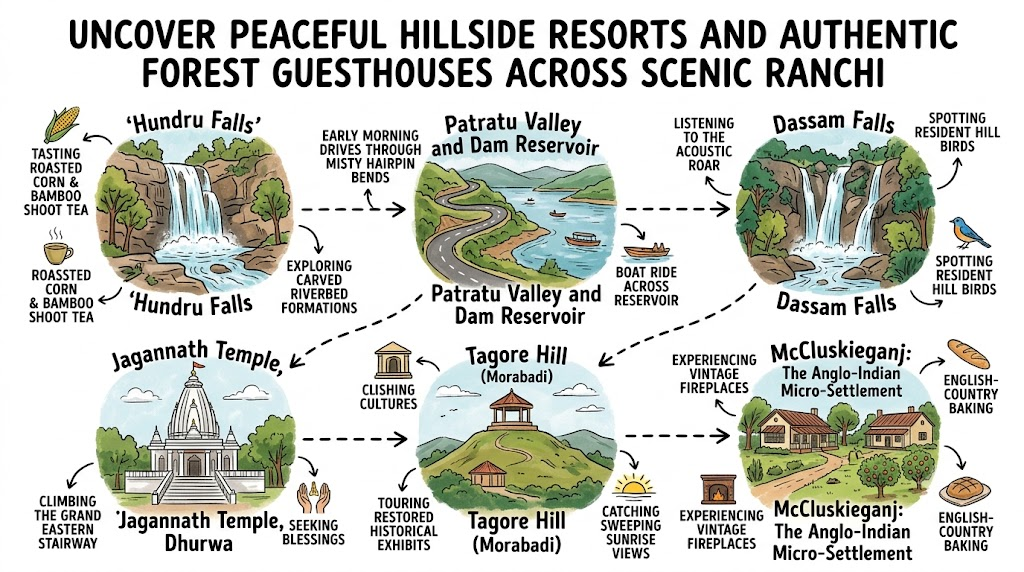
- Best things to do: Hike down the 750 stone stairs to the base pool, photograph mist-shrouded rainbow arcs in late morning light, and explore ancient carved riverbed formations.
- Best time to visit: October to February for clear paths and steady flow; post-monsoon offers the most dramatic volume.
- Ideal for whom: Adventure travelers, landscape photographers, and active families.
- Travel tip: The stone stairs become exceptionally slick with river algae; wear high-traction trekking shoes and avoid swimming near the base drop.
Patratu Valley and Dam Reservoir
Carved through the Ramgarh hills, the winding Patratu Valley ghat road unfolds like an alpine ribbon cutting across verdant subtropical ridges. Designed with sweeping switchbacks and elevated overlook terraces, the descent offers panoramic vistas over emerald canopy slopes and the vast Patratu Dam waters below.
At the valley base, the sprawling reservoir spreads across miles of quiet water against a backdrop of distant hills. The waterfront promenade and water sports complex add modern leisure amenities to an otherwise untouched natural valley.
Winding switchbacks of Patratu Valley.
- Location: Patratu, roughly 35 km north of Ranchi via Kanke Road.
- Why it is worth visiting: It provides one of Eastern India’s finest driving corridors alongside expansive lake vistas.
- Best things to do: Take an early morning drive through misty hairpin bends, rent a speed-boat across the reservoir, and watch the sunset from the hilltop viewing deck.
- Best time to visit: November to February between 6:00 AM and 10:00 AM for soft valley light and gentle breezes.
- Ideal for whom: Road trip enthusiasts, couples, and photography lovers.
- Travel tip: Drive slowly along the hairpin bends as heavy utility transport and tourist private cars share narrow passing stretches.
Dassam Falls
Formed by the Kanchi River, a primary tributary of the Subarnarekha, Dassam Falls tumbles 44 meters over sheer granite ledges. The local tribal name, Da-shong, translates to “pouring water,” capturing how the river splits into ten distinct roaring streams during peak flow.
The surrounding terrain remains wild, framed by dense Sal and Mahua forests and weathered boulders. The sheer drop and surrounding amphitheater create a continuous mist layer that cools the gorge even during warm midday hours.
Dassam Falls roaring over granite.
- Location: Taimara village, approximately 40 km southeast of Ranchi along the Ranchi-Tata Highway (NH 33).
- Why it is worth visiting: It offers an unvarnished wilderness experience with minimal commercial development.
- Best things to do: Climb the secure viewing platforms, listen to the acoustic roar echoing across the canyon, and spot resident hill birds in the canopy.
- Best time to visit: September to January, when water levels remain strong and hiking trails dry out.
- Ideal for whom: Nature lovers, ecotourists, and trekking groups.
- Travel tip: Strong undercurrents and submerged rocks make entering the reservoir pool strictly prohibited and dangerous.
Jagannath Temple, Dhurwa
Built in 1691 by King Ani Nath Shahdeo of the Barkagarh estate, this 17th-century architectural marvel crowns a solitary hillock in Dhurwa. Modeled after the sacred temple in Puri, its white spire rises proudly against open skies, commanding sweeping views over the surrounding plateau.
The complex echoes deep historical continuity, hosting an annual Rath Yatra fair that blends classical Sanatana rituals with vibrant indigenous festivities. Climbing the stone steps takes you past ancient peepal trees and red flag-draped minor shrines.
17th-century Jagannath Temple, Dhurwa.
- Location: Dhurwa, around 11 km southwest of Ranchi city center.
- Why it is worth visiting: It showcases rare 17th-century Kalinga-influenced stone architecture on a high hilltop vantage.
- Best things to do: Climb the grand eastern stairway, seek blessings inside the sanctum sanctorum, and watch the city lights flicker on across the plateau at dusk.
- Best time to visit: Late afternoon (4:30 PM to 6:30 PM) for comfortable climbing and open sanctum darshan.
- Ideal for whom: Heritage buffs, spiritual pilgrims, and architecture admirers.
- Travel tip: An alternative motorable ramp leads to the upper landing for senior travelers who wish to skip the steep stone stairs.
Tagore Hill (Morabadi)
Rising 300 feet above the northern plains of Morabadi, Tagore Hill holds a deep connection to Bengal’s cultural renaissance. Jyotirindranath Tagore, the elder brother of Nobel laureate Rabindranath Tagore, made this serene rock hillock his permanent sanctuary in 1912, constructing the Brahma Mandir and the meditative hermitage Shanti Dham.
The granite summit provides sweeping, unobstructed views of Ranchi’s northern skyline and surrounding forests. Shaded by flowering trees, the quiet stone pathways continue to invite artists, readers, and contemplative wanderers.
- Location: Morabadi, approximately 4 km north of Ranchi railway station.
- Why it is worth visiting: It is a tranquil sanctuary celebrating literary history and offering panoramic city views.
- Best things to do: Tour the restored historical exhibits, read beneath the Brahma Mandir pavilion, and catch sweeping sunrise views over Morabadi ground.
- Best time to visit: Sunrise (6:00 AM to 7:30 AM) or peaceful late afternoons.
- Ideal for whom: Solo travelers, writers, and history enthusiasts.
- Travel tip: Wear slip-resistant footwear, as the carved granite steps near the summit can get smooth and slick.
Offbeat Exploration: Hidden Gems Tourists Miss
McCluskieganj: The Anglo-Indian Micro-Settlement
Tucked 60 km northwest of Ranchi, McCluskieganj was founded in the 1930s as a promised homeland for the Anglo-Indian community. Today, it stands as a nostalgic enclave of decaying colonial bungalows, deep orchards, and gravel lanes sheltered by dense forest canopy. It offers quiet, unhurried homestays where travelers can experience vintage fireplaces, English-country baking, and historic brick architecture.
Jonha & Sita Falls Circuit
While most tourists crowd Hundru, Jonha Falls (also known as Gautamdhara) offers a peaceful alternative. Legend says Lord Buddha bathed in these waters, and an ancient hilltop Buddhist monastery overlooks the pool. A 20-minute rural dirt track leads to the nearby, rarely-visited Sita Falls, where clear mountain streams cut through untouched wilderness.
Getalsud Dam Eco-Periphery
Far from crowded city parks, the eastern banks of the massive Getalsud Reservoir offer serene, undeveloped water views. Local fishermen row traditional wooden canoes across mirror-like water as the sun dips below rural hills. It is an exceptional retreat for birdwatchers seeking winter migratory ducks, local cormorants, and kingfishers.
Detailed Practical Guidance for Travelers
| Destination | Standard Entry Fee | General Timings | Best Local Food Options Nearby | Recommended Nearby Attractions |
|---|---|---|---|---|
| Hundru Falls | ₹20 per adult | 6:00 AM – 5:00 PM | Fresh roasted corn & bamboo shoot tea stalls | Jonha Falls, Sita Falls |
| Patratu Valley | Free (Boating ₹150–₹400) | 24 Hours (Boating: 9 AM – 5 PM) | Lakeside Dhaba fresh Rohu fish fry | Patratu Dam Promenade, Lake Resort |
| Dassam Falls | ₹20 per adult | 8:00 AM – 5:00 PM | Steaming seasonal Dhuska-Ghugni stalls | Sun Temple (Bundu), Tamar Terraces |
| Jagannath Temple | Free entry | 5:00 AM – 12:00 PM, 3:30 PM – 8:00 PM | Local sweet shops offering warm Peda | Dhurwa Dam, HEC Township greens |
| Tagore Hill | ₹10 per adult | 6:00 AM – 6:00 PM | Street carts serving Litti Chokha at Morabadi | Tribal Research Institute Museum, Rock Garden |
| Jonha Falls | ₹20 per adult | 7:00 AM – 5:00 PM | Earthen-pot Chai and local Chilka Roti | Gautam Buddha Temple, Sita Falls |
Logistics & On-Ground Navigation
Local Transport Options
- App-Based Cabs & Rentals: Ola and Uber operate smoothly inside the central city grid. For waterfall day trips, hire an outstation taxi on a full-day package (typically ₹2,200 to ₹3,200).
- Auto-Rickshaws: Shared auto-rickshaws run set routes connecting Ratu Road, Main Road, Doranda, and Morabadi for ₹15 to ₹30 per passenger.
- E-Rickshaws (Totos): The quietest and most convenient way to navigate crowded interior markets, residential sectors, and short suburban stretches.
- Self-Drive Two-Wheelers: Small private outfits near Ranchi Station offer scooter and motorcycle rentals (₹500 to ₹800/day), ideal for budget trips to Patratu Valley.
Budget Planning
- Budget / Backpacker Tier: Expect to spend around ₹1,200 to ₹1,800 per day. This covers guesthouse stays or budget dorms (₹700–₹1,000), shared transit, and local street meals (Dhuska, Litti Chokha, and local thalis).
- Mid-Range / Comfort Tier: Expect to spend around ₹3,500 to ₹6,500 per day. This includes comfortable 3-star and 4-star boutique hotels, full-day private sedan rentals with drivers, and sit-down dining at authentic regional specialty restaurants.
Safety and Inclusivity Tips
- Family Travelers: Most waterfall sites feature hundreds of steps. Keep young children close, skip steep undeveloped trails, and carry your own drinking water and light snacks.
- Couples: Scenic lookout points like Patratu Valley and Tagore Hill are safe and welcoming during daylight. Head back toward the city center before nightfall.
- General Traveler Caution: Avoid isolated rural roads after 8:00 PM. Always check waterfall water levels and follow local lifeguard and security staff guidance during monsoon season.
Strategic Travel Planning Guardrails
Travel Planning Tips for Ranchi
- Book Autumn and Winter Months: Visit between October and March when the plateau enjoys bright, sunny days (22°C to 26°C) and cool, brisk evenings (8°C to 14°C).
- Carry Paper Cash: Digital payments work reliably across the city center, but network connections drop near deep waterfalls and rural ghats. Keep ₹1,500 to ₹2,000 in small cash notes.
- Pack Balanced Layers: Daytime sunshine can be warm, but plateau winds drop temperatures quickly after sunset. Pack a light windbreaker or fleece jacket.
- Respect Sacred Tribal Spaces: Sacred groves (Sarna) and tribal monoliths hold deep spiritual meaning. Never walk on marked platforms, and always ask permission before taking photos.
- Start Early: Sunrise in eastern India breaks between 5:15 AM and 5:45 AM. Reaching waterfall trails by 8:30 AM lets you enjoy quiet views before group tours arrive.
Common Mistakes to Avoid
- Ignoring Waterfall Hazards: Never climb wet, algae-covered boulders near churning plunges. The basalt rocks turn slick as glass when wet.
- Overloading a Single Day: Attempting Patratu in the north and Dassam in the south on the same afternoon leads to hours stuck in highway traffic.
- Relying Only on Mobile Network: Download offline road maps for rural blocks around Angara and Bundu, where cell coverage can drop completely.
- Skipping Regional Street Stalls: Sticking solely to hotel buffets misses the best of local food, like hand-pounded Dhuska and rich mutton curries.
- Haggling Aggressively with Tribal Artisans: Village craftspeople at roadside stalls offer hand-carved wood and brassware at very fair prices; negotiate respectfully.
Suggested Itinerary Blueprints
1. Day Quick Dash (Urban Heritage & Valley Sunset)
- Target Audience: Business travelers, short layover visitors, and fast-paced tourists.
- Morning: Start with a 7:00 AM walk up Tagore Hill in Morabadi, followed by hot Litti Chokha at the foothill stands. Visit the State Museum to discover tribal metallurgy and handloom artifacts.
- Mid-Day: Head southwest to Dhurwa to tour the 17th-century Jagannath Temple, taking in views across the plateau.
- Afternoon/Evening: Drive north through Kanke to Patratu Valley. Watch the sunset over the valley hairpins before returning to the city for dinner.
2. Day Deep-Dive (Waterfalls & Indigenous Flavors)
- Day 1: Eastern Cascade Circuit: Dedicate the day to Hundru Falls and Jonha Falls. Enjoy a rustic lunch of country chicken curry and steamed rice at a village dhaba. Return via Getalsud Dam for lakeside views at dusk.
- Day 2: Culture, Architecture & Culinary Heritage: Spend the morning exploring the Sun Temple at Bundu and Dassam Falls along the southern highway. Head back to Ranchi to sample local snacks like Arsa Roti and visit Jharcraft for handwoven Tussar silk.
3. Complete Weekend Travel Plan (Plateau Wilderness Loop)
- Friday: Arrive by noon and check into your stay. Take a relaxed evening stroll along Kanke Dam, then head to Morabadi for warm Dhuska and local sweets.
- Saturday: Take a full-day trip to Patratu Valley and Dam. Enjoy lakeside water sports and lunch at the lake resort, then return via the scenic ghats for evening dining in Lalpur.
- Sunday: Set out early on an eastern waterfall tour covering Hundru and Dassam Falls. Stop by local tribal markets for forest honey before heading to the airport or railway station.
Common Tourist Mistakes to Avoid
Geographic Blunders
Ranchi’s primary attractions fan out across opposing compass points from the city center. Attempting to combine Patratu (north) with Dassam Falls (south) on the same day means wasting over four hours in cross-city transit. Group your outings by direction: visit northern viewpoints together, and reserve southern and eastern waterfalls for a dedicated day trip.
Commercial Traps
Spending your evenings wandering multi-story shopping malls on Main Road misses the city’s character. Head instead to Morabadi Ground or the local tribal markets (Haats) in nearby blocks. There you will find genuine terracotta crafts, bamboo kitchenware, and seasonal forest produce you cannot find in modern shopping centers.
Neglecting Modern/Alternative Zones
Many visitors focus entirely on rural waterfalls and miss Ranchi’s lively modern neighborhoods. Areas like Kanke Road and Morabadi feature relaxed open-air cafes, garden bistros, and quiet lake-view promenades that showcase the city’s comfortable, modern lifestyle.
Transport Overpayment
Hiring unmetered auto-rickshaws outside railway terminals without agreeing on a price often leads to inflated fares. Always check current rideshare rates on Ola or Uber first to gauge fair pricing, or walk to the main road to catch standard-fare shared vehicles.
Luxury Dining Bias
Eating only in hotel dining rooms misses the true heart of Jharkhand’s culinary culture. The soul of local food lives in roadside earthen-pot kitchens serving slow-simmered Dehati mutton, fresh fried Dhuska with spiced chickpea curry, and steamed Chilka Roti.
Always look for busy neighborhood street stalls where locals gather—that is your guarantee of fresh batches and authentic regional flavors.
Frequently Asked Questions
1. What is the absolute best time of year to plan a trip to Ranchi?
The ideal window to explore Ranchi is from October through March. During these months, the post-monsoon greenery across the plateau looks its best, and daytime temperatures hover comfortably between 20°C and 26°C. Winter evenings are cool and refreshing, making it comfortable for outdoor hiking, waterfall walks, and scenic valley road trips.
2. Are the waterfalls around Ranchi safe for swimming and bathing?
Swimming in the natural pools of waterfalls like Dassam, Hundru, and Jonha is strictly discouraged and often prohibited by local authorities. The river beds feature hidden underwater rocks, deep drop-offs, and strong undercurrents that can easily catch swimmers off guard. Always stay behind safety railings and enjoy the water from designated shallow banks.
3. What is the most iconic local street dish that every traveler must try?
The most iconic regional dish is Dhuska, a deep-fried savory cake made from a fermented batter of ground rice and chana dal. Street stalls serve it piping hot alongside spicy Ghugni (black chickpea curry) and tangy tomato-garlic chutney. It is a hearty, vegetarian breakfast staple available at almost every local morning stand.
4. How can a tourist conveniently travel to Patratu Valley without a private car?
The easiest option without a personal vehicle is booking an app-based cab or hiring a private taxi for a half-day round trip from Ranchi. Alternatively, local state transport buses run along the Ranchi-Patratu route from the ITI Bus Stand, though they drop passengers at the town center rather than scenic valley overlooks.
5. Is Ranchi a safe destination for solo travelers and women travelers?
Ranchi is generally peaceful, welcoming, and safe for solo travelers who follow basic common-sense precautions. Stick to well-lit central neighborhoods after 9:00 PM, and arrange reliable return transport before heading out to distant waterfalls. When visiting remote forest trails, visiting during daylight hours ensures a safe and comfortable experience.
6. What authentic regional souvenirs should visitors buy before leaving Jharkhand?
Top authentic souvenirs include handwoven Tussar silk saris, brass Dhokra metal craft figurines, and carved bamboo home decor. You can also pick up certified organic forest produce like wild honey and Mahua syrup from official government emporiums like Jharcraft and Khadi India outlets near Main Road.
7. Can elderly travelers comfortably visit the major waterfalls around the city?
Elderly travelers may find Hundru and Jonha challenging due to the hundreds of steep, uneven stone stairs required to reach the water level. However, modern viewing decks at Patratu Valley, the scenic grounds of Tagore Hill, and Kanke Dam feature level paths that offer lovely views without demanding climbs.
8. What language is widely spoken and understood across tourist locations in Ranchi?
Hindi is universally spoken and understood across hotels, markets, and transit points throughout Ranchi. Most service staff, drivers, and shopkeepers speak Hindi fluently, while English is widely understood in hotels, cafes, and restaurants. In rural villages, you will also hear local languages like Nagpuri, Kurmali, Mundari, and Oraon.
9. Are automated teller machines and digital payments common in the region?
Digital payments via UPI QR codes work smoothly across Ranchi, accepted by high-end restaurants and small street fruit stalls alike. However, cellular coverage drops in deep valleys around Hundru, Dassam, and Jonha. It is always wise to keep around ₹2,000 in paper cash for parking, entry fees, and rural tea stalls.
10. How many days are needed to explore Ranchi and its surrounding attractions?
A 3-day, 2-night itinerary is the sweet spot for taking in Ranchi’s highlights without rushing. This schedule gives you one day for the city’s historical temples and cultural spots, a second day for the eastern waterfall circuit, and a final morning for the scenic drive through Patratu Valley.
11. Is Birsa Munda Airport well-connected to major Indian metropolitan cities?
Yes, Birsa Munda Airport (IXR) offers regular, direct non-stop flights to major transport hubs including New Delhi, Mumbai, Bengaluru, Kolkata, and Hyderabad. The terminal sits just 5 km from the city center, making hotel transfers quick and easy via app-based taxis and prepaid counters.
12. What specific physical preparations are recommended for visiting Hundru and Dassam Falls?
Wear lightweight, breathable cotton clothing and sturdy walking shoes with strong rubber grip for slick stone steps. Pack a refillable water bottle, sun protection, and a small hand towel to dry off from waterfall spray. Carrying a lightweight backpack keeps your hands free while navigating the stairways.
Conclusion
Traveling to Ranchi offers a welcome shift from commercial tourist trails, rewarding you with the steady rhythm of ancient Sal forests, mist-veiled granite plateaus, and genuine tribal hospitality. As the evening drumbeats from local village festivals drift across quiet valley waters, you realize this corner of Jharkhand offers something rare: room to breathe, reflect, and connect with nature. Choosing the red-soil trails of the Chota Nagpur Plateau means trading artificial tourist attractions for real, lasting memories of an authentic eastern wilderness.
