Introduction
Most vacationers rush toward overcrowded Himalayan hill stations or packed coastal boulevards, spending precious hours trapped in noisy gridlock. Ranchi, perched on the Chota Nagpur Plateau, offers something increasingly rare in contemporary Indian travel: unfiltered authenticity, expansive green canopies, and deep tribal heritage. Here, cool plateau breezes replace suffocating tourist crowds, inviting you into a grounded world where ancient indigenous traditions still guide daily life.
The city balances wild natural grandeur with vibrant culinary hubs tucked around historic water reservoirs. Standing beside the tranquil waters of Ranchi Lake, you witness the rhythmic pulse of Jharkhand’s capital unfolding along street corners lined with fragrant local delicacies. It is an invitation to slow down, explore primordial sal forests, and connect directly with an extraordinary regional culture.
Why Ranchi is a must-visit city
Ranchi serves as an underappreciated chapter in Indian tourism, defined by rich geological antiquity, profound tribal roots, and scenic waterfalls. The surrounding plateau features ancient red-soil highlands, mineral-rich terrain, and sacred grove ecosystems known locally as Sarna. Culturally, the region carries the legacy of freedom fighters like Birsa Munda, lending the city deep historical gravity.
From an accessibility standpoint, modern transit infrastructure makes Ranchi remarkably frictionless for solo travelers, families, and road trippers. Birsa Munda Airport connects directly to major metro hubs, while extensive railway routes converge at Ranchi Junction and Hatia. Smooth multi-lane state and national highways link the city seamlessly to surrounding forested valleys and dramatic escarpments.
The regional travel circuit naturally radiates outward from central urban lakes and hill shrines toward the roaring waterfalls along the Subarnarekha River basin. A short drive further brings you to mist-veiled winding ghats and dense rural woodlands.
| Metric / Parameter | Detail |
| Geographic Elevation | ~651 meters (2,136 ft) above sea level |
| Primary Transit Hubs | Birsa Munda Airport (IXR), Ranchi Junction (RNC) |
| Peak Season Window | October through March |
| Signature Local Flavors | Dhuska with Ghugni, Chilka Roti, Rugda, Arsa |
| Typical Daily Budget (Comfort) | ₹2,500 – ₹4,500 per day (covering transit & meals) |
Best Places or Experiences
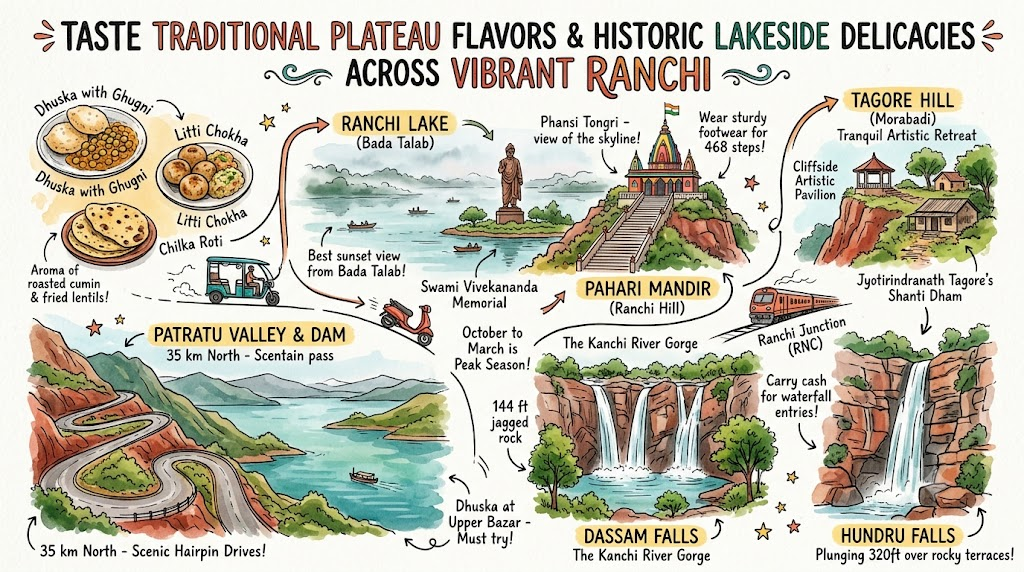
Ranchi Lake (Bada Talab) and Swami Vivekananda Memorial
Excavated in 1842 by British official Colonel Thomas Wilkinson to regulate the local water table, Ranchi Lake remains the historic anchor of the old quarter. Spanning roughly 50 acres at the base of Ranchi Hill, the lake blends colonial civil engineering with sacred community geography. In recent years, a majestic 33-foot bronze statue of Swami Vivekananda was erected in the lake’s center, adding an inspiring architectural focal point.
In the morning, mist lifts off the calm reservoir as locals jog along the paved perimeter. By late afternoon, street-side tea stalls and chaat carts come alive, filling the air with the scents of fried lentils and roasted cumin. It remains the ideal spot to unwind and sample authentic roadside treats.
- Location: Lower Bazar / Upper Bazar border, Central Ranchi, 3.5 km north of Ranchi Railway Station.
- Why it is worth visiting: The peaceful urban waterfront offers a great view of Ranchi Hill alongside iconic street food vendors.
- Best things to do: Walk the newly paved promenade at dawn, take an electric boat ride across the water, and photograph the grand Vivekananda memorial against the golden sunset.
- Best time to visit: November to February, preferably between 6:00 AM – 8:30 AM or 4:30 PM – 6:30 PM.
- Ideal for whom: Leisure walkers, street food lovers, photography enthusiasts, and budget travelers.
- Travel tip: Park your vehicle near the Upper Bazar entrance early in the evening to avoid bottleneck traffic in the dense market lanes.
Pahari Mandir (Ranchi Hill)
Rising over 2,100 feet above sea level immediately adjacent to Ranchi Lake, Pahari Mandir sits atop a prominent granite hill known as Phansi Tongri. During the colonial era, freedom fighters were executed here by British authorities. Following independence in 1947, local residents began unfurling the Indian National Flag from this temple summit every Independence Day and Republic Day—a rare tradition for a Hindu pilgrimage shrine.
Climbing the 468 stone steps brings you beneath a canopy of sacred bells, passing stone carvings dedicated to Lord Shiva. At the crest, the panoramic views reveal Ranchi’s full urban skyline, the shimmering water of Bada Talab below, and the forested edges of the plateau.
- Location: Ratu Road vicinity, Central Ranchi, roughly 1.5 km from Ranchi Lake.
- Why it is worth visiting: It blends profound sacred reverence, colonial freedom history, and the highest 360-degree vantage point in central Ranchi.
- Best things to do: Climb the steps during early dawn to hear morning temple bells, spot the historic national flag post, and take in the panoramic city vista.
- Best time to visit: October to March; early mornings (6:00 AM – 9:00 AM) help you beat the midday sun and climbing crowds.
- Ideal for whom: Spiritual travelers, fitness buffs, cultural history enthusiasts, and landscape photographers.
- Travel tip: Wear slip-on shoes with strong grip, as morning dew can make the smooth stone steps slippery.
Dassam Falls (Kanchi River Gorge)
Carved by the Kanchi River as it plunges 144 feet down a jagged rock face, Dassam Falls is one of the grandest water drops along the Chota Nagpur escarpment. Known in local Mundari dialects as Da-shong (“pouring water”), the falls feature multiple distinct streams crashing into a deep natural pool.
Surrounding the gorge are dense sal trees and rugged rock ledges that showcase the raw natural beauty of rural Jharkhand. Visiting just after the monsoon lets you witness the river at full power, creating a thick mist that blankets the entire canyon.
- Location: Taimara Village, Bundu block, 40 km southeast of Ranchi via the Ranchi-Tata National Highway (NH-33).
- Why it is worth visiting: It is a breathtaking natural canyon that lets you experience the raw power of the plateau’s river systems.
- Best things to do: Descend the secured steps to the lower observation deck, birdwatch along the surrounding sal trails, and enjoy fresh roasted corn on the cliffside.
- Best time to visit: September to February, between 9:00 AM and 3:00 PM when sunlight brightens the gorge.
- Ideal for whom: Nature lovers, road-trip travelers, geologists, and adventure photographers.
- Travel tip: Never climb over perimeter railings or attempt to swim; underwater currents and slippery moss-covered rocks pose serious safety hazards.
Patratu Valley and Dam Reservoir
Carved through the verdant Ramgarh hill tracts, Patratu Valley features an iconic series of sweeping hairpin turns that drop toward a vast emerald reservoir. Engineered through dense forest terrain, this winding mountain corridor offers one of the most cinematic highway drives in Eastern India.
At the valley base lies Patratu Dam, an expansive water reservoir originally created to support regional thermal power plants. Today, the dam functions as a scenic hub for water sports and sunset strolls, framed by surrounding forested ridges.
- Location: Ramgarh border district, approximately 35 km north of central Ranchi via Kanke Road.
- Why it is worth visiting: Sweeping hairpin highway turns drop into a peaceful reservoir ringed by forested hills.
- Best things to do: Stop at designated valley viewpoints for aerial landscape photos, ride a motorboat across the reservoir, and sample village chai at roadside stalls.
- Best time to visit: October to February, ideally between 3:30 PM and 6:30 PM to catch golden hour and illuminated road bends.
- Ideal for whom: Motorcyclists, scenic drivers, couples, and landscape photographers.
- Travel tip: Drive with extra caution around blind hairpin curves, and head back toward Ranchi before dense fog sets in during late winter evenings.
Tagore Hill (Morabadi)
Named after Jyotirindranath Tagore—the elder brother of Nobel laureate Rabindranath Tagore—this peaceful granite hillock served as an artistic retreat in the early twentieth century. Enchanted by the quiet surroundings, Jyotirindranath built a cliffside residence called Shanti Dham and an open pavilion named Brahma Mandir atop the hill.
The site honors deep literary and cultural connections, where Rabindranath Tagore himself spent time writing amid the plateau breezes. Today, shaded stone walkways wind through flowering trees, leading up to panoramic lookouts over the Morabadi plains.
- Location: Morabadi, Northern Ranchi, 6 km from Ranchi Lake.
- Why it is worth visiting: It combines tranquil open spaces, early twentieth-century literary history, and great panoramic viewpoints.
- Best things to do: Tour the restored Shanti Dham memorial, relax at the breezy hilltop pavilion, and explore the nearby Ramakrishna Mission grounds.
- Best time to visit: October to March; early mornings (7:00 AM – 9:30 AM) offer peaceful reading spots and birdwatching.
- Ideal for whom: Literature enthusiasts, solo thinkers, architecture admirers, and relaxed morning walkers.
- Travel tip: Visit on weekday mornings to avoid school groups and weekend recreational crowds.
Hundru Falls (Subarnarekha River)
Plunging roughly 320 feet across jagged rocky terraces, Hundru Falls represents the highest single drop in Ranchi’s famed waterfall belt. The Subarnarekha River cuts through dark stone beds, creating stepped pools before plunging into the gorge below.
Reaching the lower gorge involves descending several hundred steps cut into the rock. The journey rewards travelers with cool river spray, warm sunlight reflecting off stone cliffs, and sweeping valley views.
- Location: Purulia Road route, 45 km northeast of Ranchi city center.
- Why it is worth visiting: It is the tallest waterfall in the Ranchi district, framed by dramatic rocky plateaus and forests.
- Best things to do: Climb down the stone stairway to see the base cascade, explore surrounding dry rock pools during winter, and picnic near the upper tree groves.
- Best time to visit: October to January, arriving by 10:00 AM to explore while the sunlight directly illuminates the falls.
- Ideal for whom: Hikers, adventure photographers, families, and road trippers.
- Travel tip: The climb back up the steep staircase requires good stamina; carry plenty of water and take regular breathers.
Offbeat Exploration: Hidden Gems Tourists Miss
McCluskieganj Colonial Settlement
Tucked about 60 km northwest of Ranchi, McCluskieganj is a one-of-a-kind Anglo-Indian enclave founded in the 1930s by Ernest Timothy McCluskie. Set within dense sal forests, its quiet country lanes are dotted with European-style brick cottages, sloping roofs, and overgrown orchards. It offers an evocative, atmospheric step back into forgotten twentieth-century history.
Jonha Falls and the Gautam Buddha Shrine
While mainstream tourist buses crowd Hundru, Jonha Falls (also known as Gautamdhara) offers a much more tranquil experience. Fed by the Raru River, the water cascades down smooth rock steps, set against a quiet forested Buddhist ashram. Descending the 700 stairs leads you into a peaceful, sheltered river valley.
Tribal Research Institute Museum (Morabadi)
Often overlooked by travelers heading straight for natural parks, this museum houses an exceptional collection of Jharkhand’s indigenous heritage. Inside, you’ll find authentic Santhal, Munda, Oraon, and Ho hunting artifacts, terraced agricultural tools, musical instruments, and intricate Sohrai and Kohbar murals.
Detailed Practical Guidance for Travelers
| Destination | Standard Entry Fee | General Timings | Best Local Food Options Nearby | Recommended Nearby Attractions |
| Ranchi Lake | Free (Boating: ₹50–₹100) | 5:00 AM – 8:30 PM | Hot Dhuska at Upper Bazar stalls, Litti Chokha | Pahari Mandir, Shaheed Chowk eateries |
| Pahari Mandir | Free | 5:30 AM – 8:00 PM | Kachori-Sabzi near Ratu Road crossing | Ranchi Lake, Nakshatra Van |
| Dassam Falls | ₹10–₹20 per person | 8:30 AM – 5:00 PM | Highway dhabas along NH-33 (Peda & Dehati Chicken) | Sun Temple Bundu, Tamar rural craft hamlets |
| Patratu Valley | Free (Lake Club: ₹50) | 6:00 AM – 6:30 PM | Desi handi mutton and fresh lake fish at Patratu dam shacks | Patratu Dam Reservoir, Kanke Dam |
| Tagore Hill | ₹10–₹20 per person | 6:00 AM – 6:00 PM | Morabadi street food stalls (Aloo Chop, Momos) | Rock Garden, Kanke Dam, Morabadi Ground |
| Hundru Falls | ₹15 per person | 8:00 AM – 5:00 PM | Village kiosks serving hot Maggi, pakoras, and Chai | Jonha Falls, Sita Falls |
Logistics & On-Ground Navigation
Local Transport Options
- Auto-Rickshaws & E-Rickshaws: Shared autos ply set corridors like Ratu Road, Main Road, and Doranda for ₹10 to ₹30 per ride. Reserved e-rickshaws are ideal for navigating tight alleys near Ranchi Lake and Upper Bazar.
- App-Based Cabs: Uber and Ola operate reliably within municipal limits, making trips between hotels, railway stations, and airport terminals straightforward.
- Private Taxis & Car Rentals: For out-of-town waterfall circuits (Dassam, Hundru, Patratu), rent a dedicated cab from agencies near Station Road (₹2,200 to ₹3,500 per day for an SUV/sedan).
- Two-Wheeler Rentals: Several local rental outlets near Lalpur provide gearless scooters for around ₹450 to ₹700 per day, perfect for solo travelers.
Budget Planning
- Budget / Backpacking Tier (₹1,000 – ₹1,800 per day): Stay in clean guesthouses or railway dormitories (₹600–₹900). Dine on street-side dhuska, litti, and thalis (₹300). Use shared autos and local buses for transit (₹200–₹400).
- Mid-Range / Comfort Tier (₹3,200 – ₹5,500 per day): Choose reputable 3-star business hotels near Main Road or Kadru (₹2,200–₹3,500). Enjoy casual sit-down restaurants and historic sweet shops (₹800–₹1,200). Hire private chauffeured cabs for waterfall day trips (₹1,500–₹2,000 shared split).
Safety and Inclusivity Tips
- Family Travelers: Stick to well-maintained sites with secure railing infrastructure like Patratu Lake Resort and Tagore Hill; carry packed drinking water for waterfall excursions.
- Couples: Avoid staying at isolated forest viewpoints after sunset; stick to popular cafes and well-lit promenades along Morabadi and Kanke.
- General Personal Safety: Keep emergency cash tucked away; mobile data signals can drop along deep highway river valleys.
Strategic Travel Planning Guardrails
Travel Planning Tips for Ranchi
- Plan for Peak Seasons: Book winter visits (November to January) at least four weeks ahead, as festival travel fills up quality hotels quickly.
- Carry Cash for Outskirts: Digital UPI payments work seamlessly across city shops, but roadside fruit vendors and waterfall entry gates often require physical cash.
- Respect Tribal Groves: Do not enter marked Sarna Sthal (sacred groves) or touch festive totems without an invitation from local community elders.
- Dress for Temperature Swings: Plateau winters bring cool nights (8°C to 12°C) followed by pleasantly warm sunny days (24°C); wear layers you can shed easily.
- Pack Sturdy Footwear: Waterfall trails and hill temples demand comfortable walking shoes with reliable traction on smooth stone surfaces.
Common Mistakes to Avoid
- Rushing Outskirts on Arrival Day: Avoid landing at noon and trying to reach Dassam Falls the same afternoon; winter sunsets come early around 5:15 PM.
- Ignoring Slippery Rock Warnings: Never ignore warning markers around wet riverbanks at Hundru and Dassam Falls.
- Assuming Auto Fares are Fixed: Always agree on private auto-rickshaw fares before getting in if the driver isn’t using an app.
- Overlooking Regional Cuisine: Do not spend every meal at standard hotel buffets; make time for local staples like Dhuska-Chana and Chilka Roti.
- Packing Only Summer Clothes in Winter: Evenings on the Chota Nagpur plateau turn quite chilly between December and February.
Suggested Itinerary Blueprints
1. Day Quick Dash (Urban Heritage & Lake Circuit)
Designed for business travelers or short weekend stopovers looking to experience core cultural highlights in 24 hours.
Morning: Climb Pahari Mandir at dawn for panoramic sunrise views, then head down to Upper Bazar for a traditional breakfast of hot Dhuska and spiced Ghugni.
Afternoon: Tour the quiet hilltop grounds of Tagore Hill in Morabadi, followed by a hearty tribal-inspired lunch at a local dining spot.
Evening: Stroll the lakeside promenade at Ranchi Lake, admire the Vivekananda monument at dusk, and finish with evening chaat along Shaheed Chowk.
2. Day Deep-Dive (Waterfalls & Cultural Circuit)
A two-day journey balancing raw geological wonders with central urban exploration.
Day 1: The Great Waterfall Trail
Hire a private morning cab heading southeast along NH-33 to explore the roaring cascade of Dassam Falls. Enjoy rural highway snacks of warm roasted corn and seasonal local fruit. Continue toward Jonha Falls in the afternoon, visiting the quiet Gautam Buddha ashram before driving back to Ranchi for dinner along Main Road.
Day 2: City Heritage and Sunset Views
Begin the morning at the Tribal Research Institute Museum in Morabadi to appreciate indigenous art traditions. Head west by mid-afternoon toward Kanke and Patratu Valley, watching the winding hill roads light up at dusk before returning to the city center.
3. Complete Weekend Travel Plan (Grand Plateau Loop)
A comprehensive 3-day regional itinerary covering heritage, scenic valleys, and local dining hubs.
Friday: Check into your hotel, unpack, and stroll through Ranchi Lake and Upper Bazar. Savor evening street snacks and climb Pahari Mandir under evening illumination.
Saturday: Embark on an early morning road trip along the Subarnarekha river belt to visit Hundru Falls. Head north through rural Ramgarh to catch sunset over Patratu Dam, stopping for fresh fish or dehati chicken curry at a highway dhaba.
Sunday: Dedicate your final morning to Tagore Hill, pick up handmade tribal woodcrafts and Sohrai paintings from rural emporiums in Morabadi, and enjoy a relaxed regional lunch before catching your flight or train.
Common Tourist Mistakes to Avoid
Geographic Blunders
Attempting to visit Dassam Falls and Patratu Valley on the exact same afternoon is a common itinerary mistake. These destinations sit in opposite directions—one deep to the southeast via NH-33 and the other over the northwestern hill passes. Trying to see both in a single day wastes hours sitting in urban bottleneck traffic.
Commercial Traps
Spending entire evenings inside modern shopping malls on Main Road causes visitors to miss Ranchi’s most atmospheric heritage spaces. The vibrant lanes of Upper Bazar, the food stalls around Ranchi Lake, and the handicraft stalls at Morabadi offer far richer local character than generic retail plazas.
Neglecting Modern/Alternative Zones
Many visitors stick strictly to the old commercial spine and miss out on newer, greener neighborhoods. Morabadi and Kanke feature wide, leafy boulevards, quiet walking grounds, and welcoming garden cafes where young locals gather for open-air conversation.
Transport Overpayment
Accepting the first quote from unmetered auto-rickshaw drivers right outside railway stations often leads to paying double the local rate. Check prevailing rates on ride-hailing apps first, or walk 50 meters out to the main road to find shared autos or competitive fares.
Luxury Dining Bias
Eating exclusively at upscale multi-cuisine restaurants keeps you from discovering Jharkhand’s most authentic regional food. The soul of local cooking lives in rustic earthen pots: tender dehati mutton curry, fresh steamed Chilka Roti, seasonal Rugda mushrooms, and crisp roadside Dhuska.
Frequently Asked Questions
1. Where can I find the best street food near Ranchi Lake?
The lively street corners of Upper Bazar and Shaheed Chowk, located right next to Ranchi Lake, feature the city’s best casual food stalls. Here you can savor piping-hot Dhuska served with spicy chickpea Ghugni, crisp Aloo Chops, and roasted Litti Chokha brushed with pure ghee, especially during busy evening hours between 4:30 PM and 8:30 PM.
2. Which months provide the most comfortable weather for exploring Ranchi?
The best window to visit Ranchi runs from October through March, when the plateau enjoys cool, crisp air and pleasant daytime temperatures between 15°C and 25°C. December and January bring chilly evenings dipping near 8°C, creating ideal conditions for hiking around waterfalls, exploring urban lakes, and enjoying hillside scenic drives without humid summer heat.
3. Is public transport readily accessible around Ranchi Lake and central markets?
Yes, central Ranchi offers plentiful shared auto-rickshaws and eco-friendly e-rickshaws running along major routes like Ratu Road, Main Road, and Court Road. For short hops around the lake and dense bazaars, e-rickshaws cost just ₹10 to ₹20 per passenger, offering a quick, affordable way to get around without parking headaches.
4. Can Dassam and Hundru Falls be covered comfortably in a single day trip?
While you can technically visit both in one full day by private car, it makes for a rushed, tiring schedule. Both waterfalls involve climbing hundreds of steep stone stairs down into the river gorges and back up again. Splitting them across separate days allows you to truly enjoy the surrounding forest paths without physical exhaustion.
5. How far is Patratu Valley from Ranchi, and is the drive safe for families?
Patratu Valley lies roughly 35 kilometers north of Ranchi, taking about an hour by car along smooth, well-paved roads via Kanke. The drive is scenic and completely safe for families during daytime and early evening hours, provided drivers take care along sharp, winding hairpin turns and avoid driving late at night in heavy winter fog.
6. What are the signature indigenous culinary dishes to try in Ranchi?
Do not leave Ranchi without tasting Dhuska (a fried, spiced batter cake made of rice and chana dal), soft steamed Chilka Roti, and seasonal Rugda or Futkal curries. For meat lovers, slow-cooked clay pot Dehati Handi Mutton pairs wonderfully with regional red-rice variations, followed by sweet, jaggery-infused Arsa Roti.
7. Are there boat rides available on Ranchi Lake?
Yes, the municipal tourism board runs paddle and motor boating services along the lake’s waterfront promenade. Visitors can take peaceful rides across the reservoir, enjoying up-close views of the central Swami Vivekananda bronze memorial and the surrounding skyline, with tickets usually priced between ₹50 and ₹100 per person.
8. What should travelers pack for a trip to Ranchi in winter?
Pack versatile, layerable clothing: lightweight cotton shirts for sunny afternoons, paired with warm sweaters, fleeces, or light insulated jackets for cool evenings and early mornings. If you plan to explore the waterfall gorges, bring sturdy sports shoes or trail sneakers with reliable grip to keep your footing on smooth, damp rocks.
9. Is Ranchi a safe destination for solo travelers?
Ranchi is generally warm, peaceful, and welcoming toward solo travelers. Basic urban travel common sense applies: use app-based cabs or trusted autos when traveling after 9:30 PM, stick to well-lit central neighborhoods, avoid visiting isolated waterfall gorges alone after dusk, and keep your offline maps downloaded for patchy rural cell zones.
10. What makes Pahari Mandir historically unique compared to other temples?
Beyond its spiritual role as a revered Shiva shrine, Pahari Mandir—formerly known as Phansi Tongri—was a site where colonial authorities executed local freedom fighters. Commemorating independence in 1947, temple caretakers and residents began hoisting the Indian National Flag at the summit every Independence Day and Republic Day, a rare nationalistic tradition for a Hindu temple.
11. Where can tourists buy authentic Jharkhand tribal handicrafts and art?
Visit state-run emporiums like Jharcraft on Main Road or explore cultural artisan stalls near Morabadi Ground. These shops offer authentic, ethically sourced souvenirs, including handwoven Tussar silk sarees, Dokra brass castings, bamboo craftwork, and traditional Sohrai and Kohbar paintings created by local village artisans.
12. How much does a full-day private taxi hire cost for visiting nearby waterfalls?
A full-day private cab (hatchback or sedan) covering a 100-to-120-kilometer loop to destinations like Dassam Falls or Hundru typically costs between ₹2,000 and ₹2,800, including fuel and driver allowances. For larger family groups needing an SUV, day rates generally range from ₹3,200 to ₹4,000 depending on the vehicle class.
Conclusion
Traveling to Ranchi is far more than crossing another pin off a standard tourist map; it is an immersion into an enduring plateau landscape where nature and living culture remain closely intertwined. From the quiet shores of Ranchi Lake to mist-covered river canyons and ancient granite peaks, the city offers a refreshing sense of grounded discovery. Choosing this journey means trading generic commercial resort corridors for the warmth of woodsmoke, generous local hospitality, and the quiet dignity of a land shaped by deep, timeless roots.
