Introduction
Far away from the chaotic tourist corridors and concrete-choked hill stations of northern India lies a plateau city draped in dense Sal forests, red loam soil, and thunderous waterfalls. Ranchi does not cater to travelers seeking curated resort luxury; it speaks to those who crave raw geography, indigenous heritage, and culinary authenticity uncorrupted by commercial tourism.
Here, ancient tribal traditions weave seamlessly into modern urban life, where earthen pots simmer with slow-cooked Dhuska, Rugra, and Bamboo Shoots. Stepping into this highland capital means experiencing a realm where rivers carve dramatic gorges across Precambrian rock, offering genuine cultural connection over manufactured attractions.
Why Ranchi is a must-visit city
Perched at an elevation of 651 meters on the Chota Nagpur Plateau, Ranchi served as the summer capital of Bihar during British rule due to its crisp alpine breezes and temperate microclimate. The region is home to vibrant indigenous communities, primarily the Munda and Oraon tribes, whose deep ecological philosophies shape the district’s social fabric and seasonal food culture.
Ranchi is connected via the Birsa Munda Airport (IXR), direct express rail lines from Delhi, Kolkata, and Patna, and scenic highways like NH 33. Modern boutique hotels sit comfortably alongside heritage rest houses, making it an accessible base for solo backpackers, road-trippers, and traveling families.
The travel circuit forms a natural radiating spoke: the northeastern cascade loop (Hundru and Jonha), the southern highland gorge circuit (Dassam and Panchghagh), and the northwestern serpentine descent toward Patratu Valley.
| Metric / Fact | Details & Highlights |
| Geographic Elevation | 651 meters (2,136 ft) above sea level on the Chota Nagpur Plateau |
| Best Travel Season | October to March (Crisp post-monsoon chill and vibrant waterfalls) |
| Primary Transit Hubs | Birsa Munda Airport (IXR), Ranchi Junction (RNC), Hatia (HTE) |
| Core Culinary Signature | Dhuska with Ghugni, Litti Chokha, Rugra, and Malpua |
| Key Cultural Celebrations | Sarhul (Spring flower festival), Karma Puja, and Rath Yatra |
Best Places or Experiences
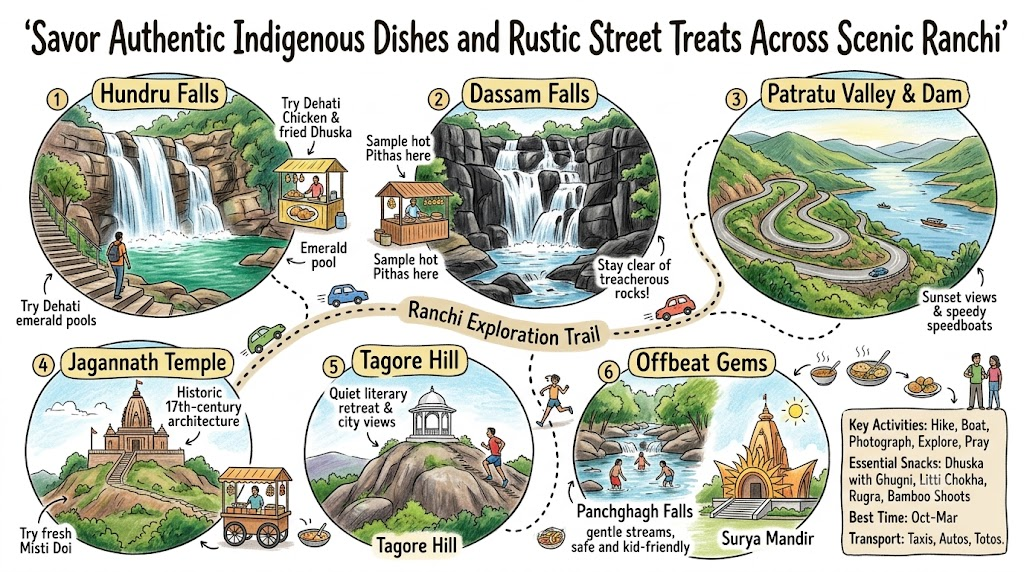
Hundru Falls
Plunging from a cliff face of 98 meters, Hundru Falls represents the fierce power of the Subarnarekha River cutting across the Ranchi plateau. The water crashes over centuries of polished metamorphic gneiss, cascading into an emerald natural pool surrounded by dense forest canopy.
Descending the roughly 750 stone steps brings you into a breezy micro-basin where the roar of the falls drowns out modern noise. The rock formations along the bank showcase fascinating fluvial erosion patterns, creating geological sculptures that contrast against the mist.
- Location: Ormanjhi-Purulia Road, roughly 45 km northeast of Ranchi city center.
- Why it is worth visiting: It is the highest waterfall in the Ranchi district, offering raw geological spectacle and misty gorge trekking.
- Best things to do: Hike down the stone stairway for close-up gorge photography, enjoy roasted country corn from local trailside vendors, and observe the rock pools below the plunge pool.
- Best time to visit: October to December when post-monsoon water volumes remain strong and paths dry out.
- Ideal for whom: Nature lovers, adventure trekkers, and landscape photographers.
- Travel tip: Wear slip-resistant footwear; the staircase gets slick, and swimming in the main plunge pool is strictly prohibited due to dangerous undertows.
Dassam Falls
Formed by the pristine Kanchi River, a major tributary of the Subarnarekha, Dassam Falls (locally called Da-song, meaning pouring water) drops 44 meters over an amphitheater of black granite shelves. The sheer horizontal span of the cascade creates a thunderous curtain of white water that sprays deep into the surrounding wilderness.
The surrounding landscape remains carpeted in thick Sal and Palash trees, which erupt into fiery orange blossoms by late winter. Unlike more urbanized waterfalls, Dassam retains a quiet forest ambiance where you can experience the earthy scent of wet soil and listen to mountain birds echo across the gorge.
- Location: Near Taimara village on the Ranchi-Tata Highway (NH 33), roughly 40 km southeast of Ranchi.
- Why it is worth visiting: The multi-tiered cascade creates one of the most picturesque natural amphitheaters in eastern India.
- Best things to do: Climb the terraced viewpoints for panoramic valley vistas, sample fresh hot fried Pithas at the entrance shacks, and photograph the river canyon from the steel footbridge.
- Best time to visit: 8:00 AM to 11:00 AM between November and February for clear morning light and minimal crowds.
- Ideal for whom: Couples, road-trip enthusiasts, and geology buffs.
- Travel tip: The rock surfaces here are deceptive and moss-laden; never venture past the security fencing for selfies.
Patratu Valley and Dam
The drive through Patratu Valley is an engineering marvel featuring over 30 tight hairpin bends carving their way through lush green mountain ridges. As your vehicle navigates this winding pass, panoramic views reveal deep forested ravines and the shimmering waters of Patratu Dam in the basin below.
Down at the reservoir, a tranquil lakeside promenade offers boating, water sports, and sunset walks. The contrast between high-octane hill driving and calm waters makes this valley a premier retreat for travelers coming from the urban plains.
- Location: Ramgarh district border, approximately 35 km northwest of Ranchi.
- Why it is worth visiting: The serpentine road offers one of India’s most scenic driving passes, ending at a vast scenic lake.
- Best things to do: Stop at mid-valley lookout points for sweeping photographs, take a speedboat or pedal boat across Patratu Dam, and enjoy fresh lake fish curry at local roadside dhabas.
- Best time to visit: Late afternoon (3:30 PM to 6:00 PM) to watch the golden sunset cast reflections over the water and surrounding hills.
- Ideal for whom: Motorcyclists, driving enthusiasts, weekend travelers, and families.
- Travel tip: Drive prudently on the hairpin curves as local heavy transport vehicles and commercial trucks frequently travel through this corridor.
Jagannath Temple, Dhurwa
Built in 1691 by King Ani Nath Shahdeo of the Nagvanshi dynasty, this historic hill shrine mirrors the architectural silhouette of the famed temple in Puri, Odisha. Rising atop a lone hillock in Dhurwa, the white stone structure overlooks the urban landscape and the wide expanse of the HEC industrial township.
The climb up the stone stairs or winding ramp takes you past stone pillars and quiet shrines into the main sanctum housing wooden deities of Jagannath, Balabhadra, and Subhadra. Every monsoon, the temple hosts an energetic Rath Yatra fair that draws hundreds of thousands of tribal villagers and townspeople in deep devotion.
- Location: Dhurwa, approximately 11 km southwest of Ranchi Railway Station.
- Why it is worth visiting: It combines 17th-century Kalinga-influenced architecture with commanding 360-degree views of Ranchi’s southwestern plains.
- Best things to do: Climb the grand stone staircase during morning prayer, admire the Nagvanshi stonework, and soak in panoramic sunset views of the city from the perimeter wall.
- Best time to visit: Early morning (6:30 AM to 9:00 AM) or sunset hours; visit during the annual June/July Rath Yatra for cultural vibrancy.
- Ideal for whom: History lovers, spiritual travelers, and architecture photographers.
- Travel tip: Remove footwear at the base of the main courtyard stairs; a gentle paved ramp is available on the side for elderly travelers.
Tagore Hill (Morabadi)
Named after Jyotirindranath Tagore—the elder brother of Nobel laureate Rabindranath Tagore—this 300-foot granite hill served as a peaceful writing retreat during the early 20th century. Jyotirindranath built a cliffside pavilion named Brahmo Mandir and spent his sunset years writing literature and translating historic plays into Bengali.
The base of the hill houses Shanti Dham, a heritage center celebrating the artistic legacy of the Tagore family in Chota Nagpur. Ascending the neat flight of shaded stairs rewards travelers with quiet meditation spots under old Banyan trees and panoramic vistas over the Morabadi plains.
- Location: Morabadi, roughly 5 km north of Ranchi Junction.
- Why it is worth visiting: It offers quiet literary history, minimalist heritage pavilions, and one of the highest natural viewpoints within the central city.
- Best things to do: Climb to the colonial-era open pavilion at the summit, write or sketch in the quiet shade, and visit the Ramakrishna Mission ashram at the foothills.
- Best time to visit: 6:00 AM to 8:30 AM for morning birdwatching and misty views across Morabadi ground.
- Ideal for whom: Writers, solo travelers, history enthusiasts, and joggers.
- Travel tip: The final stretch of stone steps is steep; carry your own water bottle as summit vendors are rare on weekdays.
Offbeat Exploration: Hidden Gems Tourists Miss
McCluskieganj Anglo-Indian Settlement
Tucked 60 km northwest of Ranchi, McCluskieganj was established in the 1930s by Ernest Timothy McCluskie as a homeland for Anglo-Indians. Walking down its mossy lanes feels like stepping into a vintage novel: dilapidated colonial bungalows, stone chimneys, wild orchards, and European bakeries nestle quietly under old Sal groves.
Panchghagh Falls, Khunti
While mainstream tourists crowd Jonha and Hundru, Panchghagh cascades gently along the Khunti road in five distinct streams over flat, accessible rock sheets. Because the water does not crash into a deep cliff-face gorge, it offers a gentle, kid-safe forest stream where you can dip your feet into calm, rock-filtered mountain waters.
Surya Mandir, Bundu
Located 40 km down the Tata highway, this unusual modern temple is sculpted in the form of an enormous, 18-wheeled chariot drawn by seven galloping white marble horses. Built near an ancient sacred pond, it offers a quiet stopover with manicured gardens and ornate sandstone carvings of solar deities.
Detailed Practical Guidance for Travelers
| Destination | Standard Entry Fee | General Timings | Best Local Food Options Nearby | Recommended Nearby Attractions |
| Hundru Falls | INR 15 per person | 6:00 AM – 5:00 PM | Country-style Dehati Chicken & fried Dhuska at parking dhabas | Jonha Falls, Sita Falls |
| Dassam Falls | INR 20 per person | 7:00 AM – 5:00 PM | Forest-stand Pithas, sweet corn, and Kachori-Sabzi stalls | Surya Mandir, Bundu |
| Patratu Valley | Free entry (Boating: INR 100-300) | 6:00 AM – 6:30 PM | Pan-fried dam fish and Litti Chokha at PTDC Lake Resort | Patratu Dam & Boating Club |
| Jagannath Temple | Free entry (Vehicle parking: INR 20) | 5:00 AM – 12:00 PM, 4:00 PM – 8:30 PM | Earthen-pot sweet curd (Misti Doi) and hot Samosas in Dhurwa market | Dhurwa Dam, Parasnath Hill shrine replica |
| Tagore Hill | INR 10 per person | 6:00 AM – 6:00 PM | Classic street-side Chhena Jhili, filter coffee, and fruit chaat at Morabadi | Morabadi Ground, Tribal Research Institute Museum |
Logistics & On-Ground Navigation
Local Transport Options
- Cab Rentals & Private Taxis: The best way to cover the waterfall circuits is booking a full-day private taxi via local fleet operators or online aggregators (INR 2,200 to INR 3,200 per day for an AC hatchback/sedan).
- Auto-Rickshaws (Tuk-Tuks): Shared auto-rickshaws dominate Main Road, Circular Road, and Ratu Road. Reserve autos for dedicated short-distance travel, but always confirm the fare before boarding.
- E-Rickshaws (Totos): Environmentally friendly and silent, battery-operated rickshaws are perfect for inner residential neighborhoods like Morabadi, Lalpur, and Doranda.
- Public Buses: State transport runs periodic buses to Khunti, Bundu, and Ramgarh from the ITI bus stand and Birsa Bus Stand (Kanta Toli), which works well for ultra-budget backpackers.
Budget Planning
- Budget Tier (INR 1,200 – 1,800 per day): Stay in budget guesthouses or railway retiring rooms near Station Road, eat Dhuska-Ghugni and Litti at street joints, and commute via shared autos and local buses.
- Comfort / Mid-Range Tier (INR 3,500 – 6,500 per day): Stay in a 3-star or boutique hotel in Lalpur or Morabadi, hire a dedicated private cab for outer loops, and dine at authentic regional restaurants.
Safety and Inclusivity Tips
- For Families: Stick to developed tourist parks and falls with paved pathways (Hundru, Patratu, Tagore Hill) and plan to return to your hotel by 7:30 PM.
- For Couples: Avoid isolated viewpoints deep in the forests around Dassam after 4:30 PM; stay within designated tourist zones where local village wardens and guards are stationed.
- General Health & Safety: Always carry cash notes; rural waterfall checkposts suffer from patchy cellular internet connections, rendering UPI payments unreliable.
Strategic Travel Planning Guardrails
Travel Planning Tips for Ranchi
- Book your car rental and driver at least 24 hours in advance if traveling during peak winter festival weekends.
- Carry liquid cash in denominations of INR 50, 100, and 200 for parking tickets, local tribal handicraft stalls, and trailside snacks.
- Dress in functional, non-restrictive layers; plateau winter mornings are crisp and breezy, while afternoons get pleasantly sunny.
- Learn basic Hindi words or polite greetings; tribal and rural vendors are exceptionally courteous and appreciate polite communication.
- Pack a sturdy, water-resistant daypack with grip shoes and a refillable stainless-steel water bottle to reduce single-use plastic waste.
Common Mistakes to Avoid
- Do not attempt to visit both Patratu Valley and Dassam Falls on the same afternoon; they lie in completely opposite directions.
- Do not underestimate the staircase climbs at the waterfalls; going down is easy, but ascending 750 stone steps requires moderate fitness.
- Never step onto black, wet river boulders along the waterfalls for selfies; they are covered in micro-algae and are slick.
- Avoid dining exclusively at continental hotel buffets; you will miss out on the rich flavors of Chhotanagpuri regional cooking.
- Do not leave rural picnic spots littered with trash; respect the sacred natural groves (Sarna) preserved by local communities.
Suggested Itinerary Blueprints
1. Day Quick Dash (The Classic Cascade & Valley Run)
Target Audience: Business travelers with a single free day or weekend road-trippers.
- Morning (8:00 AM – 12:30 PM): Depart early for Hundru Falls. Descend the stone stairs, soak in the morning spray, and savor hot Dhuska with spiced chickpea Ghugni at the trail base.
- Afternoon (1:30 PM – 4:00 PM): Head to Morabadi for a cultural stop at Tagore Hill, followed by an authentic tribal lunch plate at an indigenous restaurant.
- Evening (4:30 PM – 7:30 PM): Drive out through the serpentine hairpins of Patratu Valley to catch the sunset over Patratu Dam before heading back to the city for dinner.
2. Day Deep-Dive (Highland Heritage & Secret Waters)
Target Audience: Culture enthusiasts and visual storytellers.
- Day 1: Southern Cascades & Spiritual Horizons
- Morning journey down NH 33 to Dassam Falls. Explore the stone canyon and sample rural fried Pithas.
- Return via the 17th-century Jagannath Temple in Dhurwa; witness the 5:00 PM evening prayer and enjoy the cool breeze overlooking the plains.
- Evening stroll through Doranda or Main Road market to sample roasted dry fruit sweets and spicy Chaats.
- Day 2: Anglo Heritage & Urban Plateau Views
- Take an early-morning excursion to the heritage settlement of McCluskieganj; photograph colonial stone churches and peaceful orchards.
- Late afternoon return to Ranchi; climb Tagore Hill in Morabadi for panoramic sunset photography.
3. Complete Weekend Travel Plan (The Grand Chhotanagpur Circuit)
Target Audience: Families, couples, and road-tripping explorers.
- Friday Evening: Arrive via rail or air. Check into your hotel in Lalpur or Morabadi. Settle in with a plate of smoky Litti Chokha roasted over cow-dung cakes and topped with desi ghee.
- Saturday (The Great Waterfall Circuit):
- Early 7:30 AM departure to Hundru Falls.
- Midday drive to nearby Jonha Falls (Gautamdhara), where you can sit by the natural riverbed.
- Evening return to Morabadi for steaming milk tea, fried Chhena, and local street food.
- Sunday (Valleys, Temples, and Artisanal Souvenirs):
- Morning visit to the State Museum Hotwar to witness Dokra brass casting, Sohrai tribal art paintings, and terracotta tools.
- Afternoon drive across Patratu Valley, taking a 45-minute speedboat ride across the dam.
- Stop at the Jharcraft Emporium on Main Road to pick up Tussar silk sarees and bamboo root sculptures before boarding your return train or flight.
Common Tourist Mistakes to Avoid
Geographic Blunders
The most frequent mistake first-time visitors make is packing Hundru (northeast), Dassam (southeast), and Patratu (northwest) into a single 8-hour sprint. The distance between Dassam and Patratu alone exceeds 75 km across congested suburban roads, leaving you exhausted behind the wheel instead of enjoying the scenery. Group your days strictly by compass corridors.
Commercial Traps
Spending limited evening hours in generic multi-story shopping malls along Kanke Road robs you of Ranchi’s real charm. Head instead to traditional hubs like Daily Market or Lalpur Chowk, where local farmers bring freshly harvested seasonal forest produce like Phutkal saag, wild mushrooms, and sweet root vegetables.
Neglecting Modern/Alternative Zones
Many visitors focus entirely on rural waterfalls and skip Ranchi’s emerging cultural hotspots. Neighborhoods around Morabadi Ground feature leafy, wide boulevards, local running tracks, open-air art displays, and modern bohemian cafes serving single-estate Indian pour-overs alongside tribal-inspired snacks.
Transport Overpayment
Unmetered auto-rickshaws stationed right outside Ranchi Junction often demand two to three times the standard rate from arriving tourists. Always cross-check estimated rates using online ride-sharing apps, or walk 50 meters outside the station concourse to hire shared autos or app-based cabs at standardized rates.
Luxury Dining Bias
Resort dining halls often serve run-of-the-mill North Indian gravies that give no sense of place. Ranchi’s soul lives in its street stalls and modest local dhabas:
Food Lover’s Secret: You haven’t truly tasted Ranchi until you’ve eaten Dhuska—a deep-fried pancake of fermented rice and chana dal—served blistering hot on a dried leaf plate (Dona) alongside spicy potato-black gram curry.
Frequently Asked Questions
1. What is the single best time of year to plan a trip to Ranchi?
The ideal window spans from October through February. During these winter months, daytime temperatures hover around a pleasant 20°C to 24°C, humidity drops significantly, and waterfalls maintain strong post-monsoon volumes without the danger of flash floods.
2. Is it safe to drive personal cars or hire self-drive vehicles down Patratu Valley?
Yes, the four-lane highway through Patratu Valley is well-engineered with secure crash barriers and reflective signage. However, keep your speed under 40 km/h on hairpin corners, use low gears while descending, and avoid aggressive overtaking around blind curves.
3. What are the essential local tribal dishes one must try in Ranchi?
Do not leave without tasting Dhuska with spicy chana curry, Litti Chokha cooked over open coals, Rugra (indigenous wild earth mushrooms), tender Bamboo Shoot curry, and sweet steamed Pitha dumplings filled with spiced jaggery or lentils.
4. How accessible is Ranchi for elderly travelers visiting the waterfalls?
Most outer waterfalls, like Hundru and Jonha, require descending and ascending hundreds of steep stone stairs, which can strain elderly knees. Dassam offers accessible upper viewpoints, and Tagore Hill and Patratu Lake provide gentle, stair-free access.
5. What authentic handicrafts should I buy from Ranchi as cultural souvenirs?
Look for authentic Tussar silk fabrics, hand-carved bamboo home accessories, Dokra bell-metal tribal figurines, and traditional hand-painted Sohrai-Khovar wall canvases. Always purchase from government-run Jharcraft emporiums to ensure fair artisan compensation.
6. Do I need any special permits to explore rural villages or waterfalls around Ranchi?
No special inner-line permits are required for Indian or foreign travelers visiting standard tourist landmarks in Ranchi district. Only specific, protected ecological mining reserves or border tribal zones require prior clearance from the district magistrate.
7. Can the famous waterfalls around Ranchi be visited during the monsoon season?
While monsoon rains (July to September) turn the plateau intensely green, waterfall steps turn slick, and river levels can rise suddenly. Visiting viewpoints is fine, but stepping near waterlines or riverbeds during heavy rain is prohibited.
8. What is the local language spoken across Ranchi, and will language be a barrier?
Hindi is universally spoken and understood across all hotels, markets, and transit points. Regional languages include Nagpuri (Sadri), Mundari, and Kurukh. English is comfortably spoken in modern hospitality establishments and urban retail spaces.
9. Are app-based cabs easily accessible for early morning airport or railway pick-ups?
Yes, app-based cab services operate reliably throughout central city zones. However, if you have a pre-dawn flight or train departing before 6:00 AM, reserve a local taxi with your hotel front desk the night before to guarantee timely transit.
10. What clothes are appropriate when visiting sacred sites and tribal villages around Ranchi?
Modest, functional attire covering shoulders and knees is recommended when touring rural village settlements, sacred groves (Sarnas), and historic shrines like the Jagannath Temple. Comfortable walking sandals or running shoes are essential for varied trail terrain.
11. Is Ranchi an affordable destination for solo travelers on a backpacking budget?
Ranchi is one of the most budget-friendly capitals in India. Clean hostel and hotel rooms run under INR 1,000 per night, wholesome street food meals cost between INR 40 and INR 80, and shared public transit rarely exceeds INR 30 per ride.
12. How far are Betla National Park and Netarhat from Ranchi for an extended loop?
Netarhat sits approximately 155 km west (around a 4-hour scenic mountain drive), while Betla National Park lies roughly 170 km northwest. Both can be combined with a Ranchi trip as an extended 3-day plateau and wildlife loop.
Conclusion
Choosing Ranchi over conventional, crowded vacation circuits rewards you with the timeless rhythm of an ancient landscape. From the deep mist of wild waterfalls to the warm hospitality of its tribal hamlets, this plateau capital leaves you grounded, refreshed, and deeply connected to the authentic heart of eastern India.
