Introduction
Most travelers rush toward congested hill stations choked with tourist buses, cookie-cutter souvenir shops, and overpriced viewing decks. Ranchi offers an antidote to that synthetic tourism, sitting on the sub-tropical Chota Nagpur Plateau where rust-red soil meets ancient sal forests. It is an earthy, unhurried capital where urban energy blends directly into tribal heritage, cascading waters, and quiet colonial echoes.
Here, genuine hospitality replaces commercial hustle. Morning air carries the scent of roasted sattu and fresh eucalyptus, while surrounding escarpments rumble with perennial river runoff. For travelers who seek cultural depth and raw terrain over manicured photo traps, this plateau city rewards curiosity with unmatched authenticity.
Why Ranchi is a must-visit city
Ranchi anchors the cultural and geological heart of Jharkhand. Sitting at an altitude of roughly 650 meters above sea level, it enjoys a pleasant highland microclimate that historically earned it the status of summer capital under the British Raj. The surrounding geology features dramatic drop-offs along the Subarnarekha and Kanchi river basins, creating a natural rim of thundering waterfalls that earned Ranchi its moniker: the “City of Waterfalls.”
Culturally, the city serves as a living confluence of diverse indigenous communities, including the Munda, Oraon, and Santhal peoples. Their traditions shape everything from regional cuisine and music to sacred grove conservation and handloom weaving. Accessing this vibrant hub is seamless: Birsa Munda Airport (IXR) connects directly to major Indian metros, while Ranchi Junction links broad-gauge rail corridors across the subcontinent. Smooth four-lane expressways extend outward to historic pilgrimage and eco-tourism belts.
The travel circuit splits into three intuitive spokes: the Northern Escarpment (hill viewpoints and winding valley passes), the Southern & Eastern Waterfalls Ring (river cataracts and forest trails), and the Urban Cultural Core (centuries-old temples, local haats, and heritage sites).
| Metric / Dimension | Regional Detail |
| Geographic Elevation | ~651 meters (2,136 ft) on the Chota Nagpur Plateau |
| Major River Systems | Subarnarekha, South Koel, Jumar, and Kanchi |
| Primary Connectivity | Birsa Munda Airport (IXR), Ranchi Junction (RNC), NH 20 & NH 33 |
| Peak Season Window | October to March (crisp winters and active post-monsoon waterfalls) |
| Cultural Anchor | Tribal indigenous heritage, Sarhul & Karma festivals, Sohrai art |
| Signature Local Dish | Dhuska with Ghugni and charred Tomato Chutney |
Best Places or Experiences
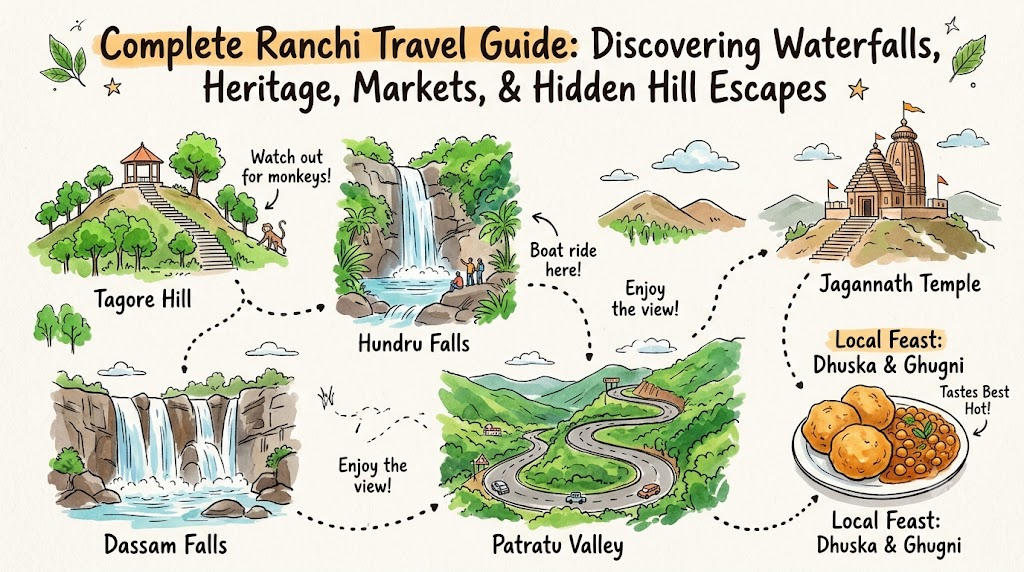
Dassam Falls
Dassam Falls drops nearly 44 meters over an angled sheet of jagged metamorphic rock, channeled by the wild currents of the Kanchi River. The surrounding landscape consists of dense, unspoiled sal forests that reverberate with the roaring cascade, sending cool mists billowing across natural stone observation ledges.
During peak flow, the river splits into ten distinct channels before plunging together into an emerald plunge pool below. Concrete pathways and stepped railings allow visitors to descend toward mid-level viewing platforms, providing panoramic angles of raw Chota Nagpur hydrology without requiring strenuous off-trail hiking.
- Location: Taimara village, Bundu block, approximately 40 km southeast of central Ranchi along the Ranchi-Tata highway.
- Why it is worth visiting: It presents one of eastern India’s most dramatic nick-point waterfalls set against pristine indigenous woodland.
- Best things to do: Photograph the tiered torrents from the lower viewing terrace, pick up hot tea brewed on clay chulhas by local village vendors, and observe rock formations along the upper riverbank.
- Best time to visit: October to February for active water volume paired with crystal-clear skies.
- Ideal for whom: Landscape photographers, nature lovers, road-trippers, and weekend explorers.
- Travel tip: Stay behind the concrete safety barriers; the submerged rocks are slick with algae and drop off into treacherous underwater vortexes.
Patratu Valley and Dam
The drive down into Patratu Valley features an engineering marvel: a serpentine ghat road with over two dozen sweeping hairpin turns cutting through lush, forested hillsides. From the summit lookouts, the road looks like a silver ribbon coiling downward toward the expansive, calm waters of Patratu Reservoir.
At the valley floor, the massive reservoir provides serene boat cruises and waterfront promenades maintained by the local tourism department. Gentle evening breezes and golden light reflecting across the lake make this descent one of the premier driving circuits in eastern India.
- Location: Ramgarh district border, approximately 35 km north of Ranchi city center.
- Why it is worth visiting: Unrivaled aerial panoramas of coiled mountain switchbacks coupled with breezy lake excursions.
- Best things to do: Stop at the elevated highway viewing decks for sunrise photography, take a motorboat ride across Patratu Lake, and relax with snacks at the lakeside promenade.
- Best time to visit: Late afternoons (3:30 PM to 6:00 PM) to catch golden hour lighting over the road bends.
- Ideal for whom: Motorcyclists, scenic drivers, couples, and leisure travelers.
- Travel tip: Start your return uphill before nightfall; dense valley fog can reduce visibility along the unlit hairpin sections during winter months.
Jagannath Temple
Built in 1691 by King Ani Nath Shahdeo of the Nagvanshi dynasty, this historic citadel mirrors the architectural layout of the renowned shrine in Puri. Perched atop a solitary granite hillock in Dhurwa, the temple features whitewashed sanctum walls and towering spires visible across the southwestern plains of Ranchi.
Visiting during the annual Rath Yatra festival reveals centuries of vibrant local devotion, drawing thousands of tribal and regional devotees to the grand fairgrounds below. The quiet stone courtyards at the summit provide sweeping, 360-degree views of the expanding cityscape and surrounding water reservoirs.
- Location: Jagannathpur, Dhurwa, roughly 11 km southwest of Ranchi Railway Station.
- Why it is worth visiting: A rare 17th-century Nagvanshi architectural landmark that bridges regional tribal worship with classic Jagannath traditions.
- Best things to do: Climb the historic stone stairway for an early morning workout, study the Nagvanshi stonework across the sanctum walls, and attend the rhythmic evening aarti.
- Best time to visit: 6:00 AM to 8:30 AM for peaceful meditation, or around sunset for cool breezes and city panoramas.
- Ideal for whom: Heritage enthusiasts, cultural photographers, architecture buffs, and families.
- Travel tip: Elderly travelers can use the paved vehicular ramp behind the hillock to avoid the steep front stairs.
Tagore Hill
Rising roughly 300 feet above the northern neighborhoods of Ranchi, Tagore Hill (Morabadi Hill) carries deep cultural ties to Bengal’s literary renaissance. Jyotirindranath Tagore, the elder brother of Nobel laureate Rabindranath Tagore, made this hill his hermitage in 1912, constructing the serene Brahmo Mandir and his retreat home, Shanti Dham, at its summit.
The hilltop offers an oasis of quiet stone pavilions, shade trees, and cool winds. It served as a personal refuge where literature, plays, and translations were penned while looking across the tranquil, tree-covered plains of Ranchi.
- Location: Morabadi, approximately 5 km north of Ranchi Junction.
- Why it is worth visiting: An evocative historical landmark showcasing the confluence of Indian literature and quiet plateau geography.
- Best things to do: Walk up the tree-lined paved steps, explore the modest gallery at the base detailing Jyotirindranath’s work, and watch the sunset over the Morabadi plains.
- Best time to visit: October through March during early mornings (6:30 AM) or sunset (5:00 PM).
- Ideal for whom: Writers, solo wanderers, history students, and casual morning walkers.
- Travel tip: Combine your visit with an early breakfast at Morabadi Ground, famous for fresh fruit stalls and steaming street snacks.
Jonha Falls
Locally revered as Gautamdhara, Jonha Falls cascades over stepped rocky terraces along the edge of the Raru River. Legend holds that Lord Buddha bathed in these calm upper pools, a heritage commemorated by an ashram and temple complex located just above the precipice.
Reaching the foot of the falls involves walking down a steep flight of over 700 well-maintained concrete steps through dense canopy. The walk down rewards visitors with misty river breezes, deep stone gorges, and spacious rocky outcroppings perfect for quiet contemplation.
- Location: Jonha village, roughly 42 km east of Ranchi off the Purulia road.
- Why it is worth visiting: A terraced hanging valley waterfall combining deep spiritual folklore with energetic forest stair climbs.
- Best things to do: Walk down to the base to feel the river spray, visit the quiet Buddhist shrine near the cliff edge, and purchase locally harvested wild honey from village vendors.
- Best time to visit: Post-monsoon from September to January when river volume is healthy and the surrounding hills are vibrant green.
- Ideal for whom: Active hikers, spiritual seekers, and birdwatchers.
- Travel tip: Pace your descent; climbing back up those 700 steps can be tiring under midday sun, so carry drinking water and electrolyte packets.
Hundru Falls
Hundru Falls is one of Jharkhand’s tallest cataracts, dropping 98 meters as the Subarnarekha River cuts through metamorphic rock sheets. The force of the falling water has carved massive circular pools and sculpted stone formations across the canyon floor over centuries.
During monsoon runoff, the fall transforms into a deafening wall of spray. In cooler winter months, the flow narrows into precise white chutes, allowing travelers to walk along the sun-baked, water-smoothed rock formations at the base.
- Location: Chandil-Ormanjhi plateau belt, roughly 45 km northeast of central Ranchi.
- Why it is worth visiting: A landmark geographic drop along the Subarnarekha basin with striking rock pools.
- Best things to do: Admire the sheer 320-foot vertical drop, explore safe rock perimeters near the lower pools, and sample fresh fried snacks at the upper parking bazaar.
- Best time to visit: November to February for pleasant weather and comfortable rock walking conditions.
- Ideal for whom: Geology enthusiasts, adventurous groups, and photography teams.
- Travel tip: Avoid swimming in the deep plunge pools; the river currents under the surface remain dangerously unpredictable year-round.
Offbeat Exploration: Hidden Gems Tourists Miss
McCluskieganj Colonial Settlement
Tucked roughly 60 km northwest of Ranchi lies McCluskieganj, a quiet enclave established in the 1930s as a homeland for the Anglo-Indian community. Scattered across thick sal and mahua forests, you will find red-roofed colonial cottages featuring wrap-around verandahs, stone fireplaces, and wild, overgrown gardens.
Walking these sleepy country lanes feels like entering a time capsule. Stop by the local bakery for handmade treats, visit the historic railway station that inspired classic cinema sets, and enjoy the rare tranquility of a bygone era far removed from modern traffic.
Sita Falls Canyon
While crowds flock to nearby Dassam and Jonha, Sita Falls remains a hidden sanctuary nestled deep inside the Kanchi river ravine. Reaching this spot requires navigating a narrow village track through dense forest followed by a short trek down raw stone ledges.
The falls drop over a dark granite amphitheater into a pristine, sunlit pool surrounded by maidenhair ferns and wild orchids. Because tourist footfall is minimal, birdlife thrives here, offering a quiet, undisturbed natural retreat.
Getalsud Dam Backwaters at Sunset
Most travelers view Getalsud Dam only from its primary barrage wall, missing the serene backwaters hidden near the village edges of Angara. Here, cattle graze peacefully on grassy headlands that slope gently into mirror-flat waters reflecting the Chota Nagpur sunset.
Rent a simple wooden dinghy from local fishermen to drift along the quiet shoreline as cormorants dive for evening fish. It is an ideal off-grid spot for an open-air thermos tea break without any commercial distractions.
Detailed Practical Guidance for Travelers
| Destination | Standard Entry Fee | General Timings | Best Local Food Options Nearby | Recommended Nearby Attractions |
| Dassam Falls | ₹10 to ₹20 per person | 8:00 AM – 5:00 PM | Local roadside dhabas serving hot Ghugni and Desi Chai | Surya Temple Bundu, Kanchi Riverbed |
| Patratu Valley | Free road access; ₹50 lake park entry | 6:00 AM – 6:30 PM | Lake resort multi-cuisine restaurants, roasted bhutta stalls | Patratu Dam Promenade, Thermal Power Lake |
| Jagannath Temple | Free entry | 5:00 AM – 12:00 PM, 3:30 PM – 8:30 PM | Traditional street stalls serving hot Jalebis and Dhuska | Dhurwa Dam Reservoir, HEC Township Park |
| Tagore Hill | ₹10 per person | 6:00 AM – 6:00 PM | Morabadi street vendors offering Litti Chokha and Chaat | Morabadi Ground, Tribal Research Institute Museum |
| Jonha Falls | ₹10 per person | 8:00 AM – 4:30 PM | Forest canteen stalls with fried pakodas and village tea | Sita Falls, Gautam Buddha Ashram |
| Hundru Falls | ₹15 per person | 8:00 AM – 5:00 PM | Village snacks, roasted corn, Maggi points, sweet pitha | Getalsud Dam, Subarnarekha River Valley |
Logistics & On-Ground Navigation
Local Transport Options
Getting around Ranchi requires a mix of transit modes depending on whether you are in the city core or heading out into the falls circuit.
- Auto-Rickshaws & E-Rickshaws: Shared autos follow fixed routes along main streets like Main Road, Ratu Road, and Hinoo for ₹10 to ₹30. For point-to-point city trips, book dedicated rides on Ola or Uber, or negotiate directly with local drivers.
- Self-Drive & Private Day Cabs: The most reliable way to explore out-of-town waterfalls like Dassam, Hundru, or Patratu is hiring a private taxi (Swift Dzire or Innova) for ₹2,500 to ₹4,000 per day.
- Intercity Buses: The Birsa Munda Bus Stand at Kantatoli and ITI Bus Stand operate frequent buses to surrounding towns, though private cabs offer far better flexibility for sightseeing.
Budget Planning
Smart Money Tip: Carry at least ₹1,500 to ₹2,500 in physical cash daily. While UPI works across Ranchi city, rural waterfall gates, parking attendants, and local tea stalls frequently suffer from patchy cellular data.
- Backpacker / Solo Tier (₹1,200 – ₹1,800 per day): Stay in budget guesthouses near the railway station or Morabadi. Use shared autos and local buses, eat delicious street food (Dhuska, Litti, Sattu Sharbat), and visit public parks and hills.
- Mid-Range / Comfort Tier (₹3,500 – ₹6,500 per day): Stay in comfortable 3-star business hotels along Main Road or Kadru. Hire an air-conditioned cab for out-of-town day trips, and dine at established family restaurants and heritage bistros.
Safety and Inclusivity Tips
Ranchi is generally peaceful, respectful, and welcoming. Keeping a few standard precautions in mind ensures an easy trip:
- Families: Waterfall locations feature extensive staircases and rocky edges. Keep young children close to marked railings, wear supportive walking shoes, and plan to head back to city limits before dusk.
- Couples: Scenic spots like Patratu Valley and Tagore Hill are popular and welcoming. To avoid awkward stares or unwanted attention, stick to well-frequented viewing zones and avoid isolated forest trails after sunset.
- General Safety: Rural highway connectivity between out-of-town waterfalls lacks street lighting. Complete all out-of-town visits and return to major highway corridors by 6:00 PM.
Strategic Travel Planning Guardrails
Travel Planning Tips for Ranchi
- Target the Winter Window: Plan your itinerary between late October and mid-March to experience comfortable 20°C daytime temperatures and cool plateau nights.
- Prioritize Waterfalls Right After Monsoon: To see falls like Hundru and Dassam in full roar, visit in September or October when river channels are brimming.
- Carry Backup Cash: Keep small bills (₹10, ₹20, and ₹50) handy for forest entry fees, camera permits, and village snack counters where digital payment scanners often drop offline.
- Dress for Steps and Sun: Pack comfortable shoes with reliable grip for wet stone surfaces, along with a wide-brim hat, sunscreen, and a light jacket for winter evenings.
- Respect Sacred Tribal Groves: Sarna sthals (sacred groves marked by sal trees and prayer flags) are deeply sacred spaces for indigenous locals. Treat these perimeter grounds with quiet respect.
Common Mistakes to Avoid
- Packing Too Many Waterfalls into One Day: Trying to visit Hundru, Dassam, and Jonha on the same day leads to exhaustion from endless stair climbing. Pick one or at most two nearby falls per day.
- Assuming Ride-Hailing Apps Work Everywhere: Ola and Uber operate smoothly inside city limits, but you cannot easily book one back from Dassam Falls or Patratu Lake. Secure a round-trip rental with your driver upfront.
- Ignoring the Regional Food Scene: Sticking solely to hotel buffets misses the soul of Jharkhand. Seek out fresh morning dhuska and steamed litti from neighborhood street stalls.
- Underestimating Plateau Sun Exposure: The plateau air feels deceptively cool in winter, but direct sun exposure during midday hikes can quickly dehydrate you. Drink water consistently.
- Skipping City Heritage: Bypassing urban spots like Tagore Hill or the State Museum deprives you of understanding the rich history that shaped modern Jharkhand.
Suggested Itinerary Blueprints
1-Day Quick Dash (City Heritage and Sunset Escarpment)
Tailored for business visitors or transit travelers with limited time who want a balanced taste of culture, food, and scenic valley views:
- Morning (8:30 AM – 11:30 AM): Begin with a fresh street breakfast of hot dhuska and ghugni near Morabadi Ground. Walk up the shady stone steps of Tagore Hill to enjoy clear views of the waking city.
- Midday (12:00 PM – 2:30 PM): Head south into town for an authentic thali lunch featuring seasonal bamboo shoot curry and regional greens. Stop by the 17th-century Jagannath Temple in Dhurwa to admire its historic Nagvanshi architecture.
- Afternoon to Sunset (3:00 PM – 6:30 PM): Drive north toward Patratu Valley. Stop at the high hairpin overlooks for golden hour photos before heading down to the lakeside promenade for evening tea. Return to Ranchi for dinner.
2-Day Deep-Dive (Waterfalls and Cultural Heritage)
A balanced weekend plan covering thunderous river gorges, historic architecture, and local arts:
- Day 1: The Southern River Cataracts and Living Craft
- 8:00 AM: Depart early for Dassam Falls along the Tata highway. Spend the morning exploring the upper and mid-level rock overlooks as the river cascades over the cliffs.
- 12:30 PM: Enjoy a traditional roadside dhaba lunch featuring fresh country chicken curry or seasonal vegetarian dishes along the Bundu highway stretch.
- 2:30 PM: Return toward the city and explore Jhamkprik and Jharcraft Emporium on Main Road to pick up authentic Tussar silk sarees and Dokra brass crafts.
- 5:30 PM: Relax with an evening stroll around Ranchi Lake, followed by regional street snacks.
- Day 2: Winding Hills, Tribal History, and Scenic Reservoirs
- 9:00 AM: Visit the Dr. Ramdayal Munda Tribal Research Institute Museum in Morabadi to discover the history, musical instruments, and lifestyle of Jharkhand’s indigenous communities.
- 12:00 PM: Head to a regional cafe for lunch, then take the scenic 45-minute drive up into Patratu Valley.
- 2:30 PM: Enjoy a motorboat cruise across the broad waters of Patratu Dam.
- 5:00 PM: Settle into a scenic cliffside viewpoint along the hairpin ghats to watch the sunset paint the valley floor in warm copper tones.
3-Day Complete Weekend Travel Plan (The Ultimate Plateau Loop)
The definitive regional circuit, taking you through cascading waterfalls, historical hill retreats, and quiet colonial settlements:
- Friday: Colonial Echoes and High Viewpoints
- Arrive in Ranchi and drive northwest toward the historic settlement of McCluskieganj.
- Explore old Anglo-Indian bungalows, walk peaceful country tracks, and visit the serene local railway station.
- Return to Ranchi by late afternoon to catch the sunset atop Tagore Hill, followed by dinner at a local family restaurant.
- Friday Night: Check into your central Ranchi hotel.
- Saturday: The Great Waterfalls Circuit
- 8:30 AM: Pack day bags and head east to descend the stairs at Jonha Falls (Gautamdhara). Explore the riverbed and nearby Buddhist shrine.
- 12:30 PM: Enjoy a picnic or lunch at a local dhaba near Angara.
- 2:00 PM: Continue along scenic country roads to Hundru Falls. Walk across the sun-warmed granite flats at the base of this 98-meter drop.
- 5:00 PM: Stop by the quiet backwaters of Getalsud Dam on your return drive for a serene sunset over the reservoir.
- Sunday: Sacred Heritage, Shopping, and Valley Drives
- 8:00 AM: Visit Jagannath Temple on its quiet hillock in Dhurwa for early morning prayers and city views.
- 10:30 AM: Shop for indigenous handicrafts, Sohrai art prints, and handloom textiles at government-run emporiums.
- 1:00 PM: Enjoy a celebratory tribal-inspired lunch featuring Marua (finger millet) rotis and earthy chutneys.
- 3:00 PM – 7:00 PM: Conclude your trip with a scenic drive through the hairpin turns of Patratu Valley, relaxing by the reservoir before your departure train or flight.
Common Tourist Mistakes to Avoid
Geographic Blunders
Trying to combine geographically opposite attractions—such as Patratu Valley in the far north and Dassam Falls in the far south—on the same day is a recipe for frustration. You will spend five hours sitting in bumper-to-bumper city traffic instead of enjoying the scenery. Group your days strictly by quadrant: reserve one day for the southeastern waterfalls and another for the northern valleys.
Commercial Traps
Spending your travel budget inside generic multi-story shopping malls on Kanke Road or Main Road misses the city’s character. Instead, wander into authentic local bazaars like Upper Bazar, daily rural haats, and government-run handloom emporiums. Here, your money goes directly to local weavers, terracotta potters, and indigenous artisans.
Neglecting Modern and Alternative Zones
Many visitors rush between out-of-town waterfalls and miss the quieter, leafy charm of Ranchi’s residential and artistic neighborhoods. Take an afternoon to explore the tree-shaded avenues of Morabadi, discover cozy homegrown coffee shops around Ashok Nagar, or browse local open-air art displays.
Transport Overpayment
Hailing private cabs directly outside arrival gates at the airport or railway station without checking prices often results in paying double the local rate. Use app-based aggregators to check standard baseline fares first, or book through the official prepaid taxi booth inside the terminal before negotiating with street drivers.
Luxury Dining Bias
Relying exclusively on four-star hotel dining rooms cuts you off from the genuine flavors of the Chota Nagpur Plateau. The culinary heart of this region thrives in humble street stalls and neighborhood eateries serving crispy dhuska, earthy litti dipped in spicy mustard chokha, and refreshing bowls of spiced sattu sharbat.
Frequently Asked Questions
1. What is the best time of year to visit Ranchi for pleasant weather?
The best window to visit Ranchi is between October and March. Temperatures stay pleasantly mild, ranging between 10°C and 25°C, making city walks and outdoor hikes comfortable. Waterfalls flow generously right after the monsoon, and the surrounding hill landscapes remain lush green and vibrant throughout early winter.
2. Which waterfall near Ranchi is the easiest to access for elderly travelers?
Dassam Falls and Hundru Falls require descending dozens of steep stone stairs, making them challenging for travelers with knee issues. Dassam Falls features an upper terrace close to the parking lot with solid railings, providing good views of the rushing waters without requiring visitors to walk down the steep lower steps.
3. What is the most famous authentic food item to eat in Ranchi?
Dhuska is the definitive street food staple of Ranchi. It is a savory, deep-fried pancake made from a fermented batter of rice and chana dal, served alongside spicy chana ghugni and charred tomato-garlic chutney. Locals also love Litti Chokha roasted over charcoal embers and refreshing sattu sharbat.
4. Can I easily find app-based cabs like Ola and Uber across Ranchi?
Ola and Uber operate reliably inside Ranchi city limits, including rides to the airport, railway station, Morabadi, and Dhurwa. However, drivers will rarely accept pick-up requests from distant waterfall sites like Dassam, Hundru, or Patratu. For those trips, hire a dedicated private taxi for the entire day.
5. How far is Patratu Valley from Ranchi and how do I get there?
Patratu Valley lies roughly 35 km north of Ranchi city center. Reaching the valley takes about an hour via the smooth, well-paved Kanke-Patratu road. The journey is best made via private car, hired taxi, or motorcycle so you can comfortably stop at the scenic hairpin curves along the way.
6. Are credit cards and UPI digital payments widely accepted in the region?
Major hotels, modern cafes, and shopping outlets in central Ranchi accept all major credit cards and UPI apps. However, cellular coverage drops in deep river valleys and forest reserves around the waterfalls. Always carry between ₹1,500 and ₹2,500 in physical cash for entry tickets, parking fees, and village snacks.
7. What unique souvenirs should I buy when visiting Ranchi?
Look for genuine Tussar silk sarees and fabrics, intricate Dokra (lost-wax cast brass) tribal figurines, hand-carved wooden items, and Sohrai-Khovar tribal art paintings. Authentic, fair-trade pieces are available at the government-run Jharcraft emporiums located on Main Road and throughout the city center.
8. Is Ranchi safe for solo women and family travelers?
Ranchi is generally peaceful, conservative, and welcoming toward families and solo travelers. People are polite and helpful. Standard travel precautions apply: avoid traveling along unlit rural roads late at night, plan to return from out-of-town waterfalls by dusk, and use verified private cabs for out-of-town transit.
9. How many days are ideal for a complete trip to Ranchi?
A 3-day itinerary provides the perfect amount of time to explore the area. You can spend one full day touring major waterfalls like Dassam or Hundru, a second day enjoying Patratu Valley and local cultural museums, and a third day discovering historical temples, local markets, and city cafes.
10. What clothes should I pack for a trip to Ranchi in winter?
Plateau winters bring crisp mornings and chilly nights, with temperatures occasionally dipping to 7°C or 8°C. Pack comfortable layered clothing, including light thermals, comfortable cotton shirts, and a medium fleece or woolen jacket for evenings. Sturdy walking shoes with reliable grip are essential for exploring the rocky waterfall trails.
11. Is it safe to swim in the pools below the waterfalls?
Swimming in the natural pools below Hundru, Dassam, or Jonha falls is strongly discouraged. Submerged granite rocks are covered in slippery algae, and unseen underwater currents can easily trap swimmers, even during dry winter months. Stick to viewing platforms and safe, shallow riverbanks marked by local guides.
12. How accessible is Ranchi by air, rail, and road networks?
Ranchi is well-connected. Birsa Munda Airport runs daily non-stop flights to major hubs like Delhi, Mumbai, Bengaluru, and Kolkata. Ranchi Junction and Hatia stations connect directly to key rail lines across India, while national highways link the city seamlessly to Jamshedpur, Bokaro, Patna, and Kolkata.
Conclusion
Traveling to Ranchi offers something far deeper than checking off predictable tourist sights; it connects you with the raw, untamed spirit of the Chota Nagpur Plateau. Here, the hum of city life gives way to the thunder of waterfalls carving through ancient stone, the scent of sal blossoms carried on cool mountain breezes, and the warmth of indigenous communities whose cultural roots run centuries deep. Leaving the crowded, commercialized tourist trail behind to experience these forested plateau trails leaves you refreshed, grounded, and genuinely connected to the land.
