Introduction
Most mainstream vacation circuits funnel travelers through crowded souvenir arcades packed with mass-produced plastic knickknacks and imported curios. Ranchi strips away that synthetic veneer, grounding your journey in ancient forests, living indigenous traditions, and artisan communities who have practiced their crafts for millennia.
When you explore Ranchi’s artisan quarters, you are not merely picking up souvenirs; you are connecting with ancestral narratives cast in bell metal, hand-woven into wild tussar silk, and etched into natural terracotta. This city offers something vanishingly rare in modern tourism: an unhurried, genuine encounter with tribal heritage where every handcrafted artifact preserves the cultural identity of Jharkhand’s indigenous communities.
Traditional Sohrai painting depicting tribal wildlife.
Why Ranchi is a must-visit city
Perched upon the mineral-rich Chota Nagpur Plateau, Ranchi serves as both the administrative capital and the spiritual heartbeat of Jharkhand. Geographically, its elevated terrain endows it with refreshing plateaus, dramatic escarpments, and cascading river valleys, while culturally, it forms the epicenter for thirty-two distinct indigenous communities, including the Santhal, Munda, Oraon, and Ho. The city seamlessly combines urban accessibility with direct gateways into artisan villages and raw natural reserves.
Ranchi is easily reachable for all types of travelers. Birsa Munda Airport connects directly to major metro hubs like Delhi, Mumbai, and Bengaluru, while the Ranchi Railway Station (Hatia and Ranchi Junction) offers extensive rail networks. The surrounding regional highway grid allows smooth transit into rural craft pockets and waterfall basins, backed by hospitality options ranging from heritage government tourist lodges to upscale boutique hotels.
The regional craft circuit radiates outwards from the central commercial arteries of Main Road and Kadru into dedicated artisan clusters. The trail connects state-supported master emporiums, rural weekly open-air markets (haats), and decentralized tribal research cooperatives.
| Core Factor | Details |
|---|---|
| Geographic Setting | Chota Nagpur Plateau (approx. 651 m elevation) |
| Best Travel Season | October to March (crisp winters, ideal for market walks) |
| Primary Crafts | Dhokra (lost-wax casting), Sohrai & Khovar murals, Tussar silk, Bamboo & Wood craft |
| Primary Transport Hubs | Birsa Munda Airport (IXR), Ranchi Junction (RNC), Hatia (HTE) |
| Average Daily Budget | ₹1,500 – ₹2,500 (Budget) / ₹4,000 – ₹7,500 (Mid-Range) |
Best Places or Experiences
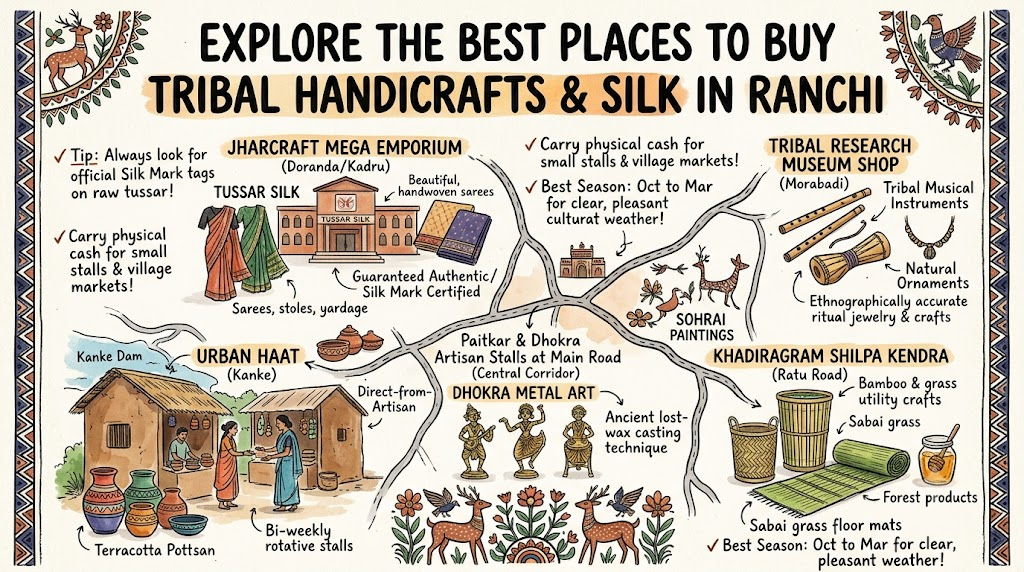
Jharcraft Mega Emporium (Kadru)
Spanning multiple expansive floors, the flagship Jharcraft Emporium at Kadru is Jharkhand’s premier institutional showcase for indigenous artisanship. Established by the state government to provide sustainable livelihoods to rural craftspeople, this emporium cuts out middlemen and features certified organic tussar silk, lost-wax brass, and intricate woodwork. The showroom is well-organized, with dedicated wings for handloom textiles, lifestyle decor, and traditional tribal apparel.
Walking through the curated galleries feels like visiting a design museum where every display item is available for ethical purchase. You will encounter genuine Kuchai silk yardage, brass sculptures hammered by artisan guilds from West Singhbhum, and rare woodcraft fashioned from local sal and gamhar timber. It is the gold standard for travelers who prioritize certification, fixed fair pricing, and artisan equity.
Handcrafted tribal art at Jharcraft. Source: www.jharcraft.in
- Location: Kadru Diversion Road, Doranda zone; roughly 3.5 km from Ranchi Railway Station.
- Why it is worth visiting: It provides guaranteed authentic Silk Mark certified fabrics and government-verified provenance for indigenous tribal craft traditions.
- Best things to do: Inspect the hand-reeled Kuchai Tussar sarees for natural sheen; browse the bell-metal lost-wax figurines; explore the organic lac jewelry showcase.
- Best time to visit: Late afternoon (3:00 PM to 6:00 PM) for unhurried browsing under good lighting.
- Ideal for whom: Discerning textile collectors, luxury ethical shoppers, and families seeking authenticated goods.
- Travel tip: Ask the floor manager for a Silk Mark authentication certificate if you purchase raw wild silk textiles.
Urban Haat (Kanke)
Urban Haat is a vibrant cultural village and craft pavilion situated along the quiet, scenic fringes of Kanke. Built to mirror traditional village architecture with mud-plastered facade aesthetics, this open-air complex features revolving stalls occupied directly by rural artisans who travel from remote corners of the state to demonstrate and sell their creations.
The atmosphere here is interactive and relaxed. You can sit beside a Sohrai artist as she dips date-palm twigs into natural red ochre and white kaolin clay, or watch a metal artisan carve wax wires for casting. Because the stalls rotate bi-weekly, every visit brings fresh regional specialties that you won’t find on regular commercial shelves.
- Location: Near Kanke Dam, northern Ranchi; approximately 11 km from Ranchi Junction.
- Why it is worth visiting: Direct, face-to-face transactions with rural artisans that eliminate retail markups entirely.
- Best things to do: Watch live craft demonstrations during state handloom weeks; pick up custom hand-painted terracotta vases; commission direct tribal portrait sketches.
- Best time to visit: Late winter afternoons (4:00 PM to 7:00 PM) when the open courtyards cool down.
- Ideal for whom: Cultural researchers, experiential shoppers, and slow travelers who enjoy interacting with makers.
- Travel tip: Carry plenty of physical cash, as the artisans’ digital payment apps often fail due to patchy rural bank servers.
Tribal Research Institute Museum Shop (Morabadi)
Nestled within the academic quietude of Morabadi, the museum store attached to the Dr. Ram Dayal Munda Tribal Welfare Research Institute is an intellectual treasure trove. Unlike commercial markets, this outlet focuses strictly on ethnographically accurate tribal musical instruments, ritual jewelry, hunting implements, and indigenous anthropological literature.
The collection features items made by indigenous groups like the Birhor, Santhal, and Asur. Here you will find ceremonial brass neck-collars (hansuli), single-string plucked instruments (banam), and hollow bamboo flutes carved to preserve oral melodies. It is a quiet, contemplative space that values cultural documentation above mass retail.
- Location: Morabadi grounds; roughly 6 km north of the city center.
- Why it is worth visiting: Unmatched historical accuracy and access to rare tribal musical instruments and specialized monographs.
- Best things to do: Inspect antique-patterned silver-wash brass ornaments; pick up hand-bound books on indigenous dialects; examine authentic hand-carved dance masks.
- Best time to visit: Mid-day weekdays (11:30 AM to 2:30 PM) when the academic staff is available for context.
- Ideal for whom: Ethnomusicology enthusiasts, cultural anthropologists, and serious antique seekers.
- Travel tip: Combine your visit with a self-guided tour through the adjacent institute museum to see how these artifacts are used in traditional ceremonies.
Paitkar & Dhokra Artisan Stalls at Main Road
Ranchi’s bustling commercial spine along Mahatma Gandhi Road (Main Road) hosts dedicated traditional artisan arcades tucked beneath the shadows of modern retail outlets. These legacy stalls focus on two of Jharkhand’s most celebrated art traditions: ancient Paitkar scroll paintings and primitive lost-wax Dhokra metalcraft.
Paitkar scroll painting is considered one of India’s oldest narrative folk painting traditions, depicting legends of the goddess Manasa and the afterlife using natural mineral and plant extracts. Alongside these scrolls, you will find Dhokra cast pieces that showcase traditional tribal motifs—stylized dancers, forest elephants, and sacred oil lamps crafted through a labor-intensive lost-wax technique.
Dhokra brass figures cast via lost-wax.
- Location: Central Main Road corridor (near GEL Church Complex); approximately 1.5 km from Ranchi Junction.
- Why it is worth visiting: Outstanding diversity of miniature cast-metal figures and narrative scroll paintings concentrated in one central walking corridor.
- Best things to do: Hunt for pocket-sized Dhokra animal talismans; pick up rolled Paitkar scrolls on handmade bark paper; compare brass bell alloys across multiple family-run stalls.
- Best time to visit: Morning hours (10:30 AM to 1:00 PM) before the narrow sidewalks become crowded with commuters.
- Ideal for whom: Souvenir hunters, backpackers short on transit time, and interior decorators looking for metal accent pieces.
- Travel tip: Carefully examine Dhokra pieces for weight; heavier items with fine wire detailing indicate higher wax precision and better alloy quality.
Khadiragram Shilpa Kendra (Ratu Road)
Tucked along the bustling Ratu Road corridor, this Khadi and Village Industries center preserves the Gandhian self-reliance model through indigenous tribal cottage industries. The cooperative brings together forest foragers, bamboo weavers, and potters from the rural outskirts of Ranchi district.
This is the ultimate destination for functional, sustainable bamboo and grasscraft. You will find sturdy bamboo laundry hampers, hand-woven sabai grass floor mats, unpolished sal leaf tableware, and seasonal forest products like wild honey, pure lac, and hand-milled arrowroot powder (tikhur).
- Location: Ratu Road shopping district; about 5 km northwest of Ranchi Railway Station.
- Why it is worth visiting: Exceptional collection of low-cost, eco-friendly bamboo items, natural grass utility craft, and wild forest produce.
- Best things to do: Buy tightly woven sabai grass baskets; browse natural handspun khadi shawls; purchase pure forest foraging derivatives like raw wild honey.
- Best time to visit: Early evening (4:30 PM to 6:30 PM).
- Ideal for whom: Eco-conscious consumers, minimalist home decorators, and zero-waste lifestyle enthusiasts.
- Travel tip: Sabai grass mats are moisture-resistant and very durable, making them great natural replacements for synthetic yoga mats.
Offbeat Exploration: Hidden Gems Tourists Miss
Amreshwar Dham Craft Clusters (Khunti Border)
While day-trippers head straight to the temple grounds, the surrounding village hamlets near the Khunti-Ranchi border host generational wood-carvers and lac turners working in open verandahs. These artisans transform fallen branches into rustic kitchen tools, combs, and lac-coated decorative eggs using hand-cranked wooden lathes. Visiting gives you a real look at rural craft production far beyond commercial showrooms.
Hazaribagh Road Sohrai Murals (Oriya Village Environs)
Take a short excursion north towards the outer Hazaribagh route to explore the rural village clusters where mud houses double as open-air art canvases. During local post-monsoon harvest cycles, women decorate their mud plaster walls with Sohrai art using wild cow dung coats, crushed stone ochre, and combs. Several village cooperatives now sell framed canvas versions of these mural designs directly from their homes.
Tupudana Lost-Wax Casting Pits
Located on Ranchi’s southern industrial periphery, the rural lanes of Tupudana hide small artisan foundries where Dhokra artisans fire their mud-encased beeswax molds in open pit kilns. Visiting these workshops lets you witness the complete lost-wax journey, from clay preparation to molten metal casting. It offers a rare, behind-the-scenes look at an ancient technique that finished showroom pieces rarely convey.
Detailed Practical Guidance for Travelers
| Destination | Standard Entry Fee | General Timings | Best Local Food Options Nearby | Recommended Nearby Attractions |
|---|---|---|---|---|
| Jharcraft Mega Emporium | Free | 10:30 AM – 8:00 PM (Closed Sundays) | Hot Dhuska & Ghugni stalls near Kadru Chowk | Doranda Old Cantonment, Tagore Hill |
| Urban Haat (Kanke) | ₹10 – ₹20 | 11:00 AM – 7:30 PM (Daily) | Fresh lake fish fry at Kanke Dam side shacks | Kanke Dam, Rock Garden, Patratu Valley |
| Tribal Research Museum Shop | ₹10 (Museum pass) | 10:30 AM – 5:00 PM (Closed Sundays) | Litti Chokha & Sattu drinks at Morabadi ground stalls | Morabadi Ground, Birsa Munda Park |
| Main Road Dhokra Arcades | Free | 11:00 AM – 9:00 PM (Daily) | Bihari & tribal snacks at GEL Church food stalls | Albert Ekka Chowk, Firayalal Market |
| Khadiragram (Ratu Road) | Free | 10:00 AM – 7:30 PM (Closed Sundays) | Traditional sweets (Thekua, Arsa) at Ratu Chowk | Pahari Mandir, Ranchi Lake (Bada Talab) |
Logistics & On-Ground Navigation
Local Transport Options
- Auto-Rickshaws (Shared & Reserve): Shared auto-rickshaws run fixed routes along major arteries like Main Road, Doranda, and Kanke for ₹10 to ₹30 per drop. You can also reserve them for half-day craft shopping trips (expect ₹400 to ₹700 after polite negotiation).
- E-Rickshaws (Totos): Best for short hops inside crowded market zones like Upper Bazar, Morabadi, and Ratu Road. They are whisper-quiet, maneuver easily through tight alleys, and cost just ₹10 to ₹20 per trip.
- Ride-Hailing Cabs (Ola/Uber): App-based cabs operate throughout central Ranchi, making them your most comfortable option for reaching outlying areas like Kanke Urban Haat and Tupudana.
- Private Car Rentals: Ideal if you want to combine craft-focused day trips with waterfall circuits like Hundru, Jonha, or Dassam. Expect fixed day rates between ₹1,800 and ₹3,200 depending on vehicle class and air conditioning.
Budget Planning
- Budget / Backpacker Tier: Expect to spend ₹1,200 to ₹2,200 per day. This covers a modest guesthouse near Station Road (₹800 to ₹1,200), shared auto-rickshaw transit (₹150), and street-side meals of dhuska, litti, and rice thalis (₹300 to ₹400), leaving the rest of your budget for small craft purchases.
- Mid-Range / Comfort Tier: Expect to spend ₹4,500 to ₹8,000 per day. This includes a comfortable 3- or 4-star hotel along Main Road or Morabadi (₹3,000 to ₹5,500), dedicated app cabs for city travel (₹1,000 to ₹1,500), comfortable sit-down regional dining (₹800 to ₹1,200), and admission passes.
Safety and Inclusivity Tips
- For Families: The city is generally welcoming and peaceful for family groups. Stick to well-lit shopping complexes like Jharcraft and Urban Haat when traveling with children or elders to avoid the chaotic pedestrian traffic of Upper Bazar.
- For Couples: Ranchi’s parks, craft spots, and lakeside promenades are safe and customary for couples. Dress modestly (covering shoulders and knees) when exploring rural artisan pockets and sacred tribal sites to respect local sensibilities.
- General Safety: Ranchi boasts lower street crime rates than many larger metropolitan centers. Keep your wallets and phones secure in crowded market lanes around Firayalal and Main Road, and avoid navigating poorly lit suburban roads late at night.
Strategic Travel Planning Guardrails
Travel Planning Tips for Ranchi
- Target the Winter Window: Plan your craft shopping trip between October and February when dry skies and cool weather (10°C to 25°C) make open-air haats a pleasure to explore.
- Balance Digital and Cash Wallets: While government emporiums accept cards and UPI, independent street artisans and weekly village haat vendors rely exclusively on crisp cash notes.
- Verify Tussar Silk Credentials: Always look for the official government-backed Silk Mark tag on raw tussar yardage to confirm you’re buying authentic hand-reeled yarn rather than imported synthetic blends.
- Time Weekly Rural Haats: Check local neighborhood schedules for weekly markets (like Morabadi on Wednesdays and Saturdays) to purchase utility bamboo baskets and raw terracotta directly from craftspeople.
- Pack Protective Wrapping: If you plan on purchasing delicate terracotta figurines, Sohrai mud plates, or fragile lost-wax castings, bring bubble wrap or soft storage pouches in your daypack.
Common Mistakes to Avoid
- Over-Bargaining with Rural Artisans: Avoid aggressive haggling over small sums with independent tribal craftspeople. The prices for hand-cast brass and hand-woven grass reflect weeks of manual labor.
- Assuming Consistent Sunday Openings: Many official handloom retail hubs, research emporiums, and cooperative stores remain closed on Sundays. Always double-check operating hours before heading out.
- Confusing Commercial Replicas with Authentic Craft: Skip generic souvenir shops selling machine-pressed brass figurines imported from other states. Insist on authentic, locally crafted Jharkhand Dhokra.
- Skipping the Street Food Stalls: Don’t limit your meals to generic hotel dining rooms. Missing out on freshly fried dhuska with spicy black chana curry means skipping half the city’s living culture.
- Overpacking Single-Day Agendas: Don’t try to cram far-flung waterfalls and urban handicraft markets into a single afternoon. Heavy cross-town traffic along Ratu Road and Main Road can easily derail rushed itineraries.
Suggested Itinerary Blueprints
1. Day Quick Dash (The Artisan Heritage Express)
Target Audience: Business travelers, airport transit passengers, or rapid weekenders.
- Morning (09:30 AM – 01:00 PM): Start your morning at the Tribal Research Institute Museum & Shop in Morabadi to understand tribal iconography. Walk across to the Morabadi stalls for warm, roasted litti chokha and fresh seasonal juice.
- Afternoon (02:00 PM – 05:00 PM): Take an auto-rickshaw south to the Jharcraft Mega Emporium at Kadru. Spend an unhurried couple of hours browsing certified Kuchai tussar silk fabrics, handloom yardage, and museum-grade Dhokra statues.
- Evening (05:30 PM – 08:00 PM): End your day exploring the Main Road Dhokra Arcades near GEL Church Complex. Pick up small brass keepsakes and hand-painted scrolls before catching dinner nearby.
2. Day Deep-Dive (Textiles, Metal & Living Culture)
Target Audience: Textile collectors, culture enthusiasts, and conscious interior decorators.
- Day 1: Handlooms & Urban Craft Hubs
- Morning: Tour the Jharcraft Mega Emporium in Kadru to learn how tussar silk is extracted and woven, picking up certified handlooms.
- Lunch: Head to Main Road for a traditional thali featuring wild leafy greens (saag) and bamboo shoot curry.
- Afternoon to Dusk: Explore the open-air courtyards at Urban Haat (Kanke). Meet visiting rural artisans, watch craft demonstrations, and enjoy scenic views of Kanke Dam at sunset.
- Day 2: Earth Murals, Bamboo & Village Metalcraft
- Morning: Visit the Khadiragram Shilpa Kendra on Ratu Road to pick up lightweight sabai grass baskets and woven bamboo home goods.
- Afternoon: Take an excursion to the rural foundries of Tupudana or the artisan clusters near Khunti to see lost-wax casting and natural wood turning in action.
- Evening: Wrap up with an evening stroll around Tagore Hill, soaking in the sunset views across the plateau.
3. Complete Weekend Travel Plan (The Master Craft & Plateau Circuit)
Target Audience: Experiential travelers seeking a complete blend of city crafts, food, and plateau geography.
- Friday (Arrival & Urban Orientation):
- Arrive in Ranchi, check into your hotel, and begin with an evening orientation walk around Morabadi Ground.
- Browse local seasonal markets and visit the Tribal Research Institute Museum Shop for an introduction to local art history.
- Saturday (The Master Shopping Loop):
- Dedicate your morning to serious textile shopping at Jharcraft Mega Emporium (Kadru).
- Enjoy a mid-day street food break featuring dhuska-ghugni and sweet mithai.
- Spend your late afternoon browsing rotating artisan stalls at Urban Haat (Kanke), followed by a relaxing dinner by Kanke Lake.
- Sunday (Foundries, Waterfalls & Farewell):
- Hire a private cab for a morning excursion out to Dassam Falls or Jonha Falls, taking in the Chota Nagpur Plateau’s dramatic escarpments.
- On your way back, stop by rural road stalls for terracotta planters and unpolished stone mortar pestles.
- Finish your trip with a quick stop at the Main Road Dhokra Arcades for last-minute gifts before heading to the airport or railway station.
Common Tourist Mistakes to Avoid
Geographic Blunders
A frequent logistical mistake is attempting to visit northern attractions (like Kanke Dam and Urban Haat) and southern excursions (like Dassam Falls or Tupudana foundries) within the same afternoon. Ranchi’s cross-city traffic moves slowly through central nodes like Albert Ekka Chowk, so group your activities into distinct northern and southern days.
Commercial Traps
Many travelers spend their souvenir budgets inside modern, multi-story shopping malls along Circular Road, walking away with generic brass items mass-manufactured in distant industrial centers. Seek out certified state outlets or community-run stalls instead; commercial gift shops rarely carry authentic, handmade tribal art.
Neglecting Modern/Alternative Zones
Don’t focus solely on the older, hectic commercial cores like Upper Bazar. Take time to explore Ranchi’s newer, greener neighborhoods, including the wide avenues around Morabadi, the quiet lakeside cafes near Kanke, and the artistic spaces that frequently host live tribal cultural performances.
Transport Overpayment
Unmetered auto-rickshaws stationed right outside the main railway station exit gates often quote inflated flat rates to newcomers. To avoid overpaying, step a short distance past the station plaza to flag down a shared auto, or use app-based services like Ola and Uber to check standard rates before negotiating.
Luxury Dining Bias
Confining your meals to air-conditioned hotel restaurants deprives you of Ranchi’s true culinary personality. The soul of local dining lives in modest street-side stalls where hot, savory dhuska is fried to order and seasonal delicacies like stir-fried rugda mushrooms or tender bamboo shoots (karil) are served fresh.
Local Food Secret: Visit local eateries between July and September to sample rugda—a wild, subterranean puffball mushroom foraged from deep within local sal forests. It has an earthy, savory flavor profile that rival the finest truffles.
Frequently Asked Questions
1. Where is the most reliable place to buy certified Tussar silk in Ranchi?
The most reliable destination is the state-run Jharcraft Mega Emporium located on Kadru Diversion Road. They carry authentic, Silk Mark-certified Kuchai Tussar silk sarees, hand-reeled stoles, and unstitched fabric lengths sourced directly from local weaver cooperatives across Jharkhand, eliminating counterfeit synthetic blends.
2. How can I differentiate authentic Dhokra metalcraft from machine-made replicas?
Authentic Dhokra uses the traditional lost-wax technique, meaning every piece is unique with subtle handcrafted variations. Look for delicate, twisted wax-thread detailing, a slightly irregular rustic surface, solid heft, and the absence of sharp, uniform industrial seam lines found on factory-stamped brass trinkets.
3. What are the typical operating hours for handicraft markets across Ranchi?
Most permanent emporiums and shopping complexes operate from 10:30 AM to 8:00 PM. Independent street vendors along Main Road usually set up by 11:30 AM and pack up around 9:00 PM. Be aware that state-run emporiums and cooperative centers remain closed on Sundays.
4. Are credit cards and UPI digital payments widely accepted by tribal artisans?
Large state-run showrooms and established private handicraft stores accept all major credit cards, debit cards, and UPI apps. However, small street-side artisans, weekly market vendors, and rural cottage workers rely primarily on physical cash due to spotty bank network connections.
5. What is special about Jharkhand’s indigenous Sohrai and Khovar paintings?
Sohrai and Khovar are ancient, GI-tagged mural art traditions practiced by indigenous women. Khovar celebrates matrimonial unions using black and white mud coats, while Sohrai celebrates post-harvest fertility with earthy red, yellow, and black natural ochres, depicting sacred cattle, forest flora, and wild animals.
6. Can I visit rural artisan villages around Ranchi to watch craftsmen at work?
Yes, you can arrange day visits to nearby artisan pockets like Tupudana for Dhokra metal casting or rural Khunti for traditional lac work and wood carving. It is best to hire a reliable local driver or guide who understands regional dialects and rural etiquette.
7. Is bargaining acceptable when shopping for handicrafts in Ranchi?
Fixed-price government emporiums like Jharcraft and Khadi Gramodyog do not allow bargaining. In open street markets and private stalls, polite bargaining is acceptable, but travelers should avoid aggressive haggling with independent artisans whose prices already reflect long hours of skilled manual labor.
8. What unique edible forest souvenirs can I purchase alongside handicrafts?
Alongside textiles and metalcraft, look for wild sal forest honey, organic lac, cold-pressed mustard oil, and dried forest delicacies like tikhur (arrowroot powder) and mahua flower concentrates at Khadiragram and certified tribal cooperative outlets across the city.
9. What is the safest way to transport fragile terracotta and metal souvenirs home?
Most government emporiums can provide basic paper wrapping, but independent stalls pack items simply with newspapers. It is best to pack fragile terracotta tiles and Dhokra figurines inside your carry-on luggage wrapped in bubble wrap or cushioned between thick clothing.
10. What is the best season to explore outdoor craft bazaars and cultural fairs in Ranchi?
The best time to visit is during the pleasant winter season from October through March. Days are clear and comfortable with temperatures between 10°C and 25°C, making it ideal for walking through open-air craft villages, outdoor weekly haats, and seasonal cultural expos without intense heat.
11. Are language barriers common when dealing with local craftspeople in Ranchi?
Most artisans and store managers speak and understand Hindi fluently, and many understand basic English. In deeper rural craft hamlets, older artisans may communicate primarily in regional languages like Sadri, Mundari, or Kurukh, though a warm smile and gestures always work wonders.
12. How do my handicraft purchases benefit the local indigenous communities?
Buying your crafts from government-run emporiums, artisan fairs, and village workshops channels funds straight back to the makers. This fair-trade support sustains traditional livelihoods, prevents rural distress migration, and encourages younger generations to keep these ancient artistic traditions alive.
Conclusion
Choosing to explore Ranchi’s tribal artisan quarters instead of typical tourist hubs rewards you with something far more lasting than standard vacation photos: an intimate connection with ancient living traditions. Each roll of wild tussar silk, hand-hammered Dhokra figurine, and earthen Sohrai painting carries the quiet wisdom of Jharkhand’s forests and the resilient spirit of its indigenous peoples. When you pack your bags to head home, you carry forward pieces of living history—tangible stories cast in metal and woven from the soil that will anchor your memories of this plateau long after your journey ends.
