Introduction
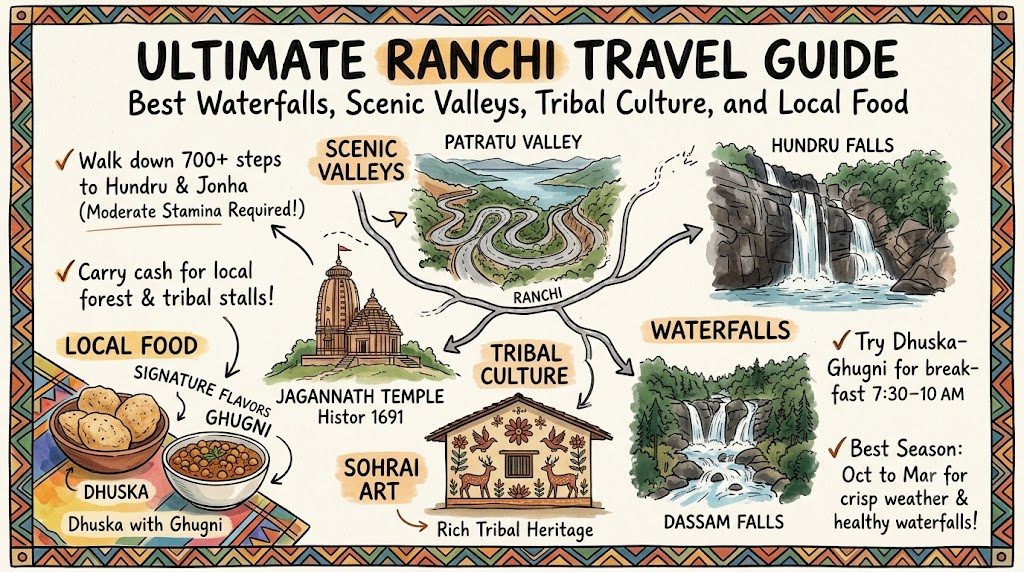
Far away from the manicured, overcrowded tourist corridors of North India and the commercialized beach shacks of the coast lies Ranchi—a destination that breathes with genuine, unhurried vitality. While mainstream vacation spots drown under tour buses, selfie queues, and aggressive souvenir hawkers, Jharkhand’s capital offers an untamed balance of primordial wilderness, tribal roots, and grounded urban warmth.
Here, the scent of petrichor mingles with woodsmoke, roasted sal seeds, and simmering mustard oil across sun-drenched plateau mornings. Exploring Ranchi means peeling back centuries of vibrant indigenous traditions, where age-old handicrafts, sacred groves, and cascading rivers exist in effortless harmony alongside a modern, evolving city center.
Why Ranchi is a must-visit city
Perched at an elevation of 651 meters upon the mineral-rich Chota Nagpur Plateau, Ranchi serves as both an ecological haven and the cultural crossroads of eastern India. The city carries profound historical weight as the bedrock of indigenous resilience, forever intertwined with the legacy of tribal freedom fighter Bhagwan Birsa Munda. Geologically blessed with an undulating tableland landscape, Ranchi creates a natural amphitheater of dramatic escarpments, ancient deciduous forests, and perennial river gorges that plunge off plateau shelves to form world-renowned waterfalls.
Practical accessibility is seamless across traveler demographics. The Birsa Munda Airport (IXR) links directly to major domestic hubs including Delhi, Kolkata, Bengaluru, and Mumbai, while Ranchi Junction connects major trunk railway routes. State and national expressways offer scenic blacktop approaches from West Bengal, Odisha, and Bihar, supported by a spectrum of hospitality ranging from heritage forest rest houses to modern business hotels.
The regional travel circuit fans out radially from the central urban core:
- The Eastern Cascades Circuit: Covering the spectacular cascade drops along the Subarnarekha and Kanchi river basins.
- The Southern Heritage Belt: Centered around 17th-century terracotta-and-stone temples, handloom clusters, and biodiversity parks.
- The Northern Ridge & Valleys: Featuring sweeping ghat passes, serpentine valleys, and serene reservoir backwaters.
| Metric / Fact | Details |
| Geographic Zone | Chota Nagpur Plateau, Jharkhand |
| Altitude | 651 meters (2,136 ft) above sea level |
| Ideal Season | October to March (Pleasant daytime temperatures: 15°C to 25°C) |
| Transit Hubs | Birsa Munda Airport (IXR), Ranchi Junction (RNC) |
| Signature Craft | Sohrai & Khovar art, Dokra brass metal craft, bamboo basketry |
| Signature Flavors | Dhuska with Ghugni, Chilka Roti, Pitha, Rugra, and Bamboo Shoot curries |
Best Places or Experiences
Hundru Falls
Carved by the relentless power of the Subarnarekha River, Hundru Falls represents one of Jharkhand’s most striking geological wonders. Falling from a sheer height of 98 meters (322 feet), the cascade thunders down polished metamorphic granite rock steps into a foaming, emerald-tinted basin below. Over millennia, the force of the water has hollowed out fascinating geological potholes, smooth stone amphitheaters, and distinct rock shelves that resemble natural sculptures.
Surrounding the falls is a dense canopy of sal and teak forests, which paint the entire gorge in deep forest green during the post-monsoon months. Walking down the winding flight of over 700 stairs brings you face-to-face with an exhilarating spray mist, while the roaring acoustics of the falling water reverberate across the forested valley walls.
- Location: Ormanjhi-Purulia Road, Ranchi District; roughly 45 km northeast of Ranchi city center.
- Why it is worth visiting: It is India’s 34th highest waterfall, offering jaw-dropping granite chasm formations and dramatic seasonal water volumes.
- Best things to do: Descend the 700-step staircase to view the natural plunge pool, photograph the dramatic granite canyon rims, and sample hot spiced tribal roasted corn at the upper stalls.
- Best time to visit: October to February for clear blue skies and safe water currents; arrive between 8:00 AM and 11:00 AM for soft morning light.
- Ideal for whom: Nature photographers, trekking enthusiasts, and adventure-seeking travelers.
- Travel tip: Wear sturdy, high-grip shoes; moss on the lower river rocks can be extremely slick, and entering the turbulent plunge pool is strictly prohibited.
Patratu Valley and Dam
Descending from the Ranchi plateau toward the Ramgarh plains, the Patratu Valley offers an engineering marvel wrapped in lush wilderness. A ribbon of smooth black tarmac snakes down steep hillsides through more than two dozen dramatic hairpin turns, framed by forested ridges and dramatic cliffs. Designed to deliver panoramic valley vistas at every switchback, the drive down this ghat section ranks among eastern India’s most breathtaking motoring stretches.
At the base of the ghat rests the sprawling expanse of Patratu Lake, fed by the Nalkari River. Modern waterfront promenades, landscaped recreational island parks, and thrilling boating facilities transform the valley into a refreshing lakeside escape where fiery sunsets reflect over calm reservoir ripples.
- Location: Patratu Ghat, Ramgarh-Ranchi border; approximately 38 km north of Ranchi Junction.
- Why it is worth visiting: It features high-thrill serpentine hairpin drives combined with peaceful waterfront vistas and watersports.
- Best things to do: Cruise along the ghat road for landscape photography, take a speedboat or pedal boat to the central reservoir islands, and stroll the illuminated promenade at sunset.
- Best time to visit: October to March; plan your arrival between 3:30 PM and 5:30 PM to experience the golden hour over the ghats.
- Ideal for whom: Road-trip lovers, motorcycle tourers, couples, and leisure weekenders.
- Travel tip: Descend before twilight; while the upper viewpoints feature illumination, heavy evening mist can settle quickly along the hairpin corners during winter.
Dassam Falls
Locally called Dassam Ghagh, this natural cascade along the Kanchi River drops from an elevation of 44 meters (144 feet). The indigenous Mundari term Da-song—meaning “the pouring of water”—aptly captures how the river divides into ten distinct torrents that vault simultaneously over jagged basalt cliffs. The thunderous roar of the divided torrents echoes through the surrounding mixed-deciduous forest.
The approach involves a well-maintained staircase path descending through scenic forest clearings. Below, natural viewing balconies constructed on rock outcrops provide dramatic sightlines of the churning, froth-filled basin, highlighting the raw kinetic energy of the Kanchi River.
- Location: Near Taimara village, Bundu; roughly 40 km southeast of Ranchi along the Ranchi-Tata Highway (NH 33).
- Why it is worth visiting: It is a rare nick-point waterfall where ten distinct torrents tumble simultaneously over step-like rock structures.
- Best things to do: Watch the cascading streams from the canyon overlook, observe wild forest flora on the descend path, and visit roadside dhabas for fresh dhuska and chana.
- Best time to visit: September to January; visit between 9:00 AM and 1:00 PM when the sunlight illuminates the canyon floor.
- Ideal for whom: Geologists, family day-trippers, and solitude seekers.
- Travel tip: The water current here hides deep, treacherous underwater rifts; respect boundary railings and do not attempt to swim in the gorge.
Jagannath Temple
Constructed in 1691 by King Thakur Ani Nath Shahdeo of the Barkagarh estate, the Jagannath Temple stands atop a hillock overlooking the south-western plains of Dhurwa. Architecturally styled as a smaller cousin of the sacred Jagannath Temple of Puri, this hilltop sanctuary features imposing stone towers (shikhara) adorned with traditional Kalinga-style relief carvings. The complex is accessed via a flight of carved stone steps or a winding motorable lane.
The temple serves as a cultural anchor for the city. During the annual Rath Yatra festival in the monsoon month of Ashadha, tens of thousands of devotees assemble here to pull massive wooden chariots carrying deities Jagannath, Balabhadra, and Subhadra. The surrounding courtyards provide sweeping panoramic views of Ranchi’s cityscape, nearby dams, and rural countryside.
- Location: Jagannathpur, Dhurwa; 11 km southwest of Albert Ekka Chowk, Ranchi.
- Why it is worth visiting: It is a 330-year-old historic Kalinga-style hilltop shrine with cultural significance and 360-degree skyline views.
- Best things to do: Study the 17th-century masonry and shrines, take in panoramic sunset views over Dhurwa Dam from the parapet walls, and participate in the evening aarti ceremony.
- Best time to visit: Throughout the year, especially July for the historic Rath Yatra festival; daily between 5:30 AM to 11:30 AM and 4:00 PM to 7:30 PM.
- Ideal for whom: Heritage travelers, architecture buffs, and spiritual pilgrims.
- Travel tip: Remove footwear at the lower terrace; during midday heat, the stone courtyard slabs can warm up quickly, making early morning or late afternoon the most comfortable times to walk around.
Jonha Falls (Gautam Dhara)
Named after Gautama Buddha—who, according to regional legend, bathed in these sacred waters during his ascetic wanderings—Jonha Falls is a serene hanging valley waterfall. Formed where the tributary Gunga River plunges 43 meters down to meet the Raru River, this two-tiered waterfall cascades gracefully over broad rock tiers into a wide, forest-lined pool.
To reach the base, travelers walk down approximately 700 steps through quiet groves of flowering trees and sal woods. Adjacent to the falls stands an ancient Buddhist ashram and temple, which lends an aura of monastic calm and contemplative stillness to the surrounding forested river banks.
- Location: Jonha Village, off the Ranchi-Purulia Road; roughly 42 km east of Ranchi city.
- Why it is worth visiting: It combines unique hanging valley geology with Buddhist heritage and peaceful forest walking trails.
- Best things to do: Ring the ceremonial bells at the hilltop Buddhist temple, explore the terraced lower pool shelves, and pick up wild honey from local forest cooperative stalls.
- Best time to visit: October to February; arrive between 8:30 AM and 11:30 AM for quiet conditions before day-tripper groups arrive.
- Ideal for whom: Cultural seekers, photographers, and trekkers.
- Travel tip: The climb back up the 700 steps requires moderate stamina; stay hydrated and carry water bottles from the vendor huts at the top.
Tagore Hill (Morabadi)
Rising 300 feet above the northern plains of Morabadi, Tagore Hill (known locally as Morabadi Hill) is an iconic literary and historical sanctuary. In 1912, Jyotirindranath Tagore—the elder brother of Nobel laureate Rabindranath Tagore—fell in love with the hill’s serenity, building his retreat Shanti Dham and the open-air pavilion Brahma Mandir atop the granite outcrop. Rabindranath himself visited the site, finding poetic inspiration in Ranchi’s cool breezes and sweeping plateau views.
Today, the heritage buildings sit surrounded by fragrant frangipani, rock gardens, and stone staircases. Climbing to the top rewards travelers with uninterrupted vistas of Ranchi’s urban canopy to the south and distant green ridges to the north.
- Location: Morabadi, Ranchi; around 5 km north of Ranchi Junction.
- Why it is worth visiting: A peaceful heritage landmark blending Bengali Renaissance history with vantage points over the city.
- Best things to do: Explore the restored Brahma Mandir pavilion, stroll the peaceful gardens at the base, and enjoy unobstructed sunrise views over the city.
- Best time to visit: Year-round; 6:00 AM to 8:30 AM for cool morning breezes and birdwatching, or 5:00 PM to 6:30 PM for sunsets.
- Ideal for whom: Literature enthusiasts, solo travelers, and casual walkers.
- Travel tip: Combine this with a morning walk across the expansive Morabadi Ground and a quick breakfast at local stalls serving hot litti-chokha.
Offbeat Exploration: Hidden Gems Tourists Miss
McCluskieganj: The Forgotten Anglo-Indian Hamlet
Tucked into rolling pine and sal country 60 km northwest of Ranchi, McCluskieganj is a surreal time capsule. Founded in the 1930s by businessman Timothy McCluskie as a homeland for Anglo-Indians, this quiet forest settlement still retains sprawling colonial brick bungalows with wooden dormers, wrap-around verandas, and mossy stone churches. Walking down its shaded gravel lanes feels like stepping into an old period novel, especially when the winter sun filters through eucalyptus leaves.
Sita Falls & The Silent Riverbed of Radhu
While crowds flock to Hundru and Dassam, few venture an additional 12 km off the beaten path near Jonha to discover Sita Falls. Fed by the crystal-clear currents of the Radhu River, this secluded waterfall cascades over stepped boulders into a serene, shallow basin surrounded by quiet forests. The lack of commercial shops preserves the pure sounds of wilderness—bird calls, rustling leaves, and rushing water.
The Megaliths of Chokahatu
Located south of Ranchi near Sonahatu, Chokahatu is one of India’s largest and most intriguing prehistoric megalithic burial grounds. Spread across acres of open terrain are hundreds of massive vertical stone menhirs and horizontal dolmens erected by the indigenous Munda community over several centuries. Each stone represents a memorial marker for departed ancestors, offering travelers a rare glimpse into living megalithic traditions practiced continuously since the Iron Age.
Detailed Practical Guidance for Travelers
| Destination | Standard Entry Fee | General Timings | Best Local Food Options Nearby | Recommended Nearby Attractions |
| Hundru Falls | ₹15 per person | 6:00 AM – 5:30 PM | Hot Dhuska-Ghugni & roasted maize at upper vendor stalls | Getalsud Dam, Sita Falls |
| Patratu Valley | Free (Boating ₹100–₹400) | 24 Hours (Boating: 9:00 AM – 6:00 PM) | Lakefront resorts serving chicken curry & fish fry | Patratu Dam Promenade, Kanke Dam |
| Dassam Falls | ₹15 per person | 7:00 AM – 5:00 PM | Highway dhabas along NH 33 serving Litti Chokha | Surya Mandir (Bundu), Deori Temple |
| Jagannath Temple | Free (Parking ₹20) | 5:30 AM – 11:30 AM, 4:00 PM – 7:30 PM | Traditional sweets (Thekua, Peda) around the entrance gate | Dhurwa Dam, JSCA International Stadium |
| Jonha Falls | ₹15 per person | 7:00 AM – 5:00 PM | Local tea stalls with Chilka Roti and potato curry | Gautam Buddha Ashram, Sita Falls |
| Tagore Hill | Free | 6:00 AM – 6:30 PM | Morabadi street vendors offering Jhalmuri and lemon tea | Morabadi Ground, Ranchi Rock Garden |
Logistics & On-Ground Navigation
Local Transport Options
- Cab Rentals (Best for Cascades & Valleys): Outstation taxis and app-based cabs (Ola, Uber) operate widely within urban Ranchi. For trips outside the center to Hundru, Dassam, or Patratu, book full-day private cabs with fixed-rate packages through local operators or car-hire desks.
- Auto-Rickshaws & E-Rickshaws (Tuk-Tuks): Within the city center, shared and private auto-rickshaws provide an efficient way to travel between Main Road, Albert Ekka Chowk, Morabadi, and Doranda. Green battery-powered e-rickshaws run frequent short-hop routes along Main Road.
- Rail Networks: Broad-gauge rail links Ranchi Junction and Hatia to nearby regional stations like Jonha and McCluskieganj, offering an economical, slow-travel alternative for rural day trips.
- Two-Wheeler Rentals: Several local rental outfits near the railway station provide geared motorcycles and scooters on daily rates (valid Indian Driving License and security deposit required).
Budget Planning
- Backpacker / Solo Explorer Tier (₹1,000 – ₹1,800 per day):
- Stay in budget guesthouses or hostels near Station Road or Morabadi (₹600–₹1,000/night).
- Use shared auto-rickshaws, public buses, and occasional e-rickshaws (₹150–₹250/day).
- Enjoy authentic regional meals like dhuska, litti, and thalis at market dhabas (₹250–₹450/day).
- Entry tickets and state park fees (₹50–₹100/day).
- Mid-Range / Comfort Tier (₹3,500 – ₹7,000 per day):
- Stay in comfortable 3-star or 4-star boutique hotels around Lalpur, Kadru, or Dhurwa (₹2,200–₹4,200/night).
- Private dedicated air-conditioned hatchback or sedan for waterfall circuits (₹1,800–₹2,500/day).
- Dine at specialty regional restaurants like Ajam Emba and contemporary cafes (₹700–₹1,200/day).
- Boating experiences and guided village walks (₹300–₹600/day).
Safety and Inclusivity Tips
- For Families: Stick to well-developed waterfalls like Hundru or Patratu Dam where safety railings, broad staircases, and family dining facilities are available. Keep children back from wet rock ledges.
- For Couples: Quiet spots like Tagore Hill, Patratu Lake, and Dhurwa Dam promenade are pleasant for romantic sunsets. Avoid lingering in isolated forest spots after sunset.
- General Safety: Return to the central city ring roads before 8:00 PM when exploring remote waterfall routes. Avoid entering swirling river currents or climbing across damp boulders near plunge pools.
Strategic Travel Planning Guardrails
Travel Planning Tips for Ranchi
- Plan Around Seasonal Windows: The sweet spot falls between October and March, when days are sunny and crisp, and waterfall volumes remain healthy.
- Keep Cash on Hand: While UPI payments (Google Pay, PhonePe, Paytm) work at most urban stores, deep canyon stalls, village shops, and entry booths near Dassam and Jonha experience patchy cell service.
- Book Vehicles Early on Weekends: Saturday and Sunday see local weekend getaways toward Patratu and Hundru. Reserve private rental cabs at least 24 hours in advance.
- Respect Sacred Tribal Heritage: Sarna groves (Jaherthan) and burial grounds (Sasandiri) carry profound spiritual meaning for local Munda, Oraon, and Santhal communities. Never litter or disturb ceremonial stone markers.
- Pack Layered Clothing: Winter evenings drop quickly to 8°C–12°C across the plateau. Pack a light windbreaker or fleece, along with high-traction walking shoes for waterfall steps.
Common Mistakes to Avoid
- Overpacking Geographically Split Circuits: Do not try visiting Dassam (in the southeast) and Patratu (in the far north) on the same day; cross-city traffic will consume your afternoon.
- Assuming Constant Mobile Data: Navigation apps can drop signal along forest roads between Ormanjhi and Hundru. Download offline maps before departing your hotel.
- Skipping Indigenous Gastronomy: Sticking only to standard hotel multi-cuisine menus misses out on Ranchi’s unique culinary offerings, such as dhuska, wild mushrooms, and bamboo-shoot dishes.
- Underestimating Physical Demands: Cascades like Hundru and Jonha require climbing 600 to 700 steep steps back to parking areas; budget your stamina accordingly.
- Ignoring Local Forest Regulations: The Chota Nagpur forests are protected eco-zones. Never drive off-trail or play loud music along designated forest reserves.
Suggested Itinerary Blueprints
1. Day Quick Dash (The Plateau Highlights Circuit)
Target Audience: Business travelers, quick weekend layovers, and fast-paced explorers.
- Morning (8:00 AM – 12:00 PM): Depart early for Hundru Falls. Walk down the granite ravine, capture dramatic photos of the cascade, and grab a hot breakfast of roadside dhuska and chai.
- Afternoon (1:00 PM – 4:00 PM): Return to the city for an authentic indigenous thali lunch at Ajam Emba. Afterwards, visit the 17th-century Jagannath Temple on Barkagarh hill.
- Evening (4:30 PM – 7:30 PM): Climb Tagore Hill to enjoy panoramic views across Morabadi as dusk settles over the city.
2. Day Deep-Dive (Waterfalls & Serpentine Valleys)
Target Audience: Road-trippers, photography lovers, and nature enthusiasts.
- Day 1: The Cascades of the South-East
- Morning: Drive out along NH 33 to Dassam Falls. Walk the nature trail and view the ten-stream cascade across the Kanchi River gorge.
- Midday: Head over to Jonha Falls, visit the quiet Buddhist monastery, and relax under the shaded forest canopies along the river.
- Evening: Return to the city center via the old Purulia road. Browse handicrafts at Jharcraft on Main Road for Sohrai tribal paintings and Tussar silk.
- Day 2: The Northern Hills and Scenic Ghats
- Morning: Head out to Rock Garden and stroll the landscaped paths overlooking Kanke Dam.
- Afternoon: Drive down through the winding hairpin turns of Patratu Valley. Enjoy a late lunch and take a boat ride across Patratu Lake.
- Evening: Capture sunset over the serpentine ghat turns from the upper viewing balconies before heading back to Ranchi.
3. Complete Weekend Travel Plan (The Grand Cultural & Eco Loop)
Target Audience: Comprehensive vacationers seeking an all-inclusive Jharkhand experience.
- Friday: Arrival & Local Culture
- Arrive via Birsa Munda Airport or Ranchi Junction. Check in to your hotel.
- Spend the late afternoon walking around Morabadi Ground and climbing Tagore Hill.
- Explore local street food along Old Commissioner’s Compound and Circular Road.
- Saturday: Nature & Scenic Waterways
- Dedicate the entire morning to Hundru Falls and a scenic lakeside stop at Getalsud Dam.
- Spend the afternoon driving along the sweeping hairpin bends of Patratu Valley.
- Enjoy an evening motorboat cruise around Patratu Lake, returning to Ranchi for dinner.
- Sunday: Heritage, Handicrafts & Departures
- Visit Jagannath Temple for early-morning peaceful views over the city plateau.
- Stop by tribal artisan markets to pick up Dokra brass sculptures, bamboo crafts, and fresh forest produce.
- Wrap up your trip with lunch in Lalpur before your departure flight or train.
Common Tourist Mistakes to Avoid
Geographic Blunders
A frequent mistake made by first-time visitors is trying to group Patratu Valley and Dassam Falls into an identical single-day plan. These sites sit on opposite sides of Ranchi—Dassam is 40 km to the southeast toward Jamshedpur, while Patratu lies nearly 40 km to the north. Driving across city traffic to connect both wastes hours inside your car; always divide your days cleanly into northern, southeastern, and central clusters.
Commercial Traps
Spending precious holiday time in generic retail shopping complexes or multi-story glass malls robs your trip of authenticity. The heart of Ranchi lives across its open-air haats and artisan centers like Jharcraft and the tribal bazaars near Daily Market. Skipping these means missing out on genuine handwoven Tussar silk, Sohrai wall motifs, and Dokra cast metalwork made by generational craftsmen.
Neglecting Modern and Alternative Zones
Many travelers view Ranchi solely as a base for day trips to waterfalls, overlooking the vibrant community life of its residential and creative neighborhoods. Places like Morabadi, Kanke, and quiet lanes near Doranda are home to relaxed tree-lined cafes, botanical paths, artisan studios, and lively morning exercise culture. Taking a couple of hours for an unhurried morning stroll through these green residential districts offers a genuine look at local everyday life.
Transport Overpayment
Unregulated private cab drivers and auto stands near railway terminals frequently overquote fares to arriving visitors. Avoid agreeing to the first flat-rate price you are quoted. Cross-check distances and standard rates using your ride-hailing apps, or arrange car rentals through your hotel front desk or verified travel operators with clear per-kilometer or half-day terms.
Luxury Dining Bias
Dining strictly inside high-end hotel restaurants prevents you from enjoying Jharkhand’s distinctive flavors. Dishes like fresh, piping-hot Dhuska dipped in spiced chickpea curry (ghugni), flaky pan-grilled Chilka Roti, seasonal forest Rugra mushrooms, and roasted Litti-Chokha are best enjoyed at buzzing local stalls and authentic regional kitchens like Ajam Emba.
Local Food Secret: Seek out fresh Dhuska prepared with fermented rice-and-dal batter early in the morning between 7:30 AM and 10:00 AM, when cauldrons of mustard oil are at their freshest.
Frequently Asked Questions
1. What is the best season to explore the waterfalls in Ranchi?
The most rewarding time to experience Ranchi’s cascades is from October to February. During these post-monsoon and winter months, the rivers maintain healthy water levels from the monsoon rains while the weather stays crisp and pleasant, with sunny days averaging between 15°C and 25°C.
2. How do I travel safely to remote waterfalls like Hundru and Dassam?
Book a dedicated private cab for the entire duration of your day trip rather than relying on one-way drop-offs. Make sure you depart waterfall parking areas well before sunset, stick strictly to marked steps and railed observation decks, and avoid swimming in dangerous plunge pools.
3. Are ride-hailing apps like Ola and Uber readily available throughout Ranchi?
Ride-hailing apps function smoothly within central urban zones such as Main Road, Lalpur, Doranda, Morabadi, and Dhurwa. However, they are unreliable for return pickups at distant spots like Dassam, Hundru, or Patratu; arrange a round-trip vehicle for out-of-town sightseeing.
4. What traditional street food specialties should a visitor sample in Ranchi?
Be sure to try Dhuska (a savory deep-fried bread made of ground rice and lentils served alongside spicy chickpea ghugni), Chilka Roti, Litti Chokha roasted over cow-dung embers, and regional desserts like sweet Pitha and winter Thekua.
5. Is Ranchi a family-friendly vacation destination with young children?
Yes, Ranchi is very family-friendly, offering wide open nature spaces, accessible scenic viewpoints, and peaceful picnic spots. Destinations like Patratu Lake, Tagore Hill, and the Ranchi Rock Garden offer comfortable walking paths and modern amenities suited for travelers of all ages.
6. Where can travelers buy genuine tribal handicrafts and souvenirs in the city?
Visit the state-run Jharcraft emporiums located on Main Road and Kadru to purchase certified Tussar silk saris, Dokra lost-wax brass sculptures, and tribal woodwork. Weekly local tribal haats are also wonderful places to find handwoven bamboo baskets and unrefined forest honey.
7. How physically demanding are the climbs down to the popular waterfalls?
Both Hundru and Jonha Falls require descending and re-climbing approximately 700 concrete steps. While the stairs have railings and rest platforms, visitors with heart conditions, joint problems, or limited mobility may find the walk back up challenging; Dassam offers easier viewpoints from upper decks.
8. Can Patratu Valley be visited comfortably as an evening day trip?
Yes, leaving Ranchi by 2:30 PM allows you to navigate the scenic ghat roads during bright daylight, enjoy afternoon boating on Patratu Lake, and view the illuminated switchbacks at twilight before returning to the city for dinner.
9. What are the common local transport options for commuting within Ranchi?
Commuters rely heavily on auto-rickshaws, affordable shared autos connecting major neighborhoods, and silent green e-rickshaws along commercial thoroughfares. App-based taxi aggregators and two-wheeler rentals are also convenient choices for visitors wanting greater flexibility.
10. Do I need special permits or passes to explore the forests around Ranchi?
Standard tourist destinations like Hundru, Dassam, Jonha, and Patratu require no special travel permits; visitors only pay modest nominal parking and municipal environmental entry tickets (usually ₹15 to ₹20) directly at local counter booths.
11. Is English or Hindi widely spoken and understood across the region?
Hindi is spoken and understood virtually everywhere across Ranchi and its surrounding districts. Basic English is commonly used in hotels, restaurants, and shopping complexes, while native regional languages such as Nagpuri, Khortha, Kurukh, and Mundari are spoken in neighboring rural areas.
12. What packing essentials are recommended for a weekend trip to Ranchi?
Pack comfortable footwear with rubber tread for stone steps, light cotton layers for daytime sightseeing, and a medium jacket or fleece for chilly winter evenings. Carrying a portable power bank, offline maps, and modest cash for remote stalls is also smart.
Conclusion
Traveling to Ranchi offers an invigorating return to travel’s elemental joys—a refreshing encounter with rushing highland rivers, aromatic sal forests, and deep-rooted tribal cultures that have thrived in step with nature for centuries. Instead of rushing between crowded tourist traps, choosing Ranchi allows you to slow down, breathe the clean plateau air, and connect with a part of India where every stone, river bend, and winding forest lane holds an authentic, untold story.
