Introduction
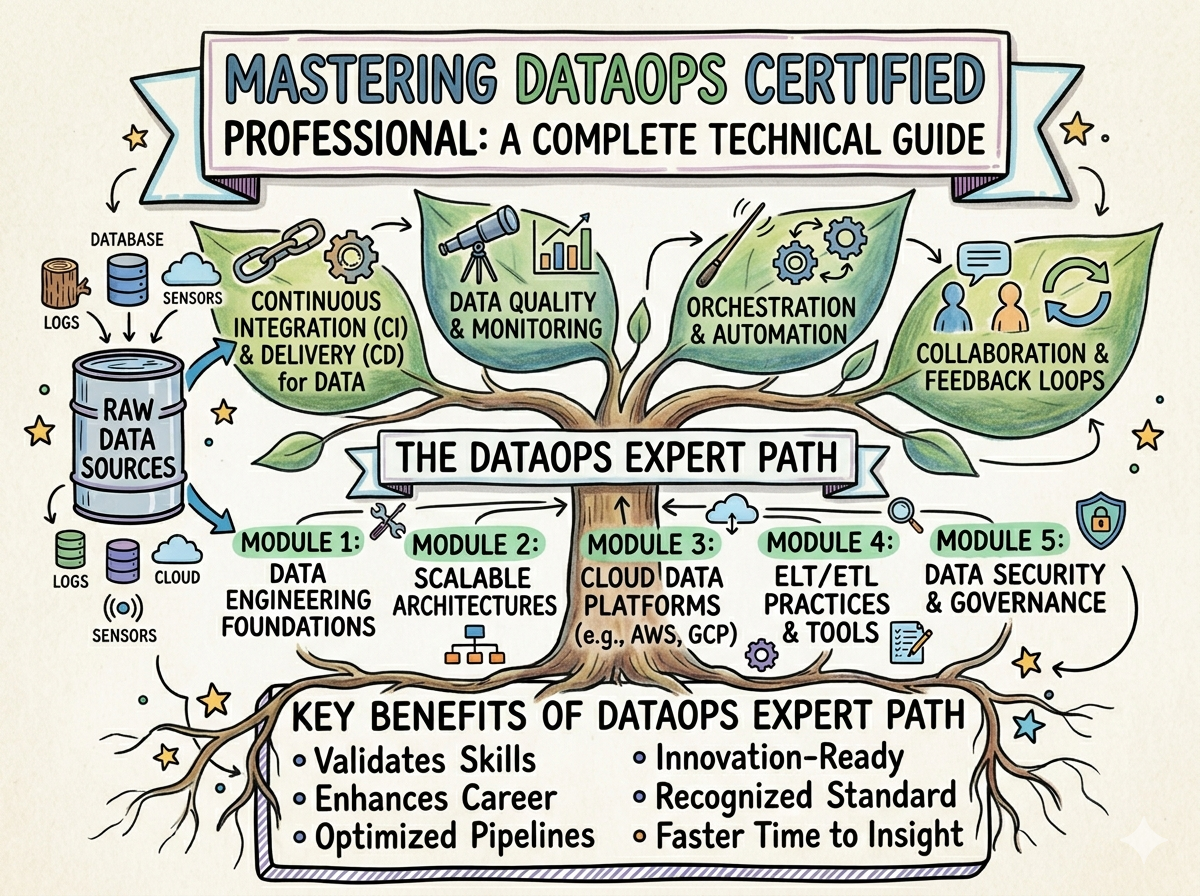
The DataOps Certified Professional (DOCP) is a specialized program designed to bridge the gap between data engineering and operational excellence. This guide is built for engineers and managers who want to move beyond basic data handling and start managing data pipelines with the same rigour as modern software code. Whether you are coming from a background in platform engineering or traditional database administration, this certification provides a clear roadmap for your growth.
Professionals can access this curriculum through the official DataOps Certified Professional (DOCP) course. It is primarily hosted and managed by devopsschool, which has established itself as a hub for technical upskilling. This guide is also highly relevant for those exploring advanced topics at aiopsschool, where the intersection of data and automated operations is a key focus. By following this breakdown, you can make an informed decision about where to invest your time and effort.
What is the DataOps Certified Professional (DOCP)?
The DataOps Certified Professional (DOCP) represents a modern methodology that applies DevOps principles to data workflows. It exists because traditional data management often suffers from silos, slow delivery cycles, and frequent quality issues that delay business insights. This program moves away from pure theory and focuses on production-ready skills like automated testing for data and continuous integration of data pipelines.
By earning this certification, you demonstrate an understanding of how to treat data as code, ensuring that every change is tracked, tested, and deployed reliably. It aligns perfectly with modern engineering workflows where speed and accuracy are equally important. Enterprises today need people who can build resilient systems that handle massive data volumes without breaking under the pressure of constant updates and schema changes.
Who Should Pursue DataOps Certified Professional (DOCP)?
This certification is highly beneficial for data engineers, site reliability engineers, and cloud architects who are responsible for data availability and integrity. Security professionals and data analysts will also find value here, as the program covers how to secure data pipelines and ensure compliance during the delivery process. It serves as a bridge for those moving from traditional IT roles into more specialized data-driven operational roles.
Beginners can use this certification to build a strong foundation in modern data practices, while experienced engineers can use it to formalize their knowledge and learn new automation techniques. In India and across the global market, there is a massive demand for professionals who understand the entire lifecycle of data. Managers and technical leaders should also consider this path to better understand how to lead teams that are building complex, automated data ecosystems.
Why DataOps Certified Professional (DOCP)
The demand for DataOps is growing because businesses can no longer afford to wait weeks for data reports or deal with broken pipelines. This certification ensures longevity in your career by focusing on principles rather than just specific, fleeting tools. As enterprise adoption of big data and real-time analytics continues to climb, the ability to manage these systems efficiently becomes a mandatory skill for any high-level technical role.
Investing in this certification provides a significant return on time because it teaches you how to reduce manual work through automation. This makes you more productive and allows you to focus on high-value architecture rather than constant firefighting. It helps you stay relevant even as specific technologies change, because the core logic of automated data delivery remains the same across different cloud providers and platforms.
DataOps Certified Professional (DOCP) Certification Overview
The program is delivered through the official course at and is hosted on the devopsschool platform. The structure is built to be practical, using an assessment approach that validates your ability to solve real-world problems. It is not just about passing a multiple-choice test; it is about proving you can handle data at scale in a production environment.
Ownership of the certification remains with the training body, which ensures the curriculum is updated to reflect changes in the industry. The levels are structured to take a learner from basic concepts to advanced architectural design. Each stage is designed to build upon the last, ensuring that you have a smooth transition from learning the basics to mastering complex, multi-stage data pipelines that serve global organizations.
DataOps Certified Professional (DOCP) Certification Tracks & Levels
The certification is divided into foundation, professional, and advanced levels to cater to different career stages. The foundation level introduces the core concepts of DataOps, including the philosophy and basic automation tools needed to start. The professional level goes deeper into orchestration, data quality, and monitoring, making it suitable for active practitioners who are building pipelines daily.
The advanced level focuses on leadership, large-scale architecture, and governance, which is ideal for those moving into senior or management positions. Specialized tracks also allow you to align your learning with other disciplines like SRE or FinOps. This structure ensures that no matter where you are in your career, there is a clear step forward that matches your current responsibilities and future goals.
Complete DataOps Certified Professional (DOCP) Certification Table
| Track | Level | Who it’s for | Prerequisites | Skills Covered | Recommended Order |
| Core DataOps | Foundation | Junior Engineers | Basic Linux/SQL | DataOps Principles, CI/CD basics | 1st |
| Implementation | Professional | Data Engineers | Foundation Cert | Pipeline Automation, Data Testing | 2nd |
| Architecture | Advanced | Senior Leads | Professional Cert | Governance, Scaling, Security | 3rd |
| Operations | Professional | SREs | System Admin Exp | Monitoring, Incident Response | 2nd |
| Management | Advanced | Tech Managers | Professional Cert | Strategy, ROI, Team Building | 3rd |
Detailed Guide for Each DataOps Certified Professional (DOCP) Certification
DataOps Certified Professional (DOCP) – Foundation Level
What it is
This certification validates your understanding of the basic concepts of DataOps and how it differs from traditional data management. It ensures you know the core vocabulary and the fundamental steps required to build an automated data pipeline.
Who should take it
It is designed for junior developers, data analysts, or students who want to enter the world of data engineering. It is also suitable for traditional database admins who are looking to modernize their skill set.
Skills you’ll gain
- Understanding the DataOps lifecycle
- Basic version control for data projects
- Knowledge of continuous integration basics
- Familiarity with automated data quality checks
Real-world projects you should be able to do
- Setting up a basic automated data ingestion pipeline
- Implementing version control on a small data set
- Creating a simple automated test for data validation
Preparation plan
- 7–14 days: Focus on reading the core documentation and understanding the fundamental shift from DevOps to DataOps.
- 30 days: Start practicing with basic tools like Git and simple shell scripts to automate small tasks.
- 60 days: Build a complete end-to-end demo project that showcases data moving from a source to a destination with basic checks.
Common mistakes
- Skipping the cultural aspect of DataOps and focusing only on tools.
- Not spending enough time understanding how version control works with data.
Best next certification after this
- Same-track option: DOCP Professional Level
- Cross-track option: Cloud Practitioner Certification
- Leadership option: Project Management Professional
DataOps Certified Professional (DOCP) – Professional Level
What it is
The professional level validates your ability to implement and manage complex data pipelines in a team environment. It focuses on orchestration, advanced testing strategies, and ensuring that data is delivered consistently across different environments.
Who should take it
This is for active data engineers, SREs, and cloud professionals who have at least a year of experience in data-related roles. It is for those who are responsible for the daily uptime and performance of data systems.
Skills you’ll gain
- Advanced pipeline orchestration and scheduling
- Implementing complex data quality frameworks
- Managing data infrastructure as code
- Monitoring and alerting for data pipelines
Real-world projects you should be able to do
- Building a multi-stage orchestration workflow for a large data set
- Implementing a self-healing data pipeline that handles common errors
- Setting up a full monitoring dashboard for data health and latency
Preparation plan
- 7–14 days: Review orchestration tools and advanced SQL or Python for data processing.
- 30 days: Work on real-world scenarios involving data failures and learn how to automate the recovery process.
- 60 days: Implement a full CI/CD pipeline for a data project, including automated security and quality gates.
Common mistakes
- Ignoring the cost implications of poorly optimized pipelines.
- Failing to document the pipeline logic, leading to maintenance issues later.
Best next certification after this
- Same-track option: DOCP Advanced Level
- Cross-track option: Certified SRE Professional
- Leadership option: Engineering Manager Certification
DataOps Certified Professional (DOCP) – Advanced Level
What it is
This certification validates your ability to design enterprise-grade data architectures and lead large-scale DataOps transformations. It focuses on the strategic side of data, including governance, compliance, and multi-cloud strategies.
Who should take it
It is built for senior architects, principal engineers, and technical directors who oversee multiple data teams. It is for those who need to ensure that data practices align with overall business objectives and security standards.
Skills you’ll gain
- Designing scalable and resilient data architectures
- Establishing data governance and compliance at scale
- Leading organizational change towards a DataOps culture
- Optimizing data costs and resource allocation
Real-world projects you should be able to do
- Designing a global data architecture that meets strict regulatory requirements
- Creating a long-term DataOps roadmap for a large enterprise
- Implementing a cross-team data sharing platform with built-in security
Preparation plan
- 7–14 days: Study enterprise architecture patterns and global data privacy laws like GDPR.
- 30 days: Analyze case studies of successful DataOps transformations in large companies.
- 60 days: Develop a comprehensive data strategy that includes cost, security, and performance metrics for a hypothetical company.
Common mistakes
- Focusing too much on technical details and losing sight of business value.
- Underestimating the difficulty of changing team habits and company culture.
Best next certification after this
- Same-track option: Specialized Data Science certifications
- Cross-track option: Chief Technology Officer (CTO) training
- Leadership option: Executive Leadership Program
Choose Your Learning Path
DevOps Path
If you are already in a DevOps role, your path into DataOps should focus on how to apply your existing CI/CD knowledge to data. You will need to learn how data testing differs from code testing and how to manage data state across different environments. This path helps you become a bridge between the software development teams and the data science teams. You will focus on building the infrastructure that makes data delivery as smooth as software delivery.
DevSecOps Path
For those in security, the focus is on “DataSecOps.” You will learn how to integrate security checks directly into the data pipeline without slowing down the delivery process. This involves automating data masking, encryption, and access controls as part of the orchestration flow. Your goal is to ensure that data is not only fast and accurate but also secure and compliant with all relevant laws. This path is essential for those working in highly regulated industries like finance or healthcare.
SRE Path
In the SRE path, the focus is on the reliability and availability of data systems. You will learn how to apply SRE principles like Error Budgets and Service Level Objectives (SLOs) to data pipelines. This involves deep monitoring of data latency and quality and building automated systems to handle failures. Your work ensures that the data is always there when the business needs it, and that the systems supporting it are stable and cost-effective.
AIOps Path
The AIOps path focuses on using artificial intelligence to improve operational efficiency. In this track, you learn how DataOps provides the high-quality data needed for AI models that monitor and manage IT environments. You will focus on building pipelines that can handle the massive amounts of telemetry data generated by modern systems. This path is ideal for those who want to work at the cutting edge of automated system management and predictive maintenance.
MLOps Path
The MLOps path is specifically for those supporting machine learning teams. You will learn how to manage the unique lifecycle of ML models, which requires tight integration between data pipelines and model training workflows. This involves versioning not just the code, but the data and the models themselves. Your goal is to create a seamless flow from raw data to a deployed model that can be updated and monitored in a production environment.
DataOps Path
The pure DataOps path is for those who want to be specialists in data delivery. You will focus on the entire lifecycle of data from ingestion to consumption. This involves mastering orchestration, data quality, and team collaboration. You will become an expert in reducing the time it takes to get data into the hands of decision-makers while ensuring that the data remains accurate and trustworthy throughout the process.
FinOps Path
The FinOps path focuses on the financial management of data in the cloud. As data volumes grow, so do the costs of storage and processing. In this track, you learn how to monitor data-related spending and optimize resources to ensure the best possible return on investment. You will work on building pipelines that are not only fast but also cost-aware, helping the business balance performance with budget constraints.
Role → Recommended (Topic name) Certifications
| Role | Recommended Certifications |
| DevOps Engineer | DOCP Foundation, DOCP Professional |
| SRE | DOCP Professional, DOCP Operations |
| Platform Engineer | DOCP Professional, DOCP Architecture |
| Cloud Engineer | DOCP Foundation, DOCP Professional |
| Security Engineer | DOCP Professional, Security Specialized Track |
| Data Engineer | DOCP Foundation, Professional, and Advanced |
| FinOps Practitioner | DOCP Foundation, FinOps Specialized Track |
| Engineering Manager | DOCP Foundation, DOCP Management |
Next Certifications to Take After DataOps Certified Professional (DOCP)
Same Track Progression
Once you have completed the advanced level of DOCP, you should look toward deep specialization in specific data technologies or methodologies. This might involve becoming an expert in specific cloud-based data warehouses or advanced big data processing frameworks. The goal here is to become the go-to person for complex technical challenges within the DataOps domain. You can also explore niche areas like real-time data streaming or complex data mesh architectures.
Cross-Track Expansion
After mastering DataOps, broadening your skills into related areas like SRE or DevSecOps can make you a much more versatile professional. Understanding how data management interacts with system reliability and security allows you to design better overall systems. This cross-training helps you speak the language of different teams and leads to better collaboration across the organization. It also opens up a wider range of career opportunities in diverse technical environments.
Leadership & Management Track
For those looking to move away from hands-on technical work, the next step is focusing on leadership and strategic management. This involves learning how to manage budgets, lead large teams, and align technical projects with business goals. Certifications in technical management or executive leadership can help you make this transition. You will use your deep technical background in DataOps to make informed decisions that drive the entire company’s data strategy forward.
Training & Certification Support Providers for DataOps Certified Professional (DOCP)
DevOpsSchool
This provider is a leader in technical training, offering a wide range of courses that cover everything from basic automation to advanced cloud architecture. They provide a practical, hands-on learning experience that is designed to prepare students for real-world challenges in the IT industry. Their instructors are experienced professionals who bring a wealth of practical knowledge to the classroom. Whether you are looking for live training or self-paced learning, they have options that fit different schedules and learning styles.
Cotocus
This organization specializes in providing high-end technical consultancy and training for enterprise-level organizations. They focus on helping teams adopt modern engineering practices like DataOps and SRE through tailored programs and expert guidance. Their approach is highly collaborative, working closely with clients to understand their specific needs and goals. By focusing on both the technical and cultural aspects of transformation, they help companies achieve long-term success in their digital initiatives.
Scmgalaxy
As a community-driven platform, this provider offers a vast library of resources for engineers looking to improve their skills in configuration management and automation. They provide tutorials, forums, and training sessions that cover a wide range of tools and methodologies. It is a great place for professionals to connect, share knowledge, and stay updated on the latest trends in the industry. Their focus on practical examples and community support makes it an excellent resource for continuous learning.
BestDevOps
This provider focuses on delivering high-quality certification programs that are recognized by the industry for their depth and rigor. They offer training in various disciplines, including DevOps, cloud security, and data management. Their curriculum is constantly updated to ensure it meets the changing needs of the global job market. With a strong emphasis on career growth, they provide students with the tools and knowledge they need to succeed in competitive technical roles.
devsecopsschool
This specialized training provider focuses exclusively on the intersection of development, security, and operations. They offer in-depth courses that teach engineers how to build security directly into their automated workflows. Their programs are designed to address the growing need for secure software delivery in an increasingly complex threat environment. By focusing on practical security implementation, they help professionals protect their organizations while maintaining a fast pace of delivery.
sreschool
Dedicated to the principles of site reliability engineering, this provider offers training that helps engineers build more stable and scalable systems. They cover core SRE topics like error budgets, monitoring, and incident response. Their courses are designed to provide a deep understanding of how to balance the need for speed with the need for reliability. It is an essential resource for anyone looking to specialize in the operational health of modern cloud applications.
aiopsschool
This platform focuses on the future of IT operations, where artificial intelligence and machine learning play a central role. They offer training on how to use AI to automate routine tasks, predict failures, and optimize system performance. Their courses are ideal for professionals who want to stay ahead of the curve and learn how to manage increasingly complex and data-rich environments. The focus is on practical applications of AI in real-world operational scenarios.
dataopsschool
As the name suggests, this provider is entirely dedicated to the discipline of DataOps. They offer comprehensive training programs that cover the entire data lifecycle, from ingestion to analytics. Their courses are designed to help data engineers and analysts adopt the automation and collaboration practices needed for modern data delivery. By focusing on the unique challenges of data, they provide students with a specialized skill set that is in high demand.
finopsschool
This provider offers training focused on the financial management and optimization of cloud resources. They teach engineers and managers how to track cloud spending, identify waste, and align technical costs with business value. As companies move more of their data and applications to the cloud, the skills taught here become vital for maintaining profitability. Their programs provide a clear framework for managing the economic side of modern technical infrastructure.
Frequently Asked Questions (General)
- How hard is it to earn a technical certification like DOCP?
The difficulty depends on your current experience with data and automation tools. If you have a strong background in SQL and basic scripting, you will find the foundation level manageable. However, the professional and advanced levels require a deep understanding of complex systems and will challenge even experienced engineers. - How much time should I dedicate to studying each day?
For most professionals, dedicated 1 to 2 hours of study per day is sufficient to make steady progress. It is better to study consistently every day than to try and cram everything into a single weekend. This allows the information to sink in and gives you time to practice the technical skills. - Are there any prerequisites for starting the foundation level?
There are no formal prerequisites for the foundation level, but having a basic understanding of Linux and SQL is very helpful. Familiarity with how data moves through a system will also give you a head start. Most of the core concepts will be covered during the training itself. - What is the typical return on investment for this certification?
The ROI is usually seen through faster career progression and higher salary potential. By gaining specialized skills in DataOps, you make yourself a more valuable asset to your company. It also saves you time in your daily work by teaching you how to automate repetitive and manual tasks. - Do I need to take the exams in a specific order?
Yes, it is highly recommended to start with the foundation level before moving to the professional and advanced levels. Each level builds on the concepts taught in the previous one. Skipping ahead might leave you with gaps in your knowledge that make the advanced material harder to understand. - Is this certification recognized globally?
Yes, the principles taught in the DOCP program are used by major companies all over the world. The certification is recognized as a mark of professional competence in the field of data operations. It is valuable whether you are looking for work in India or in international markets. - Can I complete the training while working a full-time job?
Most people who take these certifications are working professionals. The courses are designed to be flexible, with self-paced and weekend options available. You can fit your study schedule around your work commitments without having to take a break from your career. - How often do I need to renew my certification?
Technical certifications typically require renewal every two to three years to ensure your skills stay current. The industry moves fast, and what was best practice a few years ago might have changed. Renewal often involves taking an update exam or earning continuing education credits. - Will this certification help me move into a management role?
The advanced levels of the program specifically focus on leadership and strategy, making them excellent for those seeking management roles. It gives you the technical authority to lead teams and the strategic knowledge to align data projects with business goals. - Do I need to be a programmer to succeed in DataOps?
You do not need to be a professional software developer, but you should be comfortable with basic scripting and automation. Understanding the logic of code is essential because DataOps is built on the idea of treating data and infrastructure as code. - What kind of support is available if I get stuck during my studies?
Most training providers offer access to forums, mentors, or community groups where you can ask questions. You can also find a wealth of information in the official documentation and through online technical communities. Collaboration is a key part of the learning process. - Is it better to focus on one certification or get several?
It is usually better to master one area before moving to another. Starting with DOCP gives you a solid foundation in data. Once you are comfortable there, you can look into related areas like SRE or Security to become a more well-rounded professional.
FAQs on DataOps Certified Professional (DOCP)
- What makes DOCP different from a standard data engineering course?
Standard courses often focus on how to use specific tools like Spark or Hadoop. DOCP focuses on the process and methodology of delivering that data reliably and at scale through automation. - Does this certification cover cloud-specific tools?
While the principles are universal, the training often uses popular cloud tools from AWS, Azure, or Google Cloud to demonstrate how to build pipelines in a modern environment. - How does DataOps relate to the concept of a Data Mesh?
DataOps provides the operational foundation that makes a Data Mesh possible. It ensures that decentralized data teams can still maintain high standards of quality and delivery across the whole company. - Is there a heavy focus on coding in the DOCP exams?
The focus is more on orchestration and pipeline logic than on writing complex application code. You will need to understand how to write configuration files and basic scripts to automate tasks. - Can a manager benefit from the foundation level?
Absolutely. It provides managers with the vocabulary and conceptual understanding they need to lead data teams effectively and understand the technical challenges their engineers face daily. - How does DOCP address data privacy and compliance?
Privacy and compliance are built into the “DataSecOps” parts of the curriculum. You learn how to automate checks that ensure data is handled correctly according to legal standards. - What is the most common reason people fail the professional exam?
Most people fail because they focus too much on theory and not enough on the practical aspects of orchestration and troubleshooting. Hands-on practice with real pipelines is essential for success. - Does this certification help with real-time data processing?
Yes, the principles of DataOps are just as applicable to real-time streaming data as they are to traditional batch processing. The focus remains on speed, quality, and reliability.
Final Thoughts: Is DataOps Certified Professional (DOCP) Worth It?
If you are looking for a way to stand out in a crowded job market, the DataOps Certified Professional (DOCP) is a solid investment. It is not a magic bullet that will instantly change your career, but it provides the structured knowledge and practical skills that companies are actively looking for. The focus on automation and reliability is exactly what modern enterprises need to manage their growing data mountains.
Think of this certification as a way to formalize what you already know and fill in the gaps you didn’t realize you had. It moves you away from manual, repetitive work and into the world of high-level architecture and strategic delivery. For any engineer or manager serious about a long-term career in data and operations, this path offers a clear and practical way forward.
